I don't recall I said anything to the effect that I do not want
to see Russia having to pay war reparation. Since Canada
would not be the one to foot the bill I have nothing to complain
about Ukraine receiving compensation from its invader. That
being said, I am not sure how the course of the war will have
to unfold and end for Russia to end up paying reparation. I
think nothing less than total defeat could force Russia to pay
which I am not sure is a good thing. You don't want to see
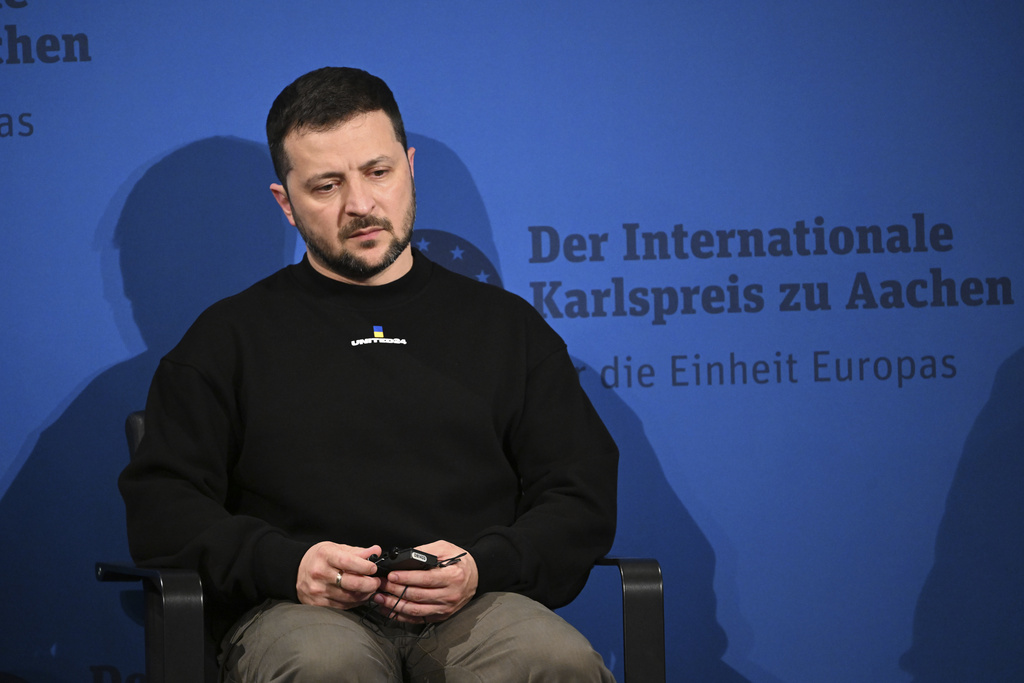
Zelensky pursuing Putin's retreating army all the way to Moscow,
don't you?
I can see why the arms supplier to Ukraine are profiting
on a good cause in the eyes of its supporter. I don't see
the war the same way as you. Were I an arms manufacturer
a proxy war is not what I want to be the source cash machine
for my business.
I don't think it is worthwhile to spend another 10 pages arguing
whether Ukraine is fighting all for themselves or a proxy war for
the west. I'll just elaborate further on what I think to be the course
of action the west will stick to.
At this point it is more imperative to the west than to Zelensky
to have Putin taken out. There is one snag though. Without that
snag Putin would meet the same fate as Saddam Hussein. If
Zelensky was not willing to fight the west would be as compelled
like George Bush to organize a military coalition to go into Moscow
to pull a regime change. That can only happen if through divine
intervention Putin's nuclear arsenal were all evaporated into
nothingness. Since such scenario is not plausible the west
is left with the option of giving aid to those willing to fight Putin
to the death. Giving out of date and worn out weapons produced by
world's most advanced military industry to Ukraine to fight up-to-date
but backward Russian military machine has the advantage of economy.
But there is more to it. If you are familiar with the character of the
communist from the history of PRC China and Soviet Union you
may understand that communists by nature are most brutal to
their own people. They are not irrational and more calculating in
dealing with foreign aggressors. It was self-preservation not the
spread of communism that drove the communist to fight foreign
enemies. Ukraine can only be supported by the west to fight Russia
to a degree about right to persuade Putin firing nuclear missile
to hit NATO members does him no good. You can be assured that
in the unlikely event of nuclear attack the bomb will be dropped only
on Ukraine soil. This is how the west can hope for winning the Ukraine
war. Let it drags on to weaken Putin and destabilize Moscow until he
is toppled without risking nuclear attack on NATO members and
putting our soldiers in harms way.
And getting back to the obscene profits made by the military industry
on the Ukraine war I must admit I too would be tempted to put my
pocketbook into the war if I were in the business. And I must also
admit jealousy is a factor underlying my grudge. I would not be as
pissed off by people cheering the arms supplier if they recognize
that business is as much if not a greater beneficiary of the war
than oil producers and certainly as obliged to give back their
blood money to Ukraine.
------------------------------------------------------------------------------
Energy minister also warns the war risks dragging on forever unless the West closes sanctions loopholes on the Kremlin’s hydrocarbon revenues.

www.politico.eu
Major international energy companies that raked in bumper profits because of price spikes over the course of the war should pour some of that cash into rebuilding Ukraine's shattered power infrastructure, Kyiv's Energy Minister German Galushchenko told POLITICO.
In a wide-ranging interview, Galushchenko also argued the West needed to close sanctions loopholes on Russian energy sales to prevent an "endless war" in Ukraine, and said Kyiv could provide alternative nuclear fuel so some EU countries could wean themselves off their dependence on Russian supplies.
"A lot of energy companies get enormous windfall profits due to the war. So we estimated this at more than $200 billion," Galushchenko said on a visit to Brussels. "They get this money because we are fighting, because of the war."
"I think it would be fair to share this money with Ukraine. I mean, to help us to restore, to rebuild the energy sector," he added.
The $200 billion figure given by Galushchenko has been widely cited as the profits of five top companies — BP, Chevron, ExxonMobil, Total and Shell — in 2022. The Kyiv School of Economics estimates the damage to Ukrainian infrastructure at close to $140 billion.
The minister noted that a Lithuanian company, Ignitis Group, is already looking to hand over some 10 percent of its profits to help reconstruction in Ukraine and said bigger companies should follow suit.
Galushchenko also warned that Moscow would be able to wage a perpetual war in Ukraine for as long as the Kremlin is able to rake in cash from selling fossil fuels. Despite sanctions against Russian oil imports imposed by the EU and a price cap set by the G7 club of rich democracies, he warned that Russian President Vladimir Putin was still finding ways to beat international embargoes.
"If on one side you're trying to restrict them and on the other you're giving them opportunities, you'll allow them to make endless war," he complained, arguing the Kremlin was using its energy export earnings "not to help Russian people to live better" but "to produce weapons" and keep the war going.
"This money costs Ukrainian lives," he said.
Russia boasts that it has diverted its oil supplies to friendly countries such as China and India, but there are signs that restrictions from big Western markets are biting hard.
Calculations by Bloomberg on March 3 suggested that tax revenues from oil almost halved in February from a year ago, while gas revenue dropped 42 percent from a year earlier given reduced sales to Europe. The EU's ban on Russian oil has been a key factor is torpedoing the price of Urals crude.
Keen to keep up that pressure, Galushchenko protested that some oil was still seeping under the cordon.
"It's important not to help Russia to escape sanctions," he said, arguing that "sanctions are efficient only if you have no way to escape and we see the Russians are trying to escape — in some cases, they find a way."
His warning comes amid recent reports that Moscow's hydrocarbons may be reaching EU countries via Azerbaijan and Turkey. Allegations are also growing that Russian oil has been discreetly sold at prices far exceeding the $60 cap imposed by the G7 in December.
The EU's plan to make the bloc independent from Moscow's fossil fuels before 2030, called RePowerEU, includes encouraging member countries to jointly purchase natural gas, and the Ukrainian minister said his country also wanted in on that program.
While the EU has slashed its oil and gas imports from Russia, the bloc still has 18 Russian-designed VVER reactors — located in Finland, Slovakia, Bulgaria, Hungary and the Czech Republic — for which no alternative fuel supply exists so far.
Rather than continuing to rely on Russia, they could soon buy their supplies off Kyiv, he said. Ukraine is in the process of making specially-tailored replacement nuclear fuel along with Westinghouse of the U.S. that could be ready by "the beginning of next year."
He also called on the European Commission to set an EU-wide target for eliminating countries' reliance on Russian nuclear technology, while reiterating Ukraine's call to bring sanctions against Moscow's state-run atomic giant Rosatom for its role in overseeing the occupied Zaporizhzhia nuclear power plant. So far, the EU has refrained from hitting Russia's nuclear industry with sanctions.
"They are participating in the capture and illegal operation of [this] nuclear station," Galushchenko said.