

Good call Finisher, on the money with that one.* Pretty sad that you have no reviews but you're always ready to respond to a thread.
* Talk is cheap......all sizzle but no substance and ready to flame someone out......me thinks you will get banned soon!
Bu-bye!


John Lennon
- Thread starter mr.cat
- Start date
A silly argument breaking out on a thread about Lennon and degenerating into invective and insults. Only on Terb.
RIP John. I recall the morning I heard of his assassination as if it were yesterday, on my old clock radio, and I just rolled over and wished it wasn't so.
He was pretty far ahead of his time, maybe we still wouldn't be ready for him today. And his music, given me so much over the years. He'll never be forgotten.
I've been playing guitar for a couple of years now, I highly recommend the doc "It Might Get Loud", which someone has already mentioned.
Take a chill pill.
Take it 'EZ'. I don't understand why you're being so rude and passionate about a subject that really doesn't concern your world.
The Beatles don't have the difficult finger-picking and "riff-slashing" music most metal fans are accustomed to, nor are the compositions of their songs difficult to play. If music was measured by how difficult it was to compose it, we should all be listening to Rachmaninov 24 hours a day.
Music influence isn't about having the most difficult piece but touching those who are willing to listen, changing the face of music going forward. You already see the breadth of how many people still listen to their songs and love them. Imagine how much influence they had on the artists and bands that were still finding their own way while the Beatles were still around.
I'll leave you with one of my favourites.
Across the Universe
Words are flying out like endless rain into a paper cup
They slither while they pass
They slip away across the universe
Pools of sorrow waves of joy are drifting thorough my open mind
Possessing and caressing me
Jai guru deva om
Nothing's gonna change my world...
Take it 'EZ'. I don't understand why you're being so rude and passionate about a subject that really doesn't concern your world.
It only took me 30 seconds to find this little tidbit from the 'Absolute Astronomy Website' 'www.absoluteastronomy.com/topics/Flanging'Show me the influence then?
Flanging is an audio effect that occurs when two identical signals are mixed together, but with one signal time-delayed by a small and gradually changing amount, usually smaller than 20 milliseconds. This produces a swept 'comb filter effect'1: peaks and notches are produced in the resultant frequency spectrum, related to each other in a linear harmonic series. Varying the time delay causes these to sweep up and down the frequency spectrum.
This is my favourite part...
The development of the classic "flanging" effect is generally attributed to Ken Townsend, an engineer at EMI's Abbey Road Studio, who devised the process in the spring of 1966. Tired of the laborious process of re-recording dual vocal tracks, John Lennon asked Townsend if there was some way for the Beatles to get the sound of double-tracked vocals without actually doing the work. After mulling the problem over, Townsend devised Artificial Double Tracking2
...whenever Lennon wanted a Beatles song double-tracked, he would ask for "Ken's flanger". According to Lewisohn, "The Beatles' influence was so vast that the term "flanging" is still in use today, more than 20 years on."
1 - In signal processing, a comb filter adds a delayed version of a signal to itself, causing constructive and destructive interference.
The frequency response of a comb filter consists of a series of regularly-spaced spikes, giving the appearance of a comb.
2 - Automatic double tracking was an analogue recording technique designed to enhance the sound of voices or instruments during the recording process. It used tape delay to create a delayed copy of an audio signal which was then combined with the original.
Here's a picture of a flanger dude.
You ever use one of these? Enough influence?.... n'est pas?
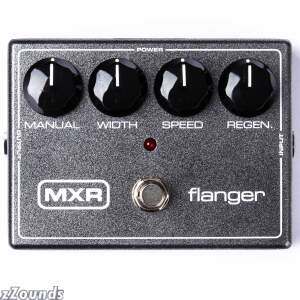
You ever use one of these? Enough influence?.... n'est pas?
The Beatles don't have the difficult finger-picking and "riff-slashing" music most metal fans are accustomed to, nor are the compositions of their songs difficult to play. If music was measured by how difficult it was to compose it, we should all be listening to Rachmaninov 24 hours a day.
Music influence isn't about having the most difficult piece but touching those who are willing to listen, changing the face of music going forward. You already see the breadth of how many people still listen to their songs and love them. Imagine how much influence they had on the artists and bands that were still finding their own way while the Beatles were still around.
I'll leave you with one of my favourites.
Across the Universe
Words are flying out like endless rain into a paper cup
They slither while they pass
They slip away across the universe
Pools of sorrow waves of joy are drifting thorough my open mind
Possessing and caressing me
Jai guru deva om
Nothing's gonna change my world...
It Might Get Loud appears to be coming out on December 22'nd.A
I've been playing guitar for a couple of years now, I highly recommend the doc "It Might Get Loud", which someone has already mentioned.
http://www.sonyclassics.com/itmightgetloud/
Hadrian you are an appallingly narcisitic and disrespectful example of the brotherhood of musicians.
You confuse complexity with a compositions intrinsic resonance and are woefully lacking in respect and the capacity to value artistry within the context of its times.
All the sadder for you. I too have been playing guitar for almost four decades and have been privileged to meet musicians who could mop the floor with some of the most renowned international talents.
Only they would never stoop to such childish, braggarts behavior and egotism, let alone disrespect their forefathers and peers.
Many of the works you value are more challenging musically; that doesn't mean they're better or speak to the heart of an audience or it's time.
Ya wanna make music for a clique of musicians with their noses as high in the air as you and a giant chip on their shoulder or do you wanna make something that lives, breathes and speaks?
By now you should have learned the code that you don't prove your worth by slamming the value of other musicians work and composition - Ya, so and so is so much better and (by extension) so am I.
You just shut up, write and play instead of telling everyone else who doesn't share your musical vision they're an ignoramous and again, by extension, inferior talent.
Playing is your truest expression. For god's sake grow up. You shame every artist who ever picked up a guitar with music in their soul and integrity in their heart. Was your dad taller than John Lennon too?
Utterly pathetic. Shut up and play.
It was a horrible, horrible event. Earlier in my life the two Kennedys had been assassinated and that was horrible. But after a while people came to accept that politicians could be targets. But killing John Lennon? Society seemed to have gone insane. He was a musician - a great musician - a man of peace. There was no reason to kill him. The shock was great. I went that month to the Dakota in New York where he had been shot. It didn't help. It didn't make sense. Since then we have had so much senseless violence. I think we have grown to accept it all. Just another headline. But back then it was truly horrific and unacceptable but we learned that there was nothing to be done. Nothing will stop the insanity.
I never cared for the Beatles one bit, nor did I like Lennon. I do not have the time of day for Yoko Ono.
Why am I posting on this thread then ?
Because I remember exactly where I was when I heard that Lennon was dead.
Watching TV, Monday Night Football and Howard Cosell, in his unique way, announced it to the viewing audience.
Why am I posting on this thread then ?
Because I remember exactly where I was when I heard that Lennon was dead.
Watching TV, Monday Night Football and Howard Cosell, in his unique way, announced it to the viewing audience.
I never heard the Cosell announcement, but here iit is:
http://www.youtube.com/watch?v=5gcdz1IRVoM
Chilling even 29 years later.
"Dead on Arrival"
http://www.youtube.com/watch?v=5gcdz1IRVoM
Chilling even 29 years later.
"Dead on Arrival"
John Lennon a legend
The top ranked song writing team of Lennon/McCartney has been one of the most influential duos of the 60s. Many of their tunes have become classics.
They did their best work together. Their work done after splitting up was never as good as when they composed together.
The top ranked song writing team of Lennon/McCartney has been one of the most influential duos of the 60s. Many of their tunes have become classics.
They did their best work together. Their work done after splitting up was never as good as when they composed together.
Actually after their very early songs they did very little composing together. They continued to list their songs as Lennon-McCartney even though the large majority of their work was done on their own and without much help from the other. George Martin was more of a collaborator for both of them than they were.The top ranked song writing team of Lennon/McCartney has been one of the most influential duos of the 60s. Many of their tunes have become classics.
They did their best work together. Their work done after splitting up was never as good as when they composed together.
Truth be told I think George Martin had an immense impact on Beatle music as we have come to know and appreciate it.Actually after their very early songs they did very little composing together. They continued to list their songs as Lennon-McCartney even though the large majority of their work was done on their own and without much help from the other. George Martin was more of a collaborator for both of them than they were.
Without Martin, I truly believe that the Beatles would have not been as good as they were.
The Beatles were the steak and Geoge Martin was the seasoning. Both needed each other.Truth be told I think George Martin had an immense impact on Beatle music as we have come to know and appreciate it.
Without Martin, I truly believe that the Beatles would have not been as good as they were.
The technology was so primitive and unexplored compared to today. Martin had no previous blueprints to follow.
I feel he was the fifth Beatle in the later years.
Fave Lennon song, Julia. Simple, plaintive, haunting.
I feel he was the fifth Beatle in the later years.
Fave Lennon song, Julia. Simple, plaintive, haunting.
Cream? Hello? Eric Clapton is the most plagiaristic, derivative bore who has contributed NOTHING to music.Yep, I still don't get the hype with the Beatles though? They really didn't change anything (musically). If you listen to the music it is kinda washed out. Imo Cream were revolutionary. Don't mean to offend anyone jmo.
Well Eric Clapton does play guitar pretty well....Cream? Hello? Eric Clapton is the most plagiaristic, derivative bore who has contributed NOTHING to music.

Rock bands are babe magnetsI hung around rock bands because of my brother.
.Strawberry Fields Forever is a good example. After they had recorded several takes, Lennon decided he liked half of one version and half of another. George Martin pointed out to him that the two parts were in different keys and at different tempos to which Lennon replied, "Well, I'm sure you can fix it". And Martin did. He did things for them they couldn't possibly have figured out themselves and likely most other producers would have told them to forget it.Truth be told I think George Martin had an immense impact on Beatle music as we have come to know and appreciate it.
Without Martin, I truly believe that the Beatles would have not been as good as they were.

