You’re absolutely right in that everyone has a right to an opinion (thought, conscience and belief falls under article 9 of UNHR code), and in a more limited sense in Canada to express this opinion (section 2 of the Charter).
But these same rights protect wigglee’s ability to criticize you.
I’ll once again emphasize, being ignorant of your own inherent internalized racist / sexist / homophobic / xenophobic / transphobic / ageist / ableist / islamaphobic / anti-Semitic (etc.) values doesn’t protect you from the ability to be criticized in the same public space for having/sharing this ignorance with the world.
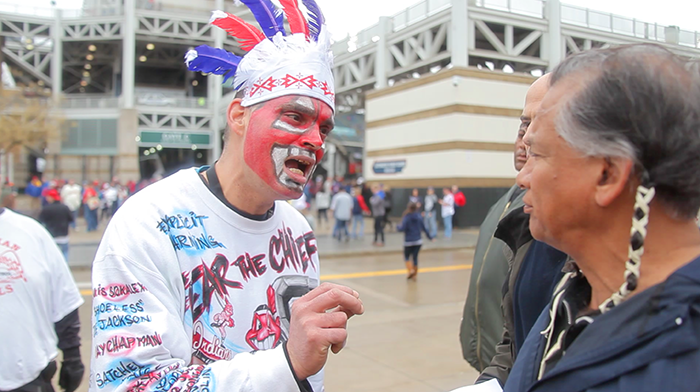
If the person in the original photo (and/or the photo editor), or the organizers/creators of the event were unaware of how insensitive this is/was, so be it... but ignorance doesn’t give you immunity from criticism if you’re choosing to publicize your own ignorance.
I often go back to cartoons like Family Guy, The Simpsons and South Park for this stuff.
The joke here is on Peter for being racist, not on the group he’s stereotyping. Family Guy may go a step further by drawing criticism to an increasingly over-sensitive society or to criticize the show and therefore the audience, but it does so at its own risk.
Similarly, Canadian jokes in South Park have always been less about taking Canadians down a notch for saying “aboot” and “eh” than it is a medium to draw attention to American society’s second easiest/laziest joke after “toilet humour” (dick and fart jokes), the stereotype. The joke is rarely if ever “on” Canada itself, but on the show/audience and/or society that chooses to laugh at the joke.

The Simpsons has tons of great examples of how jokes on racism (good) vs jokes on stereotypes (bad) work. When Hank Azaria was first asked to make Apu’s voice he pointed out the obvious racism in the stereotype. The original show runners were keenly aware of this, and attempted to balance one-dimensional stereotyped characters like Apu, wherein the joke was on him for having a funny accent and working in a convenience store, with characters like Dr. Hibbert and Homer’s friend Carl. These characters, if you’re wondering, fly in the face of traditional one-dimensional stereotypes, thus in the eyes of the original show runners, allowing them at the time to get away with marginalizing a character like Apu.
It didn’t take long for the world to recognize this hypocrisy of black men on the show being nuclear scientists, doctors and judges, while the show’s only Indian character is only ever seen working a minimum wage job, so they attempted to make this character at-least two dimensional by giving him a backstory, something they never actually did with the towns black characters over its 28 year run, because they didn’t have to, by not stereotyping them in their inception.
What this tells us is, at the time The Simpson’s was created, a stereotyped black character was a complete no-go. No shock in a society 40-years after MLK. But how could they get away with Apu? Because at the time Indians and SE Asian Americans had a very limited voice in society. Since then, we’ve gotten better at recognizing social injustice.
And we’re better because of it. Most of the time society improves when marginalized groups are given more recognition and therefore a voice in society.
Edgy humour is allowed in the era of woke, but it’s a perilous and ever-changing line that you choose to cross whenever you participate in public society.


 .


