One more copy and paste, from the current issue of Premier Guitar mag (no relation to Pure or Perla lol)
"Peter Green: 1946–2020
Ted Drozdowski
July 27, 2020
A A
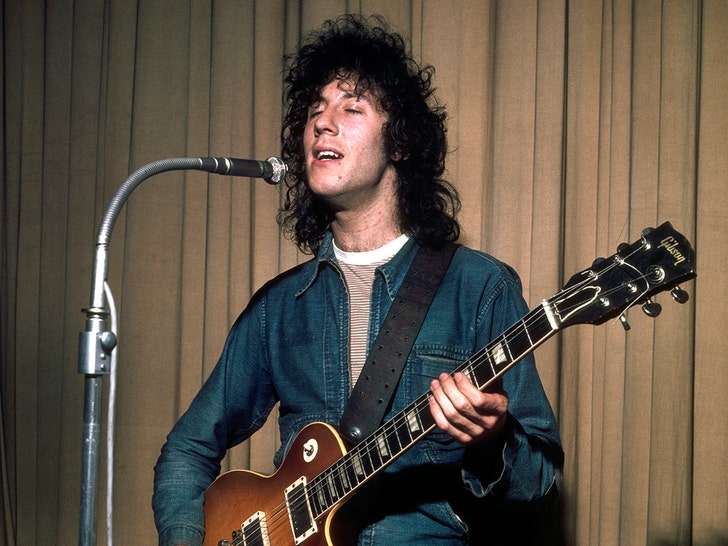
In this photo taken in 1970, Peter Green travels the fantastic with his legendary 1959 Les Paul Standard known as the Holy Grail, with Fleetwood Mac. Like Green, the instrument also has an enduring legacy and is now owned by Kirk Hammett. Photo by Christian Rose / Fastimage / Frank White Photo Agency
B.B. King proclaimed that Peter Green “has the sweetest tone I ever heard. He was the only one who gave me the cold sweats.”
Of course, King wasn’t alone in his reaction to Green’s playing, which became legendary during the four-year period, from 1966 to 1970, when Green replaced Eric Clapton in John Mayall’s Bluesbreakers for
A Hard Road, and then led the blues band version of Fleetwood Mac through three albums and a string of singles that included his original version of “Black Magic Woman,” “Need Your Love So Bad,” “Albatross,” “Oh Well Pt. 1 & 2,” and “The Green Manalishi.”
Green’s own road came to an end on Saturday, July 25, at age 73 when, according to a lawyer for his family, he died in his sleep. In the years between, Green struggled with mental illness and fallout from drug abuse that kept him from the stage and studio—except for a handful of recordings and appearances—for much of the 1970s and ’80s. In 1996, he emerged at the front of the Peter Green Splinter Group, supported by guitarist Nigel Watson and, initially, drummer Cozy Powell, and resumed touring internationally. But even then many of his performances were erratic and he often seemed distanced—even when revisiting the enduring songs he’d authored at the helm of Fleetwood Mac.
Peter Allen Greenbaum was born on October 29, 1946, in London, and grew up in the city’s Whitechapel section. He started playing guitar in elementary school and, as a teenager, began performing in bands—including a soul group called Shotgun Express, with Rod Stewart. Like so many young guitarists in mid-’60s London, Green fell under the spell of Eric Clapton, who was just a year older but was being heralded as “God” due to the burly tone, conflagrant dexterity, and vocabulary of American blues guitar he displayed onstage with Mayall’s band.
When Green was invited to replace Clapton in the Bluesbreakers, he did so with a Gibson Les Paul and
a Marshall combo, in emulation of his hero. But with the band’s 1967 album, Green stepped out of Clapton’s shadow as a 6-string visionary. He smeared transcendent guitar all over
A Hard Road, setting a new creative bar in British blues not only with his interpretations of classics like Elmore James’ “Dust My Broom” and Freddie King’s “The Stumble,” but with his own “The Same Way” and the instrumental “The Supernatural.” The latter, in particular, showcased his interest in pushing the genre’s boundaries, creating a sonic dreamscape that superbly balanced tone, volume, sustain, natural reverb, and feedback—and it did so three months before Jimi Hendrix’s
Are You Experienced was released.
That same year, Green ventured off with Mayall’s rhythm section to form Fleetwood Mac. For three years and the studio albums
Fleetwood Mac,
Mr. Wonderful, and the psychedelic blues opus
Then Play On, Green’s version of the band was at the creative forefront of the blues-rock movement. In addition to Green, Mac also included guitarists Jeremy Spencer and Danny Kirwan, providing considerable 6-string firepower.
Green’s catalog of ’66 to ’70 remains a necessary touchstone for any guitarist seriously interested in exploring foundational British blues—or, simply, blues.
Green’s catalog of ’66 to ’70 remains a necessary touchstone for any guitarist seriously interested in exploring foundational British blues—or, simply, blues. Examined chronologically, it illustrates his evolution from hard-core traditionalist to a composer capable of both deep introspection (“Man of the World”) and psychedelic experimentalism (“The Green Manalishi”).
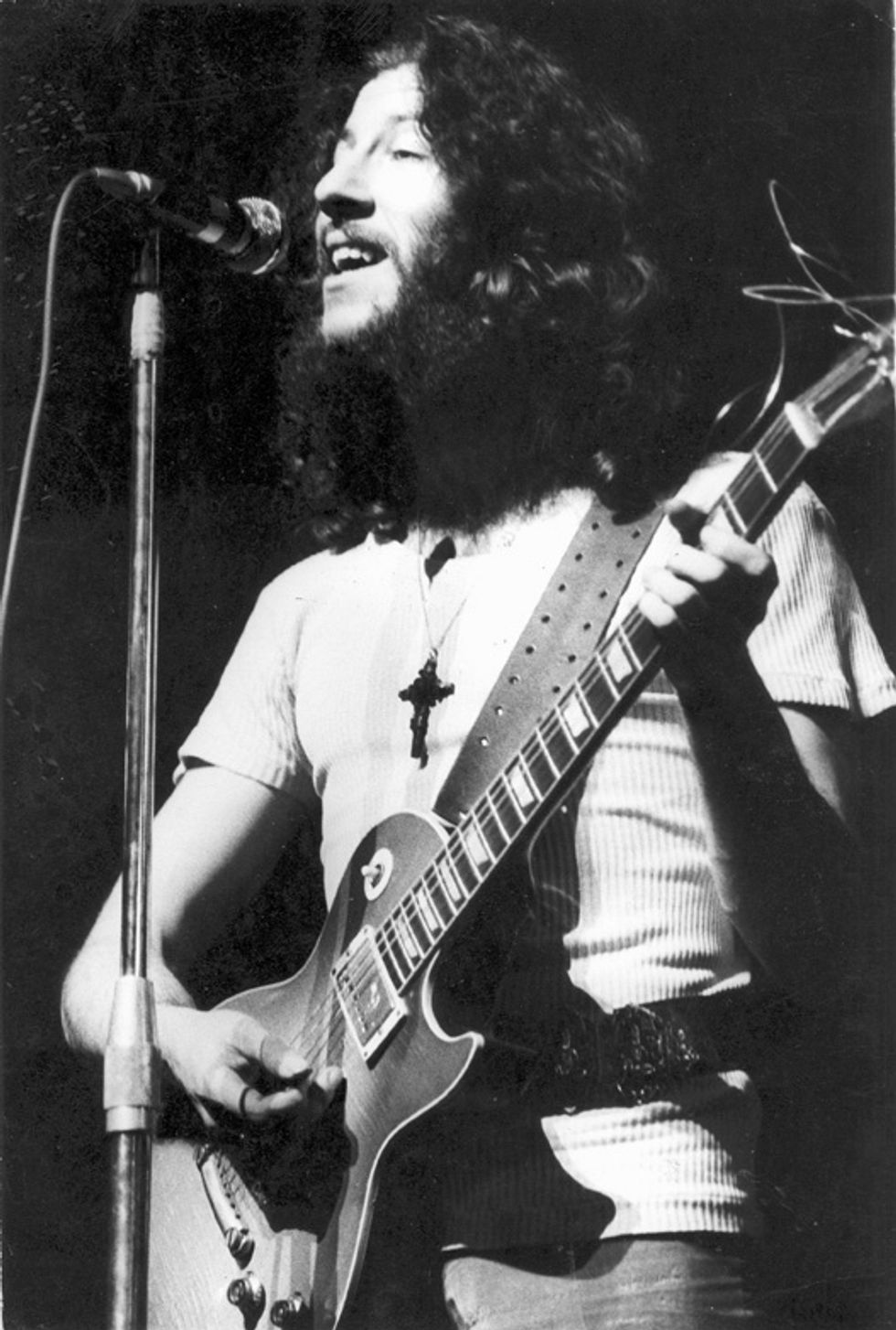
His near-constant companion on that journey was a 1959 Les Paul Standard, which became known as the Holy Grail in part due to its distinctive, airy out-of-phase sound, but mostly because of the buttery, hyper-emotive style in which Green made it sing. (Our columnist
Jol Dantzig once had the guitar on his bench, and his determination was that—contrary to many tales about the source point of its sound—a magnet was reversed in one pickup at the Gibson factory.)
In 1970, while going through a time of emotional crisis complicated by LSD use, Green quit the band, who by then were a staple of the British pop charts. As the decade continued, he began to unravel. He lost his interest in playing and was arrested for threatening his accountant with a shotgun. Eventually he left the music world altogether and moved to the outskirts of a village in the English countryside, whose residents took to calling him “the Werewolf” due to his long, unkempt hair and fingernails. He was diagnosed with schizophrenia and reportedly underwent electroconvulsive therapy and hospitalizations, along with drug therapy.
Nonetheless, Green endured and when he returned to the stage in the ’90s, there was an international cult of fans still waiting to greet him. In 1998, Green was inducted into the Rock & Roll Hall of Fame as a member of Fleetwood Mac, and he jammed at the ceremony with Carlos Santana, whose band was also inducted that year. Their song of choice was “Black Magic Woman,” which Green authored and recorded in 1968, and suggested that Santana cut.
This past February, Mick Fleetwood organized a tribute to “Greeny,” as his friends and admirers called him, at the London Palladium, with Pete Townshend, Billy Gibbons, David Gilmour, Noel Gallagher, and Kirk Hammett all taking the stage.
If a true sign of a guitarist’s impact on his art are the players who carry the torch of his influence, Green’s acolytes are an impressive lot. They include former Rolling Stones member Mick Taylor, who replaced him in Mayall’s Bluesbreakers, Clapton himself, who has praised Green as “one of the best,” Aerosmith’s Joe Perry, Genesis’ Steve Hackett, the Black Crowes’ Rich Robinson, and Wishbone Ash’s Andy Powell. But the most prominent was certainly Gary Moore, who bought Green’s Les Paul from him shortly after Green left Fleetwood Mac, and owned it for 36 years before selling the instrument at auction. Since then, it was purchased by Hammett, who reportedly paid close to $2 million and has used it in recent live performances."
My only quibble with the article is that it that it says the flipped rhythm pickup magnets were done at the Gibson factory. That would have been most unusual. Especially installing the pickup in the guitar 180 degrees turned from the normal way. I still believe that it was a result of Peter himself tinkering with the pickup.