De-Dollarization Just Got Real

Peter Schiff: The World Is Starting To Divest Itself Of The Dollar

WEDNESDAY, APR 12, 2023 - 06:20 PM
Via SchiffGold.com,
In a surprise move earlier this month, OPEC announced further oil production cuts of about 1.16 million barrels per day. Analysts projected the cuts could raise the price of oil by $10 per barrel. Peter Schiff recently appeared on NewsMax’s Wake Up America and explained why these production cuts will further complicate the Federal Reserve’s efforts to fight price inflation, and more broadly, how global moves like this and others undermine the dollar.


Screenshot-2023-04-11-at-7.21.18-AM-1024x576.png


Peter called the production cuts “a very big deal” and said it is clearly complicating efforts to bring down price inflation — especially given the fact that we’re in the midst of another financial crisis.

Not only is the supply of oil going to come down, but the supply of money – US dollars – used to buy oil is going up. The Fed has already gone back to quantitative easing to bail out the banks. So, we’re printing more money, but we’re not producing as much oil.“


Compounding the problem is the fact that the world is starting to divest itself from US dollars.

That will put more downward pressure on the value of the dollar, which of course will put more upward pressure on the price of oil.”
Wake Up America host Carl Higbie noted that President Trump made energy independence a priority. Peter said it’s not just energy independence that is necessary.

We need to be able to produce everything. We’re dependent on the rest of the world for everything that we consume because we no longer have the industrial capacity that we once enjoyed because of the policies that have been pursued for decades. We have too much regulation. We have too high taxes and too much government spending, and so we’re not producing what Americans consume. We rely on the rest of the world.”
Peter pointed out that the only way the US can rely on the world as it does is because the dollar is the reserve currency.

We may lose that privilege over the next several years, maybe even over the next few months. Who knows?”
The BRICS nations recently announced plans for a new currency. Higbie asked what impact that could have even if it only usurps a small percentage of global trade in dollars. Peter said he thinks it would hurt “substantially.”

And once they start moving in that direction, the pendulum is going to continue to swing. There are all sorts of reasons why the world should want to divest of dollars and no longer depend on the US dollar as a reserve currency, but we gave them another one. The Biden administration in slapping those economic sanctions on Russia really highlighted how dangerous it is to allow the United States to enjoy this privilege. And so, we have scared the world into divesting of dollars, something they should have done anyway because it was in their economic interest to do so.”
Peter emphasized that the dollar’s role as the world currency is a huge privilege for the US that the rest of the world pays for.

It enables Americans to live beyond our means. We’re able to consume all kinds of stuff that we did not produce. And the only reason we could do that is because we could print money that costs us nothing and our trading partners will accept that instead of actual goods. If we lose that privilege, our standard of living is going to implode.”
Higbie asked Peter what he would tell Joe Biden to do if he had 30 seconds with the president.

Well, he needs to resign. But he also needs to take Kamala Harris with him. But what we need is free market capitalism. We don’t need more government solutions to government-created problems. Government has to get out of the way so free market capitalism can clean up the mess government created.”
 
 
Lula: Peace Club To De-Dollarization

SATURDAY, APR 15, 2023 - 05:30 PM
Authored by Andrew Korybko via The Automatic Earth blog,
Brazilian President Lula was successful in reaching an agreement to de-dollarize his country’s trade with China, the significance of which was earlier explained in the context of his country’s grand strategy here, but failed to convince his counterpart to join a so-called “peace club” on Ukraine during their summit. This is no small shortcoming either since it was promoted by his Foreign Minister as one of the reasons behind his trip in an interview that he gave to the Financial Times (FT) late last month.

Copy-of-Untitled-4.jpg

Globally prominent outlets such as Bloomberg, France24, the US Government-run “Radio Free Europe/Radio Liberty” (RFERL), and others all accordingly reported that this issue would be high on the agenda during Lula’s talks with President Xi. His supporters on social media also went wild getting everyone’s expectations up about this as well, even though “Brazil & China Are Poles Apart When It Comes To Their Envisaged End Games In Ukraine” so it was never likely that anything would come of this.

While China, India, and South Africa have consistently abstained from anti-Russian UNGA Resolutions, Brazil bucked the BRICS trend by always voting against Russia except when it came to suspending it from the Human Rights Council. Lula became the first BRICS leader to personally condemn Russia in his joint statement with Biden back in February, after which he ordered his diplomats to vote in support of the latest anti-Russian UNGA Resolution later that same month.

Foreign Minister Vieira was obviously well aware of the sharp differences between Brazil and China’s officially envisaged end games to this conflict yet he still made it seem to FT like there was a chance that the People’s Republic would tacitly support his country’s position via participation in the “peace club”. That was nothing more than wishful thinking, which belied Brazilian diplomats’ refusal to acknowledge China’s principled approach to this conflict since they in hindsight seemed to assume that it was flexible.

Reality slapped them and their supporters in the face upon the publication of the joint Brazilian-Chinese communique on Friday,which can be read in English on the official website of the Brazilian Ministry of Foreign Affairs here. The ninth paragraph of that document will now be shared in full so as to prove Lula’s failure to sway President Xi to his country’s side contrary to the unrealistic expectation that Vieira set for his trip when talking to the FT late last month:

“Both parties stated that dialogue and negotiation are the only viable way out of the crisis in Ukraine and that all efforts leading to a peaceful solution to the crisis must be encouraged and supported. Brazil received in a positive way the proposal by China that offers reflections conducive to the search for a peaceful solution to the crisis. China received in a positive way the efforts by Brazil in favour of peace. The parties made an appeal for more countries to play a constructive role in the promotion of a political solution to the crisis in Ukraine. The parties decided to keep in contact on this matter.”
As can be seen, absolutely nothing of tangible significance came from Lula’s over-hyped “peace club” proposal. This paragraph of their joint statement is purely perfunctory and simply acknowledges their shared interest in peace without touching upon their sharp differences in terms of how this should be achieved. The “positive way” in which China “received” “the efforts by Brazil in favour of peace” is similar in spirit to Russia’s reported support of the optics connected to Lula’s peace rhetoric.

What’s meant by this was explained more in detail here last week but just refers to Russia and China’s interest in showing the world that the international community wants peace as soon as possible instead of indefinitely perpetuating this proxy war. Their soft power interests in no way even remotely imply endorsement of Lula’s envisaged end game as articulated in his joint condemnation of Russia with Biden and the anti-Russian UNGA Resolution that he ordered his country’s diplomats to vote in support of.

China wasn’t ever going to be manipulated into de facto taking the US’ political side in this conflict against Russia by dint of joining Lula’s “peace club” and thus extending credence to his hostile demand that their shared BRICS partner immediately withdraw from all the territory that Kiev claims as its own. Doing so would have discredited President Xi’s signature peace proposal that his diplomats unveiled on the one-year anniversary of the conflict and which he discussed at length with President Putin in March.

Lula therefore failed in his function as Biden’s “Trojan Horse” for tricking the Chinese leader into informally adopting an anti-Russian policy, but this unfriendly gamble didn’t spoil their much larger success in agreeing to de-dollarize bilateral trade. About that, while it’s indisputably a positive development that’ll accelerate the global systemic transition to multipolarity, his Finance Minister Fernando Haddad made it clear that neither this nor the trip in general were aimed against the US.

In his own words, “It doesn’t make sense to get closer to China and move away from the United States. We want the best relations with the United States and the European Union.” This aligns with the insight that was hyperlinked to in the introduction regarding Brazil’s grand strategy, which was elaborated upon in this piece here from Friday that discusses the significance of Lula’s reported plans to launch a global influence platform in joint partnership with the US Democrats.

To summarize, he believes that Brazil can “balance” – however clumsily and imperfectly – between de-dollarizing with China and aggressively propagating liberal–globalism across the world with the US, thus enabling his country to preemptively avert potentially disproportionate dependence on either. Relations with Russia are limited in this paradigm to commodities (including energy investments) and cooperation on BRICS’ new reserve currency, which are important but pale in comparison to China and the US’ roles.

All told, the grand strategic significance of Lula’s de-dollarization success with China far outweighs his failure to trick it into tacitly adopting an anti-Russian policy by joining his proposed “peace club”, but the second-mentioned outcome still deserves to be discussed. Those who expected this to happen must cogently account for the fact that it didn’t occur, though without resorting to the conspiracy theories that have become popular among his supporters, if they want to retain a semblance of credibility.
 
Ooh Lula La! Brazil Wants To Dedollarize Too

MONDAY, APR 17, 2023 - 10:20 AM
By Michael Every of Rabobank
Friday saw US Treasury yields 10-12bps higher and the curve flatter after headline retail sales were lower but strong core, Michigan year-ahead inflation expectations leaped from 3.6% to 4.6%, the Atlanta Fed wage tracker showed steady *positive* real wage growth for job switchers and stayers, and the heads of JP Morgan and Blackrock both said they don’t see inflation falling back rapidly, and that US rates will stay higher for longer. The Financial Times (‘Why economists are learning to speak human’) also mentioned Polanyi’s view that markets sit on politics and society --e.g., 2016’s ‘Thin Ice’ said the global neoliberal architecture would crack once the US saw China as a hegemonic rival; or the surge in US investment being seen under the IRA, as noted in the press today-- stressing this will continue; as will related arguments over redistribution; as will financial repression that keeps inflation higher than bond yields to reduce debts.
On Sunday, Yellen said credit tightening is de facto Fed rate hikes --not her job-- and that “There is a risk when we use financial sanctions that are linked to the role of the dollar that over time it could undermine the hegemony of the dollar,” even if this is not “easy” to do. That kind of talk raises structural inflation risks, as do a flurry of related geopolitical developments:

  • US regulators are focusing on hedge funds and shadow banking, following on from crypto.
  • Germany shut its final three nuclear power plants despite energy tail risks ahead.
  • A US intelligence leak says China secretly agreed to send Russia lethal aid, as a defence minister visit looms, and the Kyiv Independent says Chinese components are in Russian supplies. China would gain swift air superiority over Taiwan, according to the same source.
  • China "advised" the Philippines to oppose Taiwan independence instead of offering the US access to its military facilities, if it wants to protect the 150,000 Filipinos working in Taiwan.
  • Warren Buffet said he sold his shares in TSMC partly due to perceived risks of war, as BT, and other firms, are revealed to have “war gamed” China-Taiwan supply-chain disruptions.
  • China refused to reschedule a visit from US Secretary of State Blinken, as a national security expert writes that Beijing does not want US ‘guard rails’, but a new staircase.
  • Brazil’s President Lula, greeted in China with a local resistance song against the 1980s US-backed military dictatorship, called for a Sino-Brazilian partnership to “balance world politics,” asking: “Who was it that decided that the dollar was the currency after the disappearance of the gold standard? Why can’t we do trade based on our own currencies? Every night I ask myself why all countries have to base their trade on the dollar.” Even after President Macron’s recent comments, there is still political shock value (for the White House) in hearing Lula (whom the White House likes) being so anti-White House: not for many others.
  • Stephen Roach says ‘the London crowd’ talked Cold War triangulation, China+Russia vs. the US, and: “the interest rate debate between Summers and Goodhart seemed mundane by comparison.”
  • Israeli intelligence services fear a war with Iran within a year after recent probing attacks, as the Saudis host talks with Hamas, and Tehran works with China and Russia on arms supply.
  • Sudan is seeing its army and a paramilitary force clash in the capital.
Summing it up, Larry Summers noted:
“There’s a growing acceptance of fragmentation, and --maybe even more troubling-- I think there’s a growing sense that ours may not be the best fragment to be associated with…. Somebody from a developing country said to me, ‘what we get from China is an airport. What we get from the US is a lecture,’” and added that Middle East-Russia-China links are “a symbol of something that I think is a huge challenge for the US,” which is “looking a bit lonely on the right side of history, as those who seem much less on the right side of history are increasingly banding together in a whole range of structures…. If the Bretton Woods system is not delivering strongly around the world, there are going to be serious challenges and proposed alternatives.”
The BRICS are of course already free to dedollarise by reforming their economies and removing capital controls, and to denominate intra-BRICS trade in any FX: even CNY, as the PBOC tries to claim it’s now trading purely on market fundamentals - just open the capital account and see how much that’s true at present levels. Obviously the BRICS don’t or won’t for various reasons, which is why the dollar is still what it is globally. Former President Trump has recently stated the dollar losing global reserve status would be like the US losing a world war: but that’s only true if something else replaces it, and nothing can in the same way. (As Russia’s central bank is reportedly warning of CNH liquidity and hedging issues.)
Yet the BRICS --and Argentina, Indonesia, Iran, and Saudi Arabia-- could try to net out their bilateral trade (e.g., X exports $50bn of goods to Y, Y exports $40bn to X, but they don’t use $90bn to settle, instead de facto bartering $40bn, so US dollar usage is just $10bn). For that group, this could mean a potential reduction of up to 650bn in USD usage vs. the almost $1 trillion total if all bilateral trade uses dollars. Throw in more EM, and you get an even larger drop.
And a larger mess. While BRICS could stop holding as many dollars, helping those looking at 5% or 5.25% rates to borrow them, it also means fewer recycled dollars to service US dollar debts. That smells like trouble in the Eurodollar system – and don’t expect US help if so.
Worse, within the global dollar system, the Anglosphere economies run a cumulative current account deficit of $1.2 trillion. That’s a physical trade imbalance paid for in USD or ‘team US’ FX. Whether you believe it’s driven by lazy Westerners or mercantilist EM, the capital account surplus still equals the current account deficit. To truly ‘dedollarise’ means to break those capital and goods flows together.
That is what will happen if more EM defensively barter/trade more with each other, and less with the West, which would get more supply-chain disruption and/or inflation until it builds new supply chains of its own – as with the US IRA, for example. At the very worst, this could even risk a retaliatory slide into a 1930’s-style global FX/clearing/trade bifurcation. Ooh Lula la, be careful what you wish for!
On which note, a Financial Times op-ed stresses that friendshoring --which the paper elsewhere underlines is inflationary, even if Yellen won’t say so, while urging the US to take a broader view of who its friends are-- is a delusion. That’s because while low value-added processes are shifting out of China, the components assembled elsewhere still come from it before finished goods are shipped to the West. Indeed, recent trade data show Chinese imports remain depressed, but its exports are up hugely to non-US locations, who are exporting more to the US in turn. Yet the same voices were saying even this initial friend-shoring wouldn’t happen a few years ago. Indeed, the logic remains for decoupling happen across more components, with higher inflation.
Equally logical, China building trade surpluses with non-Western economies will see broader global trade pushbacks. Moreover, China building those new surpluses --with EM, they are now a third of those with DM, so rising sharply-- could mean a runway is being foamed for breaking the global system in a scenario where breaking runways are considered.
Today’s lecture over – but are we looking at global ‘lectures & dollars’ vs. ‘airports & barter’? If so, volatility is likely to go far higher from here.
 

dollars-gc5b995667_1280.jpg

Economic sanctions imposed on Russia and other countries by the United States put the dollar’s dominance at risk as targeted nations seek out an alternative, Treasury Secretary Janet Yellen said Sunday.

“There is a risk when we use financial sanctions that are linked to the role of the dollar that over time it could undermine the hegemony of the dollar,” Yellen said on CNN.

“Of course, it does create a desire on the part of China, of Russia, of Iran to find an alternative,” she told the network’s Fareed Zakaria in an interview. “But the dollar is used as a global currency for reasons that are not easy for other countries to find an alternative with the same properties.”

The robust US capital markets and rule of law “are essential in a currency that is going to be used globally for transactions,” she added. “And we haven’t seen any other country that has the basic… institutional infrastructure that would enable its currency to serve the world like this.”

Yellen noted that sanctions are an “extremely important tool,” all the more so when used by the United States and its allies as “a coalition of partners acting together to impose these sanctions.”

Asked about the possibility of using frozen Russian assets to rebuild war-ravaged Ukraine after Moscow’s invasion, Yellen said that “Russia should pay for the damages that it’s caused.”

But she noted there are “legal constraints on what we can do with frozen Russian assets, and we’re discussing with our partners what might lie in the future.”
 
Rise of the Petroyuan: The End Of The Petrodollar’s Reign And The Impact On Global Markets

MONDAY, APR 17, 2023 - 11:00 PM
Authored by Nick Giambruno via Doug Casey's International Man,

Petroyuan.png

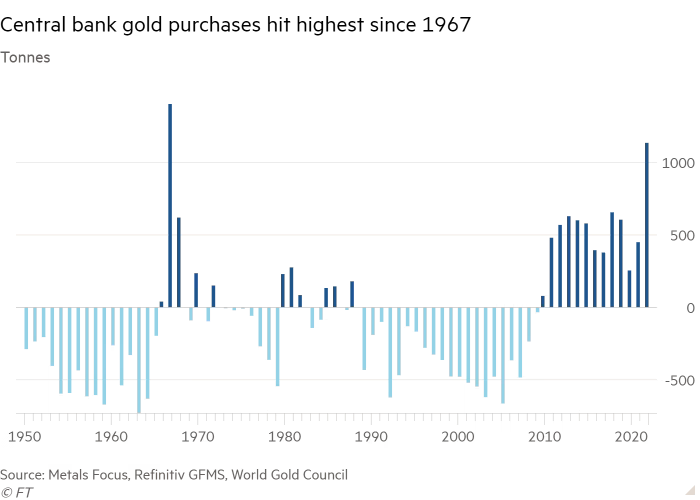
Did you know that central banks bought more gold last year than any year in the past 55 years—since 1967?

Though most don’t realize it, 1967 was a significant year in financial history, mainly due to the events at the London Gold Pool.
The London Gold Pool was an agreement among central banks of the United States and Western European countries to stabilize the price of gold. The goal was to maintain the price of gold at $35 per ounce by collectively buying or selling gold as needed.
However, in 1967 the London Gold Pool collapsed due to a shortage of gold and increased demand for the metal. That’s because European central banks bought massive amounts of gold as they began to doubt the US government’s promise to back the dollar to gold at $35/ounce. The buying depleted the London Gold Pool’s reserves and pushed the price of gold higher.
In short, 1967 was the beginning of the end of the Bretton Woods international monetary system that had been in place since the end of World War 2. It ultimately led to severing the US dollar’s last link to gold in 1971. The dollar has been unbacked fiat confetti ever since—though the petrodollar system and coercion have propped it up.
The point is large global gold flows can be a sign that a paradigm shift in the international monetary system is imminent.
Central banks are the biggest players in the gold market. And now that we have just experienced the largest year for central bank gold purchases since 1967, it’s clear to me something big is coming soon.
And those are just the official numbers that governments report. The actual gold purchases could be much higher because governments are often opaque about their gold holdings, which they consider a crucial part of their economic security.

Today, I think we are on the cusp of a radical change in the international monetary system with profound implications. Yet, few are aware of what is happening and its enormous significance.
I suspect most people will be taken by surprise—and it won’t be a pleasant one. They’ll be the ones holding the bag for a failing monetary system.
But it doesn’t have to be a disaster for everyone…
Those who get positioned properly ahead of this paradigm shift could make fortunes.
The Real Reason for China’s Massive Gold Stash
According to the Financial Times, the big buyers of gold in 2022 were China and Middle East oil producers. That’s not a coincidence, as these countries will be at the center of the changes to the international monetary system.
It’s no secret that China has been stashing away as much gold as possible for many years.
China is the world’s largest producer and buyer of gold. Most of that gold finds its way into the Chinese government’s treasury.
Nobody knows the exact amount of gold China has, but most observers believe it is many multiples of what the government declares.
Today it’s clear why China has had an insatiable demand for gold.
Beijing has been waiting for the right moment to pull the rug from beneath the US dollar. And now is that moment…
The key to understanding it all is Chinese President Xi’s recent historic visit to Saudi Arabia and other Gulf Cooperation Council (GCC) states to launch, in his words, “a new paradigm of all-dimensional energy cooperation.”
The GCC includes Saudi Arabia, Kuwait, Qatar, Bahrain, Oman, and the United Arab Emirates. These countries account for more than 25% of the world’s oil exports, with Saudi Arabia alone contributing around 17%. In addition, more than 25% of China’s oil imports come from Saudi Arabia.
China is the GCC’s largest trading partner.
The meetings reflect a natural—and growing—trade relationship between China, the world’s largest oil importer, and the GCC, the world’s largest oil exporters.
During Xi’s visit, he made the following crucial remarks (emphasis mine):
“China will continue to import large quantities of crude oil from GCC countries, expand imports of liquefied natural gas, strengthen cooperation in upstream oil and gas development, engineering services, storage, transportation and refining, and make full use of the Shanghai Petroleum and National Gas Exchange as a platform to carry out yuan settlement of oil and gas trade.”
After years of preparation, the Shanghai International Energy Exchange (INE) launched a crude oil futures contract denominated in Chinese yuan in March 2018. It’s the first oil futures contract to be traded in China. The contract is based on Brent crude oil, the global benchmark for oil prices, and is settled in cash.
Since then, any oil producer can sell its oil for something besides US dollars… in this case, the Chinese yuan.
The INE yuan oil futures contract provides a new pricing benchmark for the global oil market, which the US dollar has traditionally dominated. By trading in yuan, the contract is expected to increase the use of the Chinese currency in global trade and reduce the reliance on the US dollar.
Its significance lies in its potential to shift the balance of power in the oil market away from the US and towards China and to increase the use of the Chinese yuan in global trade.
There’s one big issue, though. Most oil producers don’t want to accumulate a large yuan reserve, and China knows this.
That’s why China has explicitly linked the crude futures contract with the ability to convert yuan into physical gold—without touching China’s official reserves—through gold exchanges in Shanghai (the world’s largest physical gold market) and Hong Kong.
PetroChina and Sinopec, two Chinese oil companies, provide liquidity to the yuan crude futures by being big buyers. So, if any oil producer wants to sell their oil in yuan (and gold indirectly), there will always be a bid.
After years of growth and working out the kinks, the INE yuan oil future contract is now ready for prime time. Xi wouldn’t promise the GCC large and consistent oil purchases if it wasn’t ready.
Why is China purchasing oil and gas from the GCC in yuan important?
Because it undercuts the petrodollar system, which has been the bedrock of the US and international financial system since the Bretton Woods system broke down in 1971.
The Saudis Acquiesce and What Happens Next
For nearly 50 years, the Saudis had always insisted anyone wanting their oil would need to pay with US dollars, upholding their end of the petrodollar system.
But that all changed recently.
After Xi’s historic visit and bombshell announcement, the Saudi government isn’t hiding its intention to sell oil in yuan. According to a recent Bloomberg report:
“Saudi Arabia is open to discussions about trade in currencies other than the US dollar, according to the kingdom’s finance minister.”
In short, the Saudis don’t think the US is holding up its end of the petrodollar deal. So they don’t feel like they should hold up their part.
The Saudis are angry at the US for not supporting it enough in its war against Yemen. They were further dismayed by the US withdrawal from Afghanistan and the nuclear negotiations with Iran.
In this context, China swooped in and, after many years, finally compelled the Saudis to accept yuan as payment.
It was bound to happen.
China is already the world’s largest oil importer. Moreover, the amount of oil it imports continues to grow as it fuels an economy of over 1.4 billion people (more than 4x larger than the US).
The sheer size of the Chinese market made it impossible for Saudi Arabia—and other oil exporters—to ignore China’s demands to pay in yuan indefinitely. The Shanghai International Energy Exchange further sweetens the deal for oil exporters.
Here’s the bottom line.
Saudi Arabia—the linchpin of the petrodollar system—is openly agreeing not to sell its oil exclusively in US dollars.
It signals an imminent and enormous change for anyone holding US dollars.
It would be incredibly foolish to ignore this giant red warning sign.
Even the WSJ admits such a move would be disastrous for the US dollar.
“The Saudi move could chip away at the supremacy of the US dollar in the international financial system, which Washington has relied on for decades to print Treasury bills it uses to finance its budget deficit.”
Ron Paul is an American politician and physician who has been a vocal critic of the current international monetary system for decades. Nixon’s move to end the dollar’s link to gold in 1971 initially motivated him to get into politics. He is known for his views on monetary policy, central banking, and the Federal Reserve. Ron Paul has written several books on these topics and advocated for a return to sound money and a gold-backed monetary system.
In short, Ron Paul knows more about the international monetary system than almost anyone alive.
He once gave a speech called “The End of Dollar Hegemony,” where he pointed out the one thing that would precipitate the US dollar’s collapse.
Here’s the relevant part:
“The economic law that honest exchange demands only things of real value as currency cannot be repealed.
The chaos that one day will ensue from our experiment with worldwide fiat money will require a return to money of real value.
We will know that day is approaching when oil-producing countries demand gold, or its equivalent, for their oil rather than dollars or euros.
The sooner the better.”
Here’s the bottom line.
The end of the petrodollar system is imminent.
For over 50 years, this arrangement has allowed the US government and many Americans to live way beyond their means.
The US takes this unique position for granted. But it will soon disappear.
There will be a lot of extra dollars floating around suddenly looking for a home now that they are not needed to purchase oil.
As a result, a lot of oil money—hundreds of billions of dollars and perhaps trillions—that would typically flow through banks in New York in US dollars into US Treasuries will instead flow through Shanghai into yuan and gold.
The end of the petrodollar system is bad news for Americans. Unfortunately, there’s little any individual can practically do to change the course of these trends in motion.
The best you can and should do is to stay informed so that you can protect yourself in the best way possible, and even profit from the situation.
That’s precisely why I just released an urgent report on where this is all headed and what you can do about it… including three strategies everyone needs today.
Click here to download the PDF now.
 
Last edited:
Is There A Worldwide Run On The Bank Of The United States Of America?

MONDAY, APR 17, 2023 - 12:40 PM
Authored by Douglas MacKinnon
In talking this week with a friend about the United States seemingly imploding from within across multiple sectors, my friend stressed:
“It’s not just from within. There is a run on the United States from certain nations and business interests around the world. Just like there was a run on banks after the collapse of Silicon Valley Bank, many nations are either thinking about — or actually proceeding with — transferring at least a portion of their allegiance, assets and commitments from the ‘Bank of the U.S.’ to the ‘Bank of China’ or elsewhere.”

This was not just some person sitting on a porch casually talking about current events while whittling a stick waiting for his Social Security or pension check to hit the mailbox. This was a former high-level U.S. government official, now a CEO, someone who sits on the boards of directors for multiple companies. He has massive real-world and business experience and believes the United State may be on the verge of collapse.
He is far from the only one to think that.


Some fear the Biden administration is losing control
of our southern border; losing control of our decaying, crime-infested big cities; creating a recession; vilifying and needlessly destroying the fossil fuel industry while pushing suspect and subsidized “green” energy alternatives; leaving tens of billions of dollars in military equipment in Afghanistan while withdrawing our troops and abandoning an ally; stepping closer to a trip-wire in the Ukraine war, which could trigger a nuclear strike; turning on Israel over ideological issues as Turkey and others call on Arab and Muslim nations to unite and crush the Jewish State; weakening our military with one “woke” edict after another; focusing on “trans” issues at the expense of failing transportation infrastructure; cheerleading the social justice warrior takeover of our colleges and universities; and weakening the dollar (the currency much of the world depends upon).

Is it any wonder, then, that nations such as France, India, Saudi Arabia, Japan, Mexico, Brazil and others are suddenly hedging their bets by looking beyond the United States of America for partnerships and stability?

On top of those problems, our allies and certain foreign corporations now have the legitimate concern of wondering what between them and the United States will be kept private and secure, in light of the massive and reportedly deliberate leak of classified Pentagon documents.

Who is an ally or foreign business partner to trust? More importantly, in the eyes of some of these nations and foreign business interests, who will prove to be the more stable and dependable partner in the coming years and decades?

In an example of a world leader hedging his bets, French President Emmanuel Macron recently traveled to Beijing to meet with China’s President Xi Jinping. Macron did not travel alone. He brought along Ursula von der Leyen, the president of the European Commission. Some saw this as Macron advertising that much of the European Union was with him in spirit as he met with Xi.

On his way back to France after the meeting, Macron emphasized that Europeans should not be “just America’s followers” and “get caught up in crises that are not ours.” Even though the French leader seemed to be spelling it out in 100-font, one could read between the lines and assume he meant not getting dragged too deeply into the Ukraine war or defending Taiwan, should China invade. The last part was music to the ears of China’s strongman, Xi.

Next, we have Mexican President Andrés Manuel López Obrador openly criticizing — and challenging — the leadership of the United States for months, by calling the U.S. an “oligarchy, not a real democracy.” He threatened to sabotage calls for U.S. military action against Mexican cartels, and has made it clear that he is not afraid to pick a fight with what he may see as a United States in decline.

Or, last month’s news that Saudi Arabia was inching closer to joining a China-led Asian security and economic bloc, after having been granted the status of a dialogue partner in the Shanghai Cooperation Organization (SCO). Aside from China and Russia, the bloc also includes India, Pakistan and some ex-Soviet states. It’s an organization one might view as not always having the best interests of the United States in mind.

As Ali Shihabi, a Saudi analyst and writer, made clear during an interview:

“The traditional monogamous relationship with the US is now over. And we have gone into a more open relationship, strong with the U.S. but equally strong with China, India, [the] UK, France and others.”
Finally, we have Brazil — China’s most important trading partner in South America — announcing a new agreement to conduct bilateral commerce in their respective currencies, rather than the U.S. dollar.The move not only shocked many in the U.S. government but opened the eyes of others around the world to the possibility of decoupling from the dollar.

Some believe these things are happening because a growing number of political and business leaders around the world now lack confidence in the United States, believing our country truly is in disarray, decline and increasingly polarized and politicized. Will such concerns accelerate a “run on the Bank of the United States” with assets being transferred to China or even Russia?

Only time will tell. But as with the collapse of Silicon Valley Bank, the signs are out there, should the analysts care to pay attention.
 
De-Dollarization: Countries Seeking Alternatives To The US Dollar

THURSDAY, APR 20, 2023 - 08:00 PM
The U.S. dollar has dominated global trade and capital flows over many decades.
However, as Visual Capitalist's Bruo Venditti details below, many nations are looking for alternatives to the greenback to reduce their dependence on the United States.
This graphic catalogs the rise of the U.S. dollar as the dominant international reserve currency, and the recent efforts by various nations to de-dollarize and reduce their dependence on the U.S. financial system.

2023-04-20_13-52-18.jpg

The Dollar Dominance
The United States became, almost overnight, the leading financial power after World War I. The country entered the war only in 1917 and emerged far stronger than its European counterparts.

As a result, the dollar began to displace the pound sterling as the international reserve currency and the U.S. also became a significant recipient of wartime gold inflows.

The dollar then gained a greater role in 1944, when 44 countries signed the Bretton Woods Agreement, creating a collective international currency exchange regime pegged to the U.S. dollar which was, in turn, pegged to the price of gold.

By the late 1960s, European and Japanese exports became more competitive with U.S. exports. There was a large supply of dollars around the world, making it difficult to back dollars with gold. President Nixon ceased the direct convertibility of U.S. dollars to gold in 1971. This ended both the gold standard and the limit on the amount of currency that could be printed.

Although it has remained the international reserve currency, the U.S. dollar has increasingly lost its purchasing power since then.

Russia and China’s Steps Towards De-Dollarization
Concerned about America’s dominance over the global financial system and the country’s ability to ‘weaponize’ it, other nations have been testing alternatives to reduce the dollar’s hegemony.

As the United States and other Western nations imposed economic sanctions against Russia in response to its invasion of Ukraine, Moscow and the Chinese government have been teaming up to reduce reliance on the dollar and to establish cooperation between their financial systems.

Since the invasion in 2022, the ruble-yuan trade has increased eighty-fold. Russia and Iran are also working together to launch a cryptocurrency backed by gold, according to Russian news agency Vedmosti.

In addition, central banks (especially Russia’s and China’s) have bought gold at the fastest pace since 1967 as countries move to diversify their reserves away from the dollar.

How Other Countries are Reducing Dollar Dependence
De-dollarization it’s a theme in other parts of the world:

  • In recent months, Brazil and Argentina have discussed the creation of a common currency for the two largest economies in South America.
  • In a conference in Singapore in January, multiple former Southeast Asian officials spoke about de-dollarization efforts underway.
  • The UAE and India are in talks to use rupees to trade non-oil commodities in a shift away from the dollar, according to Reuters.
  • For the first time in 48 years, Saudi Arabia said that the oil-rich nation is open to trading in currencies besides the U.S. dollar.
Despite these movements, few expect to see the end of the dollar’s global sovereign status anytime soon. Currently, central banks still hold about 60% of their foreign exchange reserves in dollars.
 
It's A "Defund-The-Global-Police" Moment, Jen Says De-Dollarization Is Happening At A "Stunning" Pace


Over the last few weeks, it has seemed you can't turn a page, blink at a pixel, or hear a news report without some form of de-dollarizationheadline shrieking at you. From Brazil to Saudi Arabia, and from India to Argentina, and increasing number of nations are 'reportedly' shifting away from the dollar hegemon.

Some recent headlines:

Eyeballing the Dollar Index (or some other broad index of fiat relativity) drops modest hints but the nature of the relationship of one un-backed currency against another makes that comparison worthless in the longer-term.

2023-04-22_14-12-39.jpg


But below the surface, the dollar's fecal matter is striking rotating objects at an increasing pace and Stephen Jen - infamous for his coining of the 'dollar smile' while at Morgan Stanley which posits that the US Dollar tends to do well when the economy is soaring or slumping - recently quantified just how rapidly the de-dollarization is ocurring.

Jen, who now runs money at Eurizon SLJ, warned in a recent briefing note, that the dollar is losing its reserve status at a faster pace than generally accepted, as many analysts have failed to account for last year’s frantic swings in exchange rates.

“The dollar suffered a stunning collapse in 2022 in its market share as a reserve currency, presumably due to its muscular use of sanctions,” Jen and his colleague Joana Freire wrote.
“Exceptional actions taken by the US and its allies against Russia have startled large reserve-holding countries,” most of which are emerging economies from the so-called Global South, they said.
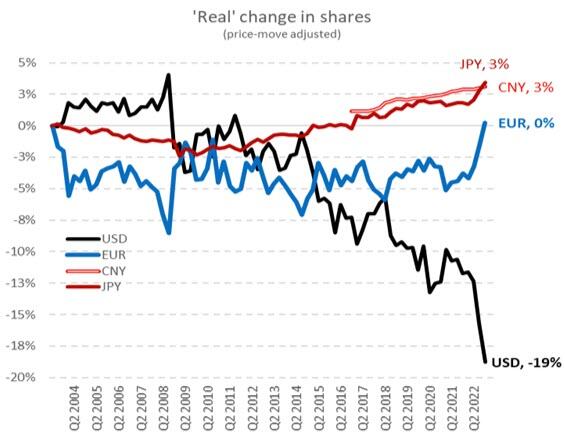
As The FT reports, Jen estimates that if you adjust for price changes the dollar’s share of official global reserve currencies has gone from about 73 per cent in 2001 to around 55 per cent in 2021.

Then, last year, it fell to 47 percent of total global reserves.


2023-04-22_14-02-54.jpg


Source: Eurizon SLJ Capital

Jen and Freire go on to ominously explain that the USD is losing its market share as a reserve currency at a much faster rate than is commonly believed.

"After steady declines in its global market share for the past two decades, in 2022 the dollar lost market share at a pace 10 times as rapidly. Analysts have failed to detect this big change because they calculate the nominal value of the world’s central banks’ dollar holdings without considering the changes in the price of the dollar. Adjusting for these price changes, the dollar, we calculate, has lost some 11 percent of its market share since 2016 and double that amount since 2008.
This erosion in the USD’s reserve currency status has accelerated precipitously since the start of the war in Ukraine. Exceptional actions taken by the US and its allies against Russia have startled large reserve-holding countries, most of which are from the Global South.
...Without the need for us to take sides in this debate on Ukraine, it seems reasonable to speculate that the main driver of the collapse in USD’s reserve status in 2022 may have reflected a panicked reaction to property rights being jeopardised. What we witnessed in 2022 was sort of a ‘defund-the-global-police’ moment, whereby many reserve managers in the world disagreed with the conduct of both Russia and the US."


2023-04-22_14-14-21.jpg


This is suddenly serious, as Jen and Freire argue that “The prevailing view of ‘nothing-to-see-here’ on the US dollar as a reserve currency seems too innocuous and complacent."

“What needs to be appreciated by investors is that, while the Global South is unable to totally avoid using the dollar, much of it has already become unwilling to do so.”
The greenback’s share in global reserves slid last year at 10 times the average speed of the past two decades as a number of countries looked for alternatives after Russia’s invasion of Ukraine triggered sanctions.

Moreover, as Jen stresses, there are actually two pillars that make the US dollar so mighty: its role as the reserve currency of choice, and its dominant use in global finance and trade. “Investors ought not be confused by these two different concepts,” he argues.

"While the Global South seems unwilling to continue to hold dollar assets, they do not seem to have the ability to divest from the US dollar as an international currency, particularly for financial transactions.
We suspect it will be very difficult to overcome the strong network effects that have been behind the dollar’s international currency status.
The key to topple the dollar’s throne as an international currency is predicated on the relative developments and stability in the various financial markets. If the financial markets outside the US could thrive (growing in size and becoming ever more energetic, without being unstable), and if the opposite happens in the US, the dollar could very well meet its demise.
This is, however, not an imminent risk, in our opinion, though the trends are heading in that direction."


Still think it won't or can't happen, here's George Soros... from 2009...


Escobar: De-Dollarization Kicks Into High Gear
FRIDAY, APR 28, 2023 - 11:40 PM
Authored by Pepe Escobar via The Cradle,
The US dollar is essential to US global power projection. But in 2022, the dollar share of reserve currencies slid 10 times faster than the average in the past two decade….

Putin-bin-Salman-Mbs-Xi.jpg


It is now established that the US dollar’s status as a global reserve currency is eroding.
When corporate western media begins to attack the multipolar world’s de-dollarization narrative in earnest, you know the panic in Washington has fully set in.
The numbers: the dollar share of global reserves was 73 percent in 2001, 55 percent in 2021, and 47 percent in 2022. The key takeaway is that last year, the dollar share slid 10 times faster than the average in the past two decades.
Now it is no longer far-fetched to project a global dollar share of only 30 percent by the end of 2024, coinciding with the next US presidential election.
The defining moment – the actual trigger leading to the Fall of the Hegemon – was in February 2022, when over $300 billion in Russian foreign reserves were “frozen” by the collective west, and every other country on the planet began fearing for their own dollar stores abroad. There was some comic relief in this absurd move, though: the EU “can’t find” most of it.
Now cue to some current essential developments on the trading front.
Over 70 percent of trade deals between Russia and China now use either the ruble or the yuan, according to Russian Finance Minister Anton Siluanov.
Russia and India are trading oil in rupees. Less than four weeks ago, Banco Bocom BBM became the first Latin American bank to sign up as a direct participant of the Cross-Border Interbank Payment System (CIPS), which is the Chinese alternative to the western-led financial messaging system, SWIFT.
China’s CNOOC and France’s Total signed their first LNG trade in yuan via the Shanghai Petroleum and Natural Gas Exchange.
The deal between Russia and Bangladesh for the construction of the Rooppur nuclear plant will also bypass the US dollar. The first $300 million payment will be in yuan, but Russia will try to switch the next ones to rubles.
Russia and Bolivia’s bilateral trade now accepts settlements in Boliviano. That’s extremely pertinent, considering Rosatom’s drive to be a crucial part of the development of lithium deposits in Bolivia.
Notably, many of those trades involve BRICS countries – and beyond. At least 19 nations have already requested to join BRICS+, the extended version of the 21st century’s major multipolar institution, whose founding members are Brazil, Russia, India, and China, then South Africa. The foreign ministers of the original five will start discussing the modalities of accession for new members in an upcoming June summit in Capetown.
BRICS, as it stands, is already more relevant to the global economy than the G7. The latest IMF figures reveal that the existing five BRICS nations will contribute 32.1 percent to global growth, compared to the G7’s 29.9 percent.
With Iran, Saudi Arabia, UAE, Turkey, Indonesia, and Mexico as possible new members, it is clear that key Global South players are starting to focus on the quintessential multilateral institution capable of smashing Western hegemony.
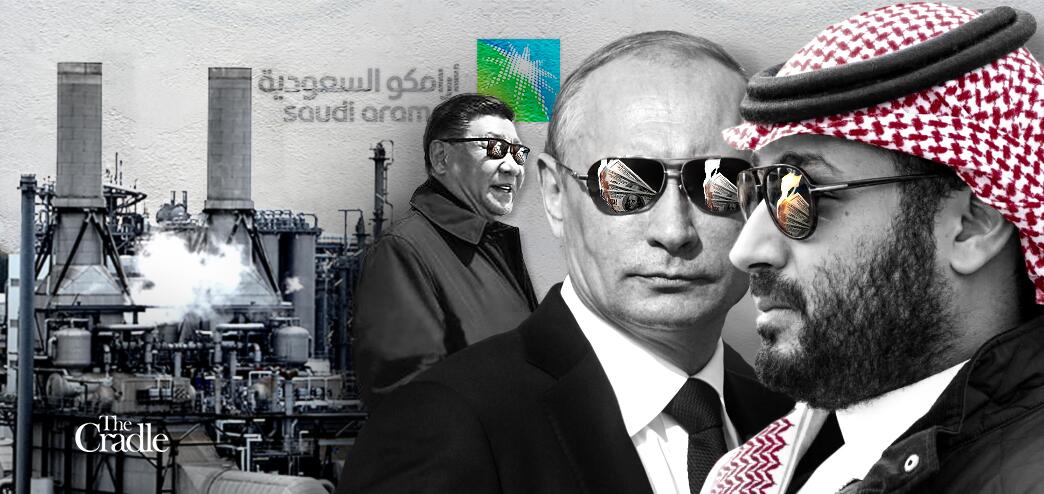
Russian President Vladimir Putin and Saudi Crown Prince Mohammad bin Salman (MbS) are working in total sync as Moscow’s partnership with Riyadh in OPEC+ metastasizes into BRICS+, in parallel to the deepening Russia-Iran strategic partnership.
MbS has willfully steered Saudi Arabia toward Eurasia’s new power trio Russia-Iran-China (RIC), away from the US. The new game in West Asia is the incoming BRIICSS – featuring, remarkably, both Iran and Saudi Arabia, whose historic reconciliation was brokered by yet another BRICS heavyweight, China.
Importantly, the evolving Iran-Saudi rapprochement also implies a much closer relationship between the Gulf Cooperation Council (GCC) as a whole and the Russia-China strategic partnership.
This will translate into complementary roles – in terms of trade connectivity and payment systems – for the International North-South Transportation Corridor (INSTC), linking Russia-Iran-India, and the China-Central-Asia-West Asia Economic Corridor, a key plank of Beijing’s ambitious, multi-trillion-dollar Belt and Road Initiative (BRI).
Today, only Brazil, with its President Luiz Inácio Lula Da Silva caged by the Americans and an erratic foreign policy, runs the risk of being relegated by the BRICS to the status of a secondary player.
Beyond BRIICSS
The de-dollarization train has been propelled to high-speed status by the accumulated effects of Covid-linked supply chain chaos and collective western sanctions on Russia.
The essential point is this: The BRICS have the commodities, and the G7 controls finance. The latter can’t grow commodities, but the former can create currencies – especially when their value is linked to tangibles like gold, oil, minerals, and other natural resources.
Arguably the key swing factor is that pricing for oil and gold is already shifting to Russia, China, and West Asia.
In consequence, demand for dollar-denominated bonds is slowly but surely collapsing. Trillions of US dollars will inevitably start to go back home – shattering the dollar’s purchasing power and its exchange rate.
The fall of a weaponized currency will end up smashing the whole logic behind the US’ global network of 800+ military bases and their operating budgets.
Since mid-March, in Moscow, during the Economic Forum of the Commonwealth of Independent States (CSI) – one of the key inter-government organizations in Eurasia formed after the fall of the USSR – further integration is being actively discussed between the CSI, the Eurasia Economic Union (EAEU), the Shanghai Cooperation Organization (SCO) and the BRICS.
Eurasian organizations coordinating the counterpunch to the current western-led system, which tramples on international law, was not by accident one of the key themes of Russian Foreign Minister Sergey Lavrov’s speech at the UN earlier this week. It is also no accident that four member-states of the CIS – Russia and three Central Asian “stans” – founded the SCO along with China in June 2001.
The Davos/Great Reset globalist combo, for all practical purposes, declared war on oil immediately after the start of Russia’s Special Military Operation (SMO) in Ukraine. They threatened OPEC+ to isolate Russia – or else, but failed humiliatingly. OPEC+, effectively run by Moscow-Riyadh, now rules the global oil market.
Western elites are in a panic. Especially after Lula’s bombshell on Chinese soil during his visit with Xi Jinping, when he called on the whole Global South to replace the US dollar with their own currencies in international trade.
Christine Lagarde, president of the European Central Bank (ECB), recently told the New York-based Council of Foreign Relations – the heart of the US establishment matrix – that “geopolitical tensions between the US and China could raise inflation by 5 percent and threaten the dominance of the dollar and euro.”
The monolithic spin across western mainstream media is that BRICS economies trading normally with Russia “creates new problems for the rest of the world.” That’s utter nonsense: it only creates problems for the dollar and the euro.
The collective west is reaching Desperation Row – now timed with the astonishing announcement of a Biden-Harris US presidential ticket running again in 2024. This means that the US administration’s neo-con handlers will double down on their plan to unleash an industrial war against both Russia and China by 2025.
The petroyuan cometh
And that brings us back to de-dollarization and what will replace the hegemonic reserve currency of the world. Today, the GCC represents more than 25 percent of global oil exports (Saudi Arabia stands at 17 percent). More than 25 percent of China’s oil imports come from Riyadh. And China, predictably, is the GCC’s top trading partner.
The Shanghai Petroleum and Natural Gas Exchange went into business in March 2018. Any oil producer, from anywhere, can sell in Shanghai in yuan today. This means that the balance of power in the oil markets is already shifting from the US dollar to the yuan.
The catch is that most oil producers prefer not to keep large stashes of yuan; after all, everyone is still used to the petrodollar. Cue to Beijing linking crude futures in Shanghai to converting yuan into gold. And all that without touching China’s massive gold reserves.
This simple process happens via gold exchanges set up in Shanghai and Hong Kong. And not by accident, it lies at the heart of a new currency to bypass the dollar being discussed by the EAEU.
Dumping the dollar already has a mechanism: making full use of the Shanghai Energy Exchange’s future oil contracts in yuan. That’s the preferred path for the end of the petrodollar.
US global power projection is fundamentally based on controlling the global currency. Economic control underlies the Pentagon’s ‘Full Spectrum Dominance’ doctrine. Yet now, even military projection is in shambles, with Russia maintaining an unreachable advance on hypersonic missiles and Russia-China-Iran able to deploy an array of carrier-killers.
The Hegemon – clinging to a toxic cocktail of neoliberalism, sanction dementia, and widespread threats – is bleeding from within. De-dollarization is an inevitable response to system collapse. In a Sun Tzu 2.0 environment, it is no wonder the Russia-China strategic partnership exhibits no intention of interrupting the enemy when he is so busy defeating himself.
 
 
No crude oil to be sold (outside the U.S.) in exchange for
greenback toilet paper. That is one way for OPEC+ to help
put a lid on global greenhouse gas emission growth.
 
Escobar: Global De-Dollarization Nearing "Crossroads Moment"

SUNDAY, MAY 07, 2023 - 07:00 AM
Authored by Ekaterina Blinova,
De-dollarization is heading for a breakthrough due to rising global discontent with US 'casino capitalism'...


2023-05-06_08-37-02.jpg


"It's a gigantic snowball all over the world. We cannot even keep up with it,” Pepe Escobar said in an interview with the New Rules podcast.
“It's very important what is going to be discussed at the BRICS summit in South Africa. This will probably be the crossroads moment where things are going to then go."
Escobar explained that a growing number of countries in the Global South were doing the math and concluding that the US dollar was not a safe bet. The combination of aggressive US sanctions policy and reckless government spending have dramatically reduced the greenback’s international appeal.
“If you want to analyze the patterns these past two decades, you need to understand the fact that, if you are rich in commodities and if you are a productive capitalist nation and you decide to issue a currency, it will be internationally respected because people will know it's based on facts, actual provenance, actual wealth,” he said. “That’s contrary to the system that we have now, which I have been calling it ‘casino capitalism’ for years. It's futures, it's bets, it's suppositions. It may go right or wrong. If you lose, you lose it all. The house mostly always wins because the house is the one who prints the currency. It's backed by nothing, literally, by a country that owes $30 trillion [in national debt] now and it will never be able to repay it."
To make matters even worse, the US Federal Reserve’s aggressive interest rate hikes has made borrowing in dollars expensive for almost everyone in the world. Prior to the Fed's move, Kristalina Georgieva, managing director of the International Monetary Fund, warned in January 2022 that the US raising interest rates could backfire on the global economy and especially on countries with higher levels of dollar-denominated debt.

The ongoing US banking crisis threatens to further destabilize international financial markets. No country in the world wants to "catch a cold" when the US economy "sneezes," as memories of the 2008 financial crisis linger.
"They say, 'look, why do we have to be subjected to this kind of arrangement?' And of course, before, as we all know, it was ‘the Empire of bases’, over 800 military bases all over the world, 'the power of the financial markets', 'the power of soft culture', 'the power of cancel culture', but the Global South is not intimidated anymore. I think this is the first [time] in this new millennium. We never had this before in the past two and a half centuries, at least," Escobar said.
BRICS Seeking to Establish New Currency
In January 2023, BRICS – an acronym for Brazil, Russia, India, China, and South Africa – made a splash by announcing that it may soon explore the possibility of creating its own currency to by-pass the US dollar. The idea was articulated on both sides of the Atlantic: Russian Foreign Minister Sergey Lavrov touched upon the plan during a presser after his meeting with Angolan President Joao Lourenco on January 25.
On the other side of the pond, President of Brazil Luiz Inacio Lula da Silva discussed the issue of the creation of a common currency for BRICS and the countries of Mercosur, a South American trade bloc, during his meeting with his Argentine counterpart Alberto Fernandez.
"Why can’t an institution like the BRICS bank have a currency to finance trade relations between Brazil and China, between Brazil and all the other BRICS countries? Who decided that the dollar was the (trade) currency after the end of gold parity?" Lula said during an April visit to the Shanghai-based New Development Bank.
According to Escobar, the formation and development of three organizations, namely BRICS, the Shanghai Cooperation Organization (SCO) and the Eurasian Economic Union predetermined the end of the greenback-centered world order. BRICS members are now discussing designing an alternative currency; similar discussions are being held in the Eurasian Economic Union; they should start coordinating and then this will spill over to the SCO, the writer projected.
The trend has already been engulfing other blocs, Escobar continued, referring to the Association of Southeast Asian Nations (ASEAN). On March 28, ASEAN finance ministers and central bank governors held a meeting in Indonesia to discuss how to move to settlements in local currencies by further enhancing an ASEAN cross-border digital payment system.
Initially, the agreement on such transactions was reached between Indonesia, Malaysia, Singapore, the Philippines, and Thailand in November 2022. The association is seeking to reduce dependence not only on the US dollar, but also on euros, yens, and British pounds in financial transactions.
"We have something that was absolutely unbelievable two months ago," Escobar emphasized.
Why is De-Dollarization Gaining Steam?
De-dollarization has been discussed for decades. For instance, Mikhail Khazin, a Russian economist and publicist, who served in the Working Center for Economic Reforms under the Boris Yeltsin government in the 1990s, and his co-author Andrey Kobyakov predicted the demise of the US dollar dominance roughly 20 years ago in their book titled "The Decline of the Dollar Empire and the End of Pax Americana." While the idea has been in the air for quite a while, why is it that this phenomenon has only now started to gain critical mass?
"We can even establish a date for it," responded Escobar. "February last year, with that freezing, confiscation, stealing of Russian foreign reserves. And the Global South as practically as a whole started asking themselves from Latin America to Africa to South East Asia, ‘if they can do this with a nuclear superpower, they can do it with any one of us snapping their fingers’. So that's why the coordination inside these multilateral organizations and in other forums picked up astronomic speed."
To illustrate his point, the journalist referred to the swift development of BRICS with a staggering 19 countries currently on the list to join the organization. Among them the strongest candidates are Iran, Argentina, Algeria, as well as the United Arab Emirates, Turkiye, Egypt, Kazakhstan, and Indonesia, as per the geopolitical analyst.
"So these are all strong middle rank powers from anywhere," Escobar said. "And they're going to start discussing the now notorious BRICS alternative currency. So they have to speed up this conversation and let's hope that they are going to start discussing it in conjunction with the Eurasian Economic Union, which is much more advanced, and the Shanghai Cooperation Organization."
Escobar believes that nothing short of a breakthrough in this respect could occur as early as next year.
"It's possible, it's a feasible scenario," he insisted. "Until a few months ago, this would be the ultra-far-fetched scenario. Not anymore, because now the speed is unbelievable. Literally every day - Bangladesh, Argentina, Algeria, countries in Southeast Asia."
Last month, Russian Foreign Minister Sergey Lavrov met with his Bolivian counterpart Rogelio Mayta in the Venezuelan capital Caracas and introduced a new trade transaction system to drop the US dollar and the euro and switch to rubles and Bolivianos instead.
Together with Argentina and Chile, Bolivia forms the so-called "Lithium Triangle" which accounts for more than half of the world's deposits of the silvery-white alkali metal. Bolivia's Salar de Uyuni salt flat alone contains 21 million metric tons of lithium, widely used in rechargeable batteries for mobile phones, laptops, digital cameras and electric vehicles.
Petroyuan May Dethrone Petrodollar
The most important element is the coming of the petroyuan, as per Escobar. For decades, crude oil has been traded in US dollars. However, the petrodollar could be soon dethroned: last year, Beijing called on Gulf leaders to settle their gas and oil deals with China in yuan. The US and China remain the world's top two consumers of crude, using 18.7 million and 15.4 million barrels per day, respectively. Energy settlements in yuan could deal a heavy blow to the greenback.
"We are on our way, which is something that even very good American financial analysts who have been following this story could never imagine that this would be literally around the corner," the journalist said. "Now, the only thing that is missing, in fact, is the Chinese delegation going to Riyadh and saying, ‘okay, from now on everything is going to be in yuan, no more Western currencies anymore.’ And we already have a mechanism for it. I did a column about that, basically explaining that it's a very simple mechanism."
"You buy oil futures at the Shanghai Exchange priced in yuan. So from now on you have a new benchmark, an oil benchmark in yuan that you transact in Shanghai. The Chinese say, ‘look, it's linked to gold as well. You want to change yuan into gold? Simple. We have a gold exchange here in Shanghai and we have another one here in Hong Kong. You can trade all you want for gold.’ This is the way. It's extremely simple. But not many people are aware of it. Only a few economists, in fact. And I have not seen this discussion in American media, for that matter," Escobar continued.
That doesn't mean, however, that the dollar will be replaced by the yuan: instead, a whole set of currencies will be used wiping out the greenback's hegemony, according to the geopolitical analyst.
"I think we're going to start with having multiple replacements, and then maybe in the second stage, these multilateral organizations start thinking, okay, why don't we think about a fusion? Because we have different priorities," he said.


Why China and its trading allies are well placed to topple the dollar
After decades meting out sanctions and financial coercion, the US may soon feel its grip on world trade beginning to loosen.
By Wolfgang Münchau

China-USA.jpg


Change is good, but dollars are better, a US author of romance novels once wrote. A similarly light-hearted sentiment often inspires discussions about the future role of the US dollar as the world’s leading currency. The consensus view is that the dollar is safe. I think the consensus is wrong.
The dollar is the foundation of US global leadership, and the future of the dollar is therefore intricately linked to the debate about geopolitical fragmentation.
Brazil’s president, Luiz Inácio Lula da Silva, asked during his recent visit to China:
“Why should every country have to be tied to the dollar for trade?… Who decided the dollar would be the [world’s] currency?”
These are good questions.
The perhaps surprising answer is that he himself made that decision, together with the former leaders of the other “Brics” group of nations: Brazil, Russia, India, China and South Africa. Their economic-development models have succeeded but have also critically depended on the US dollar. During the period of hyperglobalisation – which I date from 1990 to 2020 – the US became the global importer of last resort, and let its trade deficit against the rest of the world increase. China and many other fast-developing economies built up savings in the currency they were paid in – the US dollar. They invested those savings into US bonds and other assets. The willingness of the US to absorb the world’s savings surpluses was the engine of globalisation. It ensured that the dollar would maintain its status as the world’s leading currency.
This mechanism explains what happened in the last 20 years, but it won’t tell us what will happen in the next 20. Yet the dollar fans assume that the geopolitical and geo-economic environment will stay broadly the same.
If the five Brics countries wanted to end their dependence on the dollar, they would have to do more than just choose another currency to trade in. It is not a menu choice, as Lula suggested during the same speech. He and his fellow Brics leaders would have to change how they interact with the rest of the world, and with one another.
China is key. In 2021, the country derived 43 per cent of its GDP from investment. This is approximately twice the level of the US and other Western countries. If China managed to shift some of its GDP to consumption, it would reduce its external trade surplus, as consumers tend to buy more imported goods. If you wanted to be less reliant on the US dollar, this is where you would have to start. As a second step, China and the other Brics countries could start trading more with each other, become more self-reliant in their supply chains, and set up their own financial infrastructure.
Changing economic models is hard. Three years after Brexit, the UK is still struggling to move away from a model that depended on close integration with the EU. Germany is finding it hard to maintain competitiveness without cheap Russian gas and with impaired global supply. It takes decades to build industrial production lines and supply chains. In China, there are an awful lot of vested political interests at the regional level, which rely on the investment boom continuing. If President Xi Jinping was really keen to extricate China from the US dollar, he would need to impose policies that would meet with resistance from regional leaders. In parallel, China would also have to start a long process of shifting at least part of its $3.2trn worth of foreign reserves held in dollars into other currencies. All of this would take a long time – one or two decades, perhaps.
The reason I think China, Brazil and others will ultimately go down that difficult route is the overuse of economic sanctions by the US.When the war in Ukraine began, the first decision taken by the Western alliance was to freeze Russia’s central-bank reserves held in the West. Previously, the US had threatened German firms involved with the Nord Stream gas pipeline, by cutting off their and their banks’ entire dollar cash-flows. If two people transact in dollars via their banks, at some point the transaction goes through US jurisdiction. This is why it is possible for the US to impose sanctions in the first place.
It was the Obama administration that began developing dollar-based economic sanctions as a primary policy tool. Dollar sanctions have since become a mainstay of US diplomacy. The most insidious version are so-called secondary sanctions. European companies, for example, were forced to comply with US sanctions against Iran because they would otherwise have lost access to dollar markets. On top of those financial sanctions, the US has become far more aggressive in the use of targeted trade sanctions. The Trump administration banned Huawei. The Biden administration has banned high-performance semiconductor sales to China. The EU is also now cautiously starting to subject trade policy to geopolitical considerations.
Sanctions can bring short-term policy successes, but they come with a long-term cost that is often not accounted for. That cost will be a reduced role for the dollar as the world’s largest currency. Sanctions give incentives to countries to reorganise their economies. We are seeing this happening in Russia right now.
Having the world’s leading currency is an “exorbitant privilege” – an expression often attributed to Charles de Gaulle. But if you use a privilege too often it ceases to be seen as a privilege and begins to lose its value. This is the mechanism I see at work here.
This is the non-fiction version of a story in which dollars are not better after all.