De-Dollarization Just Got Real

U.S. Dollar "Fear Mongers" Only Need To Be Right Once

WEDNESDAY, APR 05, 2023 - 03:05 PM
Submitted by QTR's Fringe Finance
Optimists about the U.S. economy and the dollar’s global reserve status have had the wind at their back for half of a century, so why should anyone expect them to consider an alternative viewpoint?
Therein lies the folly that our country faces.

There’s a reason that every financial disclosure, brochure, hedge fund letter or commercial always says “past performance is not indicative of future results” on it: because it isn’t. But that boilerplate-sounding warning is printed in size zero font and, as a result, also rests in the equivalent of size zero font in the brains of U.S. dollar bulls.
The fact is that warnings about the precarious nature of the U.S. dollar - whether bombastic or not - are probably more important today than they have ever been. But these warnings can’t compete with 50 years of the “trend being the United States’ friend”, a hurricane force tailwind that includes politicians on both sides of the aisle, the nation’s central bank, the treasury secretary and the roaring concert of all financial news media.
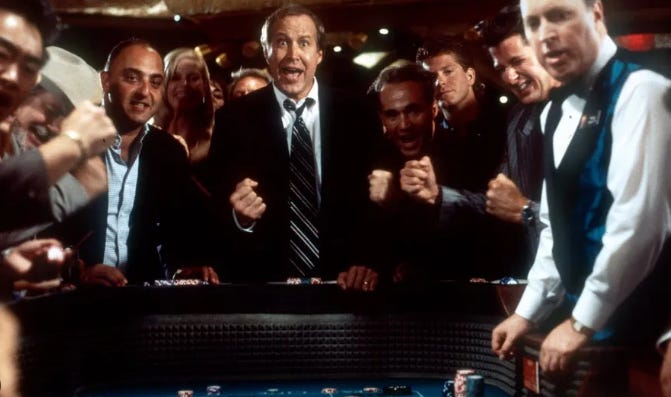
Those who believe the dollar is always destined to be the backbone of the global economy are like players at a roulette table who have a system of betting all of the inside numbers, except for the number 13. Given a small house edge and the fact that you have to lay 35 to win 36 (excluding the 0 and 00) means that, in order to start cashing in on your system in a big way, you have to get hot and tear off a ton of wins in a row. But when the odds are in your favor - and betting 35 of 36 total outcomes definitely skews them to your advantage - it’s almost a certainty you’ll “get hot” and start winning multiple spins in row. When you start winning dozens of spins in a row, it becomes impossible to hear the skepticism of the one person betting the 13 or warning you that eventually, it’ll come out.
Well right now, at the casino of the global economy, the U.S. is on a roll. We are on fire. We have figured out how to beat the house. We are casino gods.
We’ve won 1,000 spins of the roulette wheel in a row, without hitting the number 13. We are a shooter at a craps table that has made every point, over and over, for hundreds of days in a row. We are sports bettors hitting every leg of an 8 team parlay every single night for an entire month and pressing the winnings each time. We are playing multiple blackjack hands every hand, and we split and double down on every hand, and all we do is pull 20’s and 21’s. The dealer doesn’t even need to bust every hand, but it does.


https%3A%2F%2Fsubstack-post-media.s3.amazonaws.com%2Fpublic%2Fimages%2F5d7a8a7e-bc83-4ced-b775-27ebfce18428_671x397.png


The casino has plied us with drinks. We’ve been drinking top shelf for 50 years and have no idea how drunk we’ve become. The seduction of the win has blinded us to the sobering constant of the math on the other side of our “systems”. Like a slithering, unsuspecting cobra slowly making its way to our table on the floor while we high five our allies after every additional win, the snake of reality gets closer and closer, preparing to eventually bite us when we least expect it.

And the truly fucked up thing? When you’re betting it all, every hand, it only takes that one roll, or that one spin, to give back everything we’ve spent our entire winning streak accumulating.


Which brings me to the point of today’s post: the idea that so-called “fear mongers” about the U.S. dollar - arguing for everything from a mundane DXY crash to a full out loss of reserve currency status - literally only have to be right once.

Most people will tell you that, mathematically, they acknowledge that the dollar’s run can’t continue for the rest of eternity. And we’ve never experimented with a monetary system the way we have now, so we don’t have any basis for comparison about how long the fiat circus is going to continue. 50 years of fiat is actually a relatively short amount of time, so there are good arguments for both continuing to ride the “hot streak” for a few more generations and also for hegemony ending suddenly, when we least expect it.

https%3A%2F%2Fsubstack-post-media.s3.amazonaws.com%2Fpublic%2Fimages%2F975342f6-fa5f-47cc-8ae1-0446040aa6d5_533x313.png


However, after 10 years of trying to figure out the dastardly scheme that is macroeconomics, I can’t remember a time where the idea of the dollar losing reserve status has been in the mainstream media as much as it is now.


headys.jpg


And in the past few hours we’ve seen headlines like:

And also courtesy of @WatcherGuru, Saudi Arabia in just the past week has done the following:

  1. Saudi Arabia to adopt economic strategy without US dependence, following decline in relations under Biden Administration, FT reports.
  2. Saudi Arabia, Russia, UAE, Iraq, Kuwait, Oman, and Algeria to cut oil production output until the end of 2023.
  3. Saudi Arabia partners with China to build a Chinese oil refinery for 83.7 billion yuan ($12.2 billion).
  4. Saudi Arabia enters trade alliance with China, Russia, India, Pakistan, and four Central Asian nations to step further away from reliance on the US dollar.
  5. Saudi Arabia partners with India to create an investment bridge emphasizing greater economic interconnectedness.
Initially, I wrote today’s article as a concession that I would stop writing about the risks facing the dollar – but then I took personal inventory and realized it’s not likely I would be able to commit to that.

Suffice it say, however, the mainstream is finally picking up the thread.

Even the mainstream media realizes what many of us have been screaming for years: that we are in uncharted waters, given the decades of low rates, Keynesian policy, current potential for serious stagflation and the global challenge that nations like Saudi Arabia, Russia and China appear to be mounting against the dollar.

Journalists that don’t even involve themselves in finance much even agree that we haven’t faced these financial conditions before, and are exercising caution.


While we had a similar inflationary crisis back in the 70’s, we had only been off the gold standard for a couple years and our debt levels were nowhere near where they are today as a percentage of GDP.


debt%20gdp.png


Today we’re 50 years into the fiat experiment and we’ve drawn the ire of half the world.
Look, there are a lot of smart people on the other side of this argument - Brent Johnson, who I respect a ton, comes to mind - but even he can’t escape the fact that our situation, as it stands today, has never before occurred in the history of our country.
We have never been off a gold standard for 50 years, while separating economically and militarily from China, Russia and the Saudis, all while experiencing significant inflation and an economic slowdown.
And it is this very same fact – the fact that we have never been here before – that is also what makes it clear that we have no idea how or when things will change drastically.


To go back to the roulette analogy, the trend certainly seems to be continuing as our friend. But what happens when something unprecedented takes place at the casino?
For example, what if the dealer wants to drop two roulette balls in the wheel every time it spins now. And what if the craps dealer handed you three dice instead of two, and told you it was only going to take the two that landed the closest to 3 and 4? In those cases, the game changes drastically, as do the odds. This is exactly what’s happening all around the United States on a global stage.
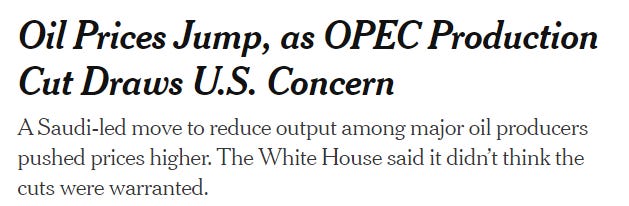
If it isn’t enough that the BRICS nations have openly stated their intent to develop a global reserve currency, and that they’re hoarding gold while ending the petrodollar, OPEC snubbed President Biden for all the world to see, just hours ago, when it announced an unplanned cut of 1 million barrels of oil per day.


https%3A%2F%2Fsubstack-post-media.s3.amazonaws.com%2Fpublic%2Fimages%2F980a1f69-86e0-4ae6-9d5d-6c2068763f25_629x206.png


There is no doubt OPEC knows that energy prices are a huge contributor to inflation in the United States, and that inflation remains the main driver of monetary policy – at least until markets crash (coming soon, in my opinion).
And so the Saudi’s and OPEC have knowingly thrown a wrench in the gears of the United States because President Biden chose not to refill the strategic petroleum reserve in the $60 range when he had the chance over the last few weeks.


SPR.png


Biden is multiple steps behind the 8 ball. This plundering of the reserves and then missing the chance to buy it back is like something out of my shitty trading playbook. Biden is “trading” like the ultimate bagholder - except he’s not pushing around 100 shares of AMC, he’s speculating with the oil reserves that our country keeps for a military emergency.

As far as the dollar goes, I’m happy to be called a fear monger as long as I’m wrong.

Being a skeptic of monetary policy and coming by it honestly is very paradoxical in nature. On one hand, I want to warn about the way it appears things are going.

On the other hand, for my country, and everybody in it, our critics are right in the sense that I don’t want to be right. Deep down, I hope guys like Brent Johnson are right and the dollar remains a shining beacon on a hill for the rest of the world. And hey, if I could think myself into some cognitive dissonance enough to truly believe that a bullish dollar situation is more likely than the ones I write about, I would do it in a heartbeat. And I would probably sleep a lot better at night.

But the fact is that, like many of you, I can’t ignore what appears to be the obvious.

When you’re betting it all, it only takes that one ‘13’ to come up on the roulette wheel or the one ‘7’ to come up with the button on in craps. With the dollar, our nation is betting it all on remaining reserve currency in the way we abuse it - and it only takes us “fear mongers” once to be right before we wake up and everything is completely different than it has ever been before.

Sure, I never want this day to happen - but that doesn’t mean that the likelihood of it happening isn’t significant enough to prepare for it. For how I’m positioned personally, you can read my latest on my portfolio here and here and my earlier market forecast for 2023 or my 23 Stocks To Watch In 2023 (Part 1 here, Part 2 here).
 
Bill Clinton saved the American economy after 12 years of republican mismanagement. He ran the first surplus in several decades. In comes GWB who lost the popular election and after 8 years he completely destroyed the economy. It took a few years but Obama brought it back. Trump inherited what he called the best economy ever and managed to run it into the ground. What conservatives fail to acknowledge is that government policies take a couple years to come into effect. It's not as if Joe Biden snaps his fingers and the next day there are jobs. He implements policies which slowly come into effect within a few years sometimes much longer. Trumps failed policies and negligent mismanagement of an epidemic caused unemployment like never seen since the great depression. Trump doled out over a trillion dollars which eventually got some people back to work but subsequently caused massive inflation a year later when he was not in power. Joe Biden borrowed another trillion dollars to combat inflation and his jobs numbers are the best in history - 10,700,000 people are now working that were unemployed under Trump. Conservatives like to blame covid but the Trump administration's abysmal response or lack of response made the problem considerably worse. Now Joe Biden is at the back end of cleaning up trumps catastrophic messes much like Bill Clinton did with Reagan/Bush and Obama did with GWB. It's funny how fox propaganda likes to pretend that trumps economy was great and Biden ran it into the ground. They use the excuse that Trump had covid to deal with but Biden can't use the same excuse for inflation. It is the right wings modus operandi to blame democrats for everything that goes wrong while they are in power and while they are not. Trump blamed Obama for everything he screwed up and now is blaming Biden for things he screwed up too. Every recession in the last 100 years except for 1 happened under the republicans so it's tough to say with straight face that they are the party of fiscal responsibility when in fact the opposite is true
 
U.S. Dollar "Fear Mongers" Only Need To Be Right Once

WEDNESDAY, APR 05, 2023 - 03:05 PM
Submitted by QTR's Fringe Finance
Optimists about the U.S. economy and the dollar’s global reserve status have had the wind at their back for half of a century, so why should anyone expect them to consider an alternative viewpoint?
Therein lies the folly that our country faces.

There’s a reason that every financial disclosure, brochure, hedge fund letter or commercial always says “past performance is not indicative of future results” on it: because it isn’t. But that boilerplate-sounding warning is printed in size zero font and, as a result, also rests in the equivalent of size zero font in the brains of U.S. dollar bulls.
The fact is that warnings about the precarious nature of the U.S. dollar - whether bombastic or not - are probably more important today than they have ever been. But these warnings can’t compete with 50 years of the “trend being the United States’ friend”, a hurricane force tailwind that includes politicians on both sides of the aisle, the nation’s central bank, the treasury secretary and the roaring concert of all financial news media.
Those who believe the dollar is always destined to be the backbone of the global economy are like players at a roulette table who have a system of betting all of the inside numbers, except for the number 13. Given a small house edge and the fact that you have to lay 35 to win 36 (excluding the 0 and 00) means that, in order to start cashing in on your system in a big way, you have to get hot and tear off a ton of wins in a row. But when the odds are in your favor - and betting 35 of 36 total outcomes definitely skews them to your advantage - it’s almost a certainty you’ll “get hot” and start winning multiple spins in row. When you start winning dozens of spins in a row, it becomes impossible to hear the skepticism of the one person betting the 13 or warning you that eventually, it’ll come out.
Well right now, at the casino of the global economy, the U.S. is on a roll. We are on fire. We have figured out how to beat the house. We are casino gods.
We’ve won 1,000 spins of the roulette wheel in a row, without hitting the number 13. We are a shooter at a craps table that has made every point, over and over, for hundreds of days in a row. We are sports bettors hitting every leg of an 8 team parlay every single night for an entire month and pressing the winnings each time. We are playing multiple blackjack hands every hand, and we split and double down on every hand, and all we do is pull 20’s and 21’s. The dealer doesn’t even need to bust every hand, but it does.


https%3A%2F%2Fsubstack-post-media.s3.amazonaws.com%2Fpublic%2Fimages%2F5d7a8a7e-bc83-4ced-b775-27ebfce18428_671x397.png


The casino has plied us with drinks. We’ve been drinking top shelf for 50 years and have no idea how drunk we’ve become. The seduction of the win has blinded us to the sobering constant of the math on the other side of our “systems”. Like a slithering, unsuspecting cobra slowly making its way to our table on the floor while we high five our allies after every additional win, the snake of reality gets closer and closer, preparing to eventually bite us when we least expect it.

And the truly fucked up thing? When you’re betting it all, every hand, it only takes that one roll, or that one spin, to give back everything we’ve spent our entire winning streak accumulating.


Which brings me to the point of today’s post: the idea that so-called “fear mongers” about the U.S. dollar - arguing for everything from a mundane DXY crash to a full out loss of reserve currency status - literally only have to be right once.

Most people will tell you that, mathematically, they acknowledge that the dollar’s run can’t continue for the rest of eternity. And we’ve never experimented with a monetary system the way we have now, so we don’t have any basis for comparison about how long the fiat circus is going to continue. 50 years of fiat is actually a relatively short amount of time, so there are good arguments for both continuing to ride the “hot streak” for a few more generations and also for hegemony ending suddenly, when we least expect it.

https%3A%2F%2Fsubstack-post-media.s3.amazonaws.com%2Fpublic%2Fimages%2F975342f6-fa5f-47cc-8ae1-0446040aa6d5_533x313.png


However, after 10 years of trying to figure out the dastardly scheme that is macroeconomics, I can’t remember a time where the idea of the dollar losing reserve status has been in the mainstream media as much as it is now.


headys.jpg


And in the past few hours we’ve seen headlines like:

And also courtesy of @WatcherGuru, Saudi Arabia in just the past week has done the following:

  1. Saudi Arabia to adopt economic strategy without US dependence, following decline in relations under Biden Administration, FT reports.
  2. Saudi Arabia, Russia, UAE, Iraq, Kuwait, Oman, and Algeria to cut oil production output until the end of 2023.
  3. Saudi Arabia partners with China to build a Chinese oil refinery for 83.7 billion yuan ($12.2 billion).
  4. Saudi Arabia enters trade alliance with China, Russia, India, Pakistan, and four Central Asian nations to step further away from reliance on the US dollar.
  5. Saudi Arabia partners with India to create an investment bridge emphasizing greater economic interconnectedness.
Initially, I wrote today’s article as a concession that I would stop writing about the risks facing the dollar – but then I took personal inventory and realized it’s not likely I would be able to commit to that.

Suffice it say, however, the mainstream is finally picking up the thread.

Even the mainstream media realizes what many of us have been screaming for years: that we are in uncharted waters, given the decades of low rates, Keynesian policy, current potential for serious stagflation and the global challenge that nations like Saudi Arabia, Russia and China appear to be mounting against the dollar.

Journalists that don’t even involve themselves in finance much even agree that we haven’t faced these financial conditions before, and are exercising caution.


While we had a similar inflationary crisis back in the 70’s, we had only been off the gold standard for a couple years and our debt levels were nowhere near where they are today as a percentage of GDP.


debt%20gdp.png


Today we’re 50 years into the fiat experiment and we’ve drawn the ire of half the world.
Look, there are a lot of smart people on the other side of this argument - Brent Johnson, who I respect a ton, comes to mind - but even he can’t escape the fact that our situation, as it stands today, has never before occurred in the history of our country.
We have never been off a gold standard for 50 years, while separating economically and militarily from China, Russia and the Saudis, all while experiencing significant inflation and an economic slowdown.
And it is this very same fact – the fact that we have never been here before – that is also what makes it clear that we have no idea how or when things will change drastically.


To go back to the roulette analogy, the trend certainly seems to be continuing as our friend. But what happens when something unprecedented takes place at the casino?
For example, what if the dealer wants to drop two roulette balls in the wheel every time it spins now. And what if the craps dealer handed you three dice instead of two, and told you it was only going to take the two that landed the closest to 3 and 4? In those cases, the game changes drastically, as do the odds. This is exactly what’s happening all around the United States on a global stage.
If it isn’t enough that the BRICS nations have openly stated their intent to develop a global reserve currency, and that they’re hoarding gold while ending the petrodollar, OPEC snubbed President Biden for all the world to see, just hours ago, when it announced an unplanned cut of 1 million barrels of oil per day.


https%3A%2F%2Fsubstack-post-media.s3.amazonaws.com%2Fpublic%2Fimages%2F980a1f69-86e0-4ae6-9d5d-6c2068763f25_629x206.png


There is no doubt OPEC knows that energy prices are a huge contributor to inflation in the United States, and that inflation remains the main driver of monetary policy – at least until markets crash (coming soon, in my opinion).
And so the Saudi’s and OPEC have knowingly thrown a wrench in the gears of the United States because President Biden chose not to refill the strategic petroleum reserve in the $60 range when he had the chance over the last few weeks.


SPR.png


Biden is multiple steps behind the 8 ball. This plundering of the reserves and then missing the chance to buy it back is like something out of my shitty trading playbook. Biden is “trading” like the ultimate bagholder - except he’s not pushing around 100 shares of AMC, he’s speculating with the oil reserves that our country keeps for a military emergency.

As far as the dollar goes, I’m happy to be called a fear monger as long as I’m wrong.

Being a skeptic of monetary policy and coming by it honestly is very paradoxical in nature. On one hand, I want to warn about the way it appears things are going.

On the other hand, for my country, and everybody in it, our critics are right in the sense that I don’t want to be right. Deep down, I hope guys like Brent Johnson are right and the dollar remains a shining beacon on a hill for the rest of the world. And hey, if I could think myself into some cognitive dissonance enough to truly believe that a bullish dollar situation is more likely than the ones I write about, I would do it in a heartbeat. And I would probably sleep a lot better at night.

But the fact is that, like many of you, I can’t ignore what appears to be the obvious.

When you’re betting it all, it only takes that one ‘13’ to come up on the roulette wheel or the one ‘7’ to come up with the button on in craps. With the dollar, our nation is betting it all on remaining reserve currency in the way we abuse it - and it only takes us “fear mongers” once to be right before we wake up and everything is completely different than it has ever been before.

Sure, I never want this day to happen - but that doesn’t mean that the likelihood of it happening isn’t significant enough to prepare for it. For how I’m positioned personally, you can read my latest on my portfolio here and here and my earlier market forecast for 2023 or my 23 Stocks To Watch In 2023 (Part 1 here, Part 2 here).

But you are wrong unless or until you are right. Subject to the consequences of a debt default the greenback is not at any imminent risk.
 
But you are wrong unless or until you are right. Subject to the consequences of a debt default the greenback is not at any imminent risk.


It's not the rising role of the Yuan that's significant, it's the slow but steady decline of the Dollar (as a percentage) in world trade.
A threshold exists, that when it is reached, will spell catastrophe for the USD.
Things are changing so fast agreement are sign oil trade are accepted in other currencies other then the Petrodollar!!


PS. Welcome to a multipolar world of two currencies and then later the beginnings demise of the Petrodollar if Saudi Arabia no longer accept any USA dollar in payment of oil! Will only accept payment of oil back by BRIC currency which is back by basket of commodities ! It just a matter of time to see how it pan out!
 
Last edited:
It's not the rising role of the Yuan that's significant, it's the slow but steady decline of the Dollar (as a percentage) in world trade.
A threshold exists, that when it is reached, will spell catastrophe for the USD.
Things are changing so fast agreement are sign oil trade are accepted in other currencies other then the Petrodollar!!


PS. Welcome to a multipolar world of two currencies and then later the beginnings demise of the Petrodollar if Saudi Arabia no longer accept any USA dollar in payment of oil! Will only accept payment of oil back by BRIC currency which is back by basket of commodities ! It just a matter of time to see how it pan out!

You are just stating the obvioois and |I do not agree. I just do not agree that the US dollar will lose its dominanvce any time soon. There is no other currency which will be as internationally accepted and liquid to take its place.
 
EDITORS' PICK
The Old World Order For Crude Oil Is Disappearing


David Blackmon
Senior Contributor
David Blackmon Is A Texas-Based Public Policy Analyst/Consultant.

960x0.jpg

RIYADH, SAUDI ARABIA - DECEMBER 8 Chinese President, Xi Jinping (L) is welcomed by Crown Prince of ... [+]ANADOLU AGENCY VIA GETTY IMAGES
Russian Energy Minister Nikolai Shulginov said on Tuesday that his country has now been able to redirect all of its crude oil exports that have been impacted by Western sanctions over Ukraine to what he referred to as "friendly" countries. "I can say today that we have managed to completely redirect the entire volume of exports affected by the embargo. There was no decrease in sales," Shulginov was quoted by Reuters as saying.


The Rise of BRICS
There is no question that Russia’s fellow members of the increasingly influential BRICS (Brazil, Russia, India, China, South Africa) Alliance have played a major role in helping the Putin government to achieve this outcome. India was the biggest buyer of Urals grade crude in March, accounting for almost 50% of all such exports. Russia’s Deputy Prime Minister, Alexander Novak, stated that Russia’s sales to India have risen 22-fold over the past year.


In a separate story in early March, Reuters reported that China’s seaborne imports of Russian crude were set to hit new record highs in March, based on ship tracking data. “Tanker tracking consultancies Vortexa and Kpler estimated nearly 43 million barrels of Russian crude oil, comprising about at least 20 million barrels of ESPO Blend and 11 million barrels of Urals, are set to reach China in March,” Reuters said, a number that would exceed the previous high of 42.48 million barrels recorded in June, 2020.


In a recent interview with WION News, South African Foreign Minister Naledi Pandor said she and leaders of other BRICS nations are experiencing “huge interest” from other countries related to those tools of finance. Saying that she had “12 letters” from such countries currently on her desk, Pandor ticked off the names of more than half a dozen of them: “ Saudi Arabia is one... United Arab Emirates, Egypt, Algeria, and Argentina,” and went onto add Mexico and Nigeria.


Saudi Arabia Looks Increasingly to the East
No country has expressed greater interest in conducting business with the BRICS group than Saudi Arabia has in recent months. In March of last year, the Wall Street Journal reported that the Kingdom had been engaged in talks with China about the possibility of conducting some of its oil sales using the Chinese Yuan as the currency. Such a move would disrupt the long-existing oil order that has used the U.S. dollar, or “petro-dollar,” as the currency of mark for international oil trades since 1973.

More recently, at the World Economic Forum in Davos in January, Saudi Finance Minister Mohammed Al-Jadaan told reporters that his country is open to trading in currencies besides the U.S. dollar. “There are no issues with discussing how we settle our trade arrangements, whether it’s in the U.S. dollar, the euro, or the Saudi riyal,” Al-Jadaan said, as reported by Yahoo News.

Saudi Arabian relations with China have been strengthening in other areas during 2023. One major signal of the growing relationship was the news early in March that the Kingdom had agreed to re-establish diplomatic relations with long-time rival Iran following negotiations hosted not by the United States, but by China.

While the move seemed to signal China’s growing influence in the Middle East region, Biden administration National Security Spokesman John Kirby strongly pushed back on the idea that U.S. influence was diminishing at the same time. The New York Times NYT +0.2% quoted Kirby as telling reporters “I would stridently push back on this idea that we are stepping back in the Middle East.” Kirby added that Saudi Arabia had kept Biden officials apprised of developments as the negotiations progressed.

Saudi Arabia’s economic entanglements with China continued to progress this week, as the Kingdom announced two separate new deals that would result in its supplying China with as much as 690,000 barrels of oil per day. The Globe and Mail reported that the two agreements are the biggest deals announced since Chinese President Xi Jinping made a state visit to Riyadh last December to formalize his country’s blossoming relations with the House of Saud.

Bottom Line: One of the 8 consequential predictions I made in my annual energy forecast piece published January 1 was that, at the annual BRICS Alliance meeting to be held this coming September, Saudi Arabia would be formally admitted as a new member of that Alliance.

Whether these events and others are preliminary signals that such an earth-shattering event will take place, there is no question that they do serve as signals that the old world order as it relates to oil has already disappeared, and a new world order for oil is rapidly emerging. The implications of this emerging new order are only now beginning to be felt, but will become increasingly apparent in the coming months.
 
You are just stating the obvioois and |I do not agree. I just do not agree that the US dollar will lose its dominanvce any time soon. There is no other currency which will be as internationally accepted and liquid to take its place.

It also depends a lot on what "lose its dominance" is supposed to mean.

Is it dropping from the 60+ percent it had in the past to 4 or 5 like what happened to the Pound Sterling?
Is it dropping from 60+ to something like 40%?

I don't think those scenarios look the same.


It also depends a lot on what "lose its dominance" is supposed to mean.

Is it dropping from the 60+ percent it had in the past to 4 or 5 like what happened to the Pound Sterling?
Is it dropping from 60+ to something like 40%?

I don't think those scenarios look the same.
I think what is happening, and it is happening quite fast, is that the $US from being dominant in the entire world, will continue to be dominant in the so called western world (40%) while the rest of the world, soon a bigger part, will either use bi-lateral currencies for trade or invent a new currency instrument based upon a few national currencies and a few commodities.

While the effect will be gradual, it will mean that USA will have a harder time financing it's annual deficit and it's interest payments on debt. Likely we will see an increase in inflation and/or interest rates.

Bad for Canada and Canadians.
 
  • Like
Reactions: Valcazar and jcpro
I think what is happening, and it is happening quite fast, is that the $US from being dominant in the entire world, will continue to be dominant in the so called western world (40%) while the rest of the world, soon a bigger part, will either use bi-lateral currencies for trade or invent a new currency instrument based upon a few national currencies and a few commodities.

While the effect will be gradual, it will mean that USA will have a harder time financing it's annual deficit and it's interest payments on debt. Likely we will see an increase in inflation and/or interest rates.

Bad for Canada and Canadians.

I think the US is going to be displaced as a global hegemon as well.
Like you, I expect it to remain a major player and extremely consequential. But the post-WWII era and then post-cold war were circumstances that won't maintain.
 
  • Like
Reactions: danmand
 
Macron Says Europe Should Reduce Dependence On US Dollar, Seek 'Strategic Autonomy'

SUNDAY, APR 09, 2023 - 02:00 PM
As the United States combats a recent flood of countries 'de-dollarizing’ - trading commodities in other currencies, the last thing that was needed was French President Emanuel Macron amplifying this message.

macron%20and%20xi.jpg

After spending around six hours with Chinese President Xi Jinping as part of a three-day state visit to China, Macron made extremely clear that France wants nothing to do with WWIII, emphasizing that Europe must employ "strategic autonomy," presumably led by France, to become a "third superpower," according to Politico.


While speaking with reporters aboard COTAM Unité, France’s Air Force One, the French President said that the "great risk" facing Europe right now is that it "gets caught up in crises that are not ours, which prevents it from building its strategic autonomy."

This isn't the first time Macron has suggested reducing dependence on the US. In November, the French President called for a “ single global order “ while discussing the power interests of Russia and China and the threat of war.

"We are in a jungle and we have two big elephants trying to become more and more nervous," he said.

"If they become very nervous and start a war, it will be a big problem for the rest of the jungle. You need the cooperation of a lot of other animals, tigers, monkeys and so on," added Macron.

China agrees

Macron's concept of strategic autonomy was 'enthusiastically endorsed' by Xi and the CCP, who have been focusing on the notion that the West is in decline while China rises, and that weakening the transatlantic relationship will accelerate this trend.

"The paradox would be that, overcome with panic, we believe we are just America’s followers," said Macron. "The question Europeans need to answer … is it in our interest to accelerate [a crisis] on Taiwan? No.The worse thing would be to think that we Europeans must become followers on this topic and take our cue from the U.S. agenda and a Chinese overreaction."

Just hours after his flight left Guangzhou headed back to Paris, China launched large military exercises around the self-ruled island of Taiwan, which China claims as its territory but the U.S. has promised to arm and defend.
Those exercises were a response to Taiwanese President Tsai Ing-Wen’s 10-day diplomatic tour of Central American countries that included a meeting with Republican U.S. House Speaker Kevin McCarthy while she transited in California. People familiar with Macron’s thinking said he was happy Beijing had at least waited until he was out of Chinese airspace before launching the simulated “Taiwan encirclement” exercise. -Politico
Macron's submissive statements come after he and Xi 'intensely' discussed Taiwan, according to French officials who accompanied the president.


macxiafp-1162337-1668438961.jpg


That said, European Commission President Ursula von der Leyen, who accompanied Macron, said she stressed stability in the region, telling Xi during their meeting last Thursday in Beijing that "The threat [of] the use of force to change the status quo is unacceptable."

According to the report, Xi responded by calling anyone who thought they could influence the CCP on Taiwan was deluded.

"Europeans cannot resolve the crisis in Ukraine; how can we credibly say on Taiwan, ‘watch out, if you do something wrong we will be there’? If you really want to increase tensions that’s the way to do it," said Xi.

According to Yanmei Xie, a geopolitics analyst at Gavekal Dragonomics, "Europe is more willing to accept a world in which China becomes a regional hegemon."

"Some of its leaders even believe such a world order may be more advantageous to Europe."

During Xi's trilateral talks with von der Leyen and Macron last Thursday, the Chinese leader became upset over two things;

"Xi was visibly annoyed for being held responsible for the Ukraine conflict and he downplayed his recent visit to Moscow," said one source who was present in the room. "He was clearly enraged by the U.S. and very upset over Taiwan, by the Taiwanese president’s transit through the U.S. and [the fact that] foreign policy issues were being raised by Europeans."

In this meeting, Macron and von der Leyen took similar lines on Taiwan, this person said. But Macron subsequently spent more than four hours with the Chinese leader, much of it with only translators present, and his tone was far more conciliatory than von der Leyen’s when speaking with journalists. -Politico
Time to ditch the dollar?

Macron suggested that Europe was too dependent on the United States for weapons and energy, and must now focus on boosting their own defense industries.

But perhaps most notable was his suggestion that Europe needs to reduce its dependence on the "extraterritoriality of the U.S. dollar," a line which both Moscow and Beijing have been emphasizing.


06ukraine-briefing-xi-macron-04-lfwt-videoSixteenByNine3000.jpg


"If the tensions between the two superpowers heat up … we won’t have the time nor the resources to finance our strategic autonomy and we will become vassals," he said.

Russia, China, Iran and other countries have been hit by U.S. sanctions in recent years that are based on denying access to the dominant dollar-denominated global financial system. Some in Europe have complained about “weaponization” of the dollar by Washington, which forces European companies to give up business and cut ties with third countries or face crippling secondary sanctions.
While sitting in the stateroom of his A330 aircraft in a hoodie with the words “French Tech” emblazoned on the chest, Macron claimed to have already “won the ideological battle on strategic autonomy” for Europe. -Politico
Meanwhile, an interesting footnote...

As is common in France and many other European countries, the French President’s office, known as the Elysée Palace, insisted on checking and “proofreading” all the president’s quotes to be published in this article as a condition of granting the interview. This violates POLITICO’s editorial standards and policy, but we agreed to the terms in order to speak directly with the French president. POLITICO insisted that it cannot deceive its readers and would not publish anything the president did not say. The quotes in this article were all actually said by the president, but some parts of the interview in which the president spoke even more frankly about Taiwan and Europe’s strategic autonomy were cut out by the Elysée.


PS. Reading between the lines, I believe Macron is saying Europe should join BRICS. Ha!
 
Last edited:
That's how American weakness looks like.
 
Empires come and go. China was the most advanced society 1000 years ago, they were in decline in the 50s,60s, 70s Portugal financed Columbus to sail to America. Holland controlled world trade in the 17th. century when the Dutch East India Company existed. The British Empire lasted till the early 20th. Century and was diminishing when the U.S.A started to grow in importance after WWII. The world is evolving and America may not be the super power of the future.
 
 
  • Haha
Reactions: Valcazar
Role Reversal: The Collapse Of The Dollar-Enforced Empire

MONDAY, APR 10, 2023 - 05:20 AM
Authored by Patrick Barron via The Mises Institute,
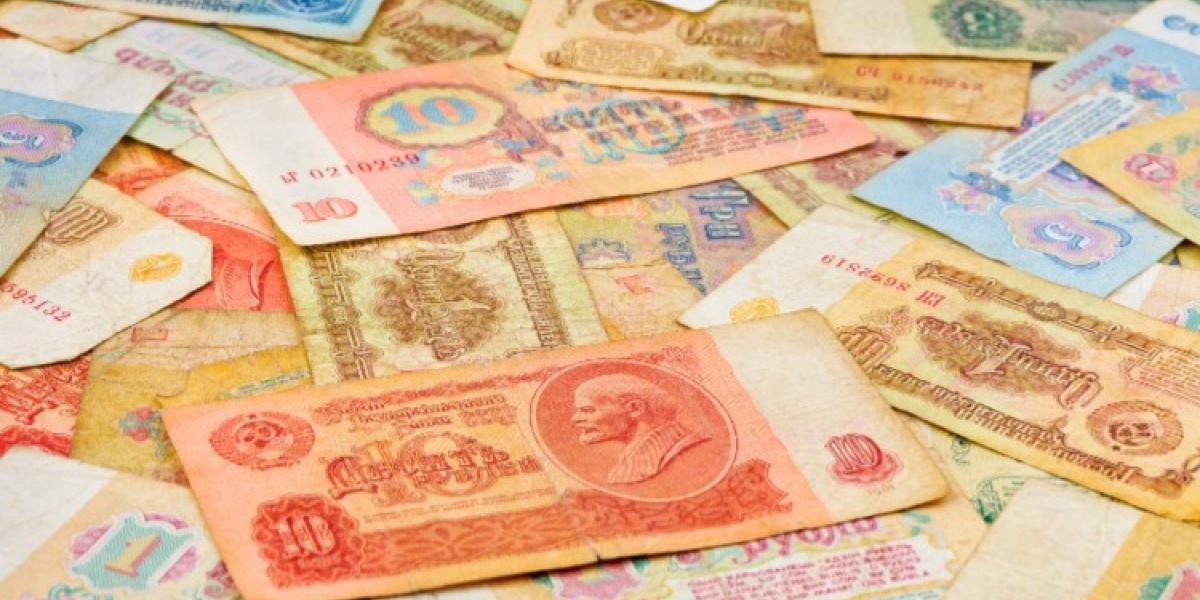
The Soviet empire started to crumble around 1989. The time period between the forming of the North Atlantic Treaty Organization (NATO) in the late 1940s and the retreat of Russia from Eastern Europe with the eventual collapse of communism in Russia is known as the Cold War. There was a great power confrontation in Europe that did not result in war.
Essentially, US-led NATO stood its ground to prevent further Soviet expansion from the territory it occupied at the end of World War II and waited for the inevitable collapse.

Now, perhaps not everyone saw the collapse of the Soviet empire as inevitable. But all one had to do was view the Soviet empire for oneself, up close and personal, which is what I did in the early 1970s as a young Air Force officer.

sovietmoney-w.jpg


The State of the Communist Economy
The Russian economy at that time is painful to describe. Moscow and Leningrad (Saint Petersburg), the so-called jewels of the Soviet Union, were depressing. Everything was shoddily built. There were very few cars on the streets. There were no retail shops deserving of the name. Lines formed in the middle of the night awaiting the opening of the few bakeries. I saw this for myself from my hotel window on the Nevsky Prospekt in Leningrad. GUM, the “world’s largest department store” near Moscow’s Red Square, sold nothing that was equal to what could be found in any garage sale in the West.
Actually, that should not be a surprise since at one time all those garage-sale goods were marketable. I did not visit Berlin, but those who did say that crossing the Brandenburg Gate from West Berlin to East Berlin was shocking. The very idea that the Soviet economy and lifestyle was in any way superior was ludicrous. It took brutal police power and the infamous Berlin Wall to prevent mass exodus to the West.
The Peaceful Collapse of the Soviet Empire
I’m sure that life only got worse in the years between my visit to the Soviet Union in the early 1970s until its final collapse. And the collapse occurred without a shot fired between the Great Powers. The collapse came very quickly and without warning. Author Amity Shlaes was a reporter for the Wall Street Journal Europe at the time.
Returning to New York from Berlin, Shlaes called her boss between planes in London and was told to return to Berlin. Something was happening. She told her boss that she had just left Berlin and that nothing was happening. Her boss told her to go back for a few days anyway. She did as ordered and witnessed the German people tearing down that despicable insult to humanity.
How the US Enforces the American Empire
The American empire is not enforced by walls with armed guards to prevent its citizens from escaping but, instead, by the almighty dollar. Since the enthronement of the dollar as a reserve currency in 1944 at the Bretton Woods conference and then the establishment of the petrodollar in the early 1970s, almost all international trade has been conducted in dollars. Thusly, dollars are held by every country’s central bank to settle international trade flows. Alasdair Macleod of Goldmoney calculates that foreigners hold around $31.8 trillion in US liabilities, of which $5.8 trillion is held by “official” institutions. (Refer to US Treasury International Capital figures.)
But the US has abused this “special privilege” by printing dollars out of thin air. It has funded its empire of hundreds of bases worldwide with excess dollars. Furthermore, it has enforced compliance with its expansionist foreign policy by freezing dollar accounts held by foreign central banks, foreign businesses, and foreign individuals whom it dislikes. By cutting them out of the international financial messaging system known as SWIFT, it has created great hardship on nations held to be offensive to the US.
Today the Roles Are Reversed
But these nations have discovered America’s Achilles’ heel and are doing something about it. The almighty dollar rests on a base of sand known as fiat money, which is not redeemable in a desirable commodity such as gold or silver. This characteristic has led to inflation of the dollar over the past fifty years at an ever-accelerating rate. Such inflation causes the exchange value of the dollar to shrink.
Since President Richard Nixon took the US off what was left of the gold standard in the fall of 1971, the dollar’s value against gold has shrunk by 98 percent. No one believes that this debasement will end or even slow down. In fact, the US seems determined to accelerate the dollar’s depreciation to pay for its military adventures and expanding welfare programs. Combining the debasement of the dollar with the trade sanctions has created an intolerable situation for those currently in America’s bad graces.
But these nations are countering American hegemony by deploying their own arsenal—not nuclear weapons but gold. Like America and NATO during the Cold War, these nations are standing their ground and arming themselves with an alternative and better reserve currency; i.e., a currency backed by gold and to be used at least initially for settling international trade.
Russia has been working on the framework of a new trade settlement currency for quite some time, and now China and others—such as Iran, India, Brazil, and South Africa—are joining the project. There is nothing nefarious per se about establishing an alternative trade settlement system. One may call it rational self-interest.
It is a peaceful project, but its results may be devastating for countries that depend upon a stable dollar. Those who join the new system will no longer need to hold dollars. This fall in the demand to hold dollars will lead to an inevitable fall in its purchasing power, perhaps even to its total collapse. This could happen literally overnight and without warning, just like the fall of the Berlin Wall.
Blinded by Fallacious Ideologies
Of course, no one in a position of power in the US understands anything about real money and real finance. They are blinded by the promise of Keynesian economics and modern monetary theory, which posits that creating aggregate demand (Keynesianism) funded by massive money printing (modern monetary theory) is the sure path to economic progress. They fail to acknowledge that the steady fall in the purchasing power of the dollar and the rise of an alternative trade settlement system are the inevitable consequences of their blindness.
I see nothing that can stop the continued debasement of the dollar, now coupled with arrogant and harmful financial sanctions, that will prevent the peaceful establishment of an alternative international reserve currency and all the consequences that it will bring to an unprepared US-dominated world.


~~~~~~~~~~~~~~~~~~~~~~~~~~~~~~~~~~~~~~~~~~~~~~~~~~~~~~~~~~~~~~~~~~~~~~~~~~~~~~~~~~~


When I played MONOPOLY as a kid, I always wondered about the 'tokens'...

Battleship?

Cannon?

Old Shoe?

Bankers Hat?

Wheelbarrow?

...aaaah yes... It's all very clear now


PS. Giving other countries printed money in return for actual goods was always going to come to an end. It's amazing it lasted as long as it did. On a long enough timeline the value of any fiat currency drops to zero.
 
Last edited: