De-Dollarization Just Got Real


Mexico Now Seriously Considering Joining BRICS – Another Blow to America Under the Corrupt Biden Administration
By Joe Hoft Apr. 3, 2023 9:15 am


Mexico is getting closer to joining BRICS (Brazil, Russia, India, China and South Africa ) per reports coming out this weekend. The Biden regime is destroying America on a daily basis and the world knows it. No country wants to be aligned with that.

After the takeover of the 2020 Election, the world knew that a coup had occurred in the US. They saw how internal forces were tearing this country apart. They saw the constant lawfare against President Trump culminating with bogus investigations, bogus impeachments, a stolen election, and now more bogus investigations against the hero of the people, President Trump.

Countries around the world began to see that being an ally to the Biden regime was not a safe place to be so they are joining the alliance with China and Russia.

These moves are devastating to the US and its national security.

It was recently reported that numerous countries were considering joining BRICS.

View attachment 223922
The Biden Effect: South African Minister Says Saudi Arabia, UAE, Egypt, Argentina, Mexico, Nigeria, and Others Want to Join BRICS Alliance

This weekend it was reported that Mexico was seriously considering joining BRICS. Eurasia Media reports:

The Biden regime is doing all it can to destroy this nation and the world sees it.


Damn it he is destroying the country with record jobs created and lowest unemployment, the economy if anything is too strong in 5he race of escalating interest rates and tighter money, supply chains are opening up. Damn him.
 
That is true.. But Afghanistan deserve some credit!

Afghanistan have been a graveyard for all great Empires!

maxresdefault.jpg


Guess no one bother to learn History! Great Britain, Roman Empire, MonGOL, Soviet Union , and finally the American ! Now if China is smart stay away from Afghanistan! Maybe the west may get a lucky break, China invaded Afghanistan and start a war there!
When Russians pulled out of Afghanistan, they did it with their commanding officer WALKING across the bridge as a last soldier. They had their share of defeats, but they left like men. Symbols matter and, as we're finding out, this world of ours is still pretty Darwinian.
 
  • Like
Reactions: danmand

Some Commodity Producers Are Now Being Offered CNY, Not Dollars

Tuesday, April 04, 2023

By Michael Every of Rabobank

dedollarization.jpg


"Johnny's in his room, building a bomb," are words spoken by no responsible parent, not even if they reassure, “Bomb-making is hard, so he won’t be able to do it right.” Yet global markets are watching as wires, fuses, solder, and the goods needed to make TNT are all assembled. Consider that the last few days have seen:

More supply destruction from OPEC+ pushing oil up, which the White House claims it knew about in advance, and which was apparently driven by its refusal to rebuild its Strategic Petroleum Reserve at lower prices, as pledged;

A Russian national security doctrine for long-lasting “hybrid war” vs. the US and Europe;

More articles on Chinese and US war preparations, or lack of, as Graham Allison of ‘The Thucydides Trap’ claims
“American politics is driving towards a provocation that China could not avoid,” and that we are sliding into a catastrophic new conflict;

G-Captain ask ‘Is COSCO China’s Secret Invasion Fleet?’
and note ‘US Congress Moves To Ban Chinese Crane Software’
so more politicized maritime logistics, and even Deeper Ship;


The EU call for de-risking supply chains vis-à-vis China, and China warn them not to; Singapore’s PM call for new ground rules so global trade can continue without decoupling, but with expectations the playing field will be much less flat, and that “we may end up on one side of the gulf or on the other. And that’s just the way the world is going to be.”;


The Financial Times’ Gillian Tett say, ‘Prepare for a multipolar currency world’,
noting the CEPR view
that: “the renminbi can play a more important role in the future, even in the absence of full financial liberalisation. This process would involve trade invoicing and settlements, central bank swap lines, and offshore renminbi markets. This would not lead to the renminbi overtaking the dollar, but rather to a multipolar world of key currencies, including the dollar, euro, and renminbi.”;

and India and Malaysia agreed to settle trade in INR.

This Daily had already been saying shifts in trade invoicing could matter to the global financial architecture; and yet that there is no ‘Bretton Woods 3’ system to replace the US dollar, as IMF data underline it is top dog, and energy expert Anas Alhajii argues there is no global alternative to it for oil. There is no contradiction there because if the dollar falls, it won’t be replaced by a global system, but with a market explosion.

The FT is right: some commodity producers are now being offered CNY, not dollars. They aren’t taking it yet because of technical difficulties – but they are talking about it. Yes, CNY is useless internationally as it doesn’t have an open capital account; but, as the CEPR note, what if PBOC CNH swaplines to central banks for trade financing, bridge that gap? Yes, CNY offers no assets like US Treasuries; but a commodity exporter isn’t a central bank, and just wants to get paid. What if the CNY price is higher than the dollar one, or CNY is politically more acceptable in some locations?

Because commodity producers in emerging markets tend to be pivot points in the broader economy, if replicated, real trade flows could be redirected even more towards China, and pricing in some commodities shift more towards CNY.

That isn’t bullish for CNY: the trade maths says we still don’t need more CNY holdings globally even if this happens – but that’s not the point. Physical supply chains and raw geopolitics are.

As long as the US runs huge trade deficits, this also doesn’t decouple China from it, which is why you can’t have a Bretton Woods 3 global system: but the aim here is a firewall for a future Russia-style crisis. Which, ironically, may be how one is precipitated, if you think like Graham Allison.

For other emerging economies, local FX settlement starts to deepen bilateral trade relations, and corresponding asset holdings, even as it unravels more of the larger global system. It can also mean de facto barter priced in dollars as a firewall against FX volatility, as many markets struggle with a soaring dollar and outright dollar shortages - and no Fed swap lines ever offered. That some are prepared to regress trade all the way back to the pre-history wrongly taught in every economics textbook --read Graeber or Polanyi and see debt came first, not barter-- should concern Western markets far more.

I’m not waving a US flag but raising a red one when saying the above actions aren’t building a new global architecture as much as a bomb underneath the current one. So what if it’s very hard to actually do? The fact it’s happening at all should worry markets.

If some commodities aren’t priced in dollars, we would get bifurcated supply chains for downstream goods, and in FX clearing, as in the 1930s - which China says it doesn’t want to see.


If fewer dollars are earned via global trade, how are global Eurodollar debts then serviced?

My view remains that the US would, after a period of adjustment, thrive in a mercantilist world. But Wall Street, in its present form, would not.

On which note, do you think the US financial hegemon “encircling” and “containing” China, and running a “hybrid war” vs. Russia, is going to do nothing if this FX shift really is looming at the margin?

As Alhajii also notes: “We should not forget that even if the switch to non-dollar pricing does not affect the US economy, the US will not let OPEC members slap it in the face. It will not quietly accept such an insult in front of the whole world. The dollar is a symbol of America’s strength, and the US will not let others disregard this symbol. OPEC members are part of the world community. Its leaders fully understand the political ramifications of pricing oil in a currency other than the dollar.”

With this US administration that’s perhaps not so clear-cut, but some on Twitter are quoting the White House press secretary as saying non-US dollar settlement of global trade ‘violates the rights of American citizens'. (I can’t find her saying that myself.)


If you still can’t link commodity invoicing to stocks and bonds, yesterday had a Bloomberg op-ed titled ‘Can Powell’s Fed Afford to Ignore Geopolitics?’ It argues the Fed must consider EM, and not push rates up too high, as Volcker did: “Think of the EM!”… now talking about invoicing more in CNY. Conversely, the Fed can’t ignore geopolitics because of what some EM are trying to do to it, as we see via oil this week already.


Hypothetically, how could the US respond to all of the above, if someone drew a simple diagram in crayon for those responsible?

One way is explosive, as Graham Allison, suggests, and is risk off; Another involves sanctions and global bifurcation, which is risk off –

Another involves sanctions and global bifurcation, which is risk off – but as Senator Rubio just said, “We won’t have to worry about sanctions in five years’ time because so many countries will be transacting in other currencies that there won’t be any sanctions.


Or there are even higher US interest rates for even longer, at least relative to others, which is risk off.

Except we have the dilemma of weak data like the US ISM survey, and the FT talking about trouble brewing in shadow banking (and the ECB calling for a clampdown on commercial property loans), which are a whole different problem going tick, tock because the responsible adults long took their eye off the ball.


What’s the number for global social services?
 
Last edited:
$US lost almost 10% the last couple of weeks, if you measure it against oil and gold.

I think another drop of 20% is coming.
 
Good news for the nation with the highest holding
of gold reserve in the world. Now the U.S. can finally
dump all of Fort Knox's gold to make it worthless for
the new BRICS currency.
 
Good news for the nation with the highest holding
of gold reserve in the world. Now the U.S. can finally
dump all of Fort Knox's gold to make it worthless for
the new BRICS currency.
Do YOU know how much gold is in Fort Knox?
 
China has to import large amounts of food and fuel during normal times, they are just a small calamity away from FUBAR.
 
  • Like
Reactions: Frankfooter
What could possibly be the reasons China is not able to meet internal
demand of food and fuel through imports considering it is in good and
relationship with Brazil, Russia/Ukraine , Saudi, Iraq and Iran? I can only
think of two: 1) China doesn't have the money to foot the import bills. 2)
Global energy and food production takes a plunge like 20%.

Anything is possible. I won't even rule out the possibility of China
going bankrupt. In such scenario it is very unlikely all other nations
would be doing well enough to find the money to buy food and fuel.
2 is always possible at least with global energy production. China
will likely be the last nation to be shunned from buying fuel from
Russia and the Middle East. Long before China finally receiving no
fossil fuel imports Europe would have already long been destroyed
by energy famine.
 
What could possibly be the reasons China is not able to meet internal
demand of food and fuel through imports considering it is in good and
relationship with Brazil, Russia/Ukraine , Saudi, Iraq and Iran? I can only
think of two: 1) China doesn't have the money to foot the import bills. 2)
Global energy and food production takes a plunge like 20%.

Anything is possible. I won't even rule out the possibility of China
going bankrupt. In such scenario it is very unlikely all other nations
would be doing well enough to find the money to buy food and fuel.
2 is always possible at least with global energy production. China
will likely be the last nation to be shunned from buying fuel from
Russia and the Middle East. Long before China finally receiving no
fossil fuel imports Europe would have already long been destroyed
by energy famine.
The lessening of demand for energy due to the worldwide industrial slow down is why OPEC just cut production.
 
No, MBS and Putin want more to pressure the US/EU and global economy.
What an outrage. These countries are so evil that they want to decide how much of their oil they want to sell.

It is totally anti- colonialism. Can't be allowed. Wait for the coup.
 
What an outrage. These countries are so evil that they want to decide how much of their oil they want to sell.

It is totally anti- colonialism. Can't be allowed. Wait for the coup.

I was waiting for kreal to come in and say that this aggression will lead to the US invading them, justifiably.
 
Some Commodity Producers Are Now Being Offered CNY, Not Dollars

TUESDAY, APR 04, 2023 - 11:10 AM
By Michael Every of Rabobank
"Johnny's in his room, building a bomb,"
are words spoken by no responsible parent, not even if they reassure, “Bomb-making is hard, so he won’t be able to do it right.” Yet global markets are watching as wires, fuses, solder, and the goods needed to make TNT are all assembled. Consider that the last few days have seen:
  • More supply destruction from OPEC+ pushing oil up, which the White House claims it knew about in advance, and which was apparently driven by its refusal to rebuild its Strategic Petroleum Reserve at lower prices, as pledged;
  • A Russian national security doctrine for long-lasting “hybrid war” vs. the US and Europe;
  • More articles on Chinese and US war preparations, or lack of, as Graham Allison of ‘The Thucydides Trap’ claims “American politics is driving towards a provocation that China could not avoid,” and that we are sliding into a catastrophic new conflict;
  • G-Captain ask ‘Is COSCO China’s Secret Invasion Fleet?’ and note ‘US Congress Moves To Ban Chinese Crane Software’ – so more politicized maritime logistics, and even Deeper Ship;
  • The EU call for de-risking supply chains vis-à-vis China, and China warn them not to;
  • Singapore’s PM call for new ground rules so global trade can continue without decoupling, but with expectations the playing field will be much less flat, and that “we may end up on one side of the gulf or on the other. And that’s just the way the world is going to be.”;
  • The Financial Times’ Gillian Tett say, ‘Prepare for a multipolar currency world’, noting the CEPR view that: “the renminbi can play a more important role in the future, even in the absence of full financial liberalisation. This process would involve trade invoicing and settlements, central bank swap lines, and offshore renminbi markets. This would not lead to the renminbi overtaking the dollar, but rather to a multipolar world of key currencies, including the dollar, euro, and renminbi.”; and
  • India and Malaysia agreed to settle trade in INR.

This Daily had already been saying shifts in trade invoicing could matter to the global financial architecture; and yet that there is no ‘Bretton Woods 3’ system to replace the US dollar, as IMF data underline it is top dog, and energy expert Anas Alhajii argues there is no global alternative to it for oil. There is no contradiction there because if the dollar falls, it won’t be replaced by a global system, but with a market explosion.
The FT is right: some commodity producers are now being offered CNY, not dollars. They aren’t taking it yet because of technical difficulties – but they are talking about it. Yes, CNY is useless internationally as it doesn’t have an open capital account; but, as the CEPR note, what if PBOC CNH swaplines to central banks for trade financing, bridge that gap? Yes, CNY offers no assets like US Treasuries; but a commodity exporter isn’t a central bank, and just wants to get paid. What if the CNY price is higher than the dollar one, or CNY is politically more acceptable in some locations?
Because commodity producers in emerging markets tend to be pivot points in the broader economy, if replicated, real trade flows could be redirected even more towards China, and pricing in some commodities shift more towards CNY.
That isn’t bullish for CNY: the trade maths says we still don’t need more CNY holdings globally even if this happens – but that’s not the point.Physical supply chains and raw geopolitics are.
As long as the US runs huge trade deficits, this also doesn’t decouple China from it, which is why you can’t have a Bretton Woods 3 global system: but the aim here is a firewall for a future Russia-style crisis. Which, ironically, may be how one is precipitated, if you think like Graham Allison.
For other emerging economies, local FX settlement starts to deepen bilateral trade relations, and corresponding asset holdings, even as it unravels more of the larger global system. It can also mean de facto barter priced in dollars as a firewall against FX volatility, as many markets struggle with a soaring dollar and outright dollar shortages - and no Fed swap lines ever offered. That some are prepared to regress trade all the way back to the pre-history wrongly taught in every economics textbook --read Graeber or Polanyi and see debt came first, not barter-- should concern Western markets far more.
I’m not waving a US flag but raising a red one when saying the above actions aren’t building a new global architecture as much as a bomb underneath the current one. So what if it’s very hard to actually do? The fact it’s happening at all should worry markets.
If some commodities aren’t priced in dollars, we would get bifurcated supply chains for downstream goods, and in FX clearing, as in the 1930s -which China says it doesn’t want to see.
If fewer dollars are earned via global trade, how are global Eurodollar debts then serviced?
My view remains that the US would, after a period of adjustment, thrive in a mercantilist world. But Wall Street, in its present form, would not.
On which note, do you think the US financial hegemon “encircling” and “containing” China, and running a “hybrid war” vs. Russia, is going to do nothing if this FX shift really is looming at the margin?
As Alhajii also notes: “We should not forget that even if the switch to non-dollar pricing does not affect the US economy, the US will not let OPEC members slap it in the face. It will not quietly accept such an insult in front of the whole world. The dollar is a symbol of America’s strength, and the US will not let others disregard this symbol. OPEC members are part of the world community. Its leaders fully understand the political ramifications of pricing oil in a currency other than the dollar.”
With this US administration that’s perhaps not so clear-cut, but some on Twitter are quoting the White House press secretary as saying non-US dollar settlement of global trade ‘violates the rights of American citizens'. (I can’t find her saying that myself.)
If you still can’t link commodity invoicing to stocks and bonds, yesterday had a Bloomberg op-ed titled ‘Can Powell’s Fed Afford to Ignore Geopolitics?’ It argues the Fed must consider EM, and not push rates up too high, as Volcker did: “Think of the EM!”… now talking about invoicing more in CNY. Conversely, the Fed can’t ignore geopolitics because of what some EM are trying to do to it, as we see via oil this week already.
Hypothetically, how could the US respond to all of the above, if someone drew a simple diagram in crayon for those responsible?
  • One way is explosive, as Graham Allison, suggests, and is risk off;
  • Another involves sanctions and global bifurcation, which is risk off – but as Senator Rubio just said, “We won’t have to worry about sanctions in five years’ time because so many countries will be transacting in other currencies that there won’t be any sanctions.”
  • Or there are even higher US interest rates for even longer, at least relative to others, which is risk off.
Except we have the dilemma of weak data like the US ISM survey, and the FT talking about trouble brewing in shadow banking (and the ECB calling for a clampdown on commercial property loans), which are a whole different problem going tick, tock because the responsible adults long took their eye off the ball.
What’s the number for global social services?
 
BRICS Nations Developing "New Currency" As Quest For Global De-Dollarization Accelerates


THURSDAY, APR 06, 2023 - 02:00 AM
Authored by Michael Maharrey via SchiffGold.com,
China and Brazil recently finalized a trade deal in their own currencies completely bypassing the dollar, but that’s not the only bad news for the world’s reserve currency.


burning-money-2113914_1280-1024x579_2.jpg


Last week, a Russian official announced that the BRICS nations are working to develop a “new currency,” yet another sign that dollar dominance is waning.

State Duma (the Russian legislative assembly) deputy chairman Alexander Babakov said the transition to settlements in national currencies is the first step. We’ve already seen this occur with recent oil deals between India and Russia being settled in currencies other than dollars.
The next one is to provide the circulation of digital or any other form of a fundamentally new currency in the nearest future. I think that at the BRICS [leaders’ summit], the readiness to realize this project will be announced, such works are underway.”
That summit is scheduled for August.
Babakov said the BRICS nations are developing a strategy that “does not defend the dollar or euro” and that “a single currency” would likely emerge within BRICS, pegged to gold or “other groups of products, rare-earth elements, or soil.”
Brazil, Russia, India, China, and South Africa make up the BRICS block. It accounts for about 40% of the global population and a quarter of the global GDP.
Last year, Iran officially applied to join BRICS, and according to a report by The Cradle, several nations have expressed interest in joining the bloc, including Saudi Arabia, Algeria, UAE, Egypt, Argentina, Mexico, and Nigeria.
Former Goldman Sachs chief economist Jim O’Neill coined the BRIC acronym. In a recent paper published by Global Policy Journal, he urged the expansion of BRICS.
“The US dollar plays a far too dominant role in global finance,” he wrote.
“Whenever the Federal Reserve Board has embarked on periods of monetary tightening, or the opposite, loosening, the consequences on the value of the dollar and the knock-on effects have been dramatic.”
It’s clear that many countries are trying to minimize their exposure to the dollar.
Confidence in the greenback continues to erode thanks to the profligate borrowing, spending and money creation by the US government. America’s use of the dollar as a foreign policy weapon also makes many countries wary of relying solely on dollars.
According to the International Monetary Fund (IMF), the dollar’s share of global foreign-exchange reserves fell below 59% at the end of 2021, extending a two-decade decline.
Strikingly, the decline in the dollar’s share has not been accompanied by an increase in the shares of the pound sterling, yen and euro, other long-standing reserve currencies…
Rather, the shift out of dollars has been in two directions: a quarter into the Chinese renminbi, and three quarters into the currencies of smaller countries that have played a more limited role as reserve currencies.”
This is a big problem for the US government.
Uncle Sam depends on the demand for dollars to underpin its profligate borrowing and spending. The only reason the US can get away with massive budget deficits and an ever-growing national debt to the extent that it does is due to the dollar’s role as the world reserve currency. It creates a built-in global demand for dollars and US Treasuries that absorb the money creation and maintain dollar strength. But what happens if that demand drops? What happens if BRICS develops its own currency and no longer needs dollars to trade?
If the demand for dollars tanks, the greenback’s value will quickly erode away. That means even worse price inflation for Americans. And in the worst-case scenario, it could collapse the dollar completely.
 
"The Last War We Can Afford To Fight": Tucker Carlson Sounds Alarm Over De-Dollarization, Slams Biden Admin For Pissing Off World

THURSDAY, APR 06, 2023 - 10:25 AM

A growing number of countries are threatening the US dollar's status as the global reserve currency by conducting global trade without it - you know, the thing Saddam and Gaddafi threatened to do before they were 'liberated' from their mortal coils for other stated reasons.

dollar%20reserve.jpg


Fox News host Tucker Carlson has picked up on this, big time, noting that the process began after the Biden administration started wielding the dollar as a political weapon by freezing US dollars held by Russians.

Carlson cites an article from the Daily Caller, in which authors E.J. Antoni and Peter St. Onge write:

A second critical feature of a reserve currency is its apolitical nature. Which Biden is now gutting. After both parties in Washington destroyed the dollar’s stability with inflation, now the Biden administration has chosen to wield the dollar as a weapon. Together, the message to foreigners they should get out while they still can.
In response to Russia’s war with the Ukraine, the US froze the dollar reserves of Russia’s central bank. To be clear, these were not American assets, but were dollars owned by the Russian central bank and the Russian people. The seizure was intended to cause bank runs and collapse Russia’s credit system. It didn’t work.
Instead, it exposed the Biden administration’s willingness to violate the trillions of dollars foreigners rightfully own.
The danger of this precedent is difficult to overstate.
This part is a must-hear from Carlson in response to the above (starts at 7:15 in the video below):

"Smart foreigners started to dump the US dollar. Why? Because the US dollar was no longer a reliable store of power. Suddenly it was a political weapon that could be wielded at will against anyone who held it.

"So what if you have a border dispute with your neighbor that the State Department hadn't authorized? Or, what if you accidentally criticized transgender theology, and irritated the human rights campaign? Well, the US government might denounce you as immoral and then confiscate all your money. Because they just did that with Russia.

"And as a result, dollars begin to look much less appealing to the rest of the world - and so de-dollarization began, and it has accelerated at remarkable speed, almost without comment in the American media, over the last year.

"So Russia announced it will conduct business in Asia, Africa and Latin America in Chinese currency. Brazil, which as a brand new government supported by the Biden administration announced it will do the same thing... Pakistan is doing the same thing, that's a long-time US ally. India and Malaysia, two of the biggest economies in the world, announced they'll be settling their trade in their own currencies - not the dollar. Even France, which we liberated, is using Chinese currency in a new liquefied natural gas trade. China and Saudi Arabia are now major business partners."

Watch: At 20 second marks of video:


Carlson also points out that nobody wants to hold a currency that continues to devalue due to endless printing, calling it "6th grade economics."
And while Biden "is continuing to send the contents of our treasury - our dollars, to corrupt oligarchs in eastern Europe and around the world," at the very same time, "he's selling off America's most valuable hard asset - that's our Strategic Petroleum Reserve, because unlike the US dollar, oil - which is in the reserve, has inherent value ... so unlike fiat currencies like the dollar, oil will always have value. That's why Russia is not now in poverty because they have a lot of oil. But we have less because the SPR has been drained."
What could reverse this? Ending the war in Ukraine, says Carlson. But US politicians are hell-bent on winning at all costs.
"Politicians in Washington remain mired in their weird boomer WWII fantasies where they're all Winston Churchill and Zelensky is the head of the French resistance."


And in a Wednesday op-ed, Carlson writes:

War always is a destabilizing event. It always challenges the existing order, but it was the West's reaction to the Russian invasion that seemed too ominous. Policy makers in the U.S. went insane. Joe Biden, helped by his Republican allies in the Senate, appear to be determined not simply to topple the Russian government in some kind of regime change war, but to blow up the postwar economic order that had served the U.S. so generously for so long. So, we thought at the time that the real threat to our future wasn't just the billions we were sending to Zelenskyy. That was reckless, but probably not going to end America. The real threat was the unprecedented economic sanctions that Joe Biden was allowed to, in fact, encourage to impose. Those sanctions, you'll recall, were supposed to hurt Russia, but even in March of last year, it seemed obvious they were going to hurt the United States much more than they hurt Russia. Here's what we said 13 months ago.

We should prepare to lose our position as holder of the world's reserve currency.
That is happening in slow motion. It's unmistakable. Now, the Biden people seem to have no idea this is going on or maybe they want it to happen. Joe Biden was up there at the State of the Union bragging about how he took 30 points off the Russian ruble in a single day. Hurray. Good for us, but once we stop celebrating our win, the destruction of the Russian economy, they deserve it. You have got to wonder, is there a downside to this? Could it be a pyrrhic victory? Let's see. These policies have driven Russia, China, India, Turkey and other countries to accelerate their flight from the U.S. dollar. Let's be clear. That's the majority of the global economy. This may be the most reckless and destructive thing any American president has ever done to the United States.

So, that was last year and at the time it was really just yelling into the wind. Those views were considered absurd, even treasonous. Biden and his Republican allies described sanctions against Russia as morally essential. We seized oligarchs’ yachts at anchor. We closed the Apple Store in Moscow. We were all assured these were important victories and anyone who has questions what their long-term economic consequences was a Putin stooge. That was the consensus in Washington last spring. In case you've forgotten what it sounded like

...

Of course, you know, the famous pictures from Germany in the early twenties, banknotes in wheelbarrows. Want to buy a cup of coffee? That will be £30 of currency. Kids playing with worthless stacks of deutschmarks. That was called Weimar, the Weimar Republic and that government collapsed because of hyperinflation and then economic collapse led to communist revolutions across Germany and ultimately to fill in the blank the Nazi regime. That's well known.

In fact, it's a cliche at this point, but here's the thing that nobody seems to remember What brought on the economic collapse that set the world on fire. Does anyone remember that? Why did the German government blow up its own currency? Well, simple. The German government took on too much debt in order to pay for a pointless war. Yes, a pointless war did that and if that sounds familiar, it's because exactly what we have done repeatedly for decades. We did it in Vietnam. We did it in Iraq. We did it in Afghanistan and every time we got away with it, because uniquely, we held the world's reserve currency, but this time could be very, very different. War against Russia will be the last war we can afford to fight.

* * *
Meanwhile, from 2009...


De-Dollarization Has Begun


WEDNESDAY, APR 05, 2023 - 04:20 PM
Authored by Peter Earle via The American Institute for Economic Research,
Last week, China and Brazil reached an agreement to settle trades in one anothers’ currencies. Over the past 15 years, China has replaced the United States as the main trading partner of resource-rich Brazil, and as such that shift may have been inevitable. But within the context of recent circumstances, this appears to be another in a series of recent blows to the central role of the dollar in global trade.


2023-04-05_10-23-03.jpg


As the world’s reserve currency, the US dollar is essentially the default currency in international trade and a global unit of account. Because of that, every central bank, Treasury/exchequer, and major firm on Earth keeps a large portion of their foreign exchange holdings in US dollars. And because holders of dollars seek returns on those balances, the ubiquity of dollars drives a substantial portion of the demand for US government bonds in world financial markets.

The switch from dollars to a yuan-real settlement basis in Chinese-Brazilian trade is only the latest in a growing trend.

Discussions of a more politically neutral reserve currency have gone on for decades. The profound economic disruption experienced by Iran, and more recently Russia, after being evicted from dollar-based trading systems like SWIFT, however, have led many nations to consider imminent contingency plans. India and Malaysia, for example, have recently begun using the Indian Rupee to settle certain trades, and there have been perennial warnings about Saudi Arabia and other energy exporters moving away from the dollar. On that note, China also recently executed a test trade for natural gas with France settled in yuan.

DXY Index (1980 – present)


bfm4E61.jpg


(Source: Bloomberg Finance, LP)


It’s not just the conscription of the dollar in economic warfare, but increasingly error-fraught monetary policy regimes that are driving various interests away from the greenback.

The monetary policy response to the 2008 financial crisis saw the dollar’s value whipped around unpredictably, and the response to the outbreak of COVID was even more frenetic. The massively expansionary response to the pandemic in 2020 was followed by an initially dismissive posture toward the outbreak of inflation, which reached four-decade highs before an aggressive contractionary shift in policy that destabilized precarious financial institutions was implemented.

Simply replacing the fiat currency of the largest economy in the world with the fiat currency(s) of (a) smaller economy(s) is hardly a viable replacement strategy.

Moving away from the dollar brings substantial barriers to exit as well as network effects to overcome, owing to historical, technological, financial, and habitual obstacles. The US dollar is the de facto currency of East Timor, Ecuador, El Salvador, the Federated States of Micronesia, the Marshall Islands, Palau, Panama, and Zimbabwe. Further, the (comparatively, relatively) transparent conduct of monetary policy in the US has led no less than 22 foreign central banks and currency boards to peg their currencies to it. And dollars are the cheapest means of access to acquire nominally risk-free US Treasury instruments.

Bloomberg Dollar Spot Index (2005 – present)
bfmCBCC.jpg


(Source: Bloomberg Finance, LP)

Some of the “twists” being discussed to provide alluring dollar replacements are cryptocurrencies, central bank digital currencies, or baskets of commodities representative of a given nation or region’s competitive advantage. The latter scenario, in which (for example) certain African nations would trade in currencies backed by titles to rare earth metals, some South American nations in currencies backed by copper deposits, and so on, is interesting but faces substantial hurdles. Nevertheless, a conference in New Delhi last week focusing on increased cooperation between Brazil, Russia, India, China, and South Africa touched on just such a plan. Variations of such a currency order have been dubbed “Bretton Woods III,” and some non-commodity proposals bear a curious similarity to the since-discarded Facebook currency plan first called Libra (later, ‘Diem’).
Owing to the role that dollar pervasiveness plays in the international appetite for US Treasuries, a side effect of the long-term attempt to establish alternative reserve currencies may be decreasing interest in tradable US debt. Over shorter time frames, that would likely result in higher yields and higher levels of debt service on securities issued by the US Treasury. Over generational time frames, that shift could force a reduction in US government spending. Should that scenario play out, the long-term effect of using access to dollars as a bludgeon of American foreign policy could well be higher average inflation and/or higher taxes on American citizens.
The dollar, in some shape or form, will likely be around for a long time. Perhaps very long. But by weaponizing dollar dominance and permitting expanding mandates to disorient US monetary policy, the dollar’s fate as the lingua franca of world commerce over the long haul may already be sealed. So long as the political will to moor US fiscal and monetary policies to those consistent with the constitution of sound money remain an inconversable matter, de-dollarization will proceed. And slower or more quickly, the dollar will lose ground abroad.
 
"No Reason" For Malaysia To Rely On US Dollar, PM Warns As Yuan Influence Grows

WEDNESDAY, APR 05, 2023 - 01:05 PM
"sheesh... that escalated quickly..."
In October 2022, Chinese government researchers proposed a digital currency based on a basket of Asian currencies.
In late March, China and Brazil agreed to transact solely in their national currencies, cutting out the greenback completely.

Also, in late March, a Russian state official spoke of a new currency for the BRICS alliance, as reported by Cointelegraph. It would be another effort to distance itself from the dollar, incorporating the burgeoning economies of Brazil, Russia, India, China and South Africa.
On April 4, South China Morning Post Columnist Alex Lo opined additional reasons for dollar distancing could exist.

2023-04-05_09-00-00.jpg


And now, as The Epoch Times' Andrew Moran reports below, Malaysia has joined the group of several Asian nations trying to detach itself from dollar dependence.

Malaysia no longer believes it is necessary to depend on the U.S. dollar, Prime Minister Anwar Ibrahim said during an address to the nation’s parliament.

Following last week’s state visit to China, the Malaysian prime minister revealed that Beijing is open to deliberations with Kuala Lumpur to establish an Asian Monetary Fund.

“When I had a meeting with President Xi Jinping, he immediately said, ‘I refer to Anwar’s proposal on the Asian Monetary Fund,’ and he welcomed discussions,” Anwar told lawmakers on Tuesday.
“There is no reason for Malaysia to continue depending on the dollar.”


2023-04-05_08-44-57.jpg


The concept of an Asian Monetary Fund (AMF) was first proposed in 1997 by the Japanese government during the regional financial crisis. The objective would be that Asian countries fund the organization and ensure ample liquidity levels to weather economic storm clouds.However, the group was never formed due to U.S. and Chinese opposition.

Now that several economies have strengthened considerably since then, such as China and Japan, Anwar thinks now is the time to “discuss this.”

Anwar, who also serves as the finance minister, further confirmed that the two countries negotiated bilateral trade in yuan and ringgit after the Chinese government invested $39 billion into the Malaysian economy.

Many Asian countries, particularly net food importers, have been negatively affected by the greenback’s strength over the last eight years.

Since 2015, the U.S. Dollar Index (DXY), a gauge of the greenback against a basket of currencies, has mostly remained above 90.00. After the U.S. Federal Reserve began raising interest rates in March 2022, the dollar accelerated to its best level since the early 2000s. This was a headache for Asian currencies, including the Malaysian ringgit. The U.S. dollar had soared as much as 9 percent against the ringgit in October, before paring some of these gains.

China Grows Yuan’s Influence
Last summer, China created a yuan-pooling program with the Bank for International Settlements (BIS), an institution for central banks. The Renminbi Liquidity Arrangement (RLA) would provide liquidity to countries in the Asia-Pacific Region during economic turmoil and market volatility.


2023-04-05_08-47-42.jpg


Chinese yuan and U.S. dollar banknotes, on Feb. 10, 2020. (Dado Ruvic/Illustration/Reuters)
The scheme includes the People’s Bank of China (PBC), the Central Bank of Chile, the Hong Kong Monetary Authority, the Bank of Indonesia, and the Central Bank of Malaysia.
Experts note this is part of the Chinese government’s broader objective to internationalize the yuan. In recent years, China has signed dozens of bilateral currency-swap agreements, including with Western central banks, such as the Bank of England and the European Central Bank (ECB).
The Chinese yuan’s presence in foreign exchange reserves rose 0.81 percent quarter over quarter, to $298.44 billion to close out 2022, according to the International Monetary Fund’s (IMF) Currency Composition of Official Foreign Exchange Reserves (COFER) statistics. But the yuan’s share of global forex reserves was down 11.51 percent year over year in the fourth quarter.
While the de-dollarization campaign has generated significant momentum over the last 12 months, critics have asserted that global financial markets will take a long time to accept and trust the yuan.
However, while speaking at a financial forum on April 4, PBC governor Yi Gang noted that China would install safeguards and employ measures to protect the yuan and maintain financial stability.
In addition, the open market could play a crucial role in keeping the currency in check and preventing policymakers from currency manipulation. The CME Group launched options trading for yuan futures on Monday. This trading mechanism allows investors to bet or hedge against moves in the Chinese currency.
But the growing prominence of the yuan and the broader de-dollarization campaign could be bad news for the international community, says U.S. senator Marco Rubio (R-Fla.).
Rubio warned that U.S. sanctions would become worthless over the next five years as more countries aligning with China will utilize currencies other than the dollar.
“Just today, Brazil … the largest country in the Western hemisphere, south of us, cut a trade deal with China,” Rubio said in an interview with Sean Hannity on Fox News.
“They’re going to … trade in their own currencies to get right around the dollar.”
Brazil and China signed an agreement on March 29 to settle trade and financial transactions in yuan and reals, effectively abandoning the U.S. dollar.
“They are creating a secondary economy in the world totally independent of the United States,” Rubio added.
“We won’t have to talk about sanctions in five years because there will be so many countries transacting in currencies other than the dollar that we won’t have the ability to sanction them.”
New data compiled by Bloomberg highlighted that the Chinese yuan surpassed the U.S. dollar as the most traded currency in Russia.


Golden Question? Is The Petrodollar The Next Thing To Break?

FRIDAY, APR 07, 2023 - 06:00 AM
Authored by Matthew Piepenburg via GoldSwitzerland.com,
As we warned throughout 2022, the Fed’s overly rapid and overly steep rate hikes would only “work” until things began breaking, and, well…things have clearly begun to break, including the petrodollar.
Even prior to the recent headlines regarding US regional banks, “credit event” stressors were already tipping like dominoes around the world, from the 2019 repo crisis and the 2020 bond spiral to the 2022 gilt implosion.

Then came SVB et al in 2023, and, of course, the forewarned disaster at Credit Suisse…
But as we also warned literally from day 1 of the sanctions against Putin, the oh-so-critical petrodollar would be among the next dominoes to tip, and tipping is precisely what we see.
As argued below, petrodollar shifts are yet another headwind for USTs and USDs, but an obvious tailwind for gold.
But before we dig into this historical tipping point, it’s important to see the forensic cause of all that is breaking…
The Bond Market, Of Course…
We can’t repeat this point enough: The bond market is the thing.
And toward this end, the signs of generational and global shifts in global trade, currency settlements and political instability is directly tied to broken sovereign credits reeling under the pressure of artificial rate hikes.
Less Credit, Less Growth, More Volatility
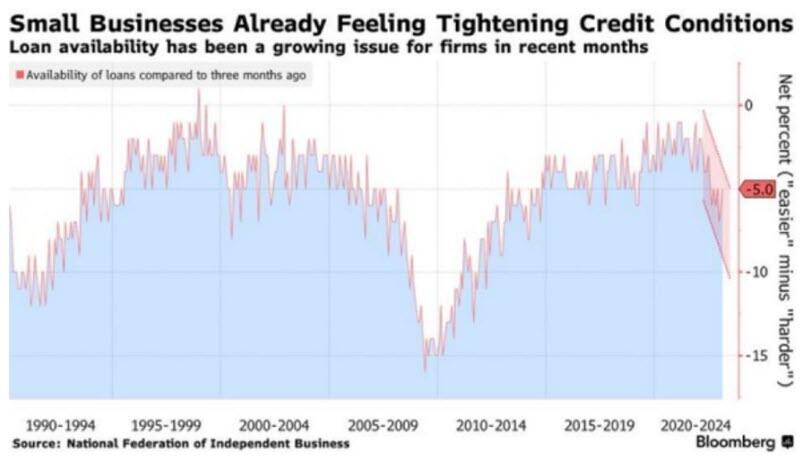
In the wake of recent bank failures and now carefully muted headlines, credit is tightening behind the curtains, and that’s a bad sign.
Even the safer companies in the US with “investment grade” credit status aren’t issuing bonds into a credit market that has seen volatility on the short end of the UST market which looks more like a crypto-coin trade than a “risk-free-return” UST.
The recent gyrations in the 2-year UST and futures market surpassed vol levels seen in 1987, 9-11, or even the GFC of 2008, but I’m betting those details didn’t make the headlines of the financial media with much attention to detail…
As the WSJ recently noted, however, March issuance of bonds by even the highest rated companies came in at just under $60B, significantly below the five-year average of $180B for the same month.
And as for the junkier companies and their junkier bonds, well…their luck, as well the demand for their IOUs, has all but dried up.
March saw US zombie/junk borrowers (who live off “extend-and-pretend” low rates and yield-desperate investors [suckers]) issuing only $5B in bonds, compared to a five-year average of over $24B for the same month.
Hmmm.
Uh-oh?
Stated simply, easy, cheap and freely available credit, which has been the fun but toxic wind beneath the otherwise broken wings of the so-called post-08 “recovery” (bubble), is ending/breaking, which means hope for any vestige of US economic growth is now all but an open joke.
Small banks, which will be falling off the vine one by one in the coming months as depositors openly move toward the larger banks and money markets, means that credit, and hence hope, for small businesses in the US will be harder to get than an honest voice in Congress.

2023-04-06_14-38-44.jpg


Needless to say, none of these open signals of tightening credit bode well for Main Street in particular or economic growth in general.

The Fed’s Generational Sucker-Punch

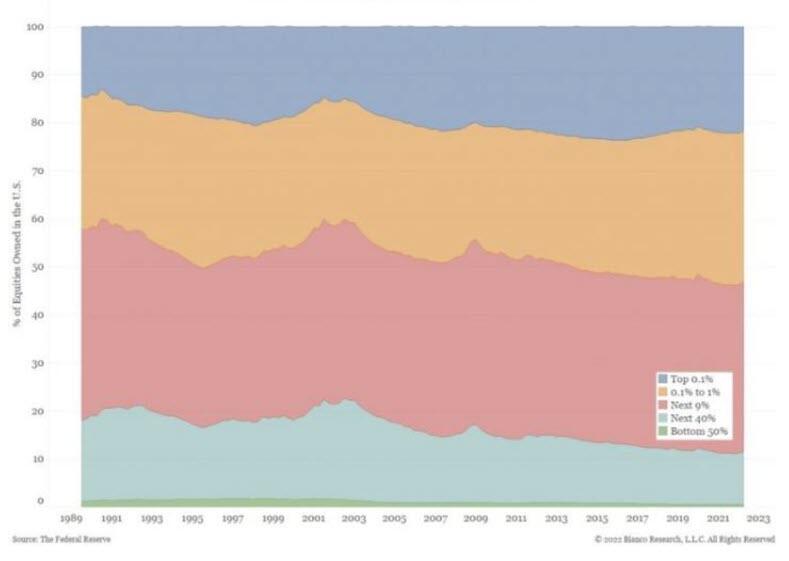
The Fed may have given the top 10% of the US 90% of all the bubble wealth which came from their post-08 rate repression…


2023-04-06_14-39-19.jpg


… but now that same centralized (and rate-hiked) bank is giving the ignored 50% of small business owners and average Joes on Main Street the sucker-punch of a generation.

The recession in which we likely already find ourselves will nevertheless (and soon) become more and more undeniable, and yes dis-inflationary, within an over-all inflationary backdrop.

In the near-term, moreover, such slowing growth and tightening credit will also be a tailwind for the USD.

But those dis-inflationary winds and rising dollars won’t last for long in my opinion.

Why?

Here are six simple reasons…

Why Dis-Inflationary Forces and a Rising USD Will Indeed be “Transitory”
Of course, I hate using a word like “transitory” … but here are six reasons a strong USD and near-term dis-inflationary forces likely won’t last for long.

With:

1) Uncle Sam running twin deficits while…
2) the US stares down the barrel of $33+T in year-end debt levels and…
3) declining tax receipts (down 10% y/y) with…
4) true-interest expense on outstanding US sovereign debt at 118% of tax receipts—and all within the setting of…
5) openly tightening credit while facing…
6) a de-dollarizing world with less rather than more interest in American IOUs/USTs…
… the US will hit that fork in the road where it must print money to survive.

In short: A Pivot Will Come
Why?

Because, when forced to choose between imploding credit markets or a dying currency, the central planners will sacrifice the dollar, not the market(s).

As warned many times, the currency is always the last bubble to pop in a broken financial system.

And that, folks, is precisely when the inflationary forces of magical mouse-clicked trillions will surpass the dis-inflationary forces (above) of a broken economy and an increasingly loan-less banking system—all of which we can thank each and every central banker since patient-zero Alan Greenspan took a chair at the Eccles Building.

All Roads Lead to Gold…
All of this, of course, leads us to my favorite topic and asset: Physical gold.

Needless to say, my colleague, Egon von Greyerz, and I have always had a lot to say about this so-called “barbarous relic.”

Many, of course, will just chalk such conviction to the good-ole “gold bug” retort, but those who understand the math and history of money in general or broken credit cycles in particular are a bit more than just “gold bugs” …

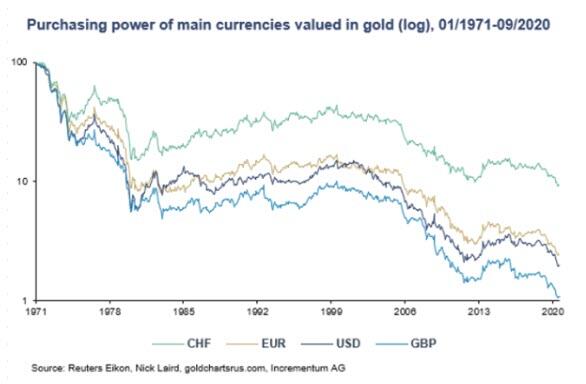
And as for gold’s inevitable direction, we know it will trend north for the undeniable reason that currencies, ever since Nixon welched on the Bretton Woods gold standard, have been steadily trending south.

2023-04-06_14-40-01.jpg


It’s really that simple.

The OPEC Factor… History Rhyming, Gold Shining
But notwithstanding our consistent and common-sense arguments, let’s look at the petrodollar shifts of late.

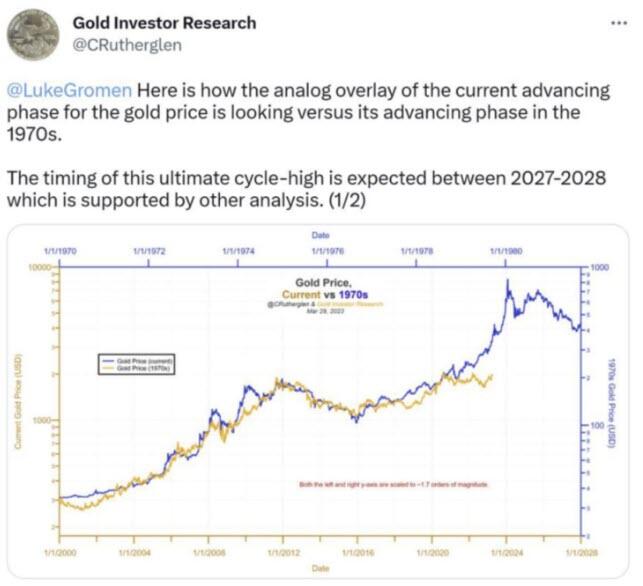
Toward this end, folks like Chris Rutherglen and Luke Gromen have done an exceptional job in reminding us of the history as well as critical importance of gold, oil and credit markets.

History Rhyming
As I’ve presented elsewhere, history (borrowing from Mark Twain) may not repeat itself, but it certainly rhymes.

And toward this end, Rutherglen and Gromen have shown the poetry of rhyming patterns in the context of the ever-changing petrodollar politics, which, modestly, we too foresaw over a year ago.

As we warned from literally day-1 of the western sanctions against Putin, the end result would be disastrous for the West in general and the USD in particular.

And nowhere was this US Dollar prognosis truer than with regard to the petrodollar—i.e., those good ol’ days when nearly every oil purchase was linked to the USD.

However, and as Gromen and Rutherglen suggest, that oil-USD linkage was never a sure thing in the 70’s, and will be even less of a sure thing in the years ahead.

And this, folks, will have a massive impact on gold in the years ahead.

How so?

Let’s dig in.

Gold and Oil—Ready to Link?
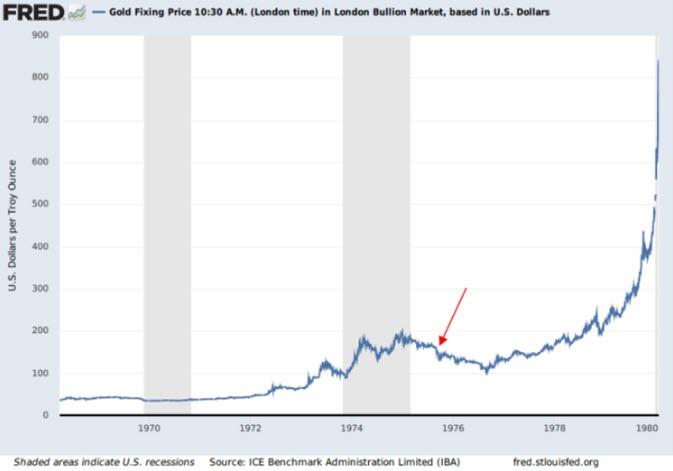
Although still in diapers when Nixon closed the gold window in 71, and still watching Saturday morning cartoons when gold soared from $175/ounce in 1975 to over $800/ounce less than five years later…

2023-04-06_14-40-39.jpg


… I am at least old enough now to glean a few historical lessons and patterns which may point toward similar and rising gold valuations tomorrow.

Gold, as Gromen and Rutherglen remind, was ripping in the late 70’s largely because it was not yet a foregone conclusion that oil would be pegged to USDs.

In that bygone era of disco, ABBA, wide neckties and checkered suits, neither OPEC nor Europe was against the idea of settling oil transactions in gold rather than USTs.

This was because those very same USTs (thanks to Nixon’s welch) were not very well…loved, trusted or valued in the 70’s.

(See where I’m going [rhyming] with this?)

Fortunately, Paul Volcker was able to seduce the oil nations into trusting Uncle Sam’s fiat money by cranking (and I do mean cranking) interest rates to the moon to restore faith in the UST and hence give OPEC the confidence to sell oil in dollars rather than settle in gold.

Specifically, Volcker took rates to 15+%, a move which placed real rates on that all-important 10Y UST at +8%.

Such hawkish policy was thus a game changer for making the petrodollar a reality and hence the USD the world’s reserve energy asset (and bully) for a generation to come.

Powell Ain’t No Volcker
Unfortunately, and thanks to Uncle Sam’s embarrassing bar tab (i.e., debt levels), those days, and those USDs and USTs, have fallen from grace, and hence are slowly falling off the radar of OPEC.

For this, we can also thank an openly cornered Powell’s so-called war on inflation, which has, among so many other backfired fiascos, led to a slow and steady process of de-dollarization and declining faith in that oh-so-important global IOU otherwise known as the UST.

The Oil Nations Aren’t Stupid
The OPEC folks know that Uncle Sam’s IOU’s aren’t what they used to be.

Unlike Volcker, however, Powell can’t get the 10Y UST to an 8% real (i.e., inflation-adjusted) rate.

Even his so-called “hawkish” nominal rates of 5% have crushed credit markets, Treasuries and nearly everything else in its path.

And if Powell even dreamed of pushing rates to 15% ala Volcker to seduce OPEC, he would literally murder the entire US economy with a double-digit rate hike against a $31T public debt pile.

In short, there is simply no way to compare Volcker’s options in the 70’s to Powell’s debt reality in 2023.

This means the Fed can’t do what will be needed this time around to prevent OPEC from looking outside the USD or UST and hence inside the gold markets as a primary asset to settle its energy transactions.

The days of the mighty petrodollar, as I warned (in two languages) over year ago here, here and here, are slowly but steadily coming to end.

Think about that a second.

Or better yet, look at it for a second—with kudos again, to Gromen and Rutherglen.


2023-04-06_14-41-16.jpg


Something to Think About
Boiled down to simple math, if the 2020’s rhyme with the 1970’s, which is clearly plausible, and gold becomes a primary (or even secondary) settlement asset in the energy market, this factor alone would place gold near $9000 an ounce by 2027 or 2028.

Again, something to think about, no?

In the interim, I’d hate to be in Powell’s shoes.

We’ll have to see if he’ll try to save the petrodollar by destroying the US economy or, who knows, even something worse…

Perhaps his neocon neighbors in DC will distract us with more war games?

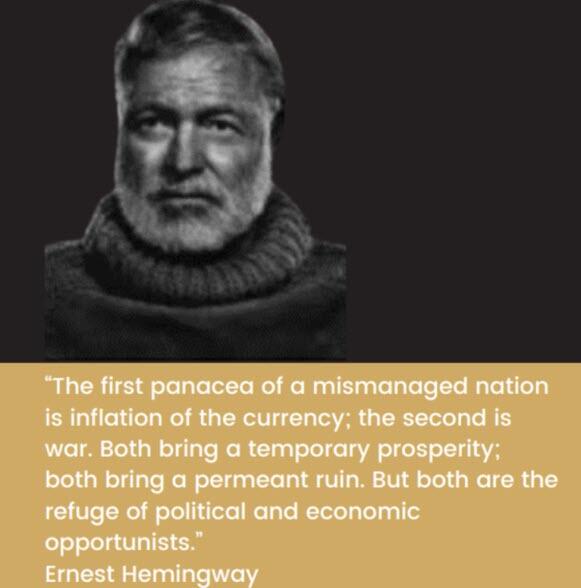
We can only wait and see as the US runs out of good options and is left with only the bad (and desperate) ones, a pattern which Hemingway, rather than Twain, made perfectly clear and is worth repeating:


2023-04-06_14-41-50.jpg