

We have enough fossil fuels here in North America to supply us and Europe. Putin wouldn't get a cent under a proper plan. But of course the Biden/Obama/Harris and Turdeau administrations are most concerned with virtue signaling instead of making sound policy decisions.Why would it be smarter to give Putin and MBS trillions instead of spending that money to free Canada from giving despots cash?
Why is it smarter to pay out massive subsidies so you can keep the privilege of buying products that will kill 1 billion people?


Climate Change
- Thread starter Addict2sex
- Start date
Once again totally right because Joe is responsible for China and India buying Russian oil. For an old man who you keep saying is out of it you sure do claim he is responsible for a lot.We have enough fossil fuels here in North America to supply us and Europe. Putin wouldn't get a cent under a proper plan. But of course the Biden/Obama/Harris and Turdeau administrations are most concerned with virtue signaling instead of making sound policy decisions.
By the way we would need an embargo if your fearless leader is elected because he will just give Ukraine to his friend. Remember, he is the apple of Putin's eye.

Bloomberg Falsely Says Climate Change is Harming Crop Production, Reality Says Otherwise
By
Linnea Lueken
-
August 31, 2023
0
A recent post at Bloomberg, titled “Climate Change Is Helping Pests and Diseases Destroy Our Food,” claims that recent crop shortages are due to increases in pest infestations and disease because of climate change. This is false for multiple reasons. First, the crops listed are not seeing substantial declines outside of particular production regions, which is to be expected from agriculture some years.
Bloomberg contributor Mumbi Gitau writes that pests and disease “are exacerbating crop shortages that have sent prices for goods like cocoa, olive oil, and orange juice soaring.” Gitau also asserts that these shortages will “become even more prevalent as extreme weather events multiply.”
To be clear data show that extreme weather events are not getting more frequent or extreme, even amid the last hundred-plus years of warming. Climate Realism has covered this fact many times, here, here, and here, for just a few examples.
While the article covers several foods allegedly threatened by climate change which have mostly been covered by Climate Realism before, including cocoa, olives, orange juice, grains, and tomatoes, the article places a bit more emphasis the first three, and so we will do likewise.
Beginning with cocoa, Gitau says “West Africa, home to two-thirds of global cocoa supply, has seen serious difficulties with its crop in recent seasons, causing wholesale prices to soar near historic highs this year.”
There are two main diseases attacking cocoa in West Africa, according to Gitau. The first is “black pod disease” – a fungal disease that is spread most easily in the wet conditions that parts of West Africa have seen. The other is swollen shoot virus, which is spread by pests that already live in warmer parts of the world, so there is no evidence modest warming is spread those pests to regions where they hadn’t previously existed.
Cocoa is typically grown in rainforests and warmer equatorial parts of the world, regions that are naturally susceptible to those diseases in the first place. Additionally, as explained in “Correct, CNN, Cocoa Prices Are Due to Natural Weather Conditions and Disease,” climate change is not necessary for these kinds of illnesses to break out in cocoa plantations. The International Cocoa Organization (ICCO) says on their website that “[a]verage yields for cocoa production are low due to extensive systems of cultivation, ageing tree populations, high incidence and poor control systems of pests and diseases, ageing farmer populations, shortage of affordable labour, lack of easily available inputs, poor extension services and above all, the use of poor/average quality planting material.”
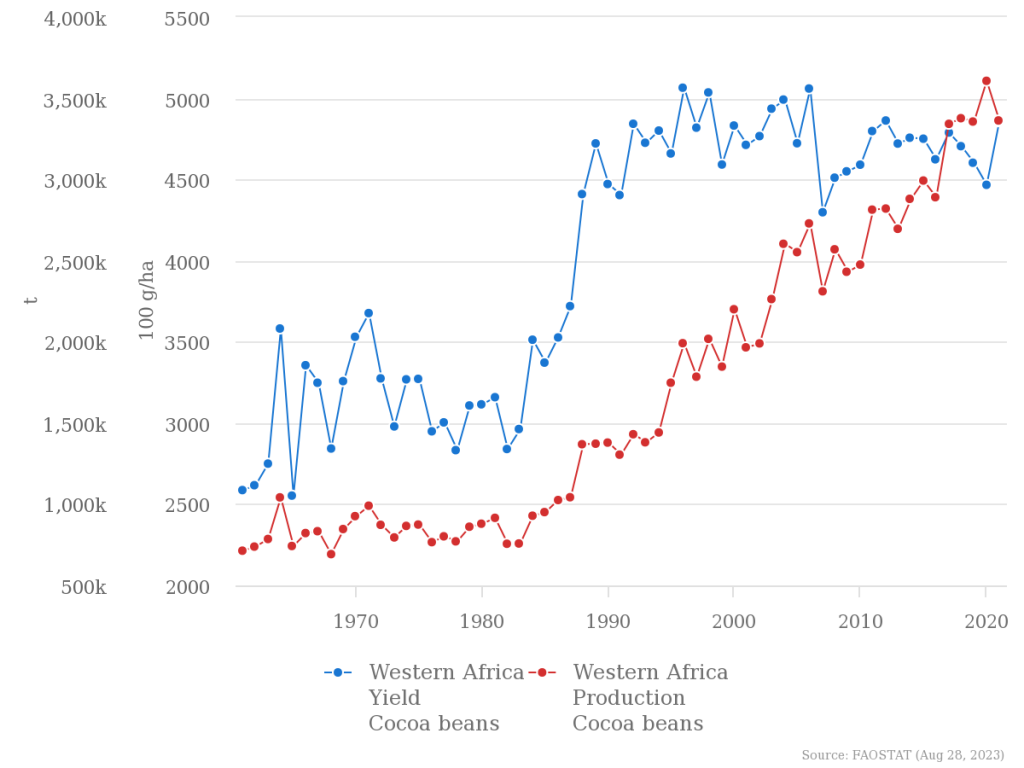
Because so much of the world’s cocoa is produced in a limited geographical area, any disease or poor conditions that strike the region will have a disproportionate impact on the total supply. Despite this, the same Climate Realism shows that world production of cocoa has steadily increased over time, despite fluctuations in yield. In fact, both yield and production of cocoa beans in West Africa have shown an increasing trend over period of modest warming, according to data from the United Nations Food and Agriculture Organization (FAO). (See Figure below)
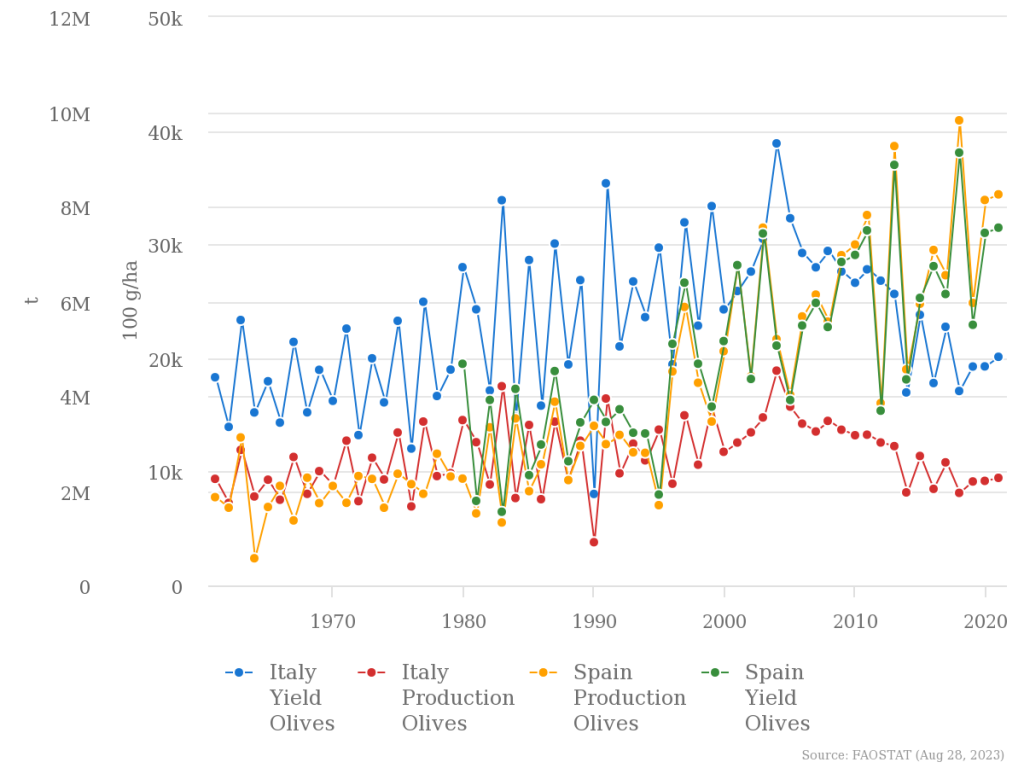
Although, according to U.N. FAO data, Italy’s production of olives has fallen off since it’s 2005 peak, Spain has meanwhile picked up the slack in a big way and is now the larger producer. (See figure below)
In Spain:
Finally, regarding orange juice, Bloomberg says “hurricanes, frost, and diseases have decimated orange groves in Florida, pushing US orange juice futures to record highs this month.” They also say citrus greening disease, spread by an insect, is likewise causing shortages. However, again, these problems are already endemic to warm weather zones where oranges are produced. Also, although bad weather like hurricanes can destroy fruit orchards and cause problems for years afterwards, data shows that the modest recent rise in global average over more than a hundred years has not caused an increase in the number or severity of hurricanes, as demonstrated in numerous Climate Realism posts. In addition, there is no evidence rising temperatures have negatively impacted orange production.
While this article points to the United States for proof of production woes, the United States has been growing fewer oranges for decades as the country is outcompeted by Brazil, China, and Mexico.
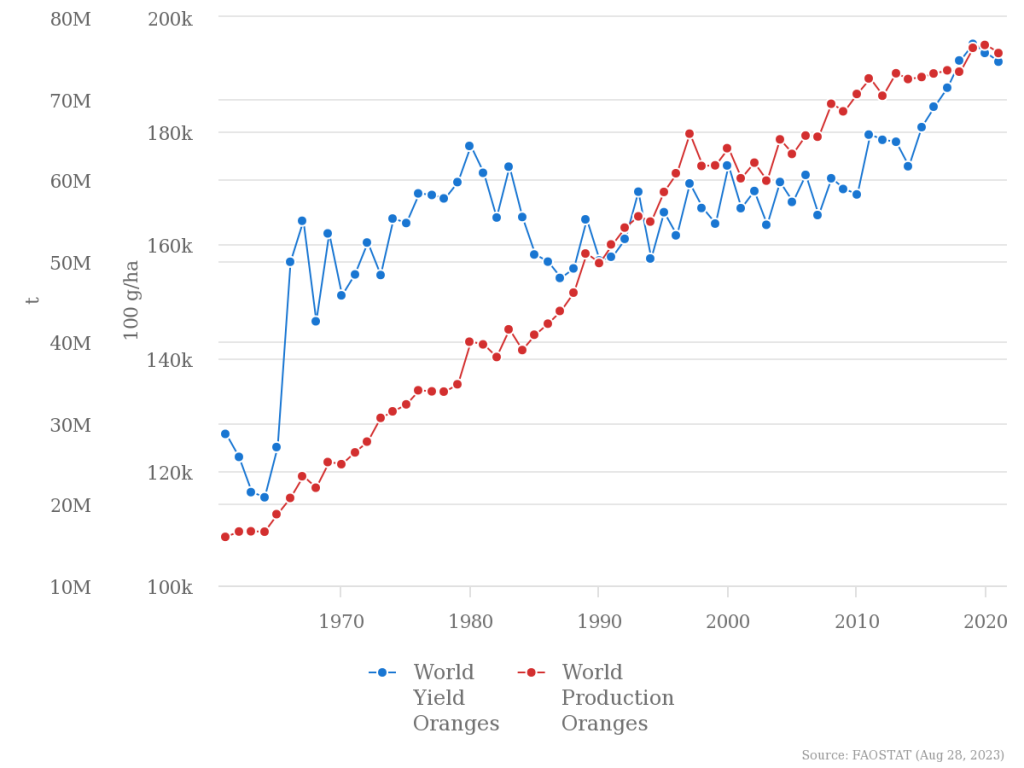
Looking again at available production data from the U.N. FAO, worldwide the production and yield of oranges has been rising for decades, with an amazing production increase of 372 percent since 1961. (See figure below)
Orange juice prices can be better explained by looking at historic price data. (See figure below)
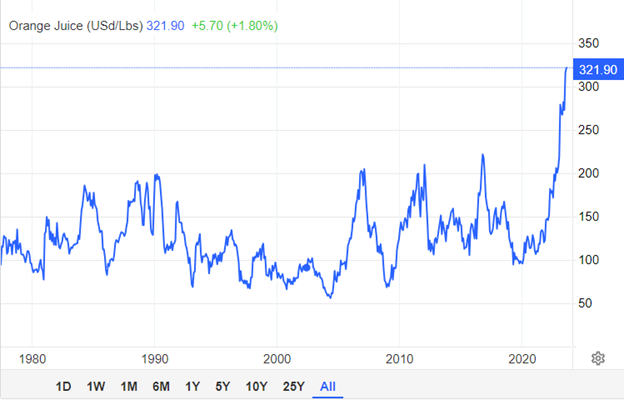
Prices have been going up along with energy costs and supply chain issues, with a historic upwards trend starting around the time of the COVID pandemic lockdowns, certainly made worse by weather like hurricane Ian, but not exclusively driven by it. And one must consider the fact that energy prices have risen, in large part due to climate policies imposed by the Biden administration, in Europe, and in other industrialized nations, which have increased the price the pesticides and fertilizers made using oil and gas. Oil and gas restrictions have increased the price of producing, transporting, storing, and selling cocoa, olive oil, and oranges at retail outlets.
It may be tempting to believe that crop failures in different parts of the world are indicative of some major global climate change impact, however, long-term data in weather trends, pest and crop disease patterns, and production show no such trends. A more likely factor for the “appearance” of a crop apocalypse is the advent of the internet and instantaneous worldwide news, allowing us for the first time ever to now can see much more of what afflicts different crops around the world, coinciding with the media’s adoption of a climate crisis narrative in which every bad thing that happens can trace its cause to climate change. Regional crop failures have always occurred, causing difficulties for producers and consumers, but there is no evidence recent isolated crop declines are more than temporary or due to long-term climate change. Bloomberg, ostensibly a business and economics focused publication, should be aware of this, and be able to explain the intricacies without resorting to climate alarm.
Bloomberg Falsely Says Climate Change is Harming Crop Production, Reality Says Otherwise - ClimateRealism
By
Linnea Lueken
-
August 31, 2023
0
A recent post at Bloomberg, titled “Climate Change Is Helping Pests and Diseases Destroy Our Food,” claims that recent crop shortages are due to increases in pest infestations and disease because of climate change. This is false for multiple reasons. First, the crops listed are not seeing substantial declines outside of particular production regions, which is to be expected from agriculture some years.
Bloomberg contributor Mumbi Gitau writes that pests and disease “are exacerbating crop shortages that have sent prices for goods like cocoa, olive oil, and orange juice soaring.” Gitau also asserts that these shortages will “become even more prevalent as extreme weather events multiply.”
To be clear data show that extreme weather events are not getting more frequent or extreme, even amid the last hundred-plus years of warming. Climate Realism has covered this fact many times, here, here, and here, for just a few examples.
While the article covers several foods allegedly threatened by climate change which have mostly been covered by Climate Realism before, including cocoa, olives, orange juice, grains, and tomatoes, the article places a bit more emphasis the first three, and so we will do likewise.
Beginning with cocoa, Gitau says “West Africa, home to two-thirds of global cocoa supply, has seen serious difficulties with its crop in recent seasons, causing wholesale prices to soar near historic highs this year.”
There are two main diseases attacking cocoa in West Africa, according to Gitau. The first is “black pod disease” – a fungal disease that is spread most easily in the wet conditions that parts of West Africa have seen. The other is swollen shoot virus, which is spread by pests that already live in warmer parts of the world, so there is no evidence modest warming is spread those pests to regions where they hadn’t previously existed.
Cocoa is typically grown in rainforests and warmer equatorial parts of the world, regions that are naturally susceptible to those diseases in the first place. Additionally, as explained in “Correct, CNN, Cocoa Prices Are Due to Natural Weather Conditions and Disease,” climate change is not necessary for these kinds of illnesses to break out in cocoa plantations. The International Cocoa Organization (ICCO) says on their website that “[a]verage yields for cocoa production are low due to extensive systems of cultivation, ageing tree populations, high incidence and poor control systems of pests and diseases, ageing farmer populations, shortage of affordable labour, lack of easily available inputs, poor extension services and above all, the use of poor/average quality planting material.”
Because so much of the world’s cocoa is produced in a limited geographical area, any disease or poor conditions that strike the region will have a disproportionate impact on the total supply. Despite this, the same Climate Realism shows that world production of cocoa has steadily increased over time, despite fluctuations in yield. In fact, both yield and production of cocoa beans in West Africa have shown an increasing trend over period of modest warming, according to data from the United Nations Food and Agriculture Organization (FAO). (See Figure below)
- Cocoa bean production in West Africa alone has increased by 371 percent since 1961.
- Yield has increased 87 percent since 1961, though it has flattened off since the 1990s.
- Production records have been broken as recently as 2020, and have occurred 7 times from 2010 to 2021.
Although, according to U.N. FAO data, Italy’s production of olives has fallen off since it’s 2005 peak, Spain has meanwhile picked up the slack in a big way and is now the larger producer. (See figure below)
In Spain:
- Olive production has increased 343 percent since 1961;
- Yield has increased 61 percent;
- All-time production records have been set as recently as 2018, and records have been set four times since 2010 alone.
Finally, regarding orange juice, Bloomberg says “hurricanes, frost, and diseases have decimated orange groves in Florida, pushing US orange juice futures to record highs this month.” They also say citrus greening disease, spread by an insect, is likewise causing shortages. However, again, these problems are already endemic to warm weather zones where oranges are produced. Also, although bad weather like hurricanes can destroy fruit orchards and cause problems for years afterwards, data shows that the modest recent rise in global average over more than a hundred years has not caused an increase in the number or severity of hurricanes, as demonstrated in numerous Climate Realism posts. In addition, there is no evidence rising temperatures have negatively impacted orange production.
While this article points to the United States for proof of production woes, the United States has been growing fewer oranges for decades as the country is outcompeted by Brazil, China, and Mexico.
Looking again at available production data from the U.N. FAO, worldwide the production and yield of oranges has been rising for decades, with an amazing production increase of 372 percent since 1961. (See figure below)
Orange juice prices can be better explained by looking at historic price data. (See figure below)
Prices have been going up along with energy costs and supply chain issues, with a historic upwards trend starting around the time of the COVID pandemic lockdowns, certainly made worse by weather like hurricane Ian, but not exclusively driven by it. And one must consider the fact that energy prices have risen, in large part due to climate policies imposed by the Biden administration, in Europe, and in other industrialized nations, which have increased the price the pesticides and fertilizers made using oil and gas. Oil and gas restrictions have increased the price of producing, transporting, storing, and selling cocoa, olive oil, and oranges at retail outlets.
It may be tempting to believe that crop failures in different parts of the world are indicative of some major global climate change impact, however, long-term data in weather trends, pest and crop disease patterns, and production show no such trends. A more likely factor for the “appearance” of a crop apocalypse is the advent of the internet and instantaneous worldwide news, allowing us for the first time ever to now can see much more of what afflicts different crops around the world, coinciding with the media’s adoption of a climate crisis narrative in which every bad thing that happens can trace its cause to climate change. Regional crop failures have always occurred, causing difficulties for producers and consumers, but there is no evidence recent isolated crop declines are more than temporary or due to long-term climate change. Bloomberg, ostensibly a business and economics focused publication, should be aware of this, and be able to explain the intricacies without resorting to climate alarm.
Bloomberg Falsely Says Climate Change is Harming Crop Production, Reality Says Otherwise - ClimateRealism
What if the point of no return of climate change is reached well before 50 years fromProbably because humans are evolved to go down fighting? Fighting for another 50 years is better than giving up. Who knows, that 50 years may give us time to innovate or adapt.
now?
According to climate alarmists/scientists global carbon emission has to be
reduced by 50% within one decade to avert climate change triggering that point
of no return. And if I understand their message correctly it won't help very much
if the world ceases to burn fossil fuel beyond that point. Climate change will be
irreversible by then and impending climate catastrophe unavoidable.
That is what I learned several years ago. So I believe the point of no return will be
reached before 2030 as there is no sign of global carbon emission going down
time any soon. Green house gas concentration in the atmosphere by 2030 will
surely be higher where it is now unless you believe in the BS that is carbon
capture technology.
Climate science is not my field. I can only base my judgement and decision
regarding the significance of their prediction of Earth's climate future on common
sense and my own understanding of the fundamentals of physical science as
a predictive tool. My view is that climate prediction is way way overblown even
if correct. At any rate I think it should be obvious to people by now that all these
fights over climate change won't make a dent in the growth of global carbon
emission; and that failure in reducing emission let alone putting a cap on its
growth actually has very little to do with climate denial or skepticism
I think it is more prudent to throw climate change aside as a secondary
issue and just focus on policies that would bring on immediate emission
reduction for protection of our environment and conservation of Earth's
remaining fossil fuel resources.
And it's far more human that some plot to reduce the world population.

True. But if they aren’t willing to run pipelines, and the left aren’t either. Fracking? Which I would think is infinitely more risky to groundwater.We have enough fossil fuels here in North America to supply us and Europe. Putin wouldn't get a cent under a proper plan. But of course the Biden/Obama/Harris and Turdeau administrations are most concerned with virtue signaling instead of making sound policy decisions.
US proven reserves will last about 4-5 years given current consumption.
Canada proven reserves at current consumption. 188 years.
The US is now where near capable of supplying anyone else let alone themselves for very long.. Canada oth…
As far as I’m concerned given current political climates and protectionism, trade disputes etc. The US can pound salt. Just need a PM with a wee bit of common sense and backbone.
Last edited:
What if the point of no return of climate change is reached well before 50 years from
now?
According to climate alarmists/scientists global carbon emission has to be
reduced by 50% within one decade to avert climate change triggering that point
of no return. And if I understand their message correctly it won't help very much
if the world ceases to burn fossil fuel beyond that point. Climate change will be
irreversible by then and impending climate catastrophe unavoidable.
That is what I learned several years ago. So I believe the point of no return will be
reached before 2030 as there is no sign of global carbon emission going down
time any soon. Green house gas concentration in the atmosphere by 2030 will
surely be higher where it is now unless you believe in the BS that is carbon
capture technology.
Climate science is not my field. I can only base my judgement and decision
regarding the significance of their prediction of Earth's climate future on common
sense and my own understanding of the fundamentals of physical science as
a predictive tool. My view is that climate prediction is way way overblown even
if correct. At any rate I think it should be obvious to people by now that all these
fights over climate change won't make a dent in the growth of global carbon
emission; and that failure in reducing emission let alone putting a cap on its
growth actually has very little to do with climate denial or skepticism
I think it is more prudent to throw climate change aside as a secondary
issue and just focus on policies that would bring on immediate emission
reduction for protection of our environment and conservation of Earth's
remaining fossil fuel resources.
I think you are in many ways quite correct. Energy runs all civilizations past and present. Today our civilization is far more sensitive to any changes in energy supply and its clear that economic growth and increase in available energy have almost a 1 to 1 relationship. Without energy this civilization ends. Moving directly to solar, wind, geothermal, nuclear can provide for a civilization just not this one. And given the scale and scope of our hydrocarbon society we cannot just electrify everything in 10 yrs. I wish we could but realistically the scale of just replacing ICE vehicles is likely to be well over 50 yrs if everything goes to plan and mining industry can provide all we need. Neither of those is likely. Ethics aside
North America from what i have researched is the only growing hydrocarbon basin in the world. Studies have found the oil basins supplying EU will be reversing flow rates by end of this decade. North America has roughly 10 yrs before this happens. In the US the EIA now considers Natural Gas Plant Liquids to be included as part of oil production which constitutes about a quarter of the yearly oil production stats. Apparently elsewhere in the world this is happening as well. There are trillions of barrels of hydrocarbons eft but all new discoveries are smaller, deeper, and much more complex wrto recover of that resource. And that has major implications. thawing of permafrost has implications for hydrocarbon production in Siberia , alaska. Ground is sinking increasing the complexity of recovering resources. Availability becomes less and society can afford less. complexity starts to unravel in our society as this happens which will likely lead to social unrest and political change in the northern hemisphere as it is now doing in Africa.
I do believe Climate issues are are one of the major problems in a age of poly crises. I expect the first to really hit us is the result of financialization of seemingly everything. Debt everywhere is massive based on future growth taking care of paying it back. When the penny drops that hydrocarbons are leaving us with a reduced flow rate, a green energy system to support the scale and scope of what we have now is not attainable to run this civilization we see major drops in stocks, bonds, pensions , insurance , bank lending slowing to very, very low levels, unemployment rising to depression era levels. Unfortunately most of the neo liberal economists who advise gov'ts, NGO's, IPCC expect we have. their projections that all will be well economically in 2100 are absurd based on their own cult like following of price solves everything and nothing else matters.
Food is a growing issue. India for example produces 40% of rice exports and has banned exports due to poor harvests. War between Russia and Ukraine is knocking back grain supply to the world. Drought, flooding , heat is affecting production . Studies have shown excess CO2 in the atmosphere is already decreasing the nutrional value in the food we grow. Heat also impairs plant growth, above a ground temperature of 45 C it stops. This will be another factor in social unrest and lead to further human migration. hydrological cycle is changing due to rising global temperature and water is needed to sustain life as well and industrial processes, mining in vast numbers.
In an age of poly crises i tend to think Finance first, then hydrocarbons, food, energy shortages , societal fracturing
I think you are in many ways quite correct. Energy runs all civilizations past and present. Today our civilization is far more sensitive to any changes in energy supply and its clear that economic growth and increase in available energy have almost a 1 to 1 relationship. Without energy this civilization ends. Moving directly to solar, wind, geothermal, nuclear can provide for a civilization just not this one. And given the scale and scope of our hydrocarbon society we cannot just electrify everything in 10 yrs. I wish we could but realistically the scale of just replacing ICE vehicles is likely to be well over 50 yrs if everything goes to plan and mining industry can provide all we need. Neither of those is likely. Ethics aside
North America from what i have researched is the only growing hydrocarbon basin in the world. Studies have found the oil basins supplying EU will be reversing flow rates by end of this decade. North America has roughly 10 yrs before this happens. In the US the EIA now considers Natural Gas Plant Liquids to be included as part of oil production which constitutes about a quarter of the yearly oil production stats. Apparently elsewhere in the world this is happening as well. There are trillions of barrels of hydrocarbons eft but all new discoveries are smaller, deeper, and much more complex wrto recover of that resource. And that has major implications. thawing of permafrost has implications for hydrocarbon production in Siberia , alaska. Ground is sinking increasing the complexity of recovering resources. Availability becomes less and society can afford less. complexity starts to unravel in our society as this happens which will likely lead to social unrest and political change in the northern hemisphere as it is now doing in Africa.
I do believe Climate issues are are one of the major problems in a age of poly crises. I expect the first to really hit us is the result of financialization of seemingly everything. Debt everywhere is massive based on future growth taking care of paying it back. When the penny drops that hydrocarbons are leaving us with a reduced flow rate, a green energy system to support the scale and scope of what we have now is not attainable to run this civilization we see major drops in stocks, bonds, pensions , insurance , bank lending slowing to very, very low levels, unemployment rising to depression era levels. Unfortunately most of the neo liberal economists who advise gov'ts, NGO's, IPCC expect we have. their projections that all will be well economically in 2100 are absurd based on their own cult like following of price solves everything and nothing else matters.
Food is a growing issue. India for example produces 40% of rice exports and has banned exports due to poor harvests. War between Russia and Ukraine is knocking back grain supply to the world. Drought, flooding , heat is affecting production . Studies have shown excess CO2 in the atmosphere is already decreasing the nutrional value in the food we grow. Heat also impairs plant growth, above a ground temperature of 45 C it stops. This will be another factor in social unrest and lead to further human migration. hydrological cycle is changing due to rising global temperature and water is needed to sustain life as well and industrial processes, mining in vast numbers.
In an age of poly crises i tend to think Finance first, then hydrocarbons, food, energy shortages , societal fracturing

In part, rather large part I just smh. Forest for the trees. Whatever Armegeddon fear mongerers are promoting, it is inevitable. So we are twisting like fish on hooks. Desperately trying to buy a wee bit of time.
Climate change, and nature might put a big dent in our population first, I rather suspect we will do it to ourselves faster. Only nit, I might have is your order. Financial problems, will accelerate social fracturing and the implosion.
/look around.
As it stands, we could be living as we were/are, even increase production some. Leverage fossils and the revenue, to seriously pour money into the the things we should be but aren’t. At its simplest buying EVs for the dirty masses that can’t afford them. Getting far more on the road faster. Looking at where/how we build etc. Food, we don’t even know if/where wheat and corn will grow, once things get warmer, summers are drier, and precipitation patterns change.
Only other thing. Assuming we make it another 50 years. The lifeblood of the planet is water……..all kinds of places around the globe running out. We Canadians using it, pissing in it, and more like there’s no tomorrow.
Last edited:
I am more or less in total agreement with your post. I'll just add that to me............................
In an age of poly crises i tend to think Finance first, then hydrocarbons, food, energy shortages , societal fracturing
it is infrastructure that comes first in our quest for solutions to the crises we
are facing. Admittedly infrastructure is tied to our finance so I don't necessarily
disagree with your. In the coming years electrification as well as expansion
of public transportation network and construction of low cost housing
community is essential for the society to continue to prosper in an age of
diminishing energy intensity. And the challenge is to raise the capital required
at a time when the already massive debt is growing with no end in sight.
Last edited:
Why do you keep posting such obvious bullshit from science denial sites?Bloomberg Falsely Says Climate Change is Harming Crop Production, Reality Says Otherwise
Bloomberg Falsely Says Climate Change is Harming Crop Production, Reality Says Otherwise - ClimateRealism
I would assume the pitchforks will come out for anyone in the oil&gas industry.What if the point of no return of climate change is reached well before 50 years from
now?
You'll have to take your dream palace and run.
Humanity already has a history of moving past sources of energy.I think you are in many ways quite correct. Energy runs all civilizations past and present. Today our civilization is far more sensitive to any changes in energy supply and its clear that economic growth and increase in available energy have almost a 1 to 1 relationship. Without energy this civilization ends. Moving directly to solar, wind, geothermal, nuclear can provide for a civilization just not this one. And given the scale and scope of our hydrocarbon society we cannot just electrify everything in 10 yrs. I wish we could but realistically the scale of just replacing ICE vehicles is likely to be well over 50 yrs if everything goes to plan and mining industry can provide all we need. Neither of those is likely. Ethics aside
North America from what i have researched is the only growing hydrocarbon basin in the world. Studies have found the oil basins supplying EU will be reversing flow rates by end of this decade. North America has roughly 10 yrs before this happens. In the US the EIA now considers Natural Gas Plant Liquids to be included as part of oil production which constitutes about a quarter of the yearly oil production stats. Apparently elsewhere in the world this is happening as well. There are trillions of barrels of hydrocarbons eft but all new discoveries are smaller, deeper, and much more complex wrto recover of that resource. And that has major implications. thawing of permafrost has implications for hydrocarbon production in Siberia , alaska. Ground is sinking increasing the complexity of recovering resources. Availability becomes less and society can afford less. complexity starts to unravel in our society as this happens which will likely lead to social unrest and political change in the northern hemisphere as it is now doing in Africa.
I do believe Climate issues are are one of the major problems in a age of poly crises. I expect the first to really hit us is the result of financialization of seemingly everything. Debt everywhere is massive based on future growth taking care of paying it back. When the penny drops that hydrocarbons are leaving us with a reduced flow rate, a green energy system to support the scale and scope of what we have now is not attainable to run this civilization we see major drops in stocks, bonds, pensions , insurance , bank lending slowing to very, very low levels, unemployment rising to depression era levels. Unfortunately most of the neo liberal economists who advise gov'ts, NGO's, IPCC expect we have. their projections that all will be well economically in 2100 are absurd based on their own cult like following of price solves everything and nothing else matters.
Food is a growing issue. India for example produces 40% of rice exports and has banned exports due to poor harvests. War between Russia and Ukraine is knocking back grain supply to the world. Drought, flooding , heat is affecting production . Studies have shown excess CO2 in the atmosphere is already decreasing the nutrional value in the food we grow. Heat also impairs plant growth, above a ground temperature of 45 C it stops. This will be another factor in social unrest and lead to further human migration. hydrological cycle is changing due to rising global temperature and water is needed to sustain life as well and industrial processes, mining in vast numbers.
In an age of poly crises i tend to think Finance first, then hydrocarbons, food, energy shortages , societal fracturing
The UK was covered in forests until they burnt them all down.
So they moved to whale oil, which lit their lanterns until they were almost hunted to extinction.
Then coal, which dirtied their cities until it ran out.
Now oil, which is running low but even worse, will make life almost uninhabitable for humans if we burn all the dead dinosaurs left in the ground.
We are now very close to hitting a few of the 7 major tipping points, which would put us past the point of no return.
Shutdown of the AMOC being #1.
Talk to the born again people.So then Franky.
How much time before Armegeddon.
So weird, Climate champions with their super computers and models. They can’t answer that question for you to Google?Talk to the born again people.
Or, if that not question. Can you not find answer for when Armegeddon will arrive assuming net zero is reached by 2030? 2050? So weird.
wouldn’t a smart investor know what his money is buying? A few years? 100?
We know, do we not. That given warmer temps, summers will be drier, winters milder and that precipitation patterns will change. We sort of know in the prairies that means less snowpack and thus less spring run off, that replenishes aquafiers. That means less water. Also true here too…You know how that works right?
We also know hotter summers means more droughts. We also know drier kindling like grass means more wildfires.
why can’t you tell us if wheat and corn will grow there, and if not where?
Last edited:
Climate models developed by climate scientists implemented onSo weird, Climate champions with their super computers and models. They can’t answer that question for you to Google?
..................................................
world's fastest super computers cannot predict timing of the impending
climate catastrophes, not even within any reasonable time frame.
Climate scientists may tell you the point of no return of climate change
will be triggered in say 10 years from now unless global emission
is halved before then. They can't predict in specific details the nature
and the intensity of the catastrophes to follow. Pretty much any outcome
will not contradict climate scientists' prediction. It could be that die-off
will commence one or two years beyond the point of no return when winter
is becoming as warm as it is in summer. It is also possible nothing catastrophic
will happen within our lifetime. Since weather around the world has rarely
been normal and probably never will be climate predictions will not likely be contradicted.
You put the pot of water on to boil.So weird, Climate champions with their super computers and models. They can’t answer that question for you to Google?
Or, if that not question. Can you not find answer for when Armegeddon will arrive assuming net zero is reached by 2030? 2050? So weird.
wouldn’t a smart investor know what his money is buying? A few years? 100?
We know, do we not. That given warmer temps, summers will be drier, winters milder and that precipitation patterns will change. We sort of know in the prairies that means less snowpack and thus less spring run off, that replenishes aquafiers. That means less water. Also true here too…You know how that works right?
We also know hotter summers means more droughts. We also know drier kindling like grass means more wildfires.
why can’t you tell us if wheat and corn will grow there, and if not where?
How long exactly will it take to boil your frogs?
You're just trolling.
Why don't you give me an exact definition of what you would be a climate Armaggedon and we can see when the IPCC projects that to happen.
Says the local spokesman for the industry getting $7 trillion a year in subsidies for products that are projected to kill 1 billion people.Climate models developed by climate scientists implemented on
world's fastest super computers cannot predict timing of the impending
climate catastrophes, not even within any reasonable time frame.
All models are derived my data and an analysis. We currently do not have the physical ability to collect data and changes on every square kilometre of the planet. Models are used to approximate and make extrapolations on the climate (not the weather). These are tested by running backward in times to see if they match observed data. Increased tools to track data to smaller points will lead to better predictive models.So weird, Climate champions with their super computers and models. They can’t answer that question for you to Google?
Or, if that not question. Can you not find answer for when Armegeddon will arrive assuming net zero is reached by 2030? 2050? So weird.
wouldn’t a smart investor know what his money is buying? A few years? 100?
We know, do we not. That given warmer temps, summers will be drier, winters milder and that precipitation patterns will change. We sort of know in the prairies that means less snowpack and thus less spring run off, that replenishes aquafiers. That means less water. Also true here too…You know how that works right?
We also know hotter summers means more droughts. We also know drier kindling like grass means more wildfires.
why can’t you tell us if wheat and corn will grow there, and if not where?
The James Webb Telescope is providing new data allowing physicists to update models on the universe developed over time since Copenicus. We are currently reviewing new data which may indicate the universe is twice as old as we believed in models just a year ago.
Chromosones were discovered in the mid 1800's and new data is providing data on how the models for the Y chromosone functions in our biology
I think its a mistake to take a mechanistic approach to complex subjects and expect to know the outcome tomorrow , the week after, a year after. One can use a mechanistic look at the stock market such as AI and expect gains with every investment but I would suggest there is more to the movement of stocks, bonds etc beyond what is found daily trades.
As George Box in the 1970s “All models are wrong, some are useful.” His point was that we should focus more on whether something can be applied to everyday life in a useful manner rather than debating endlessly if an answer is correct in all cases.
will say, I am more than just a little familiar with powerful computers and models. Might have something to do with years on Bay st, hedge funds, economics, trading. Maybe their quants and models aren’t all that…because I know what ours were able to extrapolate, the dozens or hundreds of stress test, and far far far more that could be executed in the blink of an eye.All models are derived my data and an analysis. We currently do not have the physical ability to collect data and changes on every square kilometre of the planet. Models are used to approximate and make extrapolations on the climate (not the weather). These are tested by running backward in times to see if they match observed data. Increased tools to track data to smaller points will lead to better predictive models.
The James Webb Telescope is providing new data allowing physicists to update models on the universe developed over time since Copenicus. We are currently reviewing new data which may indicate the universe is twice as old as we believed in models just a year ago.
Chromosones were discovered in the mid 1800's and new data is providing data on how the models for the Y chromosone functions in our biology
I think its a mistake to take a mechanistic approach to complex subjects and expect to know the outcome tomorrow , the week after, a year after. One can use a mechanistic look at the stock market such as AI and expect gains with every investment but I would suggest there is more to the movement of stocks, bonds etc beyond what is found daily trades.
As George Box in the 1970s “All models are wrong, some are useful.” His point was that we should focus more on whether something can be applied to everyday life in a useful manner rather than debating endlessly if an answer is correct in all cases.
funny, ticks with brains the size of pins heads have been migrating for years…yet we aren’t even….
But the point is.
funny how they seem to good at looking down the road some, so stressed about buying a few years. If it’s going to be all that, um one might think figuring out where to grow corn, and many other things….
