Anthony Bourdain dead at 61

If I were you I'd go see a good specialist and see if maybe he can get you on some type of anti-depressant. I saw a 60 Minutes episode on depression, and the trick is finding the right medication that works for you. Not everybody is the same, so you have tinker with a bunch of them before you find the right one.

I don’t mean to respond in a manner that comes off as harsh, because I don’t believe you meant any harm by this, but watching a 60 Minutes episode on the subject doesn’t mean you have any idea what it’s like. Nor do I wish to discourage people from participating in this conversation, because our culture absolutely needs more willingness to participate in this conversation. But unless you’ve been there you have absolutely no idea what you’d do in this situation. Even if you have been there, you still don’t know what you’d do if you were there again. I’ve been through several depressions and each time it feels different.

I can of course only speak for myself, but here are some of the reasons I’ve had difficulty asking for help at different times in my life:
  • It immediately intensifies the feelings of despair and anxiety I am experiencing.
  • This gets overstated sometimes, but the illness has a way of making you think it’s not an illness, especially when it’s newer to you, so you deny the idea of needing help.
  • It feels like an inevitable part of my experience. The first time I was actively suicidal (as in, I actually acted in a manner intended to cause my death) I was 10 years old.
  • It’s programmed into me to keep quiet, as I grew up in a family that refuses to discuss these issues most of the time.
  • I’m afraid of people not responding. This is not without precedent—many precedents in fact. Case in point: many years back a co-worker of mine broke a few ribs in a training accident and had to stay in the hospital for a few days. She had flowers sent, received visits from people and got many phone calls. Not long after, I was hospitalized because I was suicidal, and came very close to seeing through an attempt. People at my work knew what happened, but no one contacted me at all while I was in the hospital. I could have died and got no response. People just don’t deal. I’ve had other occasions when people I cared about literally did nothing in response to me saying I was in trouble. My (now former) best friend of 15 years hasn’t been in touch with me for nearly a year. She knows I’ve been going through a bad depression and she just walked away. So the thought of reaching out for someone and getting no response is all too familiar, and it is terrifying.
  • But equally terrifying is the thought of getting a response. The idea of placing responsibility on someone for my struggle creates a lot of guilt. If that help comes from the health care system, I feel guilty for placing a burden on the system and taking help that I believe will do nothing for me, when someone else might benefit from those resources instead. Worse, there is the feeling that if I do ultimately die to suicide, then the more people I’ve involved, the more damage I’ve done.
  • I’ve tried many times before to get help from the health care system, yet here I am. I’ve had hospital stays, been through several therapists, trialed various medications, changed my diet, done regular exercise, completed mindfulness courses… It’s not from lack of trying.
  • Wait times can be very long.
  • Services can be prohibitively expensive. I could afford some things now, but there were periods in my life there was absolutely no way.
  • The system makes it impossible. There is one psychiatrist in my region accepting new patients. One. When I saw him, he said that he will not diagnose someone with a personality disorder unless he’s known them for years. But he also won’t see patients more than a few times, so it is literally impossible to get a proper diagnosis if that is the issue.
  • I’ve had many negative experiences with health care workers. My last therapist suggested that what I needed was to find God, classifying my problem as spiritual rather than medical—and this was from a doctor by the way. When my parents first learned about my suicidal ideation, it was because a doctor blurted it out in conversation assuming they already knew. I have directly received intimidation and threats of forced medications from nurses without me having made any move to harm myself or anyone else. I’ve witnessed firsthand a nurse yelling at a patient to “shut the fuck up” because she was screaming all night and no one did anything to help her. And I’ve heard similar horror stories from others.
  • I’m afraid to be locked in a hospital and have the power to end my life taken away. Paradoxically, the ability to end your life can feel like the only means you have to control your depression, whether you intend to see it through or not.
  • The stigma is very real. You don’t have to look further than this thread, or other current/recent threads on the subject, to find the act of suicide described as a sign of selfishness, immaturity, cowardice and weakness. A society that does embarrassingly little to help people deal with severe depression has the gall to call those people selfish. Placing responsibility on a person in that position for the feelings of others while accepting no responsibility for that person’s illness is the essence of hypocrisy.

And those are the reasons I can think of right now why it’s been hard to get help. Of course they do very little to describe the effects of the illness more generally. So please, to anyone who has judgments about suicide and the mental illness that can lead to it, or who thinks they know what they would do in that situation, perhaps take a moment to consider that you don’t understand it at all.
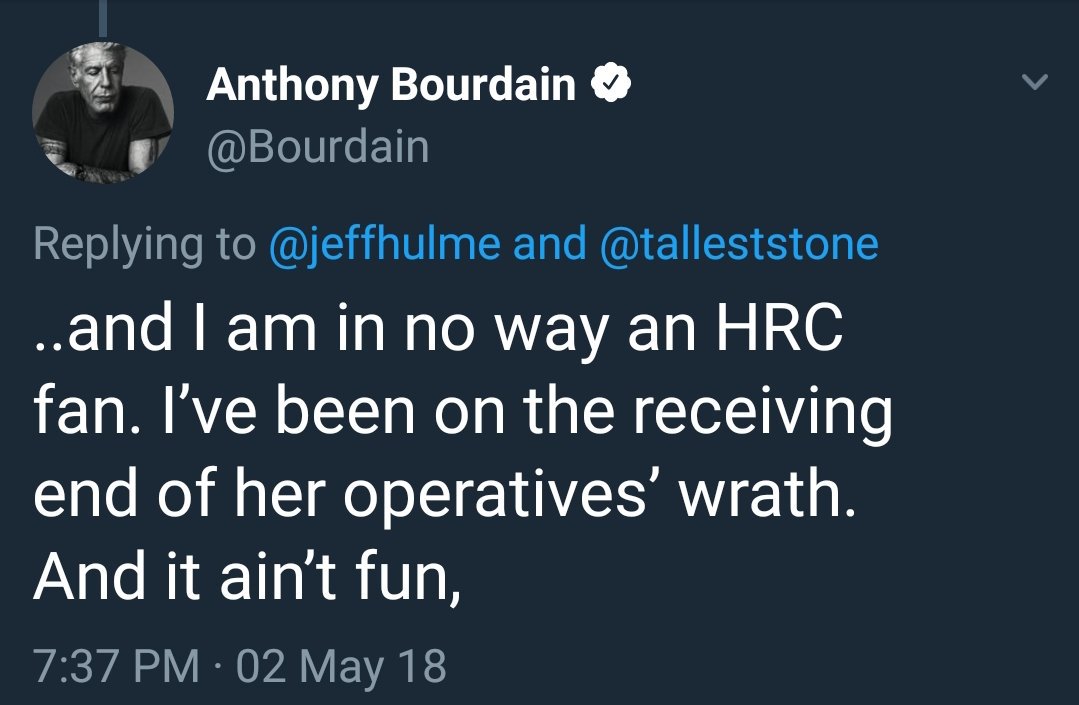
 
Parts Unknown is one of my favorite TV programs. This is so tragic and so shocking to me. By most accounts Bourdain seemed to be on top of the world. He was apparently in love with an ex model. He had 5 Emmy's and a Peabody because of his work and his ingenuity. I guess you just never know what goes through a human's mind. He obviously had too much pride to reach out to his friends, family and colleagues to seek the help he needed. And given that he had a young daughter it's even more surprising he would commit the act of ultimate selfishness.
 
He obviously had too much pride to reach out to his friends, family and colleagues to seek the help he needed. And given that he had a young daughter it's even more surprising he would commit the act of ultimate selfishness.

You think it's pride that stops people from getting help? The ignorance and prejudice behind these statements are unreal.
 
You think it's pride that stops people from getting help? The ignorance and prejudice behind these statements are unreal.
Of course I do. Particularly with men. We don't want to admit our failures or weaknesses. How you can think this is ignorant or prejudiced is simply asinine.
 
Of course I do. Particularly with men. We don't want to admit our failures or weaknesses. How you can think this is ignorant or prejudiced is simply asinine.

You have absolutely no fucking clue what you are talking about. The bullshit you are spewing is everything that is wrong in this culture's attitude towards mental illness.
 
You have absolutely no fucking clue what you are talking about. The bullshit you are spewing is everything that is wrong in this culture's attitude towards mental illness.
I guess in your world hard truths = bullshit.
 
I guess in your world hard truths = bullshit.

Tell you what: scroll up a few posts to where I describe the reasons I've had difficulty at times reaching out for help, and tell me it's all about pride. Since you are speaking of "hard truths," explain to me how you know Anthony Bourdain's issue was his pride. Or the approximately 1,000,000 who die every year from suicide, who I suppose all have the same problem?

The problem here isn't pride, but it is in part shame. Those suffering from mental illness are often prone to feeling shame and guilt (in particular these are common signs of depression, though it should be noted that depression is far from the only mental illness that should be talked about when it comes to suicide) but rather than have empathy and understanding for this, our society reaffirms it. Statements like yours confirm that we live in a culture that stigmatizes mental illness. It ultimately boils down to the attitude that mental illness comes from a lack of moral character. It is the same nonsense that furthers the belief that suicide is the easy way out. If you think there's anything easy about feeling suicidal, then you have no idea how wrong you are. And that, absolutely, is prejudice and ignorance. It borders on hate speech. So if you want to know where a big part of the problem is here--why a person would feel unable to reveal how hard it is for them--look in the mirror.
 
I don’t mean to respond in a manner that comes off as harsh, because I don’t believe you meant any harm by this, but watching a 60 Minutes episode on the subject doesn’t mean you have any idea what it’s like. Nor do I wish to discourage people from participating in this conversation, because our culture absolutely needs more willingness to participate in this conversation. But unless you’ve been there you have absolutely no idea what you’d do in this situation. Even if you have been there, you still don’t know what you’d do if you were there again. I’ve been through several depressions and each time it feels different.

I can of course only speak for myself, but here are some of the reasons I’ve had difficulty asking for help at different times in my life:
  • It immediately intensifies the feelings of despair and anxiety I am experiencing.
  • This gets overstated sometimes, but the illness has a way of making you think it’s not an illness, especially when it’s newer to you, so you deny the idea of needing help.
  • It feels like an inevitable part of my experience. The first time I was actively suicidal (as in, I actually acted in a manner intended to cause my death) I was 10 years old.
  • It’s programmed into me to keep quiet, as I grew up in a family that refuses to discuss these issues most of the time.
  • I’m afraid of people not responding. This is not without precedent—many precedents in fact. Case in point: many years back a co-worker of mine broke a few ribs in a training accident and had to stay in the hospital for a few days. She had flowers sent, received visits from people and got many phone calls. Not long after, I was hospitalized because I was suicidal, and came very close to seeing through an attempt. People at my work knew what happened, but no one contacted me at all while I was in the hospital. I could have died and got no response. People just don’t deal. I’ve had other occasions when people I cared about literally did nothing in response to me saying I was in trouble. My (now former) best friend of 15 years hasn’t been in touch with me for nearly a year. She knows I’ve been going through a bad depression and she just walked away. So the thought of reaching out for someone and getting no response is all too familiar, and it is terrifying.
  • But equally terrifying is the thought of getting a response. The idea of placing responsibility on someone for my struggle creates a lot of guilt. If that help comes from the health care system, I feel guilty for placing a burden on the system and taking help that I believe will do nothing for me, when someone else might benefit from those resources instead. Worse, there is the feeling that if I do ultimately die to suicide, then the more people I’ve involved, the more damage I’ve done.
  • I’ve tried many times before to get help from the health care system, yet here I am. I’ve had hospital stays, been through several therapists, trialed various medications, changed my diet, done regular exercise, completed mindfulness courses… It’s not from lack of trying.
  • Wait times can be very long.
  • Services can be prohibitively expensive. I could afford some things now, but there were periods in my life there was absolutely no way.
  • The system makes it impossible. There is one psychiatrist in my region accepting new patients. One. When I saw him, he said that he will not diagnose someone with a personality disorder unless he’s known them for years. But he also won’t see patients more than a few times, so it is literally impossible to get a proper diagnosis if that is the issue.
  • I’ve had many negative experiences with health care workers. My last therapist suggested that what I needed was to find God, classifying my problem as spiritual rather than medical—and this was from a doctor by the way. When my parents first learned about my suicidal ideation, it was because a doctor blurted it out in conversation assuming they already knew. I have directly received intimidation and threats of forced medications from nurses without me having made any move to harm myself or anyone else. I’ve witnessed firsthand a nurse yelling at a patient to “shut the fuck up” because she was screaming all night and no one did anything to help her. And I’ve heard similar horror stories from others.
  • I’m afraid to be locked in a hospital and have the power to end my life taken away. Paradoxically, the ability to end your life can feel like the only means you have to control your depression, whether you intend to see it through or not.
  • The stigma is very real. You don’t have to look further than this thread, or other current/recent threads on the subject, to find the act of suicide described as a sign of selfishness, immaturity, cowardice and weakness. A society that does embarrassingly little to help people deal with severe depression has the gall to call those people selfish. Placing responsibility on a person in that position for the feelings of others while accepting no responsibility for that person’s illness is the essence of hypocrisy.

And those are the reasons I can think of right now why it’s been hard to get help. Of course they do very little to describe the effects of the illness more generally. So please, to anyone who has judgments about suicide and the mental illness that can lead to it, or who thinks they know what they would do in that situation, perhaps take a moment to consider that you don’t understand it at all.
Hate to say this, but too bad that's life.

Just because you have/had mental issues, don't blame the world. In your 10+ bullets points, you've blamed everything and everyone from yourself, to friends, to government services and health workers.

For example, you criticized doctors and medical staff. Something like mental issues is subjective and everyone is different. It's not like fixing a bug in a piece of software. Maybe some people respond fine to religion and finding peace with God is something positive that may help. For you it's not a good idea since you think the med staff are idiots for recommending it. How is one to know?

People are human at the end of the day. So that nurse you criticized for telling a patient to "shut the fuck up", guess what? She's human too trying her best as a nurse. She isn't a robot. At some point even she got frazzled enough hitting her threshold of tolerance. How would you like it if someone kept screaming all night?

So as you can see, it does goes both ways.

The world owes you nothing. And to be honest, you should feel lucky that places like Canada try to help out with medical services. In lots of other countries, you'd get nothing.

A reason why your coworker who broke ribs got visitors, probably a get well card and all that is because it was an unlucky accident. Her state of mind is no different than usual. But got unlucky hurting herself in an accident.

The reason why most people won't reach out to heavily depressed people or suicidal people is multifold:

- 99% of people aren't health care workers and have no idea what to do or say

- Most of what they say, you'd probably tell them to fuck off anyway "as they don't understand"... see my point above about medical staff and religious suggestion.

- And if someone is terminally suicidal, nobody wants to risk getting hurt as some suicidal people will try to take down others with them

- In terms of coworkers, anyone who is in serious mental/stress issues are isolated.... and a reason is because employees are told not to contact the person. Not because to be pricks, but because due to legality issues, people deemed on leave of absence are not to be contacted. This is to ensure they get better, not stressed about work or people hassling them, and the company/insurance doesn't want to be found contributing to someone's condition by bothering them when they are ill. So if you want to blame someone, blame your HR department not your fellow coworkers
 
Hate to say this, but too bad that's life.

Just because you have/had mental issues, don't blame the world. In your 10+ bullets points, you've blamed everything and everyone from yourself, to friends, to government services and health workers.

I'm not sure what your point here is exactly. This is not a list of reasons why I have a mental illness. It is a list of reasons why it's hard to ask for help. That was precisely the context in which I introduced it.

For example, you criticized doctors and medical staff. Something like mental issues is subjective and everyone is different. It's not like fixing a bug in a piece of software. Maybe some people respond fine to religion and finding peace with God is something positive that may help. For you it's not a good idea since you think the med staff are idiots for recommending it. How is one to know?

People are human at the end of the day. So that nurse you criticized for telling a patient to "shut the fuck up", guess what? She's human too trying her best as a nurse. She isn't a robot. At some point even she got frazzled enough hitting her threshold of tolerance. How would you like it if someone kept screaming all night?

So as you can see, it does goes both ways.

The doctor didn't just suggest that I might get some assistance from religion. She described in some detail her religious beliefs about me and implied quite strongly that what I needed was to find God. That is unethical.

I was there when the patient was screaming all night. Did I like it? No. But no one did anything to help her. The nurse was male, by the way, and the patient was an elderly woman. Understandable? Yes. But also abusive, and provides some insight as to why I would not wish to return to that place, which again was precisely the point. This is also the same place where I received threats from the nurses for no justifiable reason. I said nothing offensive to anyone, did not interfere with anyone's care, and never implied by word or action that I was a threat to myself or anyone else at that time. Would you like to ask for help by returning to the place you'd experienced these things?

The world owes you nothing. And to be honest, you should feel lucky that places like Canada try to help out with medical services. In lots of other countries, you'd get nothing.

Let's not confuse the idea that Canada has some mental health care spending for saying that it spends sufficiently. Quite to the contrary, in fact. And that isn't just my opinion; do a search.

A reason why your coworker who broke ribs got visitors, probably a get well card and all that is because it was an unlucky accident. Her state of mind is no different than usual. But got unlucky hurting herself in an accident.

- In terms of coworkers, anyone who is in serious mental/stress issues are isolated.... and a reason is because employees are told not to contact the person. Not because to be pricks, but because due to legality issues, people deemed on leave of absence are not to be contacted. This is to ensure they get better, not stressed about work or people hassling them, and the company/insurance doesn't want to be found contributing to someone's condition by bothering them when they are ill. So if you want to blame someone, blame your HR department not your fellow coworkers

Many false assumptions here. I worked at a very small business; far too small to have an HR department. There were no such policies in place. Indeed I was outright told at my return that it was because people found it awkward. And look, I get it. It's hard. I understand that as well as anyone. But saying it's hard on other people doesn't make it easier for me. Again, the point is to explain why it's hard to ask for help when you're in trouble, and the fact that people frequently respond by doing nothing at all is a big part of it. That isn't blame; it's reality.

- Most of what they say, you'd probably tell them to fuck off anyway "as they don't understand"... see my point above about medical staff and religious suggestion.

That is an assumption on your part with no basis. When people have genuinely made an effort to listen and be supportive, I've let them know how much I appreciated the effort. This is your misconception, not my issue.

- And if someone is terminally suicidal, nobody wants to risk getting hurt as some suicidal people will try to take down others with them

This is a tough subject. There is some evidence that murder-suicides have increased somewhat. But they also still account for a very small portion of completed suicides. When considered within the context of all suicide attempts (attempts are about 20 times more common than completed suicides), they represent a much smaller portion of suicidal behaviour. Horrific, to be sure, but society is far too quick to associate mental illness with violent behaviour. In general--with the exception of particular conditions--a person with mental illness is no more likely to be violent than anyone else. And keep in mind that people with mental illness are far more likely to be victims of violent behaviour than perpetrators.

The thing is, Occasionally, as I said before my post was not a list of reasons why I've had illness--it was very specifically to rebut the idea that anyone knows how they'd respond unless they'd been there, and to provide reasons why it's difficult to ask for help. Interestingly, there have been many calls here for people to talk about it when they are dealing with illness, but when I do, the response is criticism for explaining why it's difficult.
 
You think it's pride that stops people from getting help? The ignorance and prejudice behind these statements are unreal.

Bingo! Nobody that has had severe depression just can’t understand. I’ve had my teeth knocked out, and almost lost a finger. Either were nothing compared to the pain I feel when im not mentally right.
 
I don’t mean to respond in a manner that comes off as harsh, because I don’t believe you meant any harm by this, but watching a 60 Minutes episode on the subject doesn’t mean you have any idea what it’s like. Nor do I wish to discourage people from participating in this conversation, because our culture absolutely needs more willingness to participate in this conversation. But unless you’ve been there you have absolutely no idea what you’d do in this situation. Even if you have been there, you still don’t know what you’d do if you were there again. I’ve been through several depressions and each time it feels different.

I can of course only speak for myself, but here are some of the reasons I’ve had difficulty asking for help at different times in my life:
  • It immediately intensifies the feelings of despair and anxiety I am experiencing.
  • This gets overstated sometimes, but the illness has a way of making you think it’s not an illness, especially when it’s newer to you, so you deny the idea of needing help.
  • It feels like an inevitable part of my experience. The first time I was actively suicidal (as in, I actually acted in a manner intended to cause my death) I was 10 years old.
  • It’s programmed into me to keep quiet, as I grew up in a family that refuses to discuss these issues most of the time.
  • I’m afraid of people not responding. This is not without precedent—many precedents in fact. Case in point: many years back a co-worker of mine broke a few ribs in a training accident and had to stay in the hospital for a few days. She had flowers sent, received visits from people and got many phone calls. Not long after, I was hospitalized because I was suicidal, and came very close to seeing through an attempt. People at my work knew what happened, but no one contacted me at all while I was in the hospital. I could have died and got no response. People just don’t deal. I’ve had other occasions when people I cared about literally did nothing in response to me saying I was in trouble. My (now former) best friend of 15 years hasn’t been in touch with me for nearly a year. She knows I’ve been going through a bad depression and she just walked away. So the thought of reaching out for someone and getting no response is all too familiar, and it is terrifying.
  • But equally terrifying is the thought of getting a response. The idea of placing responsibility on someone for my struggle creates a lot of guilt. If that help comes from the health care system, I feel guilty for placing a burden on the system and taking help that I believe will do nothing for me, when someone else might benefit from those resources instead. Worse, there is the feeling that if I do ultimately die to suicide, then the more people I’ve involved, the more damage I’ve done.
  • I’ve tried many times before to get help from the health care system, yet here I am. I’ve had hospital stays, been through several therapists, trialed various medications, changed my diet, done regular exercise, completed mindfulness courses… It’s not from lack of trying.
  • Wait times can be very long.
  • Services can be prohibitively expensive. I could afford some things now, but there were periods in my life there was absolutely no way.
  • The system makes it impossible. There is one psychiatrist in my region accepting new patients. One. When I saw him, he said that he will not diagnose someone with a personality disorder unless he’s known them for years. But he also won’t see patients more than a few times, so it is literally impossible to get a proper diagnosis if that is the issue.
  • I’ve had many negative experiences with health care workers. My last therapist suggested that what I needed was to find God, classifying my problem as spiritual rather than medical—and this was from a doctor by the way. When my parents first learned about my suicidal ideation, it was because a doctor blurted it out in conversation assuming they already knew. I have directly received intimidation and threats of forced medications from nurses without me having made any move to harm myself or anyone else. I’ve witnessed firsthand a nurse yelling at a patient to “shut the fuck up” because she was screaming all night and no one did anything to help her. And I’ve heard similar horror stories from others.
  • I’m afraid to be locked in a hospital and have the power to end my life taken away. Paradoxically, the ability to end your life can feel like the only means you have to control your depression, whether you intend to see it through or not.
  • The stigma is very real. You don’t have to look further than this thread, or other current/recent threads on the subject, to find the act of suicide described as a sign of selfishness, immaturity, cowardice and weakness. A society that does embarrassingly little to help people deal with severe depression has the gall to call those people selfish. Placing responsibility on a person in that position for the feelings of others while accepting no responsibility for that person’s illness is the essence of hypocrisy.

And those are the reasons I can think of right now why it’s been hard to get help. Of course they do very little to describe the effects of the illness more generally. So please, to anyone who has judgments about suicide and the mental illness that can lead to it, or who thinks they know what they would do in that situation, perhaps take a moment to consider that you don’t understand it at all
Hey bro, I had no idea you (and others) were suffering that badly from depression.
If its that bad then my hear goes out to you, and I hope you find some peace eventually.

All the best
 
Hate to say this, but too bad that's life.

Just because you have/had mental issues, don't blame the world. In your 10+ bullets points, you've blamed everything and everyone from yourself, to friends, to government services and health workers.

For example, you criticized doctors and medical staff. Something like mental issues is subjective and everyone is different. It's not like fixing a bug in a piece of software. Maybe some people respond fine to religion and finding peace with God is something positive that may help. For you it's not a good idea since you think the med staff are idiots for recommending it. How is one to know?

People are human at the end of the day. So that nurse you criticized for telling a patient to "shut the fuck up", guess what? She's human too trying her best as a nurse. She isn't a robot. At some point even she got frazzled enough hitting her threshold of tolerance. How would you like it if someone kept screaming all night?

So as you can see, it does goes both ways.

The world owes you nothing. And to be honest, you should feel lucky that places like Canada try to help out with medical services. In lots of other countries, you'd get nothing.

A reason why your coworker who broke ribs got visitors, probably a get well card and all that is because it was an unlucky accident. Her state of mind is no different than usual. But got unlucky hurting herself in an accident.

The reason why most people won't reach out to heavily depressed people or suicidal people is multifold:

- 99% of people aren't health care workers and have no idea what to do or say

- Most of what they say, you'd probably tell them to fuck off anyway "as they don't understand"... see my point above about medical staff and religious suggestion.

- And if someone is terminally suicidal, nobody wants to risk getting hurt as some suicidal people will try to take down others with them

- In terms of coworkers, anyone who is in serious mental/stress issues are isolated.... and a reason is because employees are told not to contact the person. Not because to be pricks, but because due to legality issues, people deemed on leave of absence are not to be contacted. This is to ensure they get better, not stressed about work or people hassling them, and the company/insurance doesn't want to be found contributing to someone's condition by bothering them when they are ill. So if you want to blame someone, blame your HR department not your fellow coworkers

Get off your high horse already.

The guy was just relating his experiences which was based on his first hand experience.

Try having some sympathy for a change.
 
If anyone noticed, Anthony Bourdain had aged rapidly in the last two years. He looked older than his 61 years.

He was a gold mine to CNN, but they didn't look after him very well. I have a hunch he started to have liver and stomach problems from all the drinking and smoking he'd done. Not to mention the psychological scabs of being addicted to heroin.

Something else to consider, Mario Batali let him down. He and Bourdain were best friends, on screen they were the Stan and Ollie of cuisine. Batali featured prominently on No Reservations. The accusations of sexual misconduct against Batali must have hit him hard. Driven home by dating Asia Argento, one of the women that Harvey Weinstein raped.

He looked fit but I suspect he was in a very fragile state all around - and he looked it.

p1piuglv2cb50lkg0bxe.png
 
Hey bro, I had no idea you (and others) were suffering that badly from depression.
If its that bad then my hear goes out to you, and I hope you find some peace eventually.

All the best

Thank you. The accumulation of silence and denial as the default response to this issue can quite literally be a killer, so your words are most appreciated. All the best to you too.
 
And in the 21 years since MH, how about the thousands and thousands of the mere non-celebrities. No mention of those?

I roll my eyes when I read comments like this. ^^^

The answer is pretty obvious. Celebrity suicides get mentioned, because they're celebrities. As in, millions and millions of people have some sort of connection to them. When non-famous people commit suicide, it's no less tragic but it won't make the evening news or blow up the Twittersphere.

That's not to say their deaths don't affect their friends, families and loved ones but you can't expect the news to report every single suicide. Nor should they.

If you ask your friends, I think just about everyone knows someone who's ended their own life.

A childhood friend who I used to hang out with all the time, took a handful of pills one day. He was 19.

My ex-gf's co-worker, who used to join us for regularly for after work drinks, hanged himself in his apartment. He was super good looking, funny, charming, witty and had women practically lining up to date him. He was 29.

Then there was my longtime friend's sister-in-law. She had a loving husband, 2 beautiful children and was recently promoted to a new job that she was very excited about. Seemingly had everything going right in her life. Her husband said she wanted to finish up some paperwork then was coming to bed. She left their house, took the bus to the subway and jumped in front of a train. She was 33.
 
Thank you. The accumulation of silence and denial as the default response to this issue can quite literally be a killer, so your words are most appreciated. All the best to you too.


Thanks for sharing your experiences. Depression is an evil bastard. The idea that a person can think their way out of it is completely ignorant, but a common misconception, as can be seen in this thread.