installing a light switch

Does the stove light operate when the switch is not installed?

Also, is the black wire coming from the stove light live?

yes it does

the live wire branches to the stovelight which has its own switch

I presume the wire coming from the stove light is not live
 
it is a 2 way switch

the stove light is a house light that sits over the stove along with an exhaust hood and fan

I cannot reconnect the wires like they were connected to the old switch because I never took the old switch out

so, we have a two way switch and two wires, both black


the live wire branches off to the stove light

the dead wire connects to the ceiling light

two wires and two connections on the two way switch

does it matter which wire goes where ?

the answer appears to be no
A simple switch makes or breaks the connection between two wire ends. It doesn't matter which end goes to which terminal on the switch, and the circuit can be interrupted anywhere. That is theory. Works whether the supply is from DC Battery or AC house-panel:
Simple_Circuit.jpg

Practical: House wire runs in cables with two conductors (black and white) and a bare ground. That let's everyone understand the function (and danger) of every wire they see. You can think of a negative battery terminal connecting to the white and the positive to the black. For safety, the black wire is the only wire that is interrupted by switches. The white makes a continuous run from panel to fixtures:
switch-light.jpg
light-switch.jpg
light-switchoutlet.jpg

In the second and third examples, note that the end of the white wire attached to the switch has been coloured black in all the boxes where it can be seen. That's because it is being used to extend the black wire from the fixture-box to the switch and back to the lamp. Sadly no one makes cable with two black conductors. What this means (if the electrician coloured his wires as he's supposed to) is that two black wires always connect to the two terminals on your switch. Always. So the path always reduces back down to that same path in the battery diagram; any other wires in the box are just passing through.

For you: Ignore all pix but the battery diagram and the first practical drawing.

•Get a new switch that is the same type (two screw terminals, not three or more) as the old switch has.
•Cut the power to the switch and the light it controls at the panel. Test to make sure it's now safe.
•One by one take the two wires from the old switch and move them to the new switch. It doesn't matter which wire goes to which screw terminal.
•Ignore all the other wires, do not disturb them.
•Make sure all connections are tight and secure, and that any other wires in the box are also good.
•Mount the new switch to the box so it is ON when it's flicked up/pressed in at the top. Restore power and test your work.

Please, this thread has gotten complicated enough, with sidebars about three-way switches and phases and now for the first time you mention a ceiling light. Replace only the one defective switch, do nothing else. Do NOT even do that if you have not verified that the two wires you are going to work with are both dead, because you have cut the power.

Please also note, that only you have diagnosed your problem as a defective switch and a replacement as the fix. Replacing the switch should not make anything worse, but if it doesn't fix the problem after all, then you'll have to describe your problem better.

I do recommend the huge resources of the Toronto Public Library, they have many well-written and well-illustrated books on household wiring for DIY types, and the Ontario Electrical Code Simplified which I am fond of. It has all the info a DiYer needs to wire an entire small house.
----
PS: SPST=Single pole, just one end for the switch to makes contact, Single throw, just one direction for it to move. That's the tech-talk version of our 2-way switch.
 
Last edited:
Yes - I just looked at the toggles without counting the screws - it's not that common. I'm curious about the application.

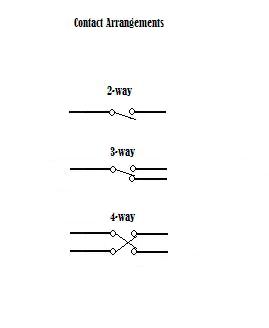
We all have our unique ways of describing a switch but in my ancient days - two way switch suggests that there are two positions that the switch can make contact (e.i: single pole / double throw). A typical two way switch in house wiring is used like this:
3way_zps3baf0d4f.jpg


These would be used to control a light from two different locations (ex: a hall light from top and bottom of a staircase)

By my definition, that's a 3-way switch. But, I agree with you, I think maybe the nomenclature has changed over time or perhaps different countries call it different things? If you google image "2 way switch" and "3 way switch" you will see the results are basically the same, which is confusing.

I'm old-school electrical and here's what I use:
269xNxcontact-diag.jpg.pagespeed.ic.yMn3HZ-O_h.jpg


wikipedia uses old-school: https://en.wikipedia.org/wiki/Multiway_switching

Electrical suppliers appear to follow the old-school definitions too. Examples:
https://www.homedepot.ca/en/home/p....-way-15a-120v-in-light-almond.1000742583.html
https://www.homedepot.ca/en/home/p.toggle-switch-3-way-white--6-pack.1000480335.html
http://www.canadiantire.ca/en/search-results.html?searchByTerm=true&q=2+way+switch

But, above examples aside, when I was googling around there are a tons of pages that use your definition too. Who knows?
 
A simple switch makes or breaks the connection between two wire ends. It doesn't matter which end goes to which terminal on the switch. That is theory.

Practical: Get a new switch that is the same type (two screw terminals, not three or more) as the old switch has. Cut the power to the switch and the light it controls at the panel. Test to make sure it's now safe. One by one take the two wires from the old switch and move them to the new switch. It doesn't matter which wire goes to which screw terminal. Ignore all the other wires, do not disturb them. Make sure all connections are tight and secure, and that any other wires in the box are also good. Mount the new switch to the box so it is ON when it's flicked up/pressed in at the top. Restore power and test your work.

Please, this thread has gotten complicated enough, with sidebars about three-way switches and phases and now for the first time you mention a ceiling light. Replace only the one defective switch, do nothing else. Do NOT even do that if you have not verified that the two wires you are going to work with are both dead, because you have cut the power.

Are you suggesting he use the tongue test or the screwdriver test? I prefer the mother-in-law technique, but she's still shaking after the last job I completed.

At least you are no longer talking down to Yoga and you've reverted to clear English instead of that other language you usually post in. :p
 

BTW, that diagram is wrong and will result in a DANGEROUS installation. You will note that the neutral (white wire) goes to the bottom of the light receptacle. That's wrong, it should go to the shell. The live wire (black wire in this example) should go to the bottom.

Reasoning when properly wired: When replacing a bulb, the idea is that when the user unscrews it, if his hand slips and touches the metal threads, he won't be energised and potentially receive a shock. By placing the live wire on the bottom, after a 1/4-1/2 turn, the live is disengaged and touching the threads won't matter. During that first 1/4-1/2 turn, the outer grounded shell of the receptacle prevents the user from touching the energised threads.

I do realize that's not your picture and therefore not your error.
 
Are you suggesting he use the tongue test or the screwdriver test? I prefer the mother-in-law technique, but she's still shaking after the last job I completed.

At least you are no longer talking down to Yoga and you've reverted to clear English instead of that other language you usually post in. :p
Thanks for your commentary on another of my replies to YogaFace. You're always so sweet, especially when adding details you neglected the first time around. You never did say what part of my earlier post you didn't understand, so I couldn't help by clarifying for you.

If YogaFace can't test for live wires he has no business mucking around inside an electrical box until he can. Nor does anyone. My own close call came when my electrician told me to "go ahead and cut that old wire", because he'd finished replacing all the old wiring and everything was now new work fed by the new panel. I certainly wish he'd used the tongue test. And my side-cutters still have a melt-gouge in the blade to remind me.

Test. Do not assume. Do not trust.