


Karl Sanchez
Jul 09, 2026
The roots of this problem are over 100 years old with the competition between Imperialist Colonial Empires for mastery of the Global System as it then existed and as it’s evolved due to the effects of three previous and now a fourth global war. Over those years and conflicts, the competition’s been reduced to the remnants of the initial Imperialist Colonial Empires, which are now distilled to the Collective Western Empire led by the Outlaw US Empire, versus three Civilization States—China, Russia and Iran and their allies within the Global Majority. Professor Richard Wolff has dubbed this the Last Great Colonial War. I see it as the War to Eliminate Hegemony.
Resistance to hegemony has existed for centuries but was greatly escalated with the onset of what’s known as the Scramble for Africa that placed all the Colonial/Imperial Empires into direct competition for what remained. One Empire that was placed on the menu was the Ottoman Empire—the Sick Man of Europe as it was then known whose lands were coveted by the other empires. And one Empire hadn’t really arrived on the world stage yet—the US Empire. Just prior to and as the 20th Century began, new views on how to attain systematic hegemonic control of the world were being voiced by the United States and the United Kingdom with Halford Mackinder’s system becoming dominant: control of the Eurasian Heartland via the maritime empires’ control of the oceans which is where most commercial trade took place as overland communication routes were very few at the time. And that doctrine also brought Japan into the mix as it had its eyes on Korea, Manchuria and the rest of East Asia to which it was suggested it control by President Roosevelt after Japan beat Russia in the 1904-5 war—Japan was to be an agent, a proxy of the USA in East Asia, or so it was suggested and interpreted by the Americans and Japanese at the time as I reported in an earlier article. So, naval power served the Imperial need to exert power and control colonies, and great competition ensued that continued after WW1.
The first two world wars, or parts one and two of the first, ruined the European Colonial powers as they devastated each other and the same happened to Japan in the Pacific. The one Empire left standing was the US Empire that became an Outlaw as soon as the UN Charter became the accepted international law by the world’s nations. During the war, US planners schemed to obtain post-war dominance in a way that would allow the Empire to control most of the planet using a method that was called indirect/informal colonialism that used financial fetters instead of occupying armies. Decolonization on a formal basis was slowly and grudgingly allowed at great cost to those nations wanting independence from their broken colonial masters.
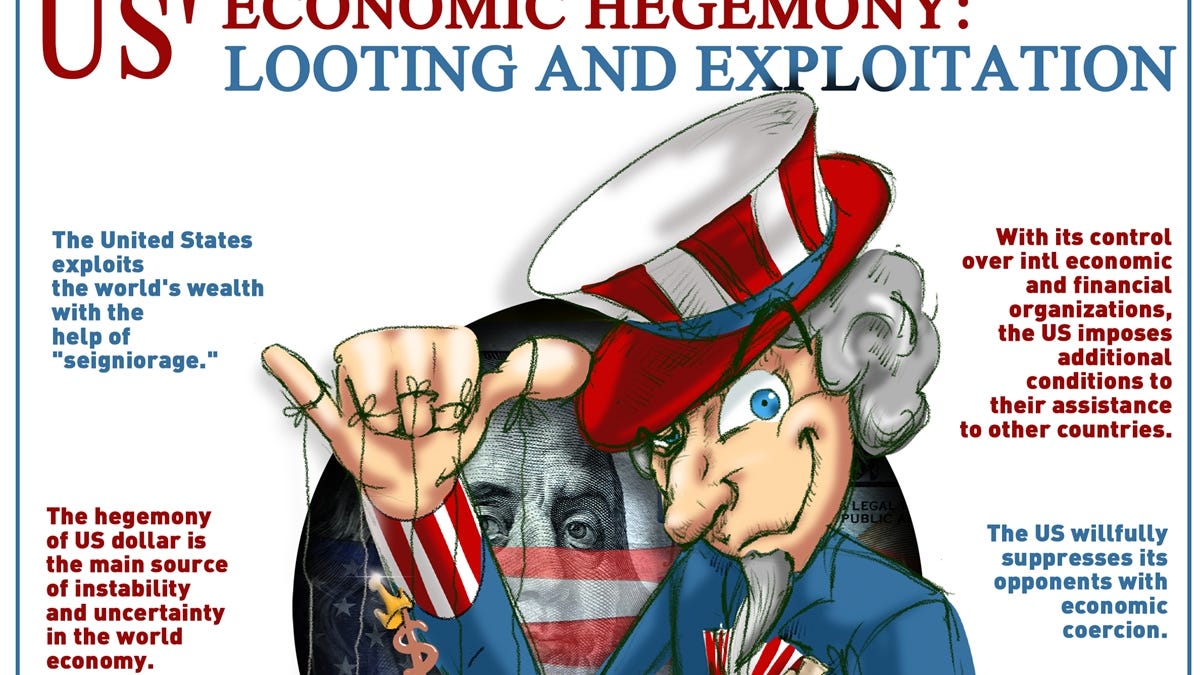
Wars were fought by the Outlaw US Empire to ensure those new nations would be controlled by it and not attain complete sovereignty. The key method was to use a tool initiated prior to WW2 that was known as Dollar Diplomacy which was enforced by the US Marines and prompted General Smedly Butler to write his seminal War is a Racket that testified to the Mafiosi methods of extracting money from what were supposedly independent sovereign nations. Those methods were modified and utilized by two new Bretton Woods institutions formulated in 1944—the World Bank and the International Monetary Fund both of which were under the complete control of the Empire. How they worked is well described in Dr. Michael Hudson’s Super Imperialism (1972) and was recently updated (2021) to reflect what had transpired over the intervening fifty years. The key is financial control mainly via dollar denominated loans and an international financial system based on dollars. This control is more powerful than many armies and navies, and as we’ve seen was recently weaponized to use against several nations the Outlaw US Empire has long coveted to control—Russia, Iran, Cuba, Venezuela. When Trump tried to use the dollar against China during his first term, he discovered China was too resilient and was forced to relent, although he tried again during his second term and lost very badly. China had anticipated and prepared. China also understands that for its economic policy goals to attain their objectives—global Win-Win trade via the Global Development Initiative—it will need to eliminate hegemony once and for all, and to accomplish that without entering into a shooting war with the Outlaw US Empire, although China’s military power can defeat the Empire. What China wants to avoid is the vast damage such a war would cause to the planet and Humanity. We’ve seen part of China’s plan with its industrial and technological development. But there’s more to it as was outlined in a 2024 speech made by Xi Jinping that was only publicly released last February and reported on here.
Recently more rumblings about what China’s already emplaced as a foundation for what Xi said in 2024: “Take the road of financial development with Chinese characteristics and build a financial power.” Recently on Dragon TV’s “This is China” program two episodes were aired, “How to Build a Financial Powerhouse,” and “Building a Strong Capital Market Nation,” which featured Professor Zhang Weiwei, Director of the China Research Institute at Fudan University, and Professor Zhang Keliang, a researcher at the National Institute of Financial and Economic Strategy at Central University of Finance and Economics, and moderator He Jie. These two programs give vital background to China’s emerging parallel financial system that is of its own creation and not aimed at displacing or directly competing with the established US Empire system; it’s an alternative. That it will be more modern, less costly for users and without coercive hooks are just matter-of-fact and not aimed at anyone as the Chinese Foreign Ministry likes to say. Of course, the reality is that is a competitor with Win-Win benefits for users.
I pause for an aside. Today’s Wolff/Hudson/Nima discussion looks at the Big Picture as they’ve done often. Hudson in summation might have said Neoliberals are what Rump refers to as Communists, while using the term Neofeudalists instead–since they covet rent and 100% control. Wolff provides an excellent example of how there are two tails wagging the dog–-Zionist and European–-for very similar reasons. Ultimately, the conflict is between the Global Majority and the Outlaw US Empire for the former’s freedom from Colonial Mafia control. Currently, Russia and Iran are the main defenders of the Global Majority and are on the firing line. A significant portion of the Global Majority remains on the fence unable to see the Big Picture with clarity, which is why Hudson and Wolff frame their discussions together and separately as they do. The key is not to get distracted by the daily happenings but to see how they can be combined to provide the overview that’s required, otherwise the main conflict will be obscured as the Empire desires and its narrative insists. Pause over.
Since the Outlaw US Mafia Empire lacks military means as its wars on Iran and Russia have shown (yes, it does have some well-aged nukes), it’s weaponized the one main tool it has remaining, which is the one it devised during WW2 and since modified. Negating that tool is the main goal of Russia and China, a task that’s been underway for quite some time given the deep planning China undertook that’s hard to pin down to its genesis. The easiest way to negate that tool is to provide an alternate that nations wishing to be free can use. Warfare cannot do the job without totally defeating the Mafia Empire, which would invite it to use its nukes and clearly isn’t the goal of Chinese or Russian planners. Mafia hegemony must be made inert without direct war between China/Russia and Empire. China’s choice to construct a very powerful financial system to complement its industrial and technological prowess is the method it’s chosen to negate hegemony. The “This is China” programs are aimed at explaining to Chinese how this will be done. That the information is being made public is a sign of China’s high degree of confidence that it will succeed. We now proceed with the transcript of “How to Build a Financial Powerhouse”:
Finance is the lifeblood of the national economy and an important component of a country’s core competitiveness. Building a strong financial nation has also become an essential part of China’s development in the new era. Although China is now a major financial powerhouse, with the largest bank scale and foreign exchange reserves in the world, the second largest bond and stock market scale, and the insurance scale also ranking among the top, overall it is large but not strong. Accelerating the construction of a strong financial nation is an inevitable requirement for fully building a modern socialist country and promoting high-quality development.
As a socialist country, what kind of financial theory should China have, and how should we build a strong socialist financial nation? On March 30th, on Dragon TV’s program “This Is China,” Professor Zhang Weiwei, Director of the China Research Institute at Fudan University, and Professor Zhang Keliang, a researcher at the National Institute of Financial and Economic Strategy at Central University of Finance
and Economics, engaged in an in-depth dialogue and discussion on the history and prospects of China’s financial development.
....................................................................................................
 karlof1.substack.com
Jul 09, 2026
The roots of this problem are over 100 years old with the competition between Imperialist Colonial Empires for mastery of the Global System as it then existed and as it’s evolved due to the effects of three previous and now a fourth global war. Over those years and conflicts, the competition’s been reduced to the remnants of the initial Imperialist Colonial Empires, which are now distilled to the Collective Western Empire led by the Outlaw US Empire, versus three Civilization States—China, Russia and Iran and their allies within the Global Majority. Professor Richard Wolff has dubbed this the Last Great Colonial War. I see it as the War to Eliminate Hegemony.
Resistance to hegemony has existed for centuries but was greatly escalated with the onset of what’s known as the Scramble for Africa that placed all the Colonial/Imperial Empires into direct competition for what remained. One Empire that was placed on the menu was the Ottoman Empire—the Sick Man of Europe as it was then known whose lands were coveted by the other empires. And one Empire hadn’t really arrived on the world stage yet—the US Empire. Just prior to and as the 20th Century began, new views on how to attain systematic hegemonic control of the world were being voiced by the United States and the United Kingdom with Halford Mackinder’s system becoming dominant: control of the Eurasian Heartland via the maritime empires’ control of the oceans which is where most commercial trade took place as overland communication routes were very few at the time. And that doctrine also brought Japan into the mix as it had its eyes on Korea, Manchuria and the rest of East Asia to which it was suggested it control by President Roosevelt after Japan beat Russia in the 1904-5 war—Japan was to be an agent, a proxy of the USA in East Asia, or so it was suggested and interpreted by the Americans and Japanese at the time as I reported in an earlier article. So, naval power served the Imperial need to exert power and control colonies, and great competition ensued that continued after WW1.
The first two world wars, or parts one and two of the first, ruined the European Colonial powers as they devastated each other and the same happened to Japan in the Pacific. The one Empire left standing was the US Empire that became an Outlaw as soon as the UN Charter became the accepted international law by the world’s nations. During the war, US planners schemed to obtain post-war dominance in a way that would allow the Empire to control most of the planet using a method that was called indirect/informal colonialism that used financial fetters instead of occupying armies. Decolonization on a formal basis was slowly and grudgingly allowed at great cost to those nations wanting independence from their broken colonial masters.
Wars were fought by the Outlaw US Empire to ensure those new nations would be controlled by it and not attain complete sovereignty. The key method was to use a tool initiated prior to WW2 that was known as Dollar Diplomacy which was enforced by the US Marines and prompted General Smedly Butler to write his seminal War is a Racket that testified to the Mafiosi methods of extracting money from what were supposedly independent sovereign nations. Those methods were modified and utilized by two new Bretton Woods institutions formulated in 1944—the World Bank and the International Monetary Fund both of which were under the complete control of the Empire. How they worked is well described in Dr. Michael Hudson’s Super Imperialism (1972) and was recently updated (2021) to reflect what had transpired over the intervening fifty years. The key is financial control mainly via dollar denominated loans and an international financial system based on dollars. This control is more powerful than many armies and navies, and as we’ve seen was recently weaponized to use against several nations the Outlaw US Empire has long coveted to control—Russia, Iran, Cuba, Venezuela. When Trump tried to use the dollar against China during his first term, he discovered China was too resilient and was forced to relent, although he tried again during his second term and lost very badly. China had anticipated and prepared. China also understands that for its economic policy goals to attain their objectives—global Win-Win trade via the Global Development Initiative—it will need to eliminate hegemony once and for all, and to accomplish that without entering into a shooting war with the Outlaw US Empire, although China’s military power can defeat the Empire. What China wants to avoid is the vast damage such a war would cause to the planet and Humanity. We’ve seen part of China’s plan with its industrial and technological development. But there’s more to it as was outlined in a 2024 speech made by Xi Jinping that was only publicly released last February and reported on here.
Recently more rumblings about what China’s already emplaced as a foundation for what Xi said in 2024: “Take the road of financial development with Chinese characteristics and build a financial power.” Recently on Dragon TV’s “This is China” program two episodes were aired, “How to Build a Financial Powerhouse,” and “Building a Strong Capital Market Nation,” which featured Professor Zhang Weiwei, Director of the China Research Institute at Fudan University, and Professor Zhang Keliang, a researcher at the National Institute of Financial and Economic Strategy at Central University of Finance and Economics, and moderator He Jie. These two programs give vital background to China’s emerging parallel financial system that is of its own creation and not aimed at displacing or directly competing with the established US Empire system; it’s an alternative. That it will be more modern, less costly for users and without coercive hooks are just matter-of-fact and not aimed at anyone as the Chinese Foreign Ministry likes to say. Of course, the reality is that is a competitor with Win-Win benefits for users.
I pause for an aside. Today’s Wolff/Hudson/Nima discussion looks at the Big Picture as they’ve done often. Hudson in summation might have said Neoliberals are what Rump refers to as Communists, while using the term Neofeudalists instead–since they covet rent and 100% control. Wolff provides an excellent example of how there are two tails wagging the dog–-Zionist and European–-for very similar reasons. Ultimately, the conflict is between the Global Majority and the Outlaw US Empire for the former’s freedom from Colonial Mafia control. Currently, Russia and Iran are the main defenders of the Global Majority and are on the firing line. A significant portion of the Global Majority remains on the fence unable to see the Big Picture with clarity, which is why Hudson and Wolff frame their discussions together and separately as they do. The key is not to get distracted by the daily happenings but to see how they can be combined to provide the overview that’s required, otherwise the main conflict will be obscured as the Empire desires and its narrative insists. Pause over.
Since the Outlaw US Mafia Empire lacks military means as its wars on Iran and Russia have shown (yes, it does have some well-aged nukes), it’s weaponized the one main tool it has remaining, which is the one it devised during WW2 and since modified. Negating that tool is the main goal of Russia and China, a task that’s been underway for quite some time given the deep planning China undertook that’s hard to pin down to its genesis. The easiest way to negate that tool is to provide an alternate that nations wishing to be free can use. Warfare cannot do the job without totally defeating the Mafia Empire, which would invite it to use its nukes and clearly isn’t the goal of Chinese or Russian planners. Mafia hegemony must be made inert without direct war between China/Russia and Empire. China’s choice to construct a very powerful financial system to complement its industrial and technological prowess is the method it’s chosen to negate hegemony. The “This is China” programs are aimed at explaining to Chinese how this will be done. That the information is being made public is a sign of China’s high degree of confidence that it will succeed. We now proceed with the transcript of “How to Build a Financial Powerhouse”:
Finance is the lifeblood of the national economy and an important component of a country’s core competitiveness. Building a strong financial nation has also become an essential part of China’s development in the new era. Although China is now a major financial powerhouse, with the largest bank scale and foreign exchange reserves in the world, the second largest bond and stock market scale, and the insurance scale also ranking among the top, overall it is large but not strong. Accelerating the construction of a strong financial nation is an inevitable requirement for fully building a modern socialist country and promoting high-quality development.
As a socialist country, what kind of financial theory should China have, and how should we build a strong socialist financial nation? On March 30th, on Dragon TV’s program “This Is China,” Professor Zhang Weiwei, Director of the China Research Institute at Fudan University, and Professor Zhang Keliang, a researcher at the National Institute of Financial and Economic Strategy at Central University of Finance
and Economics, engaged in an in-depth dialogue and discussion on the history and prospects of China’s financial development.
....................................................................................................
How to Limit a Global Hegemon Without Expanded Kinetic War
The Eurasian pathway and highly insightful long-term planning
karlof1.substack.com

