How much are you down right now?

NaSDAQ 3.8%
Dow 3%
TSX 2.6 %

all up today


that is why you do not bail then wait for bull

you will miss it

I will see what I gained when the market opens

$30 k is my guess

I am not bragging but I was once not only broke but in debt

i will always be grateful I have money and never take it for granted

Once $30 K was a dream that seemed years away because it was
 
Definitely, I am thinking of putting in another 30K.

I would normally agree as I have 100 K in safe money that I can put in but Trump is a true wild card, he is the joker actually with no controls and scary.
So I go against my investment philosophy and lean towards security so the 100 k is there for me which reduces stress
 
I would normally agree as I have 100 K in safe money that I can put in but Trump is a true wild card, he is the joker actually with no controls and scary.
So I go against my investment philosophy and lean towards security so the 100 k is there for me which reduces stress

How about security against inflation?
 
How about security against inflation?
Bonds and high interest etf cover inflation so you remain stable but without profit
and bonds often rise as investors flee the market and buy them
 
Just to be picky, Bonds rise according to interest rates. Bond prices are inversely correlated with interest rates: when rates go up, bond prices fall, and vice versa. While bond prices may rise per demand, it's a very, very, VERY, small component of its overall pricing.
 
  • Like
Reactions: fall
overnment respnds.
Just to be picky, Bonds rise according to interest rates. Bond prices are inversely correlated with interest rates: when rates go up, bond prices fall, and vice versa. While bond prices may rise per demand, it's a very, very, VERY, small component of its overall pricing.

Agree but it is complex.

Investors want safety in a bear so demand for bonds increases and a market bear can drop interest rates as government responds.

Bonds traditionally fall less than the market and may even rise

If you want safety guaranteed buy T Bills or high interest rate ETF where the ETF uses its billions to negotiate higher interest rates from banks.

That is where I put my safe money to ride out downturns so I am not forced to sell low
 
Just to be picky, Bonds rise according to interest rates. Bond prices are inversely correlated with interest rates: when rates go up, bond prices fall, and vice versa. While bond prices may rise per demand, it's a very, very, VERY, small component of its overall pricing.
Hard to get too excited about bonds. It was only around the start of the pandemic that the 40 year decline in interest rates ended.
 
Bonds and high interest etf cover inflation so you remain stable but without profit
and bonds often rise as investors flee the market and buy them

Only if you do not take into account income taxes. With a marginal tax rate just under 50%, the bond yield must be twice as high as inflation so that after tax you will just keep up with the inflation. With the current bond yield of 4% and inflation 2.3% (I think), you are 0.3% short after you pay your taxes :(. But yes, in general, after-tax long-term bonds are just enough to cover the inflation.
 
Foolish to jump in and out when value drops then u mid gains and discounted buys when market goes up. More important to stay balanced to insulate and to stay away from junk stocks. Put ur bulk in trusts to insulate from taxes and make urself a beni
 
Only if you do not take into account income taxes. With a marginal tax rate just under 50%, the bond yield must be twice as high as inflation so that after tax you will just keep up with the inflation. With the current bond yield of 4% and inflation 2.3% (I think), you are 0.3% short after you pay your taxes :(. But yes, in general, after-tax long-term bonds are just enough to cover the inflation.
Do private equity. Better rates then u 2 can lend out like a bank
 
Do private equity. Better rates then u 2 can lend out like a bank

I have some money in a Mortgage Investment Corporation. Returns a goal of 8.5% per year on one year term private second mortgages. Consistent track record of paying that goal, though by no means guaranteed, and not government insured. Income is taxed as interest, so better for RRSP's, etc. to defer the taxation.

The company I have it with is an large independent mortgage brokerage. They will not lend more than a total first and second mortgage of 65% loan to value based on a "current very conservative professionally appraised value". No condos. All loans only in the GTA.

Started Investing with them in 2018. Was very happy with them when fixed rate investment returns were very low.

And even over the past while, as safety is very important to me given my advanced age, I'm content to just watch the wild market swings since Trump became President again, and not worry about what he is going to do or say next...

If you do private mortgage lending yourself it can be even more lucrative, but you have to know what you're doing, especially if an individual loan starts going south...
 
Last edited:
I would normally agree as I have 100 K in safe money that I can put in but Trump is a true wild card, he is the joker actually with no controls and scary.
So I go against my investment philosophy and lean towards security so the 100 k is there for me which reduces stress


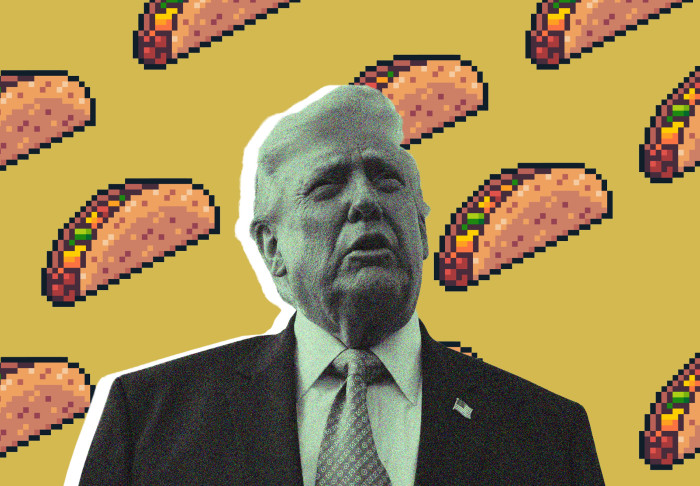
TACO Rules The Markets


How the ‘TACO’ trade went from a light-hearted Wall Street joke to a serious moneymaker
Since the start of President Trump’s second term, nine of the 10 top days for the S&P 500 have been spurred by de-escalation either involving tariffs or Iran

By
Joseph Adinolfi
Updated April 08, 2026 at 05:15 PM EDT


Gift unlocked article
Listen
(9 min)
image
Investors are making a meal out of President Trump’s tendency to back down on his own threats. Photo: MarketWatch photo illustration/Getty Images, iStockphoto
It started as a joke. But nowadays, nobody’s laughing.
Over the past year, the “TACO trade,” as many on Wall Street call it, has evolved from a humorous acronym, first popularized by a columnist with the Financial Times, into a major force in markets. As crude-oil prices soared in March following the start of the U.S. and Israel’s assault on Iran, many on Wall Street credited hopes for a swift “TACO” from President Trump with helping keep a floor under the stock market.
Even as oil prices CL00 BRN00 soared, raising the risk that the U.S. could sink into recession — or that another spike in consumer prices could pressure the Federal Reserve to hike interest rates — the S&P 500 SPX never even made it into correction territory, described as a drop of 10% or more from a recent high. As of Wednesday’s close, the index was off by about 0.9% since the start of 2026, FactSet data showed.
TACO, for those who aren’t familiar, is an acronym popularized last year by Robert Armstrong, a columnist with the FT. It stands for “Trump always chickens out,” and was initially inspired by Trump’s decision on April 9, 2025, to stage an abrupt about-face on tariffs — calling for a 90-day delay to make time for talks with U.S. trading partners.
See: The ‘Trump always chickens out’ trade is the talk of Wall Street. Here’s one way to play it.
Undergirding the trade is the idea that Trump is more sensitive than his predecessors to big swings in financial markets — particularly those that could potentially impact Republicans’ chances of maintaining control of Congress during the upcoming midterm elections. Trump has a reputation for treating the performance of the stock market as a barometer of his success as president.
MarketWatch looked back at the top 10 best days for the S&P 500 since Trump was sworn in to start his second term. By our count, during nine of these 10 sessions, gains were primarily driven by signs of de-escalation or compromise either pertaining to the White House’s tariffs or the conflict with Iran.
While there is no hard and fast definition of what constitutes a TACO, several Wall Street professionals who spoke with MarketWatch for this story agreed with our list of nine specific events.


To be sure, as expectations surrounding a TACO have become more embedded, the payoff following more recent de-escalations has become more muted. When headlines hinting at a potential Middle East cease-fire landed shortly before the closing bell on Tuesday, the S&P 500 and the Nasdaq Composite COMP immediately leapt higher, erasing earlier losses, as investors bet that a TACO from Trump might be imminent.
“The muscle memory from the post-‘liberation day’ selloff is still clearly with investors,” said Art Hogan, chief market strategist at B. Riley Wealth, during an interview with MarketWatch.
That said, this time around, some strategists raised doubts about whether Trump would be able to convince other parties to the conflict — namely, Israel and Iran — to also de-escalate. As of Wednesday, Hogan said, whether the cease-fire would hold remained to be seen.
But to truly take advantage of the TACO, investors needed to be invested before the opening bell on Wednesday, Hogan pointed out. That is because U.S. indexes saw big gains out the gate that were quickly tempered by headlines raising questions about the durability of the cease-fire agreement.
“It is pretty well-documented that if you miss the 10 best days of any given year, regardless of who is in office, you’re going to miss most of the upside,” Hogan added.
Here’s a breakdown of what drove markets during each of these days:
  • April 9, 2025: The original “TACO.” Trump announced a 90-day pause for most of his “liberation day” tariffs after the bond market — in Trump’s words — got “a little bit yippy.” The S&P 500 rose 9.5%, scoring its biggest one-day percentage gain in more than 16 years.
  • May 12, 2025: Investors cheered as the U.S. and China agreed to a reduce tariffs on one another for 90 days. The S&P 500 gained 3.3%.
  • March 31, 2026: Stocks shot higher on reports that Iranian President Masoud Pezeshkian might be open to ending the war, with conditions. Trump also made comments about the war coming to an end within two to three weeks. The S&P 500 rose 2.9%, its best day in 10 months.
  • April 22, 2025: Comments from senior Trump administration officials hinting at a coming de-escalation in the U.S.-China tariff standoff helped drive a 2.5% gain for the S&P 500.
  • April 8, 2026: This brings us to Wednesday, as investors cheered Trump and the Iranians agreeing to a two-week ceasefire, despite some worries that the fragile truce might not hold. The S&P 500 finished 2.5% higher.
  • March 14, 2025: A lack of fresh comments from Trump about his tariff plans was enough to push the S&P 500 to its biggest daily gain since the day after Election Day, helping stocks recover some of their losses from earlier that week. “On a fundamental basis, President Donald Trump (aka Tariff Man) didn’t tweet about tariffs today after doubling down on Thursday. … Any day without a Trump tariff comment is a good day for the market,” said Ed Yardeni, founder of Yardeni Research, in written commentary shared with MarketWatch at the time. The S&P 500 rose 2.1%.
  • May 27, 2025: U.S. stocks ended sharply higher after Trump said over Memorial Day weekend that he would delay the implementation of a 50% tariff on imports from the European Union. The S&P 500 rose by 2.1%, the best day in two weeks.
  • April 24, 2025: Signs of progress toward a trade deal with South Korea helped push stocks higher. The S&P 500 gained 2%, and exited correction territory.
  • Feb. 6, 2026: The lone session on this list where neither tariffs nor Iran played a major role in driving stocks higher. Instead, investors cheered the latest announcements from Big Tech companies about their plans for AI capital spending. The Dow Jones Industrial Average DJIA also crossed above 50,000 for the first time that day. The S&P 500 finished 2% higher.
  • April 11, 2025: Stocks rallied, with tech in the lead, as the Trump administration announced it would exclude semiconductors and other products from its reciprocal tariff regime. The S&P 500 gained 1.8%.
Since Inauguration Day 2025, the S&P 500 has risen by more than 13%, according to Dow Jones Market Data. But if a trader had somehow only captured the gains from these top 10 trading sessions, they would be sitting on a compound return of about 35% as of Wednesday afternoon, according to calculations from Dow Jones Market Data.
To be sure, the concept of a TACO isn’t exactly unique to Trump’s second term. During Trump’s first four years in office, investors seized on the concept of the “Trump put” — the idea that Trump would take steps to calm markets if volatility saw an aggressive pickup. Kim Caughey Forrest, founder and chief investment officer at Bokeh Capital Partners, told MarketWatch that the “Trump put” was credited with pushing Trump to strike a trade deal with China during his first term. That helped drive a big turnaround for the S&P 500 in early 2019 after the index nearly fell into bear-market territory.
Investors also learned time and time again that it rarely pays to be bearish over the long term. In 2022, expectations that aggressive interest-rate hikes by the Fed would trigger a recession caused stocks to log their biggest decline since 2008. But as it became more clear that a recession wouldn’t materialize, stocks embarked on a roaring bull market that has continued through Wednesday. The bull market reached its third birthday back in October.
“I think what the TACO trade really does is it shows how people who are looking at the downside often are overestimating the risks,” Caughey Forrest said.
U.S. stocks finished sharply higher on Wednesday, with many of the corners of the market that had been hit hardest in March seeing the biggest gains. The small-cap Russell 2000 RUT was up big, as were industrial stocks and consumer-discretionary names.
The S&P 500, Nasdaq Composite and Dow Jones Industrial Average each finished sharply higher.
Mike DeStefano contributed
 
Energy has been a great hedge. I'm up 7% YTD in one of my accounts
Do u do ur own picks. I m not but don’t make my trades. Consider politics should have seen prices going up 6 mons to a year out. As far as energy and commodities I would think it’s like a constant and will always raise with inflation
 
Do u do ur own picks. I m not but don’t make my trades. Consider politics should have seen prices going up 6 mons to a year out. As far as energy and commodities I would think it’s like a constant and will always raise with inflation
Generally, commodities are for traders, but we did have a supercycle in the 1970s and also one that started around the turn of the century.
1776015973707.png
 
copied and pasted from Reuters news service:

Dollar and oil rise, stocks slide as US-Iran peace talks collapse
Story by Amanda Cooper
• 1h•
3 min read

By Amanda Cooper
LONDON/SINGAPORE, April 13 (Reuters) - Oil and the dollar jumped on Monday as the failure of U.S.-Iran talks to yield an agreement left a fragile ceasefire hanging in the balance and no end to a choke on Mideast energy exports.

Stocks were set to fall in Asia and S&P 500 futures dropped around 1.1% in early trade. Benchmark Brent crude futures opened about 7.5% higher at $102.37 a barrel.

The euro fell about 0.5% to $1.1672.

Marathon talks in Islamabad ended in stalemate and U.S. President Donald Trump on Sunday said the U.S. Navy would itself start blockading the Strait of Hormuz nL1N40U07M.
Iran has effectively closed the choke point for 20% of the world's daily energy supplies since the war started in late February, driving up oil prices by more than 30% and fuelling fears of a surge in inflation that has whacked bond markets.

U.S. Treasury futures sank in early trade and gold, which has been a loser as investors have cashed out profits from its long pre-war rally, fell almost 2%.
"This is an absolute unwinding of any optimism heading into the peace talks into that play of dollar: safe-haven; oil jumping and selling out of everything else," City Index senior market analyst Fiona Cincotta said. "On the other hand, we have seen the markets over-exaggerate sometimes. And I think especially around this scenario, the market is struggling to really price it correctly, because there is so much uncertainty, so many unknowns."

Moves early on Monday dragged many asset prices back near where they had traded in the middle of last week, before the U.S. and Iran had struck a two-week ceasefire deal.

"The market is now largely back to conditions before the ceasefire, except now the U.S. will block the remaining up to (2 million barrels) Iranian-linked flows through the Strait of Hormuz as well," said Saul Kavonic, MST Marquee analyst in Sydney. "The key remaining question is if the U.S. renews strikes on Iran, raising the risk of strikes on energy infrastructure across the region which could have a further lasting impact beyond the duration of the war."

The Wall Street Journal reported Trump and his advisers were now weighing limited strikes on Iran.

Risk-sensitive currencies such as the Australian dollar and sterling came under pressure, falling 0.7% and 0.5%, respectively. The dollar rose 0.3% to 159.78 yen.

With expectations building for a resurgence in inflation, investors have priced in the possibility of several central banks, such as the European Central Bank and Bank of England, leaning towards raising interest rates this year, in stark contrast with pre-war expectations for cuts or steady rates.

Global equities, which ended last week around their highest since early March, buoyed by optimism that the United States and Iran were heading towards some kind of resolution, are still 2% below where they were prior to the war breaking out.

Trump said on Sunday that the price of oil and gasoline may remain high through November's midterm elections, a rare acknowledgement of the potential political fallout from the war.
(Additional reporting by Scott Murdoch in SydneyEditing by Vidya Ranganathan, Aurora Ellis and Deepa Babington)