A Moral Question for a Scientific Breakthrough......

International standard. Drivers don't make the traffic laws.

However, again, I have never had to choose between crashing and hitting a pedestrian and I don't know anyone who had to make that choice.

It's not an issue which needs to be settled before allowing self driving cars on the road.

It's only a matter of time before computer drivers are safer than human drivers on any regular road. Human drivers will likely be relegated to unpaved roads.

The number of pedestrians hit every year shows there is a need for this. And no, you can't equate th machines to humans. Thats when the lawsuits will start.

The law takes human infallibility into account when determining fault. Machines will not be given that. Or Will they? The public will have issue with this. A woman with a baby carriage, a beloved well known person. The public will fixate and demand draconian change.

That is the question as well. Who gets held to account when things go wrong.

I can imagine the Class action lawsuit in the USA now......
People hitting pedestrians doesn't mean they had a choice between doing that and crashing.

Much more likely they were texting on their phone, drunk , or otherwise distracted and didn't make any choice at all because they weren't paying attention.

Rational people will ask one question: are fewer people dying? Irrational people will fixate on crashes and ignore that human drivers are worse.

Software to avoid hitting pedestrians will have been in cars for ten years before computers fully take the wheel. Already today some cars have this feature built in to their driver assist systems.

Self driving cars will evolve from driver assist. Now your car can follow at a preset distance and stay in its lane on the highway. Teslas can already change lanes and park on their own. These features will simple become more sophisticated with the car driving more and more cases until it's driving all the time.
 
Modern cars have airbags and crush in a way that protects the occupants. Pedestrians have no such protection. The car should crash rather than hit a pedestrian. The occupants of the car are far more likely to survive probably with only minor injuries, assuming they are wearing their seatbelts. If they are NOT wearing their seatbelts their injuries are their own fault.

That said, it's very very very rare that you have to choose between hitting a pedestrian and crashing your car. In all my years it's never happened to me that I had to make a choice between a pedestrian and a crash.


I think you answered this question perfectly Fuji.
 
I can't see these automated systems functioning well is heavily congested urban areas...

LOL...why is this even a question, you cant program a car to kill someone to save the occupants. This is murder and illegal...LOL...seriously why is this even a question. If you are going to legalize such an automated system you better make sure it never it never makes that decision.

Easy solution never program it to crash on purpose or into someone. Just have it obey the laws of the road and if someone jumps infront of the car and the car can not stop not much you can do there. Make sure the car takes every reasonable precautions to stop safety as possible and/or stears around an obsticle provided it is safe to do.

I think this will make the streets safer if they do manage to figure out how to make it ubiquitous, although I remain doubtful about urban areas.


It's crazy even discussing this question. Not much you can do if a pedestrian or a one gear cray cray biker dude decides to jump in front of your car and the breaks just cant stop quickly enough.

 
I can't see these automated systems functioning well is heavily congested urban areas...

That's actually something a computer driver will do MUCH better than a human driver, for several reasons.

First, computers are just inherently better at that kind of task than humans are--tracking many moving objects in a complex space is hard for humans, easy for computers.

Second, the computer will have more sensors--it will be watching every direction all at once, and it will be watching in more spectrums than just visible light.

Things that are harder for a computer than for a human are relate to visual identification. The human eye/brain is capable of identifying what something is and what it means very rapidly and very efficiently--so things like reading road signs, understanding what is road versus what is a driveway, where the crosswalks are, etc., all are things a human can do better and are the major obstacles to computerized driving. These problems will get solved, but that's what's holding things back.

But keeping track of many moving objects and calculating a path to avoid them -- easy for a computer. That's just a bunch of equations to solve, and the solutions are well known, and the computer can recalculate the optimal solution a few hundred times over in less time than it takes you to blink.

I don't doubt that it will be safer. However what will this do for traffic management and congestion. People are good at figuring out patterns and systems. How are automated systems going to prevent people and bikes from cutting off automated vehicles and taking advantage of the system to their benifit. Are you going to feel that bad cutting off an automated vehicles. The passengers probably wont notice or care as they will be on their phones or distracted with other things. Breaking unecessarily creates a lot of domino effects behind and can people really react that quickly following the automated car if it quickly breaks.

I think it will eventually get there however the first couple of generations will have challenges. Maybe with advancement of AI will help. In the meantime maybe zones where automated is not permitted until these type of issues are ironed out could be a solution to this.
 
Computerized driving should significantly reduce congestion, for two reasons.

1. Primary cause is congestion is bad driving, somebody cuts somebody off, brakes slam, whole line of traffic on the freeway comes to a halt. This flows into city streets as arteries can't clear the traffic fast enough.

2. Computerized cars can exchange information and coordinate
 
Does the above also apply when there isn't a passenger? We will be programming them to drive. Will there have to be a differentiation when driving unoccupied?

The main reason I'm throwing these questions out there is because this may end up being one of the first Real world applications of AI with constant interaction that can be considered dangerous to the general public.

I actually expect the military to either be the first with drones or a close second. And they will be programmed to kill. How we program them will apply to the other and visa versa.

And how we legislate the use of AI will become very important in the coming days.
 
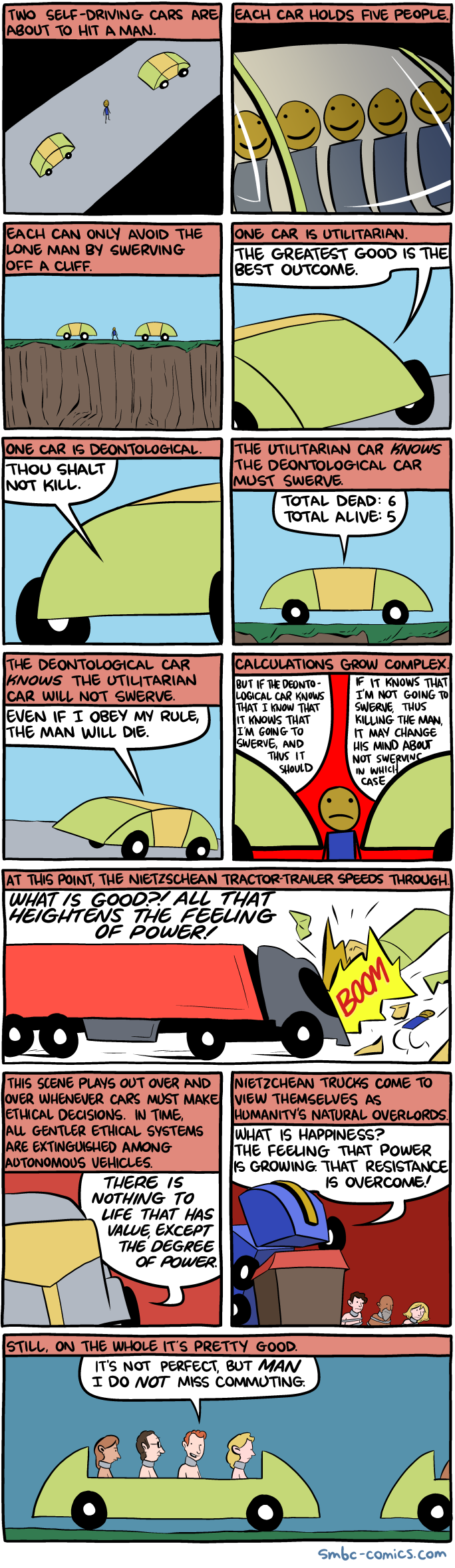
SMBC just came out with another take on the question(s) of ethical choices for self-driving cars:


1467643530-20160704.png