A Moral Question for a Scientific Breakthrough......

Butler1000

Well-known member
Oct 31, 2011
35,492
9,225
113
Should a Self Driving Car be programmed to Hit a Pedestrian to Save your life?

I saw this as the title of an article and thought I would throw it out there for debate.

I'm still working it out in my own head so no opinion from me yet.
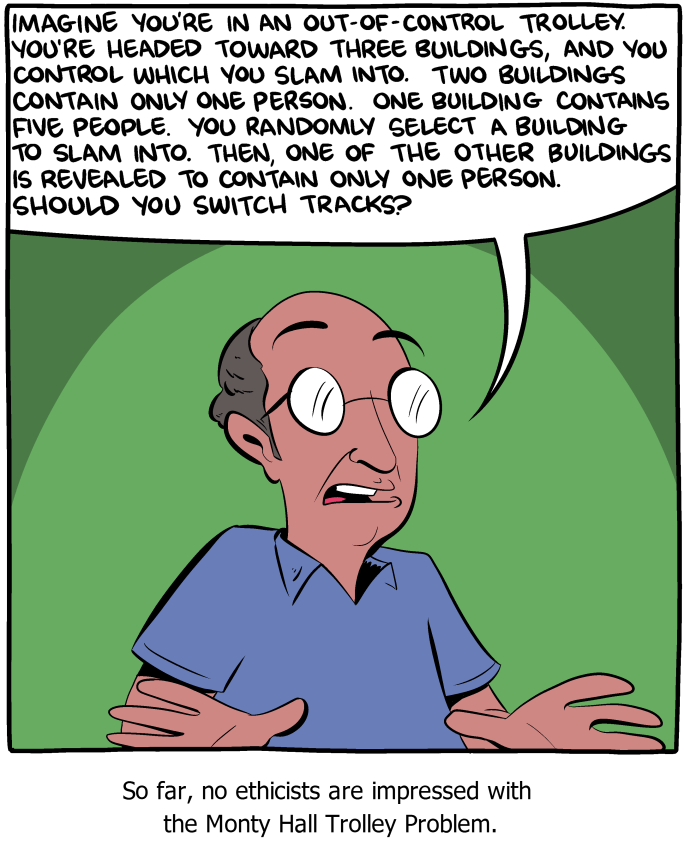
 
Take 1 life to save another, No. Take 1 life to save 2 or 3 or 4 then I might lean towards yes. However, what is the purpose of the self driving car, is not to save lives to begin with, indirectly. Ultimately , how can anyone justify taking 1 life to save 5, that 1 life could be worth more than the 5. Let nature takes its course and decides who lives and who dies.

I think it also applies if the person does not die, because it greatly impacts there future. Some would rather die than being in a wheel-chair.
 
If its me driving the car then yes.

If its me as the pedestrian then no
 
The add on is what if your family is in the car with you?
 
Modern cars have airbags and crush in a way that protects the occupants. Pedestrians have no such protection. The car should crash rather than hit a pedestrian. The occupants of the car are far more likely to survive probably with only minor injuries, assuming they are wearing their seatbelts. If they are NOT wearing their seatbelts their injuries are their own fault.

That said, it's very very very rare that you have to choose between hitting a pedestrian and crashing your car. In all my years it's never happened to me that I had to make a choice between a pedestrian and a crash.
 
Last edited:
The one above was mentioned in the article I read.

Why I find it interesting is they are at the point where they may actually have to start making these real world decisions about how to program the AI.

Do you kill a motercyclist? Does the computer count the # of people on either side of the equation?

The big question was, do you come up with an international standard or allow the owner to set the parameters. And if so can the owner be held liable for the decision of the AI.

ALL questions that we should try to answer before allowing them on the road.

Do we force humans to answer these questions before allowing them on the road? From this thread I see evidence of no consistency in the human response.
 
Do we force humans to answer these questions before allowing them on the road? From this thread I see evidence of no consistency in the human response.

Because you have to program them in. This type of thing will come up. And the main point to to improve safety. So now you have to set the parameters for them to follow. And that includes moments where a no win decision will have to be made.
 
Because you have to program them in. This type of thing will come up. And the main point to to improve safety. So now you have to set the parameters for them to follow. And that includes moments where a no win decision will have to be made.

Again, this type of thing has never come up for me while driving. If you are regularly facing a choice between hitting a pedestrian and crashing, perhaps you should examine your driving.

And again, it doesn't seem like there's a consistent answer from human drivers, so why is this a question a self driving system needs to answer one way or another?

Computer driven cars will likely have far fewer accidents than human driven vehicles owing to superior responses in much more common driving situations than this improbable edge case.
 
Shades of I, Robot. This is indeed a complex question. Then again would not most of us attempt to avoid the pedestrian.
 
Shades of I, Robot. This is indeed a complex question. Then again would not most of us attempt to avoid the pedestrian.

The article mentioned that when asked most of the people chose to save themselves.
 
Computers will be an improvement then, if they take the action likely to result in the least overall harm.

Actually that they would want the cars programmed to do that. So now we come back to the question. Should it be up to the owner to decide the programming or international standard?
 
Because you have to program them in. This type of thing will come up. And the main point to to improve safety. So now you have to set the parameters for them to follow. And that includes moments where a no win decision will have to be made.


I don't agree. The moral dilemma does not arise because it is now the subject of a computer program. The moral dilemma is still there, without the AI and the programming.

We must resolve the dilemma in the human realm first -- if it's worth it, and if we can. Then, we simply transfer the resulting solution to the AI. If the dilemma is insoluble in human terms, it will remain insoluble in AI terms.
 
Actually that they would want the cars programmed to do that. So now we come back to the question. Should it be up to the owner to decide the programming or international standard?

International standard. Drivers don't make the traffic laws.

However, again, I have never had to choose between crashing and hitting a pedestrian and I don't know anyone who had to make that choice.

It's not an issue which needs to be settled before allowing self driving cars on the road.

It's only a matter of time before computer drivers are safer than human drivers on any regular road. Human drivers will likely be relegated to unpaved roads.
 
It's not a breakthrough if it's programmed to hit pedestrians. They should be banned or limited to 5 mph if these are the choices.
 
It's not a breakthrough if it's programmed to hit pedestrians. They should be banned or limited to 5 mph if these are the choices.

I'm guessing that it's all in the programming. Realise a computer can calculate thousands of options including the resulting impact in a fraction of a second - you can have the computer take option that totals the lowest impact.

Let's suppose the car has lost it's brakes and just broke through a gate onto a crowded walkway in which any direction will result in a pedestrian getting hit. The lowest total option will be affected by the points of importance (my temp term). Assuming enough AI has been programmed to identify human characteristics matching a your perception - you could give a value to the target (victims) of : default/ general = 1; kids= 10; elderly =0.5; hot females (spinner bodies / little clothing) = 100; Me = 10,000 (in case it looks at the option of running me into a tree). Total the various options and take the option with the lowest score. That's how I would handle it.