

Reportedly it was Israel's sole factory for Arrow missiles that blew up.
You are using an out of date browser. It may not display this or other websites correctly.
You should upgrade or use an alternative browser.
You should upgrade or use an alternative browser.


War with Iran
- Thread starter Butler1000
- Start date


It’s a good day. With every warrant, peace comes closer

 www.haaretz.com
ICC prosecutor seeks warrants for Ben-Gvir, Smotrich, other Israeli officials
According to a diplomatic source, warrants were also sought for far-right Minister Orit Strock amd two military officials. The International Criminal Court in The Hague previously issued warrants for Prime Minister Netanyahu and former Defense Minister Yoav Gallant
Last edited:
Netanyahu convenes security cabinet amid reports Israel, US preparing Iran strikes
PM to speak with Trump, who warns of ‘calm before the storm’; drone strikes UAE nuclear power station, sparking a fire; Iran media says US offered no concrete concessions in talks
By Lazar Berman,

Prime Minister Benjamin Netanyahu leads the weekly cabinet meeting on May 17, 2026. (Screenshot/GPO)
Prime Minister Benjamin Netanyahu is set to convene top aides and ministers Sunday evening for a security discussion in his office in Jerusalem, amid reports that the US and Israel are preparing to restart the war with Iran.
Netanyahu is also scheduled to speak with US President Donald Trump on Sunday evening. The discussions come after a drone struck a nuclear power plant in the UAE, which, along with Israel, sustained the most blows from Iran during the war.
“Our eyes are open regarding Iran,” Netanyahu said during Sunday’s weekly cabinet meeting. Referring to Trump, he added, “I will certainly hear impressions from his trip to China, perhaps other things as well. Certainly, there are many possibilities, and we are prepared for every scenario.”
Last week Trump visited China for a summit with Chinese President Xi Jinping. He said Xi had offered to help open the Strait of Hormuz, a key artery for the global oil supply that Iran has blocked, and that the Chinese leader had pledged not to send military equipment to aid Iran in the war.
On Sunday, after Trump returned from China, he shared an AI-generated graphic of him and a US Navy admiral in front of stormy waters with several ships, including one flying the Iranian flag. A caption read, “It was the calm before the storm.”
Last week, it was reported that Israel and the United States were carrying out intense preparations to renew attacks on Iran, possibly as soon as this week.
Security discussions in the Prime Minister’s Office, often termed the “small security cabinet,” usually include Foreign Minister Gideon Sa’ar, Defense Minister Israel Katz, Finance Minister Bezalel Smotrich, National Security Minister Itamar Ben Gvir, and Shas chairman Aryeh Deri.
Fighting between the US, Israel, and Iran has largely been paused since a ceasefire came into effect on April 8. But talks between Iran and the US, aimed at coming to an agreement over the Iranian nuclear program and other issues, have stalled.
Iranian armed forces spokesman Abolfazl Shekarchi warned Trump on Sunday against restarting attacks on his country.
“The desperate American president should know that if his threats are carried out and Islamic Iran is attacked again, his country’s resources and military will be confronted with unprecedented, offensive, surprising, and tumultuous scenarios,” he said, according to state television.
Similarly, Iran’s deputy speaker of parliament, Hamidreza Hajibabaei, warned against attacking Iranian oil infrastructure.
“If Iranian oil is harmed, Iran will take measures that will prevent the United States and the world from accessing oil from the region for an extended period,” he said, according to the news agency ISNA.
PM to speak with Trump, who warns of ‘calm before the storm’; drone strikes UAE nuclear power station, sparking a fire; Iran media says US offered no concrete concessions in talks
By Lazar Berman,
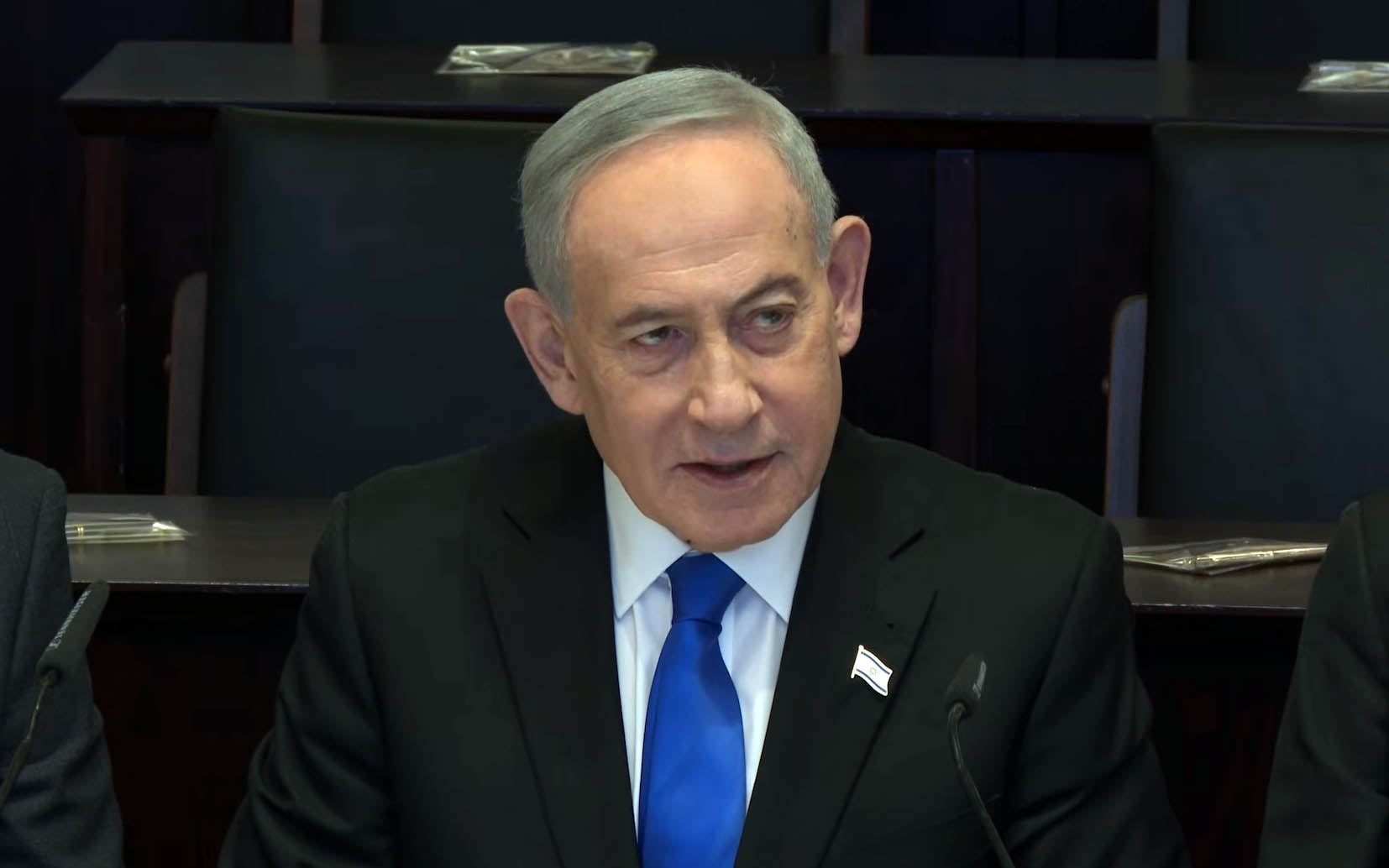
Prime Minister Benjamin Netanyahu leads the weekly cabinet meeting on May 17, 2026. (Screenshot/GPO)
Prime Minister Benjamin Netanyahu is set to convene top aides and ministers Sunday evening for a security discussion in his office in Jerusalem, amid reports that the US and Israel are preparing to restart the war with Iran.
Netanyahu is also scheduled to speak with US President Donald Trump on Sunday evening. The discussions come after a drone struck a nuclear power plant in the UAE, which, along with Israel, sustained the most blows from Iran during the war.
“Our eyes are open regarding Iran,” Netanyahu said during Sunday’s weekly cabinet meeting. Referring to Trump, he added, “I will certainly hear impressions from his trip to China, perhaps other things as well. Certainly, there are many possibilities, and we are prepared for every scenario.”
Last week Trump visited China for a summit with Chinese President Xi Jinping. He said Xi had offered to help open the Strait of Hormuz, a key artery for the global oil supply that Iran has blocked, and that the Chinese leader had pledged not to send military equipment to aid Iran in the war.
On Sunday, after Trump returned from China, he shared an AI-generated graphic of him and a US Navy admiral in front of stormy waters with several ships, including one flying the Iranian flag. A caption read, “It was the calm before the storm.”
Last week, it was reported that Israel and the United States were carrying out intense preparations to renew attacks on Iran, possibly as soon as this week.
Security discussions in the Prime Minister’s Office, often termed the “small security cabinet,” usually include Foreign Minister Gideon Sa’ar, Defense Minister Israel Katz, Finance Minister Bezalel Smotrich, National Security Minister Itamar Ben Gvir, and Shas chairman Aryeh Deri.
Fighting between the US, Israel, and Iran has largely been paused since a ceasefire came into effect on April 8. But talks between Iran and the US, aimed at coming to an agreement over the Iranian nuclear program and other issues, have stalled.
Iranian armed forces spokesman Abolfazl Shekarchi warned Trump on Sunday against restarting attacks on his country.
“The desperate American president should know that if his threats are carried out and Islamic Iran is attacked again, his country’s resources and military will be confronted with unprecedented, offensive, surprising, and tumultuous scenarios,” he said, according to state television.
Similarly, Iran’s deputy speaker of parliament, Hamidreza Hajibabaei, warned against attacking Iranian oil infrastructure.
“If Iranian oil is harmed, Iran will take measures that will prevent the United States and the world from accessing oil from the region for an extended period,” he said, according to the news agency ISNA.
trump is back to his sunday antics
Wait until the markets open.
Wait until the markets open.
Israel’s ‘war to the root’ may unravel America
May 16, 2026
Alastair Crooke
Both Trump’s Iran war and the closely connected Israeli war for Jewish hegemony across the Middle East are unravelling fast.
Iran is standing defiant in the face of Trump and Israel’s threats, leaving Trump gambling the entire U.S. economy and its global strategic standing on conjuring up a decisive ‘win’ over Iran — however deceitful and Pyrrhic that ‘win’ might prove to be.
Trump has now arrived for the summit in China (reportedly with little groundwork preparation ahead of the visit). Possibly he relies on his usual hubristic notion — that China needs the U.S. more than the U.S. needs China — and he will tell Beijing that ‘you (Xi) have to instruct Iran’ that time is moving on, and that it should capitulate to the U.S..
Well that’s not going to happen. China supports Iran’s fight for sovereignty and shares with Russia the Iranian objective of seeing the U.S. gone from the Middle East. They want instead a Gulf-led security architecture to replace the American one. Moscow concurs.
Maybe Xi — in politest of language, of course — will tell Trump, rather, that it is Washington that should concede to Iran. The longer he delays, the harder any U.S. course correction will prove to be.
In any event, despite the innate Trumpian hubris, the U.S. President arrives in Beijing bereft of ‘big wins’ (if Venezuela is counted as a gimmick, rather than a strategic victory). Contrarily and more significantly, Beijing understands that the U.S. hovers at the brink of an economic inflationary catastrophe, whereas China largely is insulated from the coming global energy shock and is in price deflation, rather than experiencing inflation.
Put bluntly, there is almost nothing that Xi wants from the U.S., but in the interests of harmony, they may buy some soya beans (to save U.S. farmers) and perhaps some airplanes. (Even though soya beans are not really required by China which has been purchasing them easily from Brazil).
Trump has taken with him to China an entourage of U.S. oligarchs — presumably in the expectation that China will give him business valued in several ‘billions’; but China’s response may be somewhat scant. They are angry, reportedly, at the games the U.S. Treasury Secretary has been playing with sanctions on Chinese firms, the seizure of Chinese oil tankers, and the obvious attempt by Trump to squeeze China out from the Western Hemisphere.
What looms in the backdrop however, is darker: America’s collapsing standing as the unipolar hegemon — and the consequential global instability. The Iran war has provided the world with an object lesson of a major world power stuck in a conceptual rut from the Cold War era. One
that refused to see the writing on the wall of a tectonic change that required it to ‘move on’ from its ‘end of history’ complacency, though all the signs of a shift to another ‘way of war’ had been present since early this century.
The turning point came with the abundance of cheap and easily available tech components.
The U.S., as the Cold War began, chose a strategy of outspending the USSR – by going for high-end, high-cost weaponry – with a main focus being on air-power and mass aerial bombardment.
That approach, at the time, had seemed justified by the subsequent Soviet implosion. This collapse was presumed to have been triggered by the American maximal spend that had over-stretched the USSR (though the collapse is now well understood to have been more a matter of a more complex internal corrosion from within).
The paradigm of western reliance on a preponderance of air power delivered by hugely expensive airframes has been blown apart and demonstrated to be ineffective by Iran’s asymmetric missile and naval warfare using weapons costing a few hundred dollars versus U.S. defence interceptors costing tens of millions.
The entire world can see the main lessons emerging from the Iran war: Firstly, that the western defence posture is as outdated as the dodo. The Establishment fell asleep, believing that the ever more billions of dollars ploughed into the Military Industrial Complex would give the U.S. a military edge that crucially would also provide the underpinning to its dollar hegemony to print more money for more weapons.
In practice however, it yielded massive corporate corruption and functionally poor, yet hugely expensive, armaments.
Of course, it is horses for courses — but up against more revolutionary adversaries, it is the
latter who are out-innovating and out-manoeuvring western powers. All can see it, and are already adjusting.
China can see how small, fleeter Iranian naval assets ran rings around the large lumbering naval vessels of the U.S. Navy. The lessons naturally will be applied to Taiwan, should the U.S. seek to exert naval pressure on China in the Taiwan context.
Russia too will have noticed how a carefully graduated and selectively targeted missile offensive provided Iran with deterrence vis-à-vis Israel. Moscow likely will be thinking in these terms in respect to missiles of British, French and German origin that have been striking deep into Russia, whilst using NATO airspace and intelligence facilitation.
The accelerating global perception of the U.S.’ decline however, rests on more than just its failure to adapt to Iran’s asymmetrical war. More significant even than the sense of cognitive dissonance reigning in the White House is the perception that Trump is a full partner to Israel’s predations across the region.
The U.S. bequeathed Israel the same doctrine of air war dominance, underpinned by ultra expensive U.S. air frames that were intended to give Israel a ‘qualitative edge’ in maintaining its regional primacy. Israel’s failure in Iran, of its flailing conflict with Hizbullah, and of the unfinished war in Gaza, are the evidence of the failure of the approach — not of success.
It is worth noting that before the Israeli shift toward the U.S. ‘way of war’, the founder of the Israeli state and its first PM, Ben Gurion’s defence doctrine for Israel was different.
Ben Gurion emphasised that Israel was geographically a small state; with a small population and limited economic resources. In such circumstances, it would not be able to afford a large standing professional army. It would need a small professional army, supported when necessary by a large cadre of reservists.
Ben Gurion grounded his argument on the need for Israel to have, as well as a defence force, a strong economy to provide for the community and the state — all of which reinforced the need for a small army. He also assumed the Clausewitzian stance that ‘war is the continuation of politics by other means’ and not an end in itself, but a part of the political game.
In Israel, since 7 October 2023 however, as Israel military strategist Colonel Udi Evental, in a series of posts, has underlined – “the link between politics and war reversed itself by 180 degrees [since Ben Gurion’s time]”.
.........................................................

 strategic-culture.su
May 16, 2026
Alastair Crooke
Both Trump’s Iran war and the closely connected Israeli war for Jewish hegemony across the Middle East are unravelling fast.
Iran is standing defiant in the face of Trump and Israel’s threats, leaving Trump gambling the entire U.S. economy and its global strategic standing on conjuring up a decisive ‘win’ over Iran — however deceitful and Pyrrhic that ‘win’ might prove to be.
Trump has now arrived for the summit in China (reportedly with little groundwork preparation ahead of the visit). Possibly he relies on his usual hubristic notion — that China needs the U.S. more than the U.S. needs China — and he will tell Beijing that ‘you (Xi) have to instruct Iran’ that time is moving on, and that it should capitulate to the U.S..
Well that’s not going to happen. China supports Iran’s fight for sovereignty and shares with Russia the Iranian objective of seeing the U.S. gone from the Middle East. They want instead a Gulf-led security architecture to replace the American one. Moscow concurs.
Maybe Xi — in politest of language, of course — will tell Trump, rather, that it is Washington that should concede to Iran. The longer he delays, the harder any U.S. course correction will prove to be.
In any event, despite the innate Trumpian hubris, the U.S. President arrives in Beijing bereft of ‘big wins’ (if Venezuela is counted as a gimmick, rather than a strategic victory). Contrarily and more significantly, Beijing understands that the U.S. hovers at the brink of an economic inflationary catastrophe, whereas China largely is insulated from the coming global energy shock and is in price deflation, rather than experiencing inflation.
Put bluntly, there is almost nothing that Xi wants from the U.S., but in the interests of harmony, they may buy some soya beans (to save U.S. farmers) and perhaps some airplanes. (Even though soya beans are not really required by China which has been purchasing them easily from Brazil).
Trump has taken with him to China an entourage of U.S. oligarchs — presumably in the expectation that China will give him business valued in several ‘billions’; but China’s response may be somewhat scant. They are angry, reportedly, at the games the U.S. Treasury Secretary has been playing with sanctions on Chinese firms, the seizure of Chinese oil tankers, and the obvious attempt by Trump to squeeze China out from the Western Hemisphere.
What looms in the backdrop however, is darker: America’s collapsing standing as the unipolar hegemon — and the consequential global instability. The Iran war has provided the world with an object lesson of a major world power stuck in a conceptual rut from the Cold War era. One
that refused to see the writing on the wall of a tectonic change that required it to ‘move on’ from its ‘end of history’ complacency, though all the signs of a shift to another ‘way of war’ had been present since early this century.
The turning point came with the abundance of cheap and easily available tech components.
The U.S., as the Cold War began, chose a strategy of outspending the USSR – by going for high-end, high-cost weaponry – with a main focus being on air-power and mass aerial bombardment.
That approach, at the time, had seemed justified by the subsequent Soviet implosion. This collapse was presumed to have been triggered by the American maximal spend that had over-stretched the USSR (though the collapse is now well understood to have been more a matter of a more complex internal corrosion from within).
The paradigm of western reliance on a preponderance of air power delivered by hugely expensive airframes has been blown apart and demonstrated to be ineffective by Iran’s asymmetric missile and naval warfare using weapons costing a few hundred dollars versus U.S. defence interceptors costing tens of millions.
The entire world can see the main lessons emerging from the Iran war: Firstly, that the western defence posture is as outdated as the dodo. The Establishment fell asleep, believing that the ever more billions of dollars ploughed into the Military Industrial Complex would give the U.S. a military edge that crucially would also provide the underpinning to its dollar hegemony to print more money for more weapons.
In practice however, it yielded massive corporate corruption and functionally poor, yet hugely expensive, armaments.
Of course, it is horses for courses — but up against more revolutionary adversaries, it is the
latter who are out-innovating and out-manoeuvring western powers. All can see it, and are already adjusting.
China can see how small, fleeter Iranian naval assets ran rings around the large lumbering naval vessels of the U.S. Navy. The lessons naturally will be applied to Taiwan, should the U.S. seek to exert naval pressure on China in the Taiwan context.
Russia too will have noticed how a carefully graduated and selectively targeted missile offensive provided Iran with deterrence vis-à-vis Israel. Moscow likely will be thinking in these terms in respect to missiles of British, French and German origin that have been striking deep into Russia, whilst using NATO airspace and intelligence facilitation.
The accelerating global perception of the U.S.’ decline however, rests on more than just its failure to adapt to Iran’s asymmetrical war. More significant even than the sense of cognitive dissonance reigning in the White House is the perception that Trump is a full partner to Israel’s predations across the region.
The U.S. bequeathed Israel the same doctrine of air war dominance, underpinned by ultra expensive U.S. air frames that were intended to give Israel a ‘qualitative edge’ in maintaining its regional primacy. Israel’s failure in Iran, of its flailing conflict with Hizbullah, and of the unfinished war in Gaza, are the evidence of the failure of the approach — not of success.
It is worth noting that before the Israeli shift toward the U.S. ‘way of war’, the founder of the Israeli state and its first PM, Ben Gurion’s defence doctrine for Israel was different.
Ben Gurion emphasised that Israel was geographically a small state; with a small population and limited economic resources. In such circumstances, it would not be able to afford a large standing professional army. It would need a small professional army, supported when necessary by a large cadre of reservists.
Ben Gurion grounded his argument on the need for Israel to have, as well as a defence force, a strong economy to provide for the community and the state — all of which reinforced the need for a small army. He also assumed the Clausewitzian stance that ‘war is the continuation of politics by other means’ and not an end in itself, but a part of the political game.
In Israel, since 7 October 2023 however, as Israel military strategist Colonel Udi Evental, in a series of posts, has underlined – “the link between politics and war reversed itself by 180 degrees [since Ben Gurion’s time]”.
.........................................................
Israel’s ‘war to the root’ may unravel America
Both Trump’s Iran war and the closely connected Israeli war for Jewish hegemony across the Middle East are unravelling fast. Join us on Telegram, Twitter, and…
Netanyahu convenes security cabinet amid reports Israel, US preparing Iran strikes
PM to speak with Trump, who warns of ‘calm before the storm’; drone strikes UAE nuclear power station, sparking a fire; Iran media says US offered no concrete concessions in talks
By Lazar Berman,
Prime Minister Benjamin Netanyahu leads the weekly cabinet meeting on May 17, 2026. (Screenshot/GPO)
He's not looking so good, aging fast, looks more evil.
He's not looking so good, aging fast, looks more evil.
He's old, trump is in worse shape, Putin is old...
When they are gone the planet will be the better for it.
trump in China:

So we are on Trump's seventh Ultimatum during this war.
Kinda defeats its purpose......
Every weekend before the markets open.
Then on Monday the threat disappears and the investments banked.
Last edited:
Every weekend before the markets open.
Then on Monday the threat disappears and the investments banked.
TACOs this week were delivered on a Monday.
TACOs this week were delivered on a Monday.
Every Monday.
Bolivia rose up and turfed their right wing, american favoured leader.
Now trump has new marching orders.
Now trump has new marching orders.
TACOs this week were delivered on a Monday.
Dr. Trita Parsi, Quincy Institute, On Today's TACO
Why does the UK arrest so many more people than Iran over SM posts?
Where is the free speech?
Where is the free speech?
america burned through its missile supply and Israel can't do it alone.
Maybe they can't restart the war at all.
Maybe they can't restart the war at all.
After The TACO. Tehran on Tuesday. Prof.Marandi
Trump The Dealmaker Taken For A Ride
Exclusive
U.S. bears brunt of Israel’s missile defense, Pentagon assessments show
Amid hostilities with Iran, the American military expended far more advanced interceptors to protect Israel than Israeli forces did, according to Defense Department data.
May 21, 2026 at 1:52 p.m. EDTToday at 1:52 p.m. EDT
An Israeli Iron Dome interceptor streaks through the sky close to the Israel-Lebanon border in late March. (Jalaa Marey/AFP/Getty Images)

By John Hudson
The U.S. military has depleted much of its inventory of advanced missile-defense interceptors after expending far more high-end munitions defending Israel amid hostilities with Iran than Israeli forces used themselves, according to Defense Department assessments described to The Washington Post.
The imbalance, according to three U.S. officials who spoke on the condition of anonymity to discuss sensitive security matters, underscores the extent to which Washington has shouldered the burden of countering Iranian ballistic missile strikes during Operation Epic Fury, and raises questions about U.S. military readiness and security commitments around the world.
The United States launched more than 200 Terminal High Altitude Area Defense, or THAAD, interceptors in defense of Israel — roughly half of the Pentagon’s total inventory — along with more than 100 Standard Missile-3 and Standard Missile-6 interceptors fired from naval vessels in the eastern Mediterranean, said the U.S. officials, who, like others in this article, spoke on the condition of anonymity to discuss sensitive security matters. By contrast, Israel fired fewer than 100 of its Arrow interceptors and around 90 David’s Sling interceptors, some of which were used against less sophisticated projectiles fired by Iran-backed groups in Yemen and Lebanon.
Military analysts said the data described to The Post offers a rare window into how the United States and Israel work together.
“The numbers are striking,” said Kelly Grieco, a senior fellow at the Stimson Center. “The United States absorbed most of the missile defense mission while Israel conserved its own magazines. Even if the operational logic was sound, the United States is left with roughly 200 THAAD interceptors and a production line that can’t keep pace with demand.”
The shortage of U.S. interceptors has alarmed U.S. allies in Asia, particularly Japan and South Korea, which rely on the United States as a deterrent to potential threats from North Korea and China. “That bill risks coming due in theaters that have nothing to do with Iran,” said Grieco.
U.S. and Israeli officials routinely tout their close cooperation and the strength of Israel’s multilayered air-defense system. But the Defense Department assessments suggest a more lopsided dynamic.
“In total, the U.S. shot around 120 more interceptors and engaged twice as many Iranian missiles,” said a U.S. administration official.
If the United States and Israel resume hostilities against Iran in the coming days, as President Donald Trump has threatened to do, the U.S. military is likely to expend an even greater share of interceptors because of a recent decision by the Israeli military to take some of its missile defense batteries offline for maintenance, said an administration official. “The imbalance will likely be exacerbated if fighting restarts,” the official said.
In a statement, the Pentagon defended the balance of military resources used between Israel and the United States.
“Ballistic missile interceptors are just one tool in a vast network of systems and capabilities that comprise a layered and integrated air defense network,” said Sean Parnell, the Pentagon’s chief spokesman. “Both Israel and the United States carried the defensive burden equitably during Operation Epic Fury, which saw both countries employ fighter aircraft, counter-UAS systems, and various other advanced air and missile defense capabilities with maximal effectiveness.”
The Israeli government also defended the approach. “Operations Roaring Lion and Epic Fury were coordinated at the highest and closest levels, to the benefit of both countries and their allies,” the Israeli Embassy in Washington said in a statement. “The U.S. has no other partner with the military willingness, readiness, shared interests, and capabilities of Israel.”
Since the start of the conflict on Feb. 28, the U.S. and Israel have worked together closely, killing Iran’s supreme leader and scores of senior Iranian military and political leaders while laying waste to Iran’s navy and air force.
Palestinians in the Israeli-occupied West Bank inspect the remnants of a missile fired from Iran in late March. (Heidi Levine/For The Washington Post)
Israeli Prime Minister Benjamin Netanyahu was central to persuading Trump to go to war, promising an offensive that would inspire regime change and rid the country of its ability to develop a nuclear weapon, said U.S. officials.
But tensions have grown between the two allies as the war has proven more challenging than either leader anticipated. Iran’s closure of the Strait of Hormuz has choked global energy supplies and ramped up inflation. Despite Trump’s claims that Iran’s missile arsenal has been “mostly decimated,” Tehran retains about 70 percent of its prewar stockpiles of missiles, according to U.S. intelligence. Much of Iran’s highly enriched uranium probably remains in the nuclear facilities bombed by the U.S. and Israel last year.
On Tuesday, Netanyahu and Trump held a tense phone call about the path forward, said U.S. and Middle Eastern officials. The Israeli leader’s persistent pressure to restart the war has irritated some U.S. officials, particularly given the strain that renewed fighting would impose on the Pentagon’s munitions supply.
“Israel is not capable of fighting and winning wars on its own, but nobody actually knows this, because they never see the back end,” said a second administration official.
https://www.washingtonpost.com/poli...mm-v-smith-mental-disabilities-death-penalty/
It’s unclear whether the United States’ munitions shortages factor into Trump’s deliberations over restarting the war.
Earlier this week, Trump said he called off an imminent military strike on Iran at the behest of America’s Arab allies who urged him to consider a peace deal with Iran that would restrict its nuclear program in exchange for reopening the Strait of Hormuz and ending the war.
“We’re in the final stages of Iran. We’ll see what happens,” Trump told reporters on Wednesday. “We’ll either have a deal, or we’re going to do some things that are a little bit nasty.”
In preparation for a potential resumption of hostilities, the United States moved more naval assets near Israel to provide additional protection from Iranian threats.
If fighting does resume, the extent to which Iran’s allies in the region may join in will be a significant factor, said U.S. officials. During the last round of fighting, Israel could generate only 50 percent of the airstrikes by the end of March compared with the beginning of the war because its aircraft and pilots were “worn down” by operations against Houthi militants in Yemen and airstrikes targeting Hezbollah in Lebanon, said a U.S. official.
“The sortie degradation is important,” said Grieco. “The IDF was worn down by Gaza, Lebanon, and the question I have is whether Israeli commanders underestimated their ability to sustain operational tempo.”
According to officials, the two countries agreed in advance to a ballistic missile-defense framework that effectively ensured that high-end interceptors such as THAAD and ship-based missiles would absorb the bulk of ballistic threats to Israel.
Israel relies more heavily on lower-tier systems such as Iron Dome and David’s Sling to counter projectiles from groups such as Hezbollah and the Houthis, while conserving its more sophisticated interceptors. The result, officials said, was a “significant” drawdown of U.S. stockpiles while Israel was able to maintain its higher-end air defense stockpiles.
The dynamic seemed to clash with Trump’s “America First,” mantra, said Justin Logan, director of defense and foreign policy studies at the libertarian CATO Institute.
“Since Trump took office again, Israel’s position makes sense: our priorities first, our resources last,” he said. “Why Trump has tried to make this America First is less clear.”
After the Pentagon last year reportedly disclosed having only 25 percent of the Patriot air defense inventory needed to fulfill existing U.S. defense plans, it should’ve been a wake up call, said Logan. “Why this wasn’t a screeching siren to Trump officials is a mystery,” he said.
Tara Copp and Dan Lamothe contributed to this report.
america burned through its missile supply and Israel can't do it alone.
Maybe they can't restart the war at all.
america burned through its missile supply and Israel can't do it alone.
Maybe they can't restart the war at all.
Israeli-US Plot To Replace Iran's Government With........??!! Stupidity On Stilts!
Early War Goal Was to Install Hard-Line Former President as Iran’s Leader
An Israeli strike designed to free Mahmoud Ahmadinejad from house arrest in Tehran, U.S. officials said, was part of an effort to bring about regime change and put him in power.
- 567

Former President Mahmoud Ahmadinejad of Iran registering as a candidate in the presidential election in Tehran in 2024.Credit...Arash Khamooshi/Polaris for The New York Times


By Mark MazzettiJulian E. BarnesFarnaz Fassihi and Ronen Bergman
The reporters have been covering the U.S.-Israeli war against Iran.
May 19, 2026
Days after Israeli strikes killed Iran’s supreme leader and other top officials in the opening salvos of the war, President Trump mused publicly that it would be best if “someone from within” Iran took over the country.
It turns out that the United States and Israel went into the conflict with a particular and very surprising someone in mind: Mahmoud Ahmadinejad, the former Iranian president known for his hard-line, anti-Israel and anti-American views.
But the audacious plan, developed by the Israelis and which Mr. Ahmadinejad had been consulted about, quickly went awry, according to the U.S. officials who were briefed on it.
Mr. Ahmadinejad was injured on the war’s first day by an Israeli strike at his home in Tehran that had been designed to free him from house arrest, the American officials and an associate of Mr. Ahmadinejad said. He survived the strike, they said, but after the near miss he became disillusioned with the regime change plan.
He has not been seen publicly since then and his current whereabouts and condition are unknown.
Image

Smoke from explosions in Tehran on Feb. 28, the first day of U.S.-Israeli strikes in Iran.Credit...Arash Khamooshi/Polaris for The New York Times
To say that Mr. Ahmadinejad was an unusual choice would be a vast understatement. While he had increasingly clashed with the regime’s leaders and had been placed under close watch by the Iranian authorities, he was known during his term as president, from 2005 to 2013, for his calls to “wipe Israel off the map.” He was a strong supporter of Iran’s nuclear program, a fierce critic of the United States and known for violently cracking down on internal dissent.
How Mr. Ahmadinejad was recruited to take part remains unknown.
The existence of the effort, which has not been previously reported, was part of a multistage plan developed by Israel to topple Iran’s theocratic government. It underscores how Mr. Trump and Prime Minister Benjamin Netanyahu of Israel went into the war not only misjudging how quickly they could achieve their objectives but also gambling to some degree on a risky plan for leadership change in Iran that even some of Mr. Trump’s aides found implausible. Some American officials were skeptical in particular about the viability of putting Mr. Ahmadinejad back into power.
“From the outset, President Trump was clear about his goals for Operation Epic Fury: destroy Iran’s ballistic missiles, dismantle their production facilities, sink their navy, and weaken their proxy,” Anna Kelly, a White House spokeswoman, said in response to a request for comment about the regime change plan and Ahmadinejad. “The United States military met or exceeded all of its objectives, and now, our negotiators are working to make a deal that would end Iran’s nuclear capabilities for good.”
A spokesperson for Mossad, the Israeli foreign intelligence agency, declined to comment.
U.S. officials spoke during the early days of the war about plans developed with Israel to identify a pragmatist who could take over the country. Officials insisted that there was intelligence that some within the Iranian regime would be willing to work with the United States, even if those people couldn’t be described as “moderates.”
Mr. Trump was enjoying the success of the raid by U.S. forces to capture Venezuela’s leader, Nicolas Maduro, and the willingness of his interim replacement to work with the White House — a model that Mr. Trump appeared to think could be replicated elsewhere.
Want to stay updated on what’s happening in Iran and Israel? Sign up for Your Places: Global Update, and we’ll send our latest coverage to your inbox.
In recent years, Mr. Ahmadinejad has clashed with regime leaders, accusing them of corruption, and rumors have swirled about his loyalties. He was disqualified from numerous presidential elections, his aides were arrested and Mr. Ahmadinejad’s movements were increasingly restricted to his home in the Narmak section of eastern Tehran.
Image

Former Iranian President Mahmoud Ahmadinejad speaks to supporters and receives letters requesting help outside his home at “Square 72” in the working-class Narmak district in Tehran, Iran in 2014.Credit...Scott Peterson/Getty Images
That American and Israeli officials saw Mr. Ahmadinejad as a potential leader of a new government in Iran is further evidence that the war in February was launched with the hopes of installing more pliable leadership in Tehran. Mr. Trump and members of his cabinet have said that the goals of the war were narrowly focused on destroying Iran’s nuclear, missile and military capabilities.
There are many unanswered questions about how Israel and the United States planned to put Mr. Ahmadinejad in power, and the circumstances surrounding the airstrike that injured him. American officials said that the strike — carried out by the Israeli Air Force — was meant to kill the guards watching over Mr. Ahmadinejad as part of a plan to release him from house arrest.
On the first day of the war, Israeli strikes killed Ayatollah Ali Khamenei, Iran’s supreme leader. The strike at Ayatollah Khamenei’s compound in central Tehran also blew up a meeting of Iranian officials, killing some officials whom the White House had identified as more willing to negotiate over a change in government than their bosses.
There were also initial reports at the time in the Iranian media that Mr. Ahmadinejad had been killed in the strike on his home.
The strike did not significantly damage Mr. Ahmadinejad’s house at the end of a dead-end street. But the security outpost at the entrance to the street was struck. Satellite imagery shows that building was destroyed.
In the days that followed, official news agencies clarified that he had survived but that his “bodyguards” — in actuality Islamic Revolutionary Guard Corps members who were both guarding him and holding him under house arrest — were killed.
Image

A Basij Paramilitary group holding flags and photos of Mojtaba Khamenei, the new Supreme Leader, last month.Credit...Arash Khamooshi/Polaris for The New York Times
An article in The Atlantic in March, citing anonymous associates of Mr. Ahmadinejad, said that the former president had been freed from government confinement after the strike at his house, which the article described as “in effect a jailbreak operation.”
After that article, an associate of Mr. Ahmadinejad confirmed to The New York Times that Mr. Ahmadinejad saw the strike as an attempt to free him. The associate said the Americans viewed Mr. Ahmadinejad as someone who could lead Iran, and had the capability to manage “Iran’s political, social and military situation.”
Mr. Ahmadinejad would have been able to “play a very important role” in Iran in the near future, the associate said, suggesting that the United States saw him as similar to Delcy Rodriguez, who took power in Venezuela after American forces seized Mr. Maduro and has since worked closely with the Trump administration, the person said.
During his presidency, Mr. Ahmadinejad was known both for his hard-line policies and his often outlandish fundamentalist pronouncements, such as his declaration that there was not a single gay person in Iran and his denial of the Holocaust. He spoke at a conference in Tehran called “A World Without Zionism.”
Western satirists lampooned these views, and Mr. Ahmadinejad became something of an unwitting pop culture curiosity, even the subject of Saturday Night Live parodies.
He also presided over the country at a time when Iran was accelerating the enrichment of uranium it could one day use for making a nuclear bomb should it choose to weaponize its program. An American intelligence assessment in 2007 concluded that Iran had, years earlier, frozen its work on building a nuclear device but was continuing the enrichment of nuclear fuel it could use for a nuclear weapon if it changed its mind.
Image

Mr. Ahmadinejad before addressing the United Nations General Assembly in New York in 2012.Credit...Chang W. Lee/The New York Times
After Mr. Ahmadinejad left office he gradually became something of an open critic of the theocratic government, or at least at odds with Ayatollah Khamenei.
Three times — 2017, 2021, and 2024 — Mr. Ahmadinejad tried to run for his previous job, but each time Iran’s Guardian Council, a group of civilian and Islamic jurists, blocked his presidential campaign. Mr. Ahmadinejad has accused senior Iranian officials of corruption or bad governance and become a critic of the government in Tehran. While he never was an overt dissident, the regime began to treat him as a potentially destabilizing element.
Mr. Ahmadinejad’s ties to the West are far murkier.
In a 2019 interview with The New York Times, Mr. Ahmadinejad praised President Trump and argued for a rapprochement between Iran and the United States.
“Mr. Trump is a man of action,” Mr. Ahmadinejad said. “He is a businessman and therefore he is capable of calculating cost-benefits and making a decision. We say to him, let’s calculate the long-term cost-benefit of our two nations and not be shortsighted.”
People close to Mr. Ahmadinejad have been accused of having too close ties to the West, or even spying for Israel. Esfandiar Rahim Mashai, Mr. Ahmadinejad’s former chief of staff, was put on trial in 2018 and the judge in the case publicly asked about his links to British and Israeli spy agencies, an accusation publicized by state media.
In the past few years Mr. Ahmadinejad has made trips out of Iran that further fueled speculation.
In 2023, he traveled to Guatemala and in 2024 and 2025 he went to Hungary, trips detailed by New Lines magazine. Both countries have close ties to Israel.
The Hungarian prime minister at the time, Viktor Orban, has a close relationship with Mr. Netanyahu. During the trips to Hungary, Mr. Ahmadinejad spoke at a university connected to Mr. Orban.
He returned from Budapest just days before Israel began attacking Iran last June. When that war broke out, he kept a low public profile and posted only few statements on social media. His relative silence about a war with a country that Mr. Ahmadinejad had long viewed as Iran’s main enemy was noted by many on Iranian social media.
Discussion of Mr. Ahmadinejad on Iranian social media picked up after reports of his death, according to an analysis by FilterLabs, a company that tracks public sentiment. But the discussion declined in the weeks following, mainly amounting to confusion about his whereabouts.
At the outset, Israel envisioned the war unfolding in several phases, starting with air assaults by the United States and Israel plus the killing of Iran’s supreme leaders and the mobilization of Kurds to fight Iranian forces, according to two Israeli defense officials familiar with the operational planning.
Then, the Israeli plan foresaw a combination of influence campaigns carried out by Israel and the Kurdish invasion creating political instability in Iran and a sense that the regime was losing control. In a third stage, the regime, under intense political pressure and the weight of damage to key infrastructure like electricity, would collapse, allowing for what the Israelis referred to as an “alternative government” to be established.
Other than the air campaign and the killing of the supreme leader, little of the plan played out as the Israelis had hoped, and much of it appears in retrospect to have profoundly misjudged Iran’s resilience and the capacity of the United States and Israel to exert their will.
But even after it became clear that Iran’s theocratic government had survived the first months of the war, some Israeli officials continued to express belief in their vision of imposing regime change in Tehran.
David Barnea, Mossad’s chief, told associates in several discussions that he still thought that the agency’s plan, based on decades of intelligence collection and operational activity in Iran, had a very good chance of succeeding had it received approval to move forward.

Similar threads

