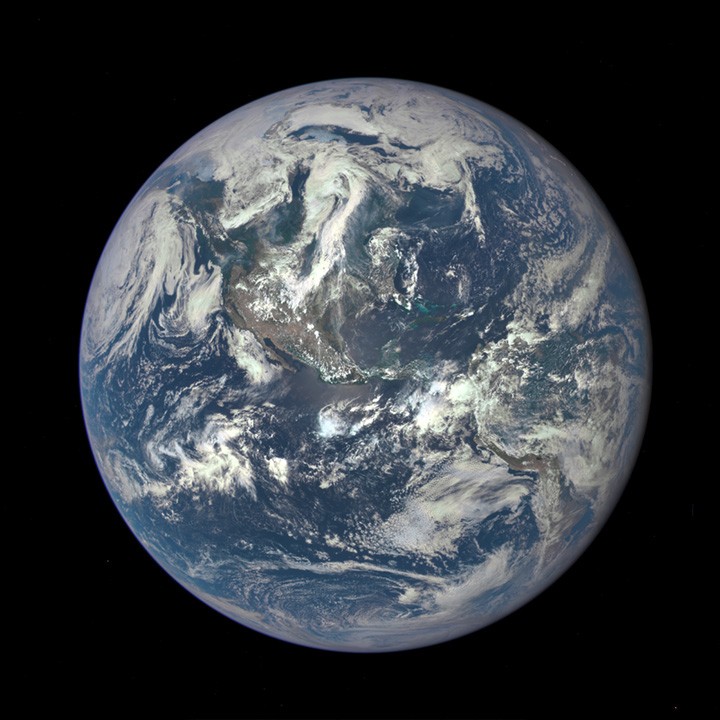
"This true-color image shows North and South America as they would appear from space 35,000 km (22,000 miles) above the Earth. The image is a combinationof data from two satellites."
From one million miles away, the DSCOVR satellite returned its first view of the entire sunlit side of Earth.
earthobservatory.nasa.gov
On February 11, 2015, DSCOVR was finally lofted into space by a SpaceX Falcon 9 rocket. After a journey of about 1.6 million kilometers (1 million miles) to the L1 Lagrange Point, the satellite and its Earth Polychromatic Imaging Camera (EPIC) has returned its first view of the entire sunlit side of Earth. At L1—four times farther than the orbit of the Moon—the gravitational pull of the Sun and Earth cancel out, providing a stable orbit and a continuous view of Earth. The image above was made by combining information from EPIC’s red, green, and blue bands. (Bands are narrow regions of the electromagnetic spectrum to which a remote sensing instrument responds. When EPIC collects data, it takes a series of 10 images at different bands—from ultraviolet to near-infrared.)
When your iPhone takes a picture, it takes in the Red, Green and Blue bands, and then combines it internally to produce a true colour image.
This camera pretty much did the same thing.
The "observable universe" is 93 Billion Light years. Which is Eight hundred eighty sextillion, one hundred seventy-three quintillion km.
That is just the observable part. lmao.
If you have a single picture with multiple objects of vastly different distances all in focus, like the earth and the stars, that picture is a composition of multiple images.
The iPhone uses computational photography, it actually takes multiple images and outputs a single composite image. It may use 2 or more cameras taking multiple shots, or just a single camera taking multiple shots.