

Was this also on Fux News? If not, it could be fake, crisis actor or something...Here he is interviewed.
You are using an out of date browser. It may not display this or other websites correctly.
You should upgrade or use an alternative browser.
You should upgrade or use an alternative browser.


Has Biden Blown His Chances?
- Thread starter niniveh
- Start date

Was this also on Fux News? If not, it could be fake, crisis actor or something...
No, that looks like MSNBC.
I'm sure there are really people on staff who are upset with Biden and resigning because of it.
No, that looks like MSNBC.
I'm sure there are really people on staff who are upset with Biden and resigning because of it.
There are.
Losing The Youth Vote
Young voters helped Biden to victory. They may abandon him this year
Voting bloc who supported Biden in 2020 over climate change see war in Gaza as environmental justice issue
Supported by

About this content
Whitney Bauck
Sun 7 Jan 2024 16.00 GMT
Elise Joshi stumped for Joe Biden as a college freshman, motivated in no small part by her sense of urgency about climate change. The environmental policy student campaigned before the 2020 election as part of TikTok for Biden, in hopes of persuading other young people to show up to the polls.
The work undertaken by Joshi and her peers paid off for Democrats – youth voter turnout surged in 2020, and has been widely credited as playing a key role in propelling Biden to victory.

Former EPA official says agency fails to protect public from toxic pesticides
Read more
But as the Israeli bombing of Gaza has killed more than 22,000 Palestinians to date, Joshi is feeling disillusioned with the president she once “happily” voted for. She’s not alone. With US military support for Israel holding steady, Joshi says that the White House’s current handling of the situation in Palestine is alienating young people – the very demographic Biden will need to win re-election in 2024.
“My generation is appalled. There’s a lot of people who are not willing to put their votes towards this administration as a result of their actions in Gaza,” she said.
And if Democrats think their climate track record will be enough to redeem them, she said, then they’re miscalculating how young people view the current administration’s actions on climate in the first place.
Biden has sometimes been described as the “climate president” for signing into law the Inflation Reduction Act (IRA), the largest investment in clean energy in American history. But many young people in Joshi’s cohort are more concerned with the oil and gas provisions within the IRA, as well as Biden’s unwillingness to declare a climate emergency. Joshi also says her peers are frequently disappointed over the Willow Project, an oil-drilling project approved by the Biden administration early last year that’s estimated to emit more climate pollution per year than 99.7% of all single-point sources in the country.
Joshi is just one leader connected to the youth climate movement trying to warn the current administration about the potential consequences of its stance on Gaza. She signed an open letter to that effect in her capacity as executive director of Gen-Z for Change – the organization formerly known as TikTok for Biden — alongside leaders from groups like the Sunrise Movement and March for Our Lives this fall.
“The vast majority of young people in this country are rightfully horrified by the atrocities committed with our tax dollars, with your support,” the letter read. “The position of your administration is badly out of step with young people and the positions of Democratic voters, whom have been shown to support a ceasefire by supermajorities in multiple polls.”

Youth plaintiffs in Held v Montana on June 20, 2023, in Helena, Montana. Photograph: Thom Bridge/AP
Numerous polls have indeed shown Biden trailing Trump among young voters, in stark contrast to their overwhelming preference for Biden in 2020. Recent polling by the New York Times suggests that young people’s support of Biden is wavering in light of his stance on the Israeli-Palestinian conflict. “The young Biden ’20 voters with anti-Israel views are the likeliest to report switching to Mr Trump,” the Times’ analysis read.
That prospect would be extremely concerning to the youth climate vote, who understand the risk Trump poses to the environment.
War as environmental injustice
While many big green groups and climate-focused news organizations in the US have been slow to address Israeli attacks on Gaza, the youth climate movement globally has overwhelmingly expressed solidarity with Palestinians, and staunchly rejected the idea that criticizing the actions of the Israeli government is inherently antisemitic. From Greta Thunberg posting a picture of herself holding a “Stand with Gaza” sign to activists at COP28 staging pro-Palestine rallies, climate-focused youth have made clear that they see the war as an environmental justice issue.
For climate activists used to raising the alarm about the ways that climate change is causing displacement and forced migration, increasing food and water insecurity and ravaging beloved landscapes and ecosystems, it’s not hard to draw a parallel to the way that Israel’s bombing is having the same impacts on Gaza and its inhabitants. That’s not to mention the emissions associated with military operations, nor the symbolic connection many environmentalists, whom some call “tree huggers”, might feel to Palestinians who have been photographed hugging olive trees after their orchards were attacked by Israeli settlers.
“Many of these people that are from global south countries had an unwavering support for Palestine,” said Isaias Hernandez of his experience meeting other young people at the UN climate conference in Dubai. Hernandez, who posts environmental content under the username @queerbrownvegan, is one of more than 120 content creators with a combined audience of millions who signed onto an open letter of their own in support of a “free Palestine”.
Youth climate activists are often close with their peers in other countries, connecting via social media, meeting up and working together to stage actions at global conferences multiple times a year. That sense of global solidarity is helping bolster US youth in their convictions about Gaza.
“We are a nonviolent movement that is fighting for the safety and well-being of all people in their communities,” said Michele Weindling, the political director of the Sunrise Movement. “We feel a direct link and a stake in what’s happening in Gaza in that we believe that no people should lose access to life-sustaining resources like water.”
Even for young people who might be hesitant to weigh in on a geopolitical conflict with a long, complex and painful history, the simple math of US spending is enough to spark outrage.
“Our president has, time and time again, told us we don’t have the money or the resources to implement climate solutions at the scale that we’re asking for; that we can’t forgive student debt at the scale that we need; but that we have the resources to send more bombs to the Israeli military,” Weindling said. “And young people are really upset about that.”
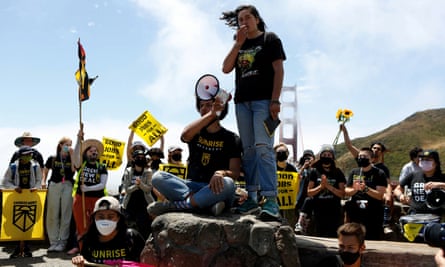
Youth activists listen to 17-year-old Ema Govea (center) in San Francisco, California, on 14 June 2021. Photograph: Amy Osborne/ReutersThe road to November
Both Weindling and Joshi want to make clear that they’re not asking their movement to withhold votes in the primary election. On the contrary, they want young people to vote.
“I really hope young people don’t become apathetic to voting in the first place and stop showing up to the polls, because the president is an important job,” Joshi said. “I’m incredibly worried about that.”
But both organizers want to warn the current administration about where the youth vote is currently headed. What’s more, they argue that the administration’s reluctance to call for a ceasefire in Gaza will make it increasingly challenging for grassroots groups to mobilize youth voters who are disillusioned with Biden’s “pro-war” stance.
“This is not only a morally problematic direction of leadership, but it’s also politically a very risky one,” said Weindling. “We cannot explain [Biden’s] position to our generation, and that will have significant effects, not just on how young people turn out in 2024 to vote, but also on whether or not they volunteer and get their friends and family out to vote.”
Still, the alternative – potentially four more years of Trump – is “frightening”, according to Joshi. Not only did Trump make the US dirtier and the planet warmer in his four years in office, weakening environmental regulations, pulling the nation out of international climate agreements and more, but he recently promised to expand oil drilling on day one of the presidency if he’s re-elected.
Elise Joshi, studentThe first step toward preventing a Trump administration is calling for a ceasefire right now
This – along with the havoc Trump wreaked on immigration rights, voting rights and the democratic process, among other things – is why Hernandez said he plans to vote. He sympathizes with his peers who plan to opt out, but he wants “to help reduce harm and violence throughout the world”.
If Biden wants to lure more young people back to the voting booth come November, he may still have time to course-correct, the young activists said, but he needs to act decisively, and soon.
“The first step toward preventing a Trump administration is calling for a ceasefire right now,” said Joshi. “Climate voters and voters that care about Palestinians – they’re one and the same.”

Losing The Youth Vote
Young voters helped Biden to victory. They may abandon him this year
Voting bloc who supported Biden in 2020 over climate change see war in Gaza as environmental justice issue
Supported by
About this content
Whitney Bauck
Sun 7 Jan 2024 16.00 GMT
Elise Joshi stumped for Joe Biden as a college freshman, motivated in no small part by her sense of urgency about climate change. The environmental policy student campaigned before the 2020 election as part of TikTok for Biden, in hopes of persuading other young people to show up to the polls.
The work undertaken by Joshi and her peers paid off for Democrats – youth voter turnout surged in 2020, and has been widely credited as playing a key role in propelling Biden to victory.
Former EPA official says agency fails to protect public from toxic pesticides
Read more
But as the Israeli bombing of Gaza has killed more than 22,000 Palestinians to date, Joshi is feeling disillusioned with the president she once “happily” voted for. She’s not alone. With US military support for Israel holding steady, Joshi says that the White House’s current handling of the situation in Palestine is alienating young people – the very demographic Biden will need to win re-election in 2024.
“My generation is appalled. There’s a lot of people who are not willing to put their votes towards this administration as a result of their actions in Gaza,” she said.
And if Democrats think their climate track record will be enough to redeem them, she said, then they’re miscalculating how young people view the current administration’s actions on climate in the first place.
Biden has sometimes been described as the “climate president” for signing into law the Inflation Reduction Act (IRA), the largest investment in clean energy in American history. But many young people in Joshi’s cohort are more concerned with the oil and gas provisions within the IRA, as well as Biden’s unwillingness to declare a climate emergency. Joshi also says her peers are frequently disappointed over the Willow Project, an oil-drilling project approved by the Biden administration early last year that’s estimated to emit more climate pollution per year than 99.7% of all single-point sources in the country.
Joshi is just one leader connected to the youth climate movement trying to warn the current administration about the potential consequences of its stance on Gaza. She signed an open letter to that effect in her capacity as executive director of Gen-Z for Change – the organization formerly known as TikTok for Biden — alongside leaders from groups like the Sunrise Movement and March for Our Lives this fall.
“The vast majority of young people in this country are rightfully horrified by the atrocities committed with our tax dollars, with your support,” the letter read. “The position of your administration is badly out of step with young people and the positions of Democratic voters, whom have been shown to support a ceasefire by supermajorities in multiple polls.”
Youth plaintiffs in Held v Montana on June 20, 2023, in Helena, Montana. Photograph: Thom Bridge/AP
Numerous polls have indeed shown Biden trailing Trump among young voters, in stark contrast to their overwhelming preference for Biden in 2020. Recent polling by the New York Times suggests that young people’s support of Biden is wavering in light of his stance on the Israeli-Palestinian conflict. “The young Biden ’20 voters with anti-Israel views are the likeliest to report switching to Mr Trump,” the Times’ analysis read.
That prospect would be extremely concerning to the youth climate vote, who understand the risk Trump poses to the environment.
War as environmental injustice
While many big green groups and climate-focused news organizations in the US have been slow to address Israeli attacks on Gaza, the youth climate movement globally has overwhelmingly expressed solidarity with Palestinians, and staunchly rejected the idea that criticizing the actions of the Israeli government is inherently antisemitic. From Greta Thunberg posting a picture of herself holding a “Stand with Gaza” sign to activists at COP28 staging pro-Palestine rallies, climate-focused youth have made clear that they see the war as an environmental justice issue.
For climate activists used to raising the alarm about the ways that climate change is causing displacement and forced migration, increasing food and water insecurity and ravaging beloved landscapes and ecosystems, it’s not hard to draw a parallel to the way that Israel’s bombing is having the same impacts on Gaza and its inhabitants. That’s not to mention the emissions associated with military operations, nor the symbolic connection many environmentalists, whom some call “tree huggers”, might feel to Palestinians who have been photographed hugging olive trees after their orchards were attacked by Israeli settlers.
“Many of these people that are from global south countries had an unwavering support for Palestine,” said Isaias Hernandez of his experience meeting other young people at the UN climate conference in Dubai. Hernandez, who posts environmental content under the username @queerbrownvegan, is one of more than 120 content creators with a combined audience of millions who signed onto an open letter of their own in support of a “free Palestine”.
Youth climate activists are often close with their peers in other countries, connecting via social media, meeting up and working together to stage actions at global conferences multiple times a year. That sense of global solidarity is helping bolster US youth in their convictions about Gaza.
“We are a nonviolent movement that is fighting for the safety and well-being of all people in their communities,” said Michele Weindling, the political director of the Sunrise Movement. “We feel a direct link and a stake in what’s happening in Gaza in that we believe that no people should lose access to life-sustaining resources like water.”
Even for young people who might be hesitant to weigh in on a geopolitical conflict with a long, complex and painful history, the simple math of US spending is enough to spark outrage.
“Our president has, time and time again, told us we don’t have the money or the resources to implement climate solutions at the scale that we’re asking for; that we can’t forgive student debt at the scale that we need; but that we have the resources to send more bombs to the Israeli military,” Weindling said. “And young people are really upset about that.”
Youth activists listen to 17-year-old Ema Govea (center) in San Francisco, California, on 14 June 2021. Photograph: Amy Osborne/ReutersThe road to November
Both Weindling and Joshi want to make clear that they’re not asking their movement to withhold votes in the primary election. On the contrary, they want young people to vote.
“I really hope young people don’t become apathetic to voting in the first place and stop showing up to the polls, because the president is an important job,” Joshi said. “I’m incredibly worried about that.”
But both organizers want to warn the current administration about where the youth vote is currently headed. What’s more, they argue that the administration’s reluctance to call for a ceasefire in Gaza will make it increasingly challenging for grassroots groups to mobilize youth voters who are disillusioned with Biden’s “pro-war” stance.
“This is not only a morally problematic direction of leadership, but it’s also politically a very risky one,” said Weindling. “We cannot explain [Biden’s] position to our generation, and that will have significant effects, not just on how young people turn out in 2024 to vote, but also on whether or not they volunteer and get their friends and family out to vote.”
Still, the alternative – potentially four more years of Trump – is “frightening”, according to Joshi. Not only did Trump make the US dirtier and the planet warmer in his four years in office, weakening environmental regulations, pulling the nation out of international climate agreements and more, but he recently promised to expand oil drilling on day one of the presidency if he’s re-elected.
Elise Joshi, student
This – along with the havoc Trump wreaked on immigration rights, voting rights and the democratic process, among other things – is why Hernandez said he plans to vote. He sympathizes with his peers who plan to opt out, but he wants “to help reduce harm and violence throughout the world”.
If Biden wants to lure more young people back to the voting booth come November, he may still have time to course-correct, the young activists said, but he needs to act decisively, and soon.
“The first step toward preventing a Trump administration is calling for a ceasefire right now,” said Joshi. “Climate voters and voters that care about Palestinians – they’re one and the same.”
Federal Employees to Stage Walk Out Over Biden’s Support for Gaza Slaughter
Federal employees from dozens of agencies will walk out on Tuesdayby Dave DeCamp January 14, 2024 at 3:35 pm ET CategoriesNewsTagsGaza, Israel
Federal employees from nearly two dozen US government agencies will walk off their jobs on Tuesday in protest of President Biden’s full-throated support for Israel’s brutal assault on Gaza, Al-Monitor reported on Friday.
The Biden administration has faced significant internal dissent over the Israeli slaughter in Gaza, which has killed nearly 24,000 Palestinians, mostly women and children. Officials from across government agencies have signed letters protesting the US support for Israel, but a walkout will be the most dramatic step yet, besides the two resignations from administration officials.
Dozens of US officials are organizing the walkout as a group calling itself Feds United for Peace. They expect hundreds of other federal employees to join them on Tuesday.
Al-Monitor obtained a list of some of the agencies where employees are expected to participate in the protest, which includes the Executive Office of the President, the National Security Agency, the Departments of State, Defense, Homeland Security, and Veterans Affairs, and more.
In light of the Al-Monitor Report, House Republicans are calling for any employees who participate in the protest to be fired. “Any government worker who walks off the job to protest US support for our ally Israel is ignoring their responsibility and abusing the trust of taxpayers,” said House Speaker Mike Johnson (R-LA), according to Axios. “They deserve to be fired.”
President Biden is also facing dissent from within his re-election campaign as his backing of Israel’s mass killing of Palestinians is hurting his chances of winning another term. Seventeen Biden campaign staffers said in a letter protesting his support for Israel that they’ve seen “volunteers quit in droves, and people who have voted blue for decades feel uncertain about doing so for the first time ever, because of this conflict.”
Free Palestine! Down with Biden! Trump for president! Oh wait..Federal Employees to Stage Walk Out Over Biden’s Support for Gaza Slaughter
Federal employees from dozens of agencies will walk out on Tuesdayby Dave DeCamp January 14, 2024 at 3:35 pm ET CategoriesNewsTagsGaza, Israel
Federal employees from nearly two dozen US government agencies will walk off their jobs on Tuesday in protest of President Biden’s full-throated support for Israel’s brutal assault on Gaza, Al-Monitor reported on Friday.
The Biden administration has faced significant internal dissent over the Israeli slaughter in Gaza, which has killed nearly 24,000 Palestinians, mostly women and children. Officials from across government agencies have signed letters protesting the US support for Israel, but a walkout will be the most dramatic step yet, besides the two resignations from administration officials.
Dozens of US officials are organizing the walkout as a group calling itself Feds United for Peace. They expect hundreds of other federal employees to join them on Tuesday.
Al-Monitor obtained a list of some of the agencies where employees are expected to participate in the protest, which includes the Executive Office of the President, the National Security Agency, the Departments of State, Defense, Homeland Security, and Veterans Affairs, and more.
In light of the Al-Monitor Report, House Republicans are calling for any employees who participate in the protest to be fired. “Any government worker who walks off the job to protest US support for our ally Israel is ignoring their responsibility and abusing the trust of taxpayers,” said House Speaker Mike Johnson (R-LA), according to Axios. “They deserve to be fired.”
President Biden is also facing dissent from within his re-election campaign as his backing of Israel’s mass killing of Palestinians is hurting his chances of winning another term. Seventeen Biden campaign staffers said in a letter protesting his support for Israel that they’ve seen “volunteers quit in droves, and people who have voted blue for decades feel uncertain about doing so for the first time ever, because of this conflict.”
Free Palestine! Down with Biden! Trump for president! Oh wait..
JANUARY 15, 2024Israel’s War on Palestine and the Global Upsurge Against It
BY VIJAY PRASHAD
FacebookTwitterRedditEmail


Photo by Tristan Sosteric
Hundreds of millions of people across the world have been deeply moved by the atrocity of the Israeli war on Palestine. Millions have attended marches and protests, many of them participating in such demonstrations for the first time in their lives. Social media, in almost all the world’s languages, is saturated with memes and posts about this or that terrible action. Some people focus on the Israeli attack on Palestinian children, others on the illegal targeting of Gaza’s health infrastructure, and yet others point to the annihilation of at least four hundred families (more than ten people in each family killed). The focus of attention does not seem to be diminishing. Holidays in December went by, but the intensity of the protests and the posts remained steady. No attempt by social media companies to turn the algorithm against the Palestinians succeeded, no attempt to ban the protests—even the display of the Palestinian flag—worked. Accusations of antisemitism fell flat and demands for the condemnation of Hamas were dismissed. This is a new mood, a new kind of attitude toward the Palestinian struggle.
Never before in the 75 previous years has there been such sustained attention to the cause of the Palestinians and of Israeli brutality. Israel has launched eight bombing campaigns on Gaza since 2006. . And Israel has built up an entire illegal structure against the Palestinians in East Jerusalem and the West Bank (an apartheid wall, settlements, checkpoints). When Palestinians have tried to resist—whether through civic action or armed struggle—they have faced immense violence from the Israeli military. Ever since social media has been available, images from Palestine have circulated, including of the use of white phosphorus against civilians in Gaza, and including the arrest and murder of Palestinian children across the Occupied Palestine Territory. But none of the previous acts of violence evoked the kind of response from around the world as this violence that began in October 2023.
Genocide
The Israeli armed violence against Gaza since October has been in a qualitatively different form than any previous violence. The bombardment of Gaza was vicious, with Israeli aircraft hitting residential areas with no concern for civilian life. The number of dead increased day by day at a rate not seen before. Then, when Israeli ground forces entered Gaza, they effected an illegal mass eviction of the Palestinian civilians from their homes and pushed them further and further south toward the border with Egypt. The Israelis violated their own promises of “safe zones,” hitting areas more densely packed than before because of the internal displacement. It was this scale of violence that provoked an early use of the term “genocide” to describe what was happening in Gaza. By early January, more than 1 percent of the entire Palestinian population in Gaza had been killed, while over 95 percent had been displaced. The kind of violence used here was not seen in any contemporary war, neither in Iraq (where the U.S. disregarded most laws of war) nor in Ukraine (where the death toll of civilians is far smaller despite the war now lasting two years).
The momentum of mass protest pushed the government of South Africa to file a dispute in the International Court of Justice (ICJ) against Israel for the crime of genocide. Both countries are parties to the 1948 Convention Against Genocide, and the ICJ is the venue for dispute settlements. The 84-page filing by the South African government documents many of the atrocities perpetrated by Israel, and also, crucially, the words of Israeli high officials. Nine pages of this text (pp. 59 to 67) list the Israeli officials in their own words, many of them calling for a “Second Nakba” or a “Gaza Nakba,” a use of the term “Nakba” or Catastrophe that refers to the 1948 Nakba of the Palestinians from their homes that led to the creation of the State of Israel. These words are chilling, and they have been widely circulated since October. Racist language about “monsters,” “animals,” and the “jungle” shape the speeches and statements by these Israeli government officials. Israel’s Defense Minister Yoav Gallant said on October 9, 2023, that his forces are “imposing a complete siege on Gaza. No electricity, no food, no water, no fuel. Everything is closed. We are fighting human animals, and we are acting accordingly.” This, along with the character of the Israeli military strikes, is sufficient as a benchmark for the accusation of genocide. At the hearing at the ICJ, Israel was unable to respond credibly to the South African complaint.
It is a combination of the images from Gaza and the words of these Israeli high officials—backed fully by the United States government and many of the governments of European states—that provoked the sustained anger and desolation that has driven these mass protests.
Legitimacy
Over the course of the past two years—from the start of the war in Ukraine until now—there has been a rapid decline in the legitimacy of the West, notably the countries of the North Atlantic Treaty Organization (NATO), led by the United States. These wars are not the cause of this drop in legitimacy, but they have accelerated the decline in the legitimacy of the NATO countries, particularly in the Global South.
Since the start of the Third Great Depression in 2007, the Global North has slowly lost its control over the world economy, over technology and science, and over raw materials. Billionaires in the Global North deepened their “tax strike” and withdrew a large share of social wealth into tax havens and into unproductive financial investments. This left the Global North with few instruments to maintain economic power, including by making investments in the Global South. That role was slowly taken up by China, which has been recycling global profits into infrastructural projects across the world. Rather than contest China’s Belt and Road Initiative, for instance, through its own commercial and economic project, the Global North has sought to militarize its response with massive spending (three-quarters of global military spending is by the NATO states). The Global North has used Ukraine and Taiwan as levers to provoke Russia and China into military conflicts so as to ‘weaken’ them rather than contest growing Russian energy power and Chinese industrial and technological power through trade and development.
It is clear to the majority of people in the world that it is the Global North that has failed to address the crises in the world, whether the climate crisis or the consequences of the Third Great Depression. It has tried to substitute a language of euphemism for reality, using terms such as “democracy promotion,” “sustainable development,” “humanitarian pause,” and—from UK Foreign Secretary Lord David Cameron and Germany’s Foreign Minister Annalena Baerbock—the ridiculous formulation of a “sustainable ceasefire.” Empty words are no substitute for real actions. To speak of a “sustainable ceasefire” while arming Israel or to speak of “democracy promotion” while backing anti-democratic governments now defines the hypocrisy of the Global North’s political class.
The Israelis say that they will continue this genocidal war for as long as it takes. As each day goes by of this war, the legitimacy of Israel deteriorates. But behind that violence itself is the much deeper end of the legitimacy of the NATO project, whose sanctimonies sound like nails being dragged across a bloodied chalkboard.
This article was produced by Globetrotter.
Vijay Prashad’s most recent book (with Noam Chomsky) is The Withdrawal: Iraq, Libya, Afghanistan and the Fragility of US Power (New Press, August 2022).
JANUARY 15, 2024Israel’s War on Palestine and the Global Upsurge Against It
BY VIJAY PRASHAD
FacebookTwitterRedditEmail
Photo by Tristan Sosteric
Hundreds of millions of people across the world have been deeply moved by the atrocity of the Israeli war on Palestine. Millions have attended marches and protests, many of them participating in such demonstrations for the first time in their lives. Social media, in almost all the world’s languages, is saturated with memes and posts about this or that terrible action. Some people focus on the Israeli attack on Palestinian children, others on the illegal targeting of Gaza’s health infrastructure, and yet others point to the annihilation of at least four hundred families (more than ten people in each family killed). The focus of attention does not seem to be diminishing. Holidays in December went by, but the intensity of the protests and the posts remained steady. No attempt by social media companies to turn the algorithm against the Palestinians succeeded, no attempt to ban the protests—even the display of the Palestinian flag—worked. Accusations of antisemitism fell flat and demands for the condemnation of Hamas were dismissed. This is a new mood, a new kind of attitude toward the Palestinian struggle.
Never before in the 75 previous years has there been such sustained attention to the cause of the Palestinians and of Israeli brutality. Israel has launched eight bombing campaigns on Gaza since 2006. . And Israel has built up an entire illegal structure against the Palestinians in East Jerusalem and the West Bank (an apartheid wall, settlements, checkpoints). When Palestinians have tried to resist—whether through civic action or armed struggle—they have faced immense violence from the Israeli military. Ever since social media has been available, images from Palestine have circulated, including of the use of white phosphorus against civilians in Gaza, and including the arrest and murder of Palestinian children across the Occupied Palestine Territory. But none of the previous acts of violence evoked the kind of response from around the world as this violence that began in October 2023.
Genocide
The Israeli armed violence against Gaza since October has been in a qualitatively different form than any previous violence. The bombardment of Gaza was vicious, with Israeli aircraft hitting residential areas with no concern for civilian life. The number of dead increased day by day at a rate not seen before. Then, when Israeli ground forces entered Gaza, they effected an illegal mass eviction of the Palestinian civilians from their homes and pushed them further and further south toward the border with Egypt. The Israelis violated their own promises of “safe zones,” hitting areas more densely packed than before because of the internal displacement. It was this scale of violence that provoked an early use of the term “genocide” to describe what was happening in Gaza. By early January, more than 1 percent of the entire Palestinian population in Gaza had been killed, while over 95 percent had been displaced. The kind of violence used here was not seen in any contemporary war, neither in Iraq (where the U.S. disregarded most laws of war) nor in Ukraine (where the death toll of civilians is far smaller despite the war now lasting two years).
The momentum of mass protest pushed the government of South Africa to file a dispute in the International Court of Justice (ICJ) against Israel for the crime of genocide. Both countries are parties to the 1948 Convention Against Genocide, and the ICJ is the venue for dispute settlements. The 84-page filing by the South African government documents many of the atrocities perpetrated by Israel, and also, crucially, the words of Israeli high officials. Nine pages of this text (pp. 59 to 67) list the Israeli officials in their own words, many of them calling for a “Second Nakba” or a “Gaza Nakba,” a use of the term “Nakba” or Catastrophe that refers to the 1948 Nakba of the Palestinians from their homes that led to the creation of the State of Israel. These words are chilling, and they have been widely circulated since October. Racist language about “monsters,” “animals,” and the “jungle” shape the speeches and statements by these Israeli government officials. Israel’s Defense Minister Yoav Gallant said on October 9, 2023, that his forces are “imposing a complete siege on Gaza. No electricity, no food, no water, no fuel. Everything is closed. We are fighting human animals, and we are acting accordingly.” This, along with the character of the Israeli military strikes, is sufficient as a benchmark for the accusation of genocide. At the hearing at the ICJ, Israel was unable to respond credibly to the South African complaint.
It is a combination of the images from Gaza and the words of these Israeli high officials—backed fully by the United States government and many of the governments of European states—that provoked the sustained anger and desolation that has driven these mass protests.
Legitimacy
Over the course of the past two years—from the start of the war in Ukraine until now—there has been a rapid decline in the legitimacy of the West, notably the countries of the North Atlantic Treaty Organization (NATO), led by the United States. These wars are not the cause of this drop in legitimacy, but they have accelerated the decline in the legitimacy of the NATO countries, particularly in the Global South.
Since the start of the Third Great Depression in 2007, the Global North has slowly lost its control over the world economy, over technology and science, and over raw materials. Billionaires in the Global North deepened their “tax strike” and withdrew a large share of social wealth into tax havens and into unproductive financial investments. This left the Global North with few instruments to maintain economic power, including by making investments in the Global South. That role was slowly taken up by China, which has been recycling global profits into infrastructural projects across the world. Rather than contest China’s Belt and Road Initiative, for instance, through its own commercial and economic project, the Global North has sought to militarize its response with massive spending (three-quarters of global military spending is by the NATO states). The Global North has used Ukraine and Taiwan as levers to provoke Russia and China into military conflicts so as to ‘weaken’ them rather than contest growing Russian energy power and Chinese industrial and technological power through trade and development.
It is clear to the majority of people in the world that it is the Global North that has failed to address the crises in the world, whether the climate crisis or the consequences of the Third Great Depression. It has tried to substitute a language of euphemism for reality, using terms such as “democracy promotion,” “sustainable development,” “humanitarian pause,” and—from UK Foreign Secretary Lord David Cameron and Germany’s Foreign Minister Annalena Baerbock—the ridiculous formulation of a “sustainable ceasefire.” Empty words are no substitute for real actions. To speak of a “sustainable ceasefire” while arming Israel or to speak of “democracy promotion” while backing anti-democratic governments now defines the hypocrisy of the Global North’s political class.
The Israelis say that they will continue this genocidal war for as long as it takes. As each day goes by of this war, the legitimacy of Israel deteriorates. But behind that violence itself is the much deeper end of the legitimacy of the NATO project, whose sanctimonies sound like nails being dragged across a bloodied chalkboard.
This article was produced by Globetrotter.
Vijay Prashad’s most recent book (with Noam Chomsky) is The Withdrawal: Iraq, Libya, Afghanistan and the Fragility of US Power (New Press, August 2022).
500,000 killed in Syria, not a peep.
300,000 killed in Yemen, not a peep.
20,000 in Gaza Genocide.
I guess when Muslims kill muslims the world should mind its own business but if Jews are involved well no suddenly its all about the innocents right?
I keep forgeting to issue periodic sarcasm alerts...No, that looks like MSNBC.
I'm sure there are really people on staff who are upset with Biden and resigning because of it.
500,000 killed in Syria, not a peep.
300,000 killed in Yemen, not a peep.
20,000 in Gaza Genocide.
I guess when Muslims kill muslims the world should mind its own business but if Jews are involved well no suddenly its all about the innocents right?
Syria happened over years, Canada sent support and brought in thousands of refugees. Do you think Canada should have sent in troops to back Syria, Turkey, Lebanon, the US, Kurds or Russia?
Yemen happened over 7 years and as a war do you think Canada should have sent troops to back Saudi Arabia or Yemen?
Gaza is the 6th war in 15 year, part of a 17 year long blockade in a concentration camp run through apartheid and now a genocide actively backed by Canada. Its the active support that makes the biggest difference.
Biden needs to listen to Democratic voters on Gaza
As the civilian death toll amounts, a significant portion of US public opinion has shifted away from Israel

JAMES
ZOGBY

US President Joe Biden, accompanied by Vice President Kamala Harris and US Secretary of State Antony Blinken, speaks after Hamas's attacks in Israel on October 10. Reuters
Listen In English
Listen In Arabic
Powered by automated translation
This year’s US presidential election may be the first in which the issues involving Palestinian rights may affect the outcome.
Over the past several decades, elections have been fought over a range of domestic and foreign policy concerns – from civil rights and abortion to the wars in Vietnam and Iraq. In most instances, these were partisan “wedge” issues – that is, issues that were used by one party against the other. The growing concern for Palestinian rights has become a “wedge issue“ that is dividing the governing Democratic Party.
Whether deliberate or not, Democrats made a fateful choice over the past several decades. They abandoned the white working class in favour of courting what has come to be known as the “Obama voters”. They were young voters, voters of colour (black, Latino and Asian), and educated women voters. The problem is that having lost a sizable percentage of white working-class voters, Democrats can’t afford to lose the substantial majorities of voters from the Obama coalition they need to win national elections.
Recent polls, such as the one conducted in December by The New York Times, show that young voters are deeply disappointed with President Joe Biden’s handling of the war on Gaza. They demonstrate greater solidarity with Palestinians than with Israelis and, in part, motivated by their dissatisfaction, they appear less inclined to support him in this year’s election.
Given the continuing deadly violence in Gaza and the start of the election year, this past week my Arab American Institute co-sponsored a summit on Gaza together with the Rainbow Push Coalition, founded by Rev Jesse Jackson, and other partners. In order to have a detailed look at how voters were thinking about the war, we commissioned a special nationwide poll of likely voters.


Palestinian Muhammad Al Durra with his children in the ruins of a house in Rafah where they sheltered on January 11, 2024. EPA
The caviler attitude of those who are guiding Mr Biden’s campaign is simplistic and deeply flawed
We learnt four central lessons: because of growing sympathy for Palestinians, voters want American policy to be more balanced and less supportive of Israel. Second, because of the toll the bombings have taken on Palestinian lives, voters want US military aid to Israel to be restricted and conditional. Third, voters want members of Congress to support a ceasefire and are less inclined to support candidates who oppose a ceasefire.
And finally, in almost every instance, the percentages of young voters and non-white voters who support a more balanced Middle East policy, conditioning aid to Israel and a ceasefire far exceed those of other groups of voters. And because these two groups are so important to their party’s chances in 2024, Democrats had better find ways to change direction and win them back.
The numbers speak for themselves.
American public opinion has shifted away from Israel as the invasion of Gaza continues. Forty-two per cent of voters now say they sympathise with both Israelis and Palestinians equally. While a higher percentage of Americans indicated sympathy towards Israelis alone rather than Palestinians alone, Palestinians have more support among voters who are young (34 per cent to 16 per cent) and people of colour (21 per cent to 17 per cent).
Since the start of the current violence in Gaza, sympathy for Palestinians has increased, especially among Democrats (23 per cent increased sympathy towards Palestinians versus 17 per cent towards Israelis), younger Americans (37 per cent increased sympathy towards Palestinians versus 27 per cent for Israelis), and people of colour (29 per cent increased sympathy towards Palestinians versus 13 per cent for Israelis).
At the same time, Americans are calling into question the Biden administration’s handling of the conflict.
Fifty per cent of Americans believe Mr Biden’s policy favours Israel. But when asked how his administration should conduct US policy, a plurality of respondents (42 per cent) say it should be balanced between Israeli and Palestinian needs. By a decisive two-to-one margin, voters say that instead of siding with Israel (a position held by only 26 per cent), the US should strive to be an honest broker between Israelis and Palestinians (a position held by 57 per cent).

MORE FROM JAMES ZOGBY
Broken promises and empty pledges stopped Gaza's progress decades ago
Almost three months after October 7, lessons have yet to be learnt
For Palestinian Christians in Bethlehem, Christmas themes are not the same as in the West
This questioning of the administration’s one-sided support for Israel also has an impact on voters’ attitudes towards US military assistance to that state. By a two-to-one margin (51 per cent to 26 per cent), voters reject the notion that the US should give unrestricted military assistance to Israel as long as Israel is putting Palestinian civilian lives at risk.
By the same two-to-one margin, respondents said that they sided with those Democratic senators who objected to the President’s recent decision to bypass congressional oversight in sending weapons to Israel. A plurality of voters (41 per cent) now indicate that it is time to consider cutting or conditioning Israel’s annual $3.8 billion appropriation for military assistance.
American voters are more likely to vote for candidates that support a ceasefire. Respondents want a ceasefire and an end to the conflict. In responses to two separate questions, by a two-to-one margin, respondents indicated that they are more inclined to support a member of Congress who supports a ceasefire and that they are less willing to support those who oppose calls for it.
The bottom line is that Democrats should be hearing alarms going off as a result of the White House’s refusal to stop the way Israel is conducting this war or even consider supporting a ceasefire to end the killing. The result is that they are losing votes from groups that have formed their most loyal supporters.
The cavalier attitude of those who are guiding Mr Biden’s campaign is simplistic and deeply flawed. Betting on young and non-white voters drifting back to Mr Biden in November – on the assumption that they won’t want to see Donald Trump return to the White House – is demeaning to the feelings of these voters.
It’s also dangerous. As The New York Times poll demonstrates, almost one in five say they would prefer to vote for third-party candidates. The “political pros” in the White House need to consider this threat and not discount it as Democrats did in the 2000 and 2016 elections.
Published: January 17, 2024, 8:00 AM
Biden needs to listen to Democratic voters on Gaza
As the civilian death toll amounts, a significant portion of US public opinion has shifted away from Israel
JAMES
ZOGBY
US President Joe Biden, accompanied by Vice President Kamala Harris and US Secretary of State Antony Blinken, speaks after Hamas's attacks in Israel on October 10. Reuters
Listen In English
Listen In Arabic
Powered by automated translation
This year’s US presidential election may be the first in which the issues involving Palestinian rights may affect the outcome.
Over the past several decades, elections have been fought over a range of domestic and foreign policy concerns – from civil rights and abortion to the wars in Vietnam and Iraq. In most instances, these were partisan “wedge” issues – that is, issues that were used by one party against the other. The growing concern for Palestinian rights has become a “wedge issue“ that is dividing the governing Democratic Party.
Whether deliberate or not, Democrats made a fateful choice over the past several decades. They abandoned the white working class in favour of courting what has come to be known as the “Obama voters”. They were young voters, voters of colour (black, Latino and Asian), and educated women voters. The problem is that having lost a sizable percentage of white working-class voters, Democrats can’t afford to lose the substantial majorities of voters from the Obama coalition they need to win national elections.
Recent polls, such as the one conducted in December by The New York Times, show that young voters are deeply disappointed with President Joe Biden’s handling of the war on Gaza. They demonstrate greater solidarity with Palestinians than with Israelis and, in part, motivated by their dissatisfaction, they appear less inclined to support him in this year’s election.
Given the continuing deadly violence in Gaza and the start of the election year, this past week my Arab American Institute co-sponsored a summit on Gaza together with the Rainbow Push Coalition, founded by Rev Jesse Jackson, and other partners. In order to have a detailed look at how voters were thinking about the war, we commissioned a special nationwide poll of likely voters.
The caviler attitude of those who are guiding Mr Biden’s campaign is simplistic and deeply flawed
We learnt four central lessons: because of growing sympathy for Palestinians, voters want American policy to be more balanced and less supportive of Israel. Second, because of the toll the bombings have taken on Palestinian lives, voters want US military aid to Israel to be restricted and conditional. Third, voters want members of Congress to support a ceasefire and are less inclined to support candidates who oppose a ceasefire.
And finally, in almost every instance, the percentages of young voters and non-white voters who support a more balanced Middle East policy, conditioning aid to Israel and a ceasefire far exceed those of other groups of voters. And because these two groups are so important to their party’s chances in 2024, Democrats had better find ways to change direction and win them back.
The numbers speak for themselves.
American public opinion has shifted away from Israel as the invasion of Gaza continues. Forty-two per cent of voters now say they sympathise with both Israelis and Palestinians equally. While a higher percentage of Americans indicated sympathy towards Israelis alone rather than Palestinians alone, Palestinians have more support among voters who are young (34 per cent to 16 per cent) and people of colour (21 per cent to 17 per cent).
Since the start of the current violence in Gaza, sympathy for Palestinians has increased, especially among Democrats (23 per cent increased sympathy towards Palestinians versus 17 per cent towards Israelis), younger Americans (37 per cent increased sympathy towards Palestinians versus 27 per cent for Israelis), and people of colour (29 per cent increased sympathy towards Palestinians versus 13 per cent for Israelis).
At the same time, Americans are calling into question the Biden administration’s handling of the conflict.
Fifty per cent of Americans believe Mr Biden’s policy favours Israel. But when asked how his administration should conduct US policy, a plurality of respondents (42 per cent) say it should be balanced between Israeli and Palestinian needs. By a decisive two-to-one margin, voters say that instead of siding with Israel (a position held by only 26 per cent), the US should strive to be an honest broker between Israelis and Palestinians (a position held by 57 per cent).
Former US president Donald Trump speaks during a campaign event in Atkinson, New Hampshire, on Tuesday. Bloomberg
MORE FROM JAMES ZOGBY
Broken promises and empty pledges stopped Gaza's progress decades ago
Almost three months after October 7, lessons have yet to be learnt
For Palestinian Christians in Bethlehem, Christmas themes are not the same as in the West
This questioning of the administration’s one-sided support for Israel also has an impact on voters’ attitudes towards US military assistance to that state. By a two-to-one margin (51 per cent to 26 per cent), voters reject the notion that the US should give unrestricted military assistance to Israel as long as Israel is putting Palestinian civilian lives at risk.
By the same two-to-one margin, respondents said that they sided with those Democratic senators who objected to the President’s recent decision to bypass congressional oversight in sending weapons to Israel. A plurality of voters (41 per cent) now indicate that it is time to consider cutting or conditioning Israel’s annual $3.8 billion appropriation for military assistance.
American voters are more likely to vote for candidates that support a ceasefire. Respondents want a ceasefire and an end to the conflict. In responses to two separate questions, by a two-to-one margin, respondents indicated that they are more inclined to support a member of Congress who supports a ceasefire and that they are less willing to support those who oppose calls for it.
The bottom line is that Democrats should be hearing alarms going off as a result of the White House’s refusal to stop the way Israel is conducting this war or even consider supporting a ceasefire to end the killing. The result is that they are losing votes from groups that have formed their most loyal supporters.
The cavalier attitude of those who are guiding Mr Biden’s campaign is simplistic and deeply flawed. Betting on young and non-white voters drifting back to Mr Biden in November – on the assumption that they won’t want to see Donald Trump return to the White House – is demeaning to the feelings of these voters.
It’s also dangerous. As The New York Times poll demonstrates, almost one in five say they would prefer to vote for third-party candidates. The “political pros” in the White House need to consider this threat and not discount it as Democrats did in the 2000 and 2016 elections.
Published: January 17, 2024, 8:00 AM
James Zogby
Biden needs to listen to Democratic voters on Gaza
As the civilian death toll amounts, a significant portion of US public opinion has shifted away from Israel
JAMES
ZOGBY
US President Joe Biden, accompanied by Vice President Kamala Harris and US Secretary of State Antony Blinken, speaks after Hamas's attacks in Israel on October 10. Reuters
Listen In English
Listen In Arabic
Powered by automated translation
This year’s US presidential election may be the first in which the issues involving Palestinian rights may affect the outcome.
Over the past several decades, elections have been fought over a range of domestic and foreign policy concerns – from civil rights and abortion to the wars in Vietnam and Iraq. In most instances, these were partisan “wedge” issues – that is, issues that were used by one party against the other. The growing concern for Palestinian rights has become a “wedge issue“ that is dividing the governing Democratic Party.
Whether deliberate or not, Democrats made a fateful choice over the past several decades. They abandoned the white working class in favour of courting what has come to be known as the “Obama voters”. They were young voters, voters of colour (black, Latino and Asian), and educated women voters. The problem is that having lost a sizable percentage of white working-class voters, Democrats can’t afford to lose the substantial majorities of voters from the Obama coalition they need to win national elections.
Recent polls, such as the one conducted in December by The New York Times, show that young voters are deeply disappointed with President Joe Biden’s handling of the war on Gaza. They demonstrate greater solidarity with Palestinians than with Israelis and, in part, motivated by their dissatisfaction, they appear less inclined to support him in this year’s election.
Given the continuing deadly violence in Gaza and the start of the election year, this past week my Arab American Institute co-sponsored a summit on Gaza together with the Rainbow Push Coalition, founded by Rev Jesse Jackson, and other partners. In order to have a detailed look at how voters were thinking about the war, we commissioned a special nationwide poll of likely voters.
The caviler attitude of those who are guiding Mr Biden’s campaign is simplistic and deeply flawed
We learnt four central lessons: because of growing sympathy for Palestinians, voters want American policy to be more balanced and less supportive of Israel. Second, because of the toll the bombings have taken on Palestinian lives, voters want US military aid to Israel to be restricted and conditional. Third, voters want members of Congress to support a ceasefire and are less inclined to support candidates who oppose a ceasefire.
And finally, in almost every instance, the percentages of young voters and non-white voters who support a more balanced Middle East policy, conditioning aid to Israel and a ceasefire far exceed those of other groups of voters. And because these two groups are so important to their party’s chances in 2024, Democrats had better find ways to change direction and win them back.
The numbers speak for themselves.
American public opinion has shifted away from Israel as the invasion of Gaza continues. Forty-two per cent of voters now say they sympathise with both Israelis and Palestinians equally. While a higher percentage of Americans indicated sympathy towards Israelis alone rather than Palestinians alone, Palestinians have more support among voters who are young (34 per cent to 16 per cent) and people of colour (21 per cent to 17 per cent).
Since the start of the current violence in Gaza, sympathy for Palestinians has increased, especially among Democrats (23 per cent increased sympathy towards Palestinians versus 17 per cent towards Israelis), younger Americans (37 per cent increased sympathy towards Palestinians versus 27 per cent for Israelis), and people of colour (29 per cent increased sympathy towards Palestinians versus 13 per cent for Israelis).
At the same time, Americans are calling into question the Biden administration’s handling of the conflict.
Fifty per cent of Americans believe Mr Biden’s policy favours Israel. But when asked how his administration should conduct US policy, a plurality of respondents (42 per cent) say it should be balanced between Israeli and Palestinian needs. By a decisive two-to-one margin, voters say that instead of siding with Israel (a position held by only 26 per cent), the US should strive to be an honest broker between Israelis and Palestinians (a position held by 57 per cent).
This questioning of the administration’s one-sided support for Israel also has an impact on voters’ attitudes towards US military assistance to that state. By a two-to-one margin (51 per cent to 26 per cent), voters reject the notion that the US should give unrestricted military assistance to Israel as long as Israel is putting Palestinian civilian lives at risk.
By the same two-to-one margin, respondents said that they sided with those Democratic senators who objected to the President’s recent decision to bypass congressional oversight in sending weapons to Israel. A plurality of voters (41 per cent) now indicate that it is time to consider cutting or conditioning Israel’s annual $3.8 billion appropriation for military assistance.
American voters are more likely to vote for candidates that support a ceasefire. Respondents want a ceasefire and an end to the conflict. In responses to two separate questions, by a two-to-one margin, respondents indicated that they are more inclined to support a member of Congress who supports a ceasefire and that they are less willing to support those who oppose calls for it.
The bottom line is that Democrats should be hearing alarms going off as a result of the White House’s refusal to stop the way Israel is conducting this war or even consider supporting a ceasefire to end the killing. The result is that they are losing votes from groups that have formed their most loyal supporters.
The cavalier attitude of those who are guiding Mr Biden’s campaign is simplistic and deeply flawed. Betting on young and non-white voters drifting back to Mr Biden in November – on the assumption that they won’t want to see Donald Trump return to the White House – is demeaning to the feelings of these voters.
It’s also dangerous. As The New York Times poll demonstrates, almost one in five say they would prefer to vote for third-party candidates. The “political pros” in the White House need to consider this threat and not discount it as Democrats did in the 2000 and 2016 elections.
Published: January 17, 2024, 8:00 AM
James Zogby
Why Joe Biden Is a Foreign Policy Failure
Only an exceptional president could resist the endless war-profiteering of this mammoth war machine; alas, Biden doesn’t even try.
by Jeffrey D. Sachs Posted onJanuary 17, 2024
Reprinted from Common Dreams.
When it comes to foreign policy, the president of the United States has two essential roles. The first is to rein in the military-industrial complex, or MIC, which is always pushing for war. The second is to rein in U.S. allies that expect the U.S. to go to war on their behalf. A few savvy presidents succeed, but most fail. Joe Biden is certainly a failure.
One of the savviest presidents was Dwight Eisenhower. In late 1956, he confronted two simultaneous crises. The first was a disastrously misguided war launched by the United Kingdom, France, and Israel to overthrow the Egyptian government and retake control of the Suez Canal following its nationalization by Egypt. Eisenhower forced the allies to stop their brazen and illegal attack, including through a U.S.-sponsored United Nations General Assembly resolution. The second crisis was the Hungarian Uprising against Soviet domination of Hungary. While Eisenhower sympathized with the uprising, he wisely kept the U.S. out of Hungary and thereby avoided a dangerous military showdown with the Soviet Union.
Eisenhower’s historic farewell address to the American people in January 1961 alerted the public to the growing power of the MIC:
In the councils of government, we must guard against the acquisition of unwarranted influence, whether sought or unsought, by the military-industrial complex. The potential for the disastrous rise of misplaced power exists and will persist.
We must never let the weight of this combination endanger our liberties or democratic processes. We should take nothing for granted. Only an alert and knowledgeable citizenry can compel the proper meshing of the huge industrial and military machinery of defense with our peaceful methods and goals, so that security and liberty may prosper together.
Even Eisenhower did not fully rein in the military-industrial complex, especially the Central Intelligence Agency. No president has done so entirely. The CIA was created in 1947 with two distinct roles. The first and valid one was as an intelligence agency. The second and disastrous one was as a covert army for the president. In the latter capacity, the CIA has led one calamitous failure after another from Eisenhower’s time till now, including coups, assassinations, and stage-managed “color revolutions,” all of which have produced endless havoc and destruction.
Following Eisenhower, John F. Kennedy brilliantly resolved the 1962 Cuban Missile Crisis, narrowly avoiding nuclear Armageddon by facing down his own war-mongering advisers to reach a peaceful solution with the Soviet Union. The following year he successfully negotiated the Partial Nuclear Test Ban Treaty with the Soviet Union, over Pentagon objections, and then won Senate ratification, thereby pulling the U.S. and Soviet Union back from the brink of war. Many believe that Kennedy’s peace initiatives led to his assassination at the hands of rogue CIA officials. Biden has joined the long line of presidents that have kept classified or redacted thousands of documents that would shed more light on the assassination.
Sixty years onward, the MIC has an iron grip on American foreign policy. As I’ve recently described, foreign policy has become an insider racket, with the MIC in control of the White House, Pentagon, State Department, the Armed Services Committees of the Congress, and of course the CIA, all in a tight embrace with the major arms contractors. Only an exceptional president could resist the endless war-profiteering of this mammoth war machine.
Alas, Biden doesn’t even try. Throughout his long political career, Biden has been supported by the MIC and has in turn enthusiastically supported wars of choice, massive arms sales, CIA-backed coups, and NATO enlargement.
Biden’s 2024 military budget breaks all records, reaching at least $1.5 trillion in outlays for the Pentagon, CIA, homeland security, non-Pentagon nuclear arms programs, subsidized foreign weapons sales, other military-linked outlays, and interest payments on past war-related debts. On top of this mountain of military spending, Biden is seeking an additional $50 billion in “emergency supplemental funding” for America’s “defense industrial base” to keep shipping munitions to Ukraine and Israel.
Biden doesn’t have any realistic plans for Ukraine, and even rejected a peace agreement between Russia and Ukraine in March 2022 that would have ended the conflict based on Ukrainian neutrality by ending Ukraine’s futile bid to join NATO (futile because Russia will never accept it). Ukraine is big business for the MIC – tens and potentially hundreds of billions of dollars of arms contracts, manufacturing facilities across the U.S,, the opportunity to develop and test new weapons systems – so Biden keeps the war going despite the destruction of Ukraine on the battlefield, and the tragic and needless deaths of hundreds of thousands of Ukrainians. The MIC, and hence Biden, continue to shun negotiations, even though direct U.S.-Russia negotiations regarding NATO and other security issues (such as U.S. missile placements in Eastern Europe) could end the war.
In Israel, Biden’s failure is even more on display. Israel is led by an extremist government that reviles the two-state solution, according to which Israelis and Palestinians should live side by side in two sovereign peaceful and secure states, or indeed any solution that grants Palestinians their political rights. The two-state solution is deeply embedded in international law, including U.N. Security Council and General Assembly resolutions and supposedly in U.S. foreign policy. The Arab and Islamic leaders are committed to normalizing and securing safe relations with Israel in the context of the two-state solution.
Yet Israel is led by violent zealots who make the messianic claim that God has given Israel all the land of today’s Palestine, including the West Bank, Gaza, and East Jerusalem. These zealots therefore insist on political domination over the millions of Palestinians in their midst, or their annihilation or expulsion. Netanyahu and his colleagues don’t even hide their genocidal intentions, though most foreign observers don’t fully understand the biblical references that the Israeli leaders invoke to justify their ongoing mass slaughter of the Palestinian people.
Israel now faces highly credible charges of genocide in the International Court of Justice in a case brought by South Africa. The documentary record presented by South Africa and others is as clear as it is chilling. Israeli politics is not the politics of pragmatism and certainly not the politics of peace. It is the politics of biblical apocalypse.
Biden nonetheless provides Israel with the munitions to carry out its massive war crimes. Instead of acting like Eisenhower and pressing Israel to end its slaughter in contravention of international law including the Genocide Convention, Biden continues to ship munitions, even bypassing congressional review to the maximum extent he can. The result is U.S. diplomatic isolation from the rest of the world, and the growing involvement of the U.S. military in a war that is rapidly and all-too-predictably expanding across Lebanon, Syria, Iraq, Iran, and Yemen. In the recent U.N. General Assembly vote backing political self-determination for the people of Palestine, the U.S. and Israel stood alone save two votes: Micronesia (bound by compact to vote with the U.S.) and Nauru (population 12,000).
America foreign policy is rudderless, with a president whose only foreign policy recipe is war. With the U.S. already up to its neck in the wars in Ukraine and the Middle East, Biden also intends to ship more arms to Taiwan despite China’s strident objections that the U.S. is thereby violating long-standing U.S. commitments to the One-China policy, including the commitment made 42 years ago in the U.S.-PRC Joint Communique that the U.S. government “does not seek to carry out a long-term policy of arms sales to Taiwan.” Eisenhower’s dire prophecy has been confirmed. The military-industrial complex threatens our liberty, our democracy, and our very survival.
Jeffrey D. Sachs is a University Professor and Director of the Center for Sustainable Development at Columbia University, where he directed The Earth Institute from 2002 until 2016. He is also President of the UN Sustainable Development Solutions Network and a commissioner of the UN Broadband Commission for Development. He has been advisor to three United Nations Secretaries-General, and currently serves as an SDG Advocate under Secretary-General Antonio Guterres. Sachs is the author, most recently, of A New Foreign Policy: Beyond American Exceptionalism (2020). Other books include: Building the New American Economy: Smart, Fair, and Sustainable (2017), and The Age of Sustainable Development, (2015) with Ban Ki-moon.
Israel has lost so much global support over their genocide.
It will be the end of zionism.

 time.com
It will be the end of zionism.
New Polling Shows How Much Global Support Israel Has Lost
Research from Morning Consult shows that favorable views of Israel have declined in 42 of 43 countries polled since the war in Gaza began.
time.com
The 22,000 is an already inflated figure. And they include the Hamas terrorists in the body count. The real figure is probably somewhere between 33%-50% of the reported number.500,000 killed in Syria, not a peep.
300,000 killed in Yemen, not a peep.
20,000 in Gaza Genocide.
I guess when Muslims kill muslims the world should mind its own business but if Jews are involved well no suddenly its all about the innocents right?
The 22,000 is an already inflated figure. And they include the Hamas terrorists in the body count. The real figure is probably somewhere between 33%-50% of the reported number.
The number is over 30k when you include those missing and buried in rubble.
Not to mention that could double when they turn cell service back on and report on numbers dying from starvation and disease.
The number is over 30k when you include those missing and buried in rubble.
Not to mention that could double when they turn cell service back on and report on numbers dying from starvation and disease.
JOE BIDEN HAS LOST EVEN THE IRISH OVER ISRAEL!!!
President Joe Biden is facing increased international criticism over his support for Israel as its war with Hamas continues.
On October 7, Palestinian militant group Hamas carried out a surprise attack in the south of Israel, killing roughly 1,200 people and taking hostages. The subsequent Israeli military response in Gaza has killed nearly 24,000 Palestinians, according to the Associated Press. The conflict has escalated to other countries, with the U.S. and its allies carrying out attacks on Houthi bases in Yemen after the Houthis targeted shipping in the Red Sea in response to the war in Gaza.
That doesn't leave Israel a pariah state with occupation and
Loaded: 100.00%
Play
Current Time 0:13
/
Duration 0:46
Quality Settings
Captions
Fullscreen

Joe Biden Trashed By Irish Lawmaker Over His Israel Policy
Unmute
0
View on Watch

The U.S. has long been an ally of Israel and Biden has supported the country with aid and weaponry. He has resisted calls for a ceasefire, despite global criticism, but also toughened his approach to Israel. In December, he told a campaign fundraising event that Israeli Prime Minister Benjamin Netanyahu's government is "starting to lose support" and that changes needed to be made because of the mounting death toll in Gaza.
As a result, while some have supported the President, Biden has faced some backlash, with a December poll by the New York Times/ Siena College finding that nearly 75 percent of a sample of young voters aged between 18 and 29 disapprove of how the Democrat is handling the conflict.
Now, it appears his policy is also having negative ramifications on his international reputation, particularly in Ireland, where Biden has heritage.
Newsweek contacted representatives for Biden by email to comment on this story.
Michael Desch, a professor of international relations at the University of Notre Dame who specializes in international relations, told Newsweek: "Blood is generally thicker than water and President Biden has had a good relationship with the Emerald Isle over the years given his family ties to the Old Sod.
"But there are limits to how much Irish ancestry will make up for the gallons of innocent blood being shed in Gaza by Israel with the Biden administration's reluctant support.
"In general, global opinion is turning against Israel and the United States and it is not surprising that many in Ireland would share this critical view.
"We are well past the point where wearing a shamrock on St. Patrick's Day will endear the president with his ancestors' country given his unconditional support of Israel's overreaction to the tragic events of 10/7."
Meanwhile, Robert Schmuhl, professor emeritus of American Studies at the University of Notre Dame and adjunct professor of law and government at Dublin City University, said: "President Biden's Irish heritage is important to his identity, but its value in Ireland is in jeopardy for what appears to many to be a lack of concern for the Palestinian people caught up in the war in Gaza. The perception abroad, particularly in Ireland, is that America's support of Israel tends to obscure a human tragedy—and Biden is paying a personal price in terms of popularity and respect for him.
"A big question is whether this opinion will affect the decisions the Irish government will make vis-a-vis Biden and the administration. Will, for example, Irish officials forego the traditional St. Patrick's Day activities in the White House this March? That's difficult to imagine, but well worth watching."
Meanwhile, speaking in a plenary session in Strasbourg on Tuesday, MEP Clare Daley, who is a member of the left-wing Irish party Independents 4 Change, which is part of the European Parliament group The Left in the European Parliament-GUE/NGL, criticized the U.S. president for supporting Israel and authorizing airstrikes on positions held by Iran-backed Houthis inside Yemen last week.
"Despite the catastrophic death toll it has inflicted, Israel is losing," Daly said. "On the ground and in the court of public opinion. There's no way that this ends that doesn't leave Israel a pariah state, with occupation and apartheid on borrowed time and they know it. So they're doing everything they can: desperate acts of aggression to provoke a wider conflict with Lebanon, with Iran, with anybody, to draw in the U.S. to save them from the consequences of their own actions.
"And as Yemen shows, butcher Biden is reporting for duty. With Europe's Frau Genocide by his side, they are the ones who have enabled the continuation of Israeli terror. Without them, it would already be over. So take notes butcher Biden: the ancestors of the Ireland that you claim to be from disown you. Keep our country out of your mouth. And as for [Ursula] von der Leyen and genocidal Germany with your words and deeds supporting Israel in the ICJ: not in our name! The people of Europe stand with Palestine and with South Africa."
Meanwhile, Sinn Féin, the nationalist party that is leading in national polls in Ireland, has long been vocal in its support for Palestine. In November, party leader Mary Lou McDonald called for Israel's ambassador to Ireland, Dana Erlich, to be expelled during the party's annual conference.
There have also been calls for Irish politicians to show solidarity with the Palestinian people by refusing to attend St Patrick's Day celebrations in the White House.
Gerry Carroll, a member of the legislative assembly of Northern Ireland for the People Before Profit party, called for a boycott in January.
Biden visited Ireland in April 2023 and while he received a warm welcome for most of his visit left-wing Irish lawmakers in People Before Profit (PBP) boycotted Biden's speech to the country's parliament over his foreign policy including his support for Israel, months before the October 7 attacks.
However Peter McLoughlin, senior lecturer, School of History, Anthropology, Philosophy and Politics at Queen's University Belfast, said the Irish establishment is not "turning against Biden."
"I don't believe Ireland, and certainly not the Irish establishment, is turning against Biden per se, but like many people, particularly in Europe, the Irish are increasingly questioning the U.S. government's continued support for Israel at this time," he told Newsweek.
He added: "Irish opinion was probably ahead of that in most European countries in this – its own historical experience means it will always side with the perceived underdog in any conflict. However, there are so many reasons beyond the Israel-Palestine conflict that the Irish government will want to keep good relations with Biden—economic, due to support over the challenges of Brexit, etc. What might be more interesting is if Sinn Fein is part of the next Irish government, as Irish republicans have long made alliance with the cause of Palestinians. Equally, in power, realpolitik may create pressure for Sinn Fein to recalibrate its position here—at least in what it says to the U.S."
JOE BIDEN HAS LOST EVEN THE IRISH OVER ISRAEL!!!
President Joe Biden is facing increased international criticism over his support for Israel as its war with Hamas continues.
On October 7, Palestinian militant group Hamas carried out a surprise attack in the south of Israel, killing roughly 1,200 people and taking hostages. The subsequent Israeli military response in Gaza has killed nearly 24,000 Palestinians, according to the Associated Press. The conflict has escalated to other countries, with the U.S. and its allies carrying out attacks on Houthi bases in Yemen after the Houthis targeted shipping in the Red Sea in response to the war in Gaza.
That doesn't leave Israel a pariah state with occupation and
Loaded: 100.00%
Play
Current Time 0:13
/
Duration 0:46
Quality Settings
Captions
Fullscreen
Newsweek
Joe Biden Trashed By Irish Lawmaker Over His Israel Policy
Unmute
0
View on Watch
The U.S. has long been an ally of Israel and Biden has supported the country with aid and weaponry. He has resisted calls for a ceasefire, despite global criticism, but also toughened his approach to Israel. In December, he told a campaign fundraising event that Israeli Prime Minister Benjamin Netanyahu's government is "starting to lose support" and that changes needed to be made because of the mounting death toll in Gaza.
As a result, while some have supported the President, Biden has faced some backlash, with a December poll by the New York Times/ Siena College finding that nearly 75 percent of a sample of young voters aged between 18 and 29 disapprove of how the Democrat is handling the conflict.
Now, it appears his policy is also having negative ramifications on his international reputation, particularly in Ireland, where Biden has heritage.
Newsweek contacted representatives for Biden by email to comment on this story.
Michael Desch, a professor of international relations at the University of Notre Dame who specializes in international relations, told Newsweek: "Blood is generally thicker than water and President Biden has had a good relationship with the Emerald Isle over the years given his family ties to the Old Sod.
"But there are limits to how much Irish ancestry will make up for the gallons of innocent blood being shed in Gaza by Israel with the Biden administration's reluctant support.
"In general, global opinion is turning against Israel and the United States and it is not surprising that many in Ireland would share this critical view.
"We are well past the point where wearing a shamrock on St. Patrick's Day will endear the president with his ancestors' country given his unconditional support of Israel's overreaction to the tragic events of 10/7."
Meanwhile, Robert Schmuhl, professor emeritus of American Studies at the University of Notre Dame and adjunct professor of law and government at Dublin City University, said: "President Biden's Irish heritage is important to his identity, but its value in Ireland is in jeopardy for what appears to many to be a lack of concern for the Palestinian people caught up in the war in Gaza. The perception abroad, particularly in Ireland, is that America's support of Israel tends to obscure a human tragedy—and Biden is paying a personal price in terms of popularity and respect for him.
"A big question is whether this opinion will affect the decisions the Irish government will make vis-a-vis Biden and the administration. Will, for example, Irish officials forego the traditional St. Patrick's Day activities in the White House this March? That's difficult to imagine, but well worth watching."
Meanwhile, speaking in a plenary session in Strasbourg on Tuesday, MEP Clare Daley, who is a member of the left-wing Irish party Independents 4 Change, which is part of the European Parliament group The Left in the European Parliament-GUE/NGL, criticized the U.S. president for supporting Israel and authorizing airstrikes on positions held by Iran-backed Houthis inside Yemen last week.
"Despite the catastrophic death toll it has inflicted, Israel is losing," Daly said. "On the ground and in the court of public opinion. There's no way that this ends that doesn't leave Israel a pariah state, with occupation and apartheid on borrowed time and they know it. So they're doing everything they can: desperate acts of aggression to provoke a wider conflict with Lebanon, with Iran, with anybody, to draw in the U.S. to save them from the consequences of their own actions.
"And as Yemen shows, butcher Biden is reporting for duty. With Europe's Frau Genocide by his side, they are the ones who have enabled the continuation of Israeli terror. Without them, it would already be over. So take notes butcher Biden: the ancestors of the Ireland that you claim to be from disown you. Keep our country out of your mouth. And as for [Ursula] von der Leyen and genocidal Germany with your words and deeds supporting Israel in the ICJ: not in our name! The people of Europe stand with Palestine and with South Africa."
Meanwhile, Sinn Féin, the nationalist party that is leading in national polls in Ireland, has long been vocal in its support for Palestine. In November, party leader Mary Lou McDonald called for Israel's ambassador to Ireland, Dana Erlich, to be expelled during the party's annual conference.
There have also been calls for Irish politicians to show solidarity with the Palestinian people by refusing to attend St Patrick's Day celebrations in the White House.
Gerry Carroll, a member of the legislative assembly of Northern Ireland for the People Before Profit party, called for a boycott in January.
Biden visited Ireland in April 2023 and while he received a warm welcome for most of his visit left-wing Irish lawmakers in People Before Profit (PBP) boycotted Biden's speech to the country's parliament over his foreign policy including his support for Israel, months before the October 7 attacks.
However Peter McLoughlin, senior lecturer, School of History, Anthropology, Philosophy and Politics at Queen's University Belfast, said the Irish establishment is not "turning against Biden."
"I don't believe Ireland, and certainly not the Irish establishment, is turning against Biden per se, but like many people, particularly in Europe, the Irish are increasingly questioning the U.S. government's continued support for Israel at this time," he told Newsweek.
He added: "Irish opinion was probably ahead of that in most European countries in this – its own historical experience means it will always side with the perceived underdog in any conflict. However, there are so many reasons beyond the Israel-Palestine conflict that the Irish government will want to keep good relations with Biden—economic, due to support over the challenges of Brexit, etc. What might be more interesting is if Sinn Fein is part of the next Irish government, as Irish republicans have long made alliance with the cause of Palestinians. Equally, in power, realpolitik may create pressure for Sinn Fein to recalibrate its position here—at least in what it says to the U.S."
PROGRESSIVE DEMS GO AFTER MCGURK'S SCALP
Democrats in the House of Representatives are discussing asking President Joe Biden for the resignation of Brett McGurk, his deeply controversial Middle East adviser, according to a Democratic lawmaker and a senior congressional aide.
Led by progressives who see McGurk as driving a counterproductive Middle East policy with an unacceptable human rights toll, the effort would take the form of a letter to Biden from a group of House Democrats, they said.
A draft has already been written and supporters of the bid expect to secure between 10 and 15 signatories, the lawmaker told HuffPost. The plan is to circulate the letter widely next week and raise the proposal at the next meeting of the powerful Congressional Progressive Caucus, which has more than 100 members.
Frustration “has reached a boiling point” among Democrats who see McGurk as responsible for harmful policies that undermine Biden’s support, the lawmaker said. Sources for this story requested anonymity to discuss ongoing deliberations. Spokespeople for McGurk declined to comment.
The White House adviser has faced significant criticism since he became White House coordinator for the Middle East and North Africa when Biden entered office in 2021.
Skeptics say that he wrongly focused Biden’s Middle East policy on deepening U.S. ties to Saudi Arabia — a risky proposition given its record of rights abuses that implicate the U.S., and its resistance to Washington’s requests on matters from drawing closer to Russia and China to preventing spikes in oil prices.
In announcing McGurk’s appointment, Biden cast him as one of a group of “crisis-tested, deeply experienced public servants [who] will work tirelessly to protect the American people and restore America’s leadership in the world.” Current and former U.S. officials told HuffPost that McGurk wields major influence over the president and has sidelined expertise from other national security personnel at agencies like the State Department and Pentagon.
McGurk’s focus on Saudi matters made him determined to craft a U.S.-brokered deal for the kingdom to establish relations with Israel for the first time since its founding in 1948. Many U.S. officials and regional experts say that the U.S. push for a Saudi-Israel agreement inspired resentment among Palestinians who wanted the Saudis — major players in the Muslim-majority world — to resist such a bargain without the creation of a Palestinian state. Biden has publicly said that the Oct. 7 attack inside Israel by the Palestinian militant group Hamas was intended to stymie Saudi-Israel talks.
But despite the October massacre of approximately 1,200 people in Israel and the killing of more than 24,000 Palestinians in Israel’s U.S.-backed offensive against Hamas since then, McGurk has doubled down on the idea of a Saudi-Israel bargain as the way to establish peace in the Middle East, HuffPost has reported. In recent weeks, he has pushed fellow U.S. officials to tie the future of the Palestinian enclave of Gaza to the prospective Saudi-Israel deal, circulating a plan suggesting that Washington can secure reconstruction money from the Saudis, Israeli concessions to the Palestinians, and a Palestinian blessing for the deal as part of an urgent road map for rebuilding Gaza, HuffPost revealed last week.
U.S. officials told HuffPost that the plan was unlikely to succeed — one called it “delusionally optimistic” — and, even if implemented in some form, would likely overlook Palestinian discontent, sowing seeds of future violence. The White House National Security Council initially declined to comment, and then called the story “not true.” On Thursday, Israeli Prime Minister Benjamin Netanyahu publicly denied that the plan could be adopted, saying that Israel would not accept the establishment of a Palestinian state or even the limited Palestinian autonomy in Gaza that McGurk’s proposal envisioned.


Brett McGurk speaks during a security conference in Manama, Bahrain, on Nov. 18, 2023.© Provided by HuffPost
Concerns about McGurk’s handling of the Israeli-Palestinian conflict and the Gaza crisis are only the latest aspect of his record to disturb some observers. He is one of a tiny group of noncareer national security professionals tasked with Middle East policy under four presidents of different parties. His work on the region began in Iraq under President George W. Bush, and he then remained mostly focused on Iraq and Syria under Presidents Barack Obama and Donald Trump. Interviewed for a 2022 HuffPost profile, one former U.S. official said that colleagues inside the government viewed McGurk as “the most talented bureaucrat they’ve ever seen, with the worst foreign policy judgment they’ve ever seen.”
Under Biden, he drew particular ire from Democrats who did not support his campaign to encourage the president to travel to Saudi Arabia and meet with Saudi Crown Prince Mohammed bin Salman. That strategy became even more toxic a few months later when the Saudis raised oil prices ahead of the midterm elections, potentially harming Biden and his party.
Rep. Ro Khanna (D-Calif.), a prominent progressive, at the time called for McGurk to testify before Congress over the “disastrous visit.”
Sen. Chris Murphy (D-Conn.) demanded a “wholesale reevaluation” of U.S.-Saudi ties, saying, “I just don’t know what the point of the current alliance is, if we have to work so hard to get the Saudis to do the right thing.”
Murphy and 19 other senators have publicly warned Biden’s team to tread carefully in making U.S. promises to Saudi Arabia as part of its quest for a U.S.-Saudi-Israel agreement. McGurk has consistently been a pro-Saudi voice inside the administration, recently by pushing for Biden to lift his ban on exporting offensive weaponry to the country, HuffPost revealed in December.
Khanna this week wrote on X, formerly Twitter, that McGurk “was involved with failed policy in Iraq, disastrous policy on Yemen, and the initiative for normalization of Israel & Gulf States with an indifference to the aspirations of the Palestinian people.”
As evidence of his expertise and success in guiding Biden’s Middle East approach, McGurk’s allies often cite his work on developing a truce between the Saudis and an Iran-backed militia in Yemen called the Houthis that paused a devastating U.S.-backed, Saudi-led military operation in the country.
Yet in recent months, Biden’s choices on Gaza have spurred the Houthis to begin attacking commercial shipping in the vital Red Sea, prompting the U.S. and its partners to start bombing Yemen in a campaign that is alarming to top Saudis and risks igniting broader conflict. Two congressional aides say it’s unclear in Washington foreign policy circles whether McGurk and the administration have a plan beyond launching strikes on Houthi targets, as they have done repeatedly since last week after HuffPost first reported their decision to begin doing so.
Asked Thursday if his response was effective, Biden said: “When you say ‘working,’ are they stopping the Houthis? No. Are they going to continue? Yes.”
The number is over 30k when you include those missing and buried in rubble.
Not to mention that could double when they turn cell service back on and report on numbers dying from starvation and disease.
MAUREEN DOWD ON OUR TWO CODGERS
So we’re stuck with two narcissistic, circa-80 pols in a race most of us don’t want.
One of them has been cut off from a lot of media coverage because of fears about his deteriorating performances. The other has been cut off by some media outlets over fears about his deceptive performances.
Look like the Davor/ WEF crowd has picked their winner.
It's Trump all the way.
It's Trump all the way.
1/21 - toll reaches 25K, estimates that 9 or 10K are actual fighters, leaving 14-15K civilians. even at inflated numbers it's truly horrendous...The 22,000 is an already inflated figure. And they include the Hamas terrorists in the body count. The real figure is probably somewhere between 33%-50% of the reported number.
Similar threads
- Replies
- 19
- Views
- 569
- Replies
- 4
- Views
- 222
- Replies
- 42
- Views
- 796
- Replies
- 2
- Views
- 260
