

That’s exactly what it doesContext does not excuse or justify what Hamas did,
You are using an out of date browser. It may not display this or other websites correctly.
You should upgrade or use an alternative browser.
You should upgrade or use an alternative browser.


Canadians With A Conscience Denounce Zionist "McCarthyism"
- Thread starter niniveh
- Start date

All contextualizing does is give you the information you need to form a nuanced opinion. I hear the context of what Hamas did and go "Hamas should not have target civilians", then I hear the context of what Israel is doing and I go "Israel should not be targeting civilians". I do not think the context justifies any of this, but it allows me to understand better what I am forming an opinion about.
Now, there are definitely people that receive that exact same context and come to different conclusions, on both situations, because the context itself does not give an opinion. So yes, contextualizing does not justify, but you might use the context to justify or not, however, that is absolutely independent of the contextualization itself. As the letter says, contextualizing is a legitimate form of expression. What you do with that context might not me.
But I'm aware TERB is not the place for nuance, just nuisances.

It helps to push the narrative that October 7 was a little bit justified because what else could oppressed indigenous people do other than kill and rape kids at an EDM festival and take 200 hostages including babies and elderly.All contextualizing does is
I was so happy to see so many name of professors at my school that I admire, as well as the names of many academics I admire as well.
To say that this letter in any way calls for harm to Jewish people is absurd. All it says is that adding context to the conflict, supporting Palestine and criticizing Israel are all legitimate forms of expression. Going a step further and calling ANY of these things support for Hamas or any civilian deaths, is just people reaching.
We need to contextualize what is going on right now globally. The first context is that Jewish, Arab and Muslim people all have good reasons to be scared right now as all groups are experiencing heighten threats and actual violence globally. The second context is that Jewish and Palestinian people both have generational trauma running through their veins, and the actions of both right now need to be viewed in that light, and it should afford them some grace. But like any other contextualization it has its limits as to what it excuses (see where I'm going?). Contextualization can excuse some slightly hateful posts on either side, maybe some verbal bickering on the streets, unwillingness to listen and sharing misinformation on impulse because it feeds into your heightened need to feed a confirmation bias because of your panicked state. Context does not excuse or justify what Hamas did, and it does not excuse or justify what Israel is still doing. So automatically saying that any contextualization is excusing or justifying is erroneous and a bad faith argument. This is what the above legal academics and professionals are pushing back against.
It is an aspirational cry of a National Liberation Movement. In my ears it has a haunting kinship with its cognate: Next Year In Jerusalem. Yet the phrase From The River To The Sea seems to have panicked university leaders, who bring out their favourite cudgel to crush it: Anti-Semitism. Let there be no doubt, the panic is real when a hedge fund manager or a billionaire menaces your cherished Endowment and all those hollow liberal pronouncements of University Values fade away.
From the River to the Sea: The undying promise of Palestinian liberation in the face of genocide
“From the River to the Sea” is not merely a slogan—it is an undying promise and demand for national liberation. Attempts to vilify it are only meant to undermine the movement against Zionism and silence calls for Palestinian freedom.
BY PALESTINIAN YOUTH MOVEMENT NOVEMBER 13, 2023 0
Share on Facebook Share on Twitter
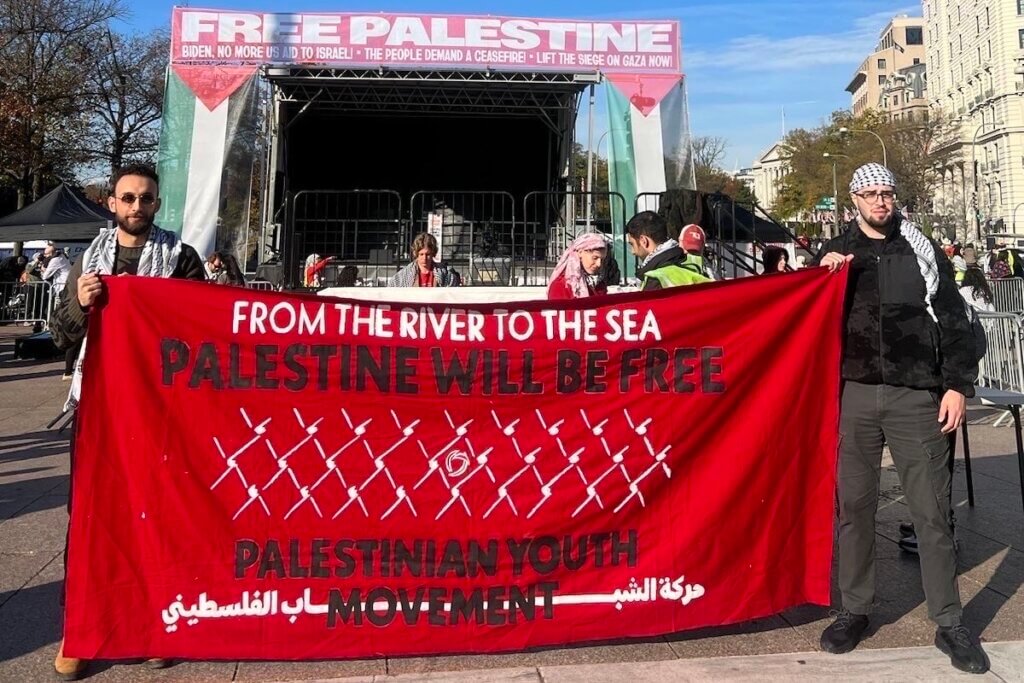
Over the past five weeks, we have seen millions, if not billions, of people around the world mobilizing for Palestine. On November 4, history was made in the heart of the United States empire with the largest Palestine march in U.S. history. On November 11, over a million people took to the streets of London in another record-breaking march. We have also seen protests regularly organized across the globe. These demonstrations are protesting the Zionist entity’s genocide which this month alone has claimed over 11,000 Palestinian lives, over half of them children. Amidst this genocide, and the building of a historic global movement in support of the Palestinian people, Zionist institutions and the Western nations that finance Israel’s savagery have earnestly attacked a central slogan and chant heard at these historic actions: “From the River to the Sea, Palestine Will be Free.”
Through this attack, the forces of Zionism and imperialism are attempting to delegitimize the movement for Palestinian national liberation and distract from Israel’s genocide. The attempts to vilify and criminalize this chant are part of a broader effort to undermine the movement against Zionism and to silence the calls for Palestinian freedom, which can be heard in every corner of the world. The thousands of people joining the movement each day are living proof that efforts to undermine our calls for freedom are failing and that we, and our supporters, will remain steadfast in our vision for Palestinian liberation from the river to the sea.
This chant for freedom is currently being smeared as hate speech or incitement to violence. U.S. Congresswoman Rashida Tlaib was censured for saying it. Harvard’s President condemned the use of the phrase by student organizers, announcing the creation of an antisemitism advisory group in response. A Palestinian organizer in Calgary, Canada was charged by police for leading the chant during a protest. In Britain, former Home Secretary Suella Braverman penned a letter to the Metropolitan Police encouraging them to “consider whether chants such as ‘from the river to the sea, Palestine will be free’ should be understood as an expression of a violent desire” and even insinuated the criminalization of the chant. The mainstream media has painted the slogan in a similar light, either suggesting it calls for the genocide of Jewish people or attempting to both-sides it by painting the history of the call for Palestinian liberation as “complex.” In response, some have defended the phrase by decontextualizing it from its ties to a struggle for national liberation, suggesting that it is “a call for Israel to extend citizenship and legal and political equality to every single human being residing within its current borders.” What this kind of analysis fails to grasp is that Palestinians do not chant this phrase in a plea for citizenship within a nation built on our genocide, but rather as a demand for national liberation and freedom.
Of course, for Zionism, Palestinian freedom is an existential threat to the project of creating a colonial ethno-state on top of Palestine. This is a state that has no official borders and, over the past 75 years, has occupied Egyptian, Syrian, and Lebanese land (and continues to violate Syria and Lebanon’s sovereignty). Netanyahu, two months ago in the United Nations General Assembly, held up a map of “the New Middle East.” This Zionist geographical imaginary eliminated Palestine from the region and absorbed the occupied Syrian Golan Heights, reflecting the Likud party’s charter, which steals our call for freedom and demands that “between the Sea and Jordan there will only be Israeli sovereignty.”
The reality is that Zionism’s brutal violence against the Palestinian people extends across all of historic Palestine: from the West Bank’s Jordan River to Gaza’s sea. No Palestinian life is sacred amidst its genocidal blockade, in the presence of its settlements and checkpoints, nor within its prison walls where thousands of Palestinians are held and tortured, and 2.3 million Gazans are held hostage. Palestinian freedom necessitates total liberation: not only from the river to the sea, but beyond the borders of historic Palestine, where millions of Palestinians await return. Palestinian liberation necessitates liberation from Zionism.
But why is there now a heightened attempt to equate Palestinian calls for liberation with genocidal hate speech? There is an actual genocide that the Israeli regime and its Western backers are undertaking between the river and the sea. This smear campaign is a strategy that works to keep the Palestinian movement on the defensive as we attempt to stop a genocide that Western governments are greenlighting and funding. It aims to distract from the genocide unfolding and promote doubt and fear among the increasing numbers of people who are growing conscious of their institutions’ and governments’ complicity in it. It intends to obfuscate the question of violence: simultaneously painting violence as the words of the occupied and detracting from the violence of the occupier’s genocide.
In response to these claims, Palestinians in Western countries and those who stand with them are having to (at best) spend their time explaining the meaning of “From the River to the Sea,” or (at worst) defend themselves against backlash, suspensions, and repression for using the phrase. The fixation on discourse and the scrutinization of our chants aims to sow uncertainty into the hearts and minds of those new to the movement while providing institutions such as universities, the media, and workplaces with new tools to continue justifying their repression.
Such strategies make invisible what is happening in Palestine, that is: over 11,000 Palestinians have been killed by bombs funded by imperialist powers like the U.S., Canada, and Britain; patients in the ICU of Al Shifa hospital have died due to power outages; children are collecting water pooled up in the streets to drink; people are dying from lack of food, medical care, and water; hospitals are collapsing; 10,000 Palestinians are held hostage in Israeli prisons, being tortured to death; hundreds of Palestinians have been murdered in the West Bank; and hundreds of Palestinians with Israeli citizenship have been arrested in the 1948 territories since October 7. Israel’s horrific crimes cannot even be fully documented because they have cut off Gaza’s communications infrastructure and killed more than 40 Palestinian journalists and media workers. Alongside this, there is clear discursive evidence of Israel’s ambitions in Gaza: politicians, officials, and media personalities have repeatedly called for genocide in Gaza and even Israeli doctors, those who have taken the Hippocratic oath of ethics, have greenlighted the bombing of Gaza’s hospitals. These are the material facts of genocide happening on the ground.
How is anyone to believe, amidst a genocide that has taken over 11,000 Palestinian lives, that a chant for freedom is what incites violence? How dare anyone fear the call for liberation recited by the masses instead of the bombs raining down on Gaza? This is precisely what this focus on discourse aims to achieve: a vehicle through which to further the projects of Zionism and Western imperialism. It is true, however, that Zionists know very well that Zionism is incompatible with Palestinian life and that its foundation is premised on the expulsion, exploitation, and ethnic cleansing of the Palestinian people. This is precisely why a chant for Palestinian freedom and national liberation is met with such hysteria and repression. This is particularly evident in a moment where this march for Palestinian freedom grows stronger, with millions across the globe joining our struggle. All over North America and Europe, people are waking up to the role of their governments in this genocide. From protests to blocking the transport of weapons to shutting down media outlets and political offices, the masses are calling not only for a ceasefire but for an end to the siege on Gaza and the halting of aid and weapons to the Zionist state.
For over 75 years, the Zionist project has aimed to destroy and eliminate the Palestinian people. And for 75 years, the Palestinian people have continued to maintain their presence and struggle to stay on and return to their lands.
“From the River to the Sea” is not merely a slogan—it is an undying promise. Each day, the Palestinian revolution grows stronger, the calls for freedom are louder, and we are one day closer to total liberation: from the river to the sea.
From the river to the sea, Palestine will be free. From the sea to the river, Palestine will live forever.
Before you go – we need your sup
Really, is this what you felt when you either heard the context after the attack, or if you already up to date when the attack happened, is this how you felt when it happened, knowing the context?It helps to push the narrative that October 7 was a little bit justified because what else could oppressed indigenous people do other than kill and rape kids at an EDM festival and take 200 hostages including babies and elderly.
As someone very sympathetic to Palestine, who wrote about the conflict extensively before law school in my poli sci degree, that's not how I felt. I felt so sad for those people and their loved ones, and also felt terrible and scared for the Palestinians because I knew exactly what was about to happen. I was also scared for all Jewish, Muslim and arab people because I knew all about the rise in violence against all them that happens when conflict intensifies in Palestine.
So no, context isn't inherently justification.
Well israel did not need “context” on October 7. It had dead bodies and hostages taken.Really, is this what you felt when you either heard the context after the attack, or if you already up to date when the attack happened, is this how you felt when it happened, knowing the context?
As someone very sympathetic to Palestine, who wrote about the conflict extensively before law school in my poli sci degree, that's not how I felt. I felt so sad for those people and their loved ones, and also felt terrible and scared for the Palestinians because I knew exactly what was about to happen. I was also scared for all Jewish, Muslim and arab people because I knew all about the rise in violence against all them that happens when conflict intensifies in Palestine.
So no, context isn't inherently justification.
Hamas did need “context” to justify what they did.
"Context" helps hamas, and it also helps Iran and their friend Russia. Your "context" helps the evil in this world.
Simple.
Last edited:
.... October 7th is the context my guy lolWell israel did not need “context” on October 7. It had dead bodies and hostages taken.
Hamas did need “context” to justify what they did.
Simple.

And oct 7th doesn't justify the murder of 11k civilians.
couldn't give a shit about civilians who liked what happened on October 7..... October 7th is the context my guy lol
And it doesn't justify the murder of 11k civilians.
I'm out, I don't argue with racist Islamophobics who equate hamas with all Palestinians.
Is This The Return of McCarthyism? Had McCarthyism Ever Left Us?
Palestine is the single most urgent free speech crisis in the U.S. today
Similar to attacks on LGBTQ books and works of “Critical Race Theory,” the pro-Israel crusade to suppress Palestinian voices is a systematic campaign of political targeting.
BY WHITNEY STRUB NOVEMBER 12, 2023 4
Share on Facebook Share on Twitter
PROTEST AGAINST THE ISRAEL ANTI-BOYCOTT ACT, 2019. (PHOTO VIA ACLU)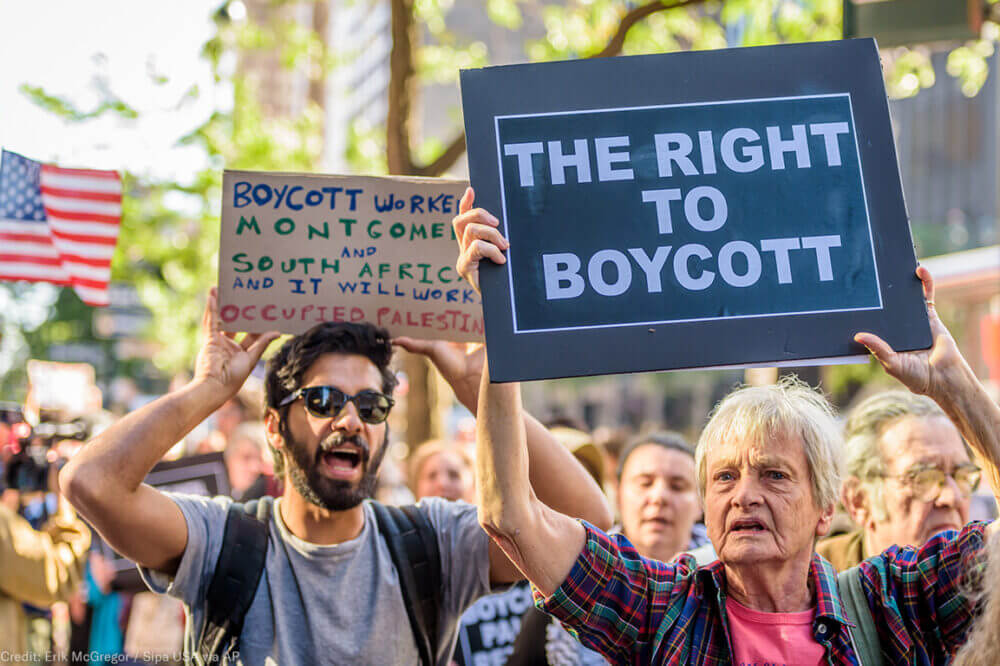
The repression of Palestinian rights claims is the single most urgent crisis of free speech in the United States today. How we narrate this crisis, and the frameworks we use to analyze organized efforts to silence pro-Palestine speech, shape the strategies through which we resist them. As Gaza burns, the hegemony of anti-Palestine, pro-apartheid zealots seems suffocating – and that’s the point. The history of McCarthyism, as Alex Kane recently noted in Jewish Currents, offers one useful lens: doxxing trucks, rescinded job offers, law-firm blacklists, and the ignominious House censure of Rashida Tlaib all carry the eerie chill of the 1950s Cold War era.
As a historian of censorship, I believe a complementary framework for analyzing the intensifying repression of pro-Palestinian voices can be found in recent censorship campaigns that have resulted in banning LGBTQ books and works of so-called “Critical Race Theory.” It’s firmly established that efforts to ban these texts are motivated by anti-gay sentiment and racism. But rarely is the suppression of Palestinian voices linked to such efforts – yet Islamophobia animates the pro-Israel crusade in strikingly parallel ways; these are deeply interrelated campaigns of political targeting. The only serious difference is that the recent censorship campaigns are aligned with the U.S. political right, whereas anti-Palestinian censorship is a joint project of the Republican and Democratic parties.
A thorough new report released by the Rutgers Law School Center for Security, Race and Rights maps out the role Islamophobia plays in structuring the national discussion of Palestinian rights. In Presumptively Antisemitic: Islamophobic Tropes in the Palestine-Israel Discourse, authors Mitchell Plitnick and Sahar Aziz identify how Palestinian rights claims are laundered by the Israel Lobby and others, through Islamophobic lenses. Self-styled experts imbue such claims – calls for Palestinian human rights, for the consistent application of international law, and the like – with the presumption they are antisemitic to preemptively nullify them. It’s essentially the same “folk devil” basis for moral panic that drives the book bans, with such organizations as AIPAC playing the parallel role to explicitly far-right groups like Moms for Liberty.
When right-wing dark-money groups come for Jonathan Evison’s Lawn Boy or Maia Kobabe’s Gender Queer, they’re extending a legacy dating back to the 1873 Comstock Act, which first put teeth in federal obscenity law. “Obscenity” was always a tool for enforcing sexual normativity. The anti-queer aspects of obscenity were on display when the Supreme Court affirmed the law in the 1957 Roth v. U.S. decision, pinning the legal definition of obscenity to “prurient interest,” defined by the “average person, applying contemporary community standards.” Sex was not inherently obscene, declared the court—but male physique magazines, lesbian pulp novels, queer avant-garde cinema, however, were all targets for obscenity charges. This has been replayed every subsequent decade; a generation ago, it was Heather Has Two Mommies under fire.
Signup for the Daily Headlines newsletter. You'll get new stories delivered directly to your inbox every morning at 8am EST.
Subscribe
The accompanying assault on “Critical Race Theory” is a patently bad-faith effort whose architect, Christopher Rufo, publicly acknowledged that he was devising a new dog whistle the right could use to win political campaigns. Of course, CRT is actually a small body of legal theory rarely assigned to high school or elementary school students, but under Rufo’s guidance, it came to mean anything critical of white supremacy – particularly when penned by Black authors. Rufo’s efforts are worth taking seriously only because their social power forces us to do so – his intellectually-bankrupt campaign simply repackaged previous anti-Black talking points: “welfare queens,” “forced busing,” etc. Yet, it has achieved a number of official bans.
Similar dynamics shape U.S. political discourse around Palestine.
The report takes stock of “Racist tropes that Muslims and Arabs innately hate Jews.” These tropes serve the same foundational role as heteronormative standards for obscenity: setting up foregone conclusions – here, “discrediting the Palestinian people from realizing their full civil, political, national, and human rights” by foreclosing free and open debate on Israel’s well-documented violations of international law that human rights organizations now consider apartheid. Instead, the House of Representatives diverts attention toward Tlaib for sharing the universalist human rights chant, “From the river to the sea…” and reading antisemitism into the terse rhyme where none exists. The message is clear: a Palestinian calling for a one-state solution where people of all faiths and ethnicities have equal rights is anathema that must be falsely depicted as antisemitic. Because the call comes from a prominent Arab and Muslim woman, the media gladly plays along – knowing full well the accusation is baseless.
In the report, the authors carefully define how Islamophobic tropes operate, in ways both heavy-handed (the post-9/11 knee-jerk Islamophobic backlash) and subtle (eugenics concerns over Palestinian birth rates that have seeped into even liberal senator Elizabeth Warren’s public comments). The report also charts an institutional nexus that shapes American Islamophobia, ranging from outright nativist groups like Christians United for Israel to the Democratic Majority for Israel, formed in 2019 to bolster flagging Zionist sentiment among the U.S. electorate and to bolster centrist politics more broadly within the Democratic Party. The money trails often converge; billionaire oil heiress Stacy Schusterman has funded both DMFI and AIPAC, and, through her family’s charity, the Islamophobic Middle East Media Research Institute. This “Islamophobia Network” helps blur the lines, ensuring pervasive anti-Muslim sentiment often bleeds into anti-Palestinian attitudes as well.
Ritualized attacks on representatives Ilhan Omar and Tlaib, repeatedly deemed terrorists and antisemites for challenging U.S. aid to Israel, exemplify the analysis. Muslims are rendered presumptively antisemitic. This scurrilous charge is then carried into discrediting Palestinian rights claims on the same basis: “The fallacy that all Muslims are presumptively antisemitic is increasingly deployed by Zionist groups to eliminate critical debate inclusive of Palestinian experiences. Muslims or Arabs criticizing Israel’s state practices are presumed to be motivated by antisemitism, not a commitment to universal human rights or social justice principles.” It’s a well-oiled (and well-funded) demonology machine.
While much of this process hinges on media complicity and the propagandistic forging of consensus, risks to free speech emerge when anti–Palestine speech efforts are blessed with formal state power, which occurs with alarming regularity. The nearly three dozen state-level anti-BDS laws are the most striking example (their chilling effect never acknowledged by the self-professed anti-“woke” reactionaries who bemoan “cancel culture”).
Recurring state and municipal efforts to adopt the International Holocaust Remembrance Alliance (IHRA) definition of antisemitism would put criticism of Israel at legal risk by marking it as hate speech. And in the days before Presumptively Antisemitic was published, Florida’s State University System new ban on Students for Justice in Palestine groups shows another use of state power to censor and silence oppositional voices, again through the Islamophobic rhetoric of “terrorism.”
Plitnick and Aziz, in their landmark report, methodically connect the component parts that make Islamophobic/anti-Palestinian politics systematic; being able to name and identify this system provides us better tools to chip away at its power. As a scholar of history and censorship, I would counsel that those who oppose the racism and homophobia of Moms for Liberty and its ilk recognize that the struggle for Palestinian liberation is not just parallel but precisely aligned with the fights for queer and racial justice, and that the forces of oppression follow the same strategies of demonization, stigmatization, and silencing.
Before you go – we need your support

There is so much systematic racism against Palestinians right now its shocking.
Instagram was 'accidentally' auto translating Arabic from Palestinians into calls that they were 'terrorists'.
If instagram did this to the Jewish people there would be so much outrage but with Palestinians it didn't even merit a headline in the MSM.
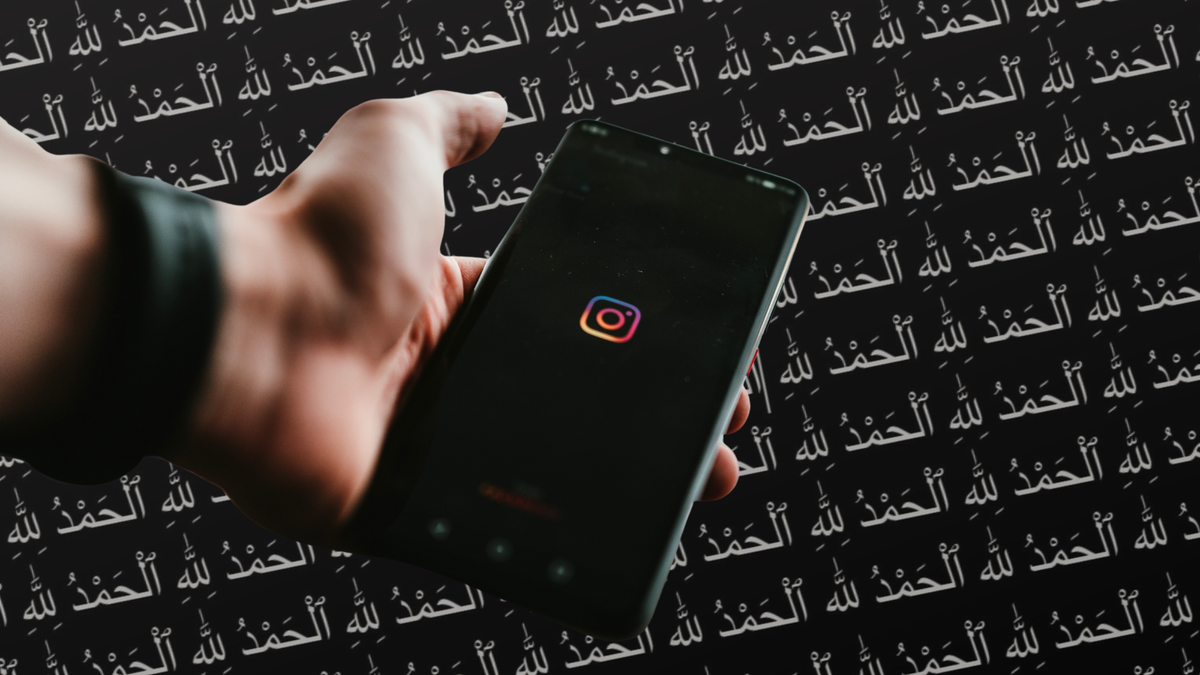
Instagram Is Hiding Its 'Palestinian Terrorists' Translation Problem Inside a Black Box
While we still don't know for sure what happened, researchers are looking at ways faulty AI models could have caused Instagram to auto-translate Arabic text into calling Palestinians “terrorists.”
 www.404media.co
It helps to push the narrative that October 7 was a little bit justified because what else could oppressed indigenous people do other than kill and rape kids at an EDM festival and take 200 hostages including babies and elderly.
Your narrative includes blatant falsehoods like saying Hamas 'raped kids'.
Now you're looking for the context to justify murdering 11,000 people.
Why would you think that justifies killing 6,000 children?
Why would you think anything justifies murdering 6,000 children?
Just for the record I love people of all colours (particularly when they are tall skinny females with round asses and natural boobs.).I'm out, I don't argue with racist Islamophobics who equate hamas with all Palestinians.
And I like Islam because it allows men to have four wives.
So I’m not sure where the allegations of racism or Islamophobia came from.
If it’s the race or Islam that makes certain “oppressed” people to vote for people who kidnap and kill civilians that’s not on me lol and I retain the right to not give a fuck about those people no matter what their reasons are
It is an aspirational cry of a National Liberation Movement. In my ears it has a haunting kinship with its cognate: Next Year In Jerusalem. Yet the phrase From The River To The Sea seems to have panicked university leaders, who bring out their favourite cudgel to crush it: Anti-Semitism. Let there be no doubt, the panic is real when a hedge fund manager or a billionaire menaces your cherished Endowment and all those hollow liberal pronouncements of University Values fade away.
From the River to the Sea: The undying promise of Palestinian liberation in the face of genocide
“From the River to the Sea” is not merely a slogan—it is an undying promise and demand for national liberation. Attempts to vilify it are only meant to undermine the movement against Zionism and silence calls for Palestinian freedom.
BY PALESTINIAN YOUTH MOVEMENT NOVEMBER 13, 2023 0
Share on Facebook Share on Twitter
PALESTINIAN YOUTH MOVEMENT ACTIVISTS HOLDING THE BANNER THAT LEAD THE MARCH OF 300,000 PRO-PALESTINE SUPPORTERS IN WASHINGTON, D.C., ON NOVEMBER 4, 2023. (PHOTO COURTESY OF THE PALESTINIAN YOUTH MOVEMENT)
Over the past five weeks, we have seen millions, if not billions, of people around the world mobilizing for Palestine. On November 4, history was made in the heart of the United States empire with the largest Palestine march in U.S. history. On November 11, over a million people took to the streets of London in another record-breaking march. We have also seen protests regularly organized across the globe. These demonstrations are protesting the Zionist entity’s genocide which this month alone has claimed over 11,000 Palestinian lives, over half of them children. Amidst this genocide, and the building of a historic global movement in support of the Palestinian people, Zionist institutions and the Western nations that finance Israel’s savagery have earnestly attacked a central slogan and chant heard at these historic actions: “From the River to the Sea, Palestine Will be Free.”
Through this attack, the forces of Zionism and imperialism are attempting to delegitimize the movement for Palestinian national liberation and distract from Israel’s genocide. The attempts to vilify and criminalize this chant are part of a broader effort to undermine the movement against Zionism and to silence the calls for Palestinian freedom, which can be heard in every corner of the world. The thousands of people joining the movement each day are living proof that efforts to undermine our calls for freedom are failing and that we, and our supporters, will remain steadfast in our vision for Palestinian liberation from the river to the sea.
This chant for freedom is currently being smeared as hate speech or incitement to violence. U.S. Congresswoman Rashida Tlaib was censured for saying it. Harvard’s President condemned the use of the phrase by student organizers, announcing the creation of an antisemitism advisory group in response. A Palestinian organizer in Calgary, Canada was charged by police for leading the chant during a protest. In Britain, former Home Secretary Suella Braverman penned a letter to the Metropolitan Police encouraging them to “consider whether chants such as ‘from the river to the sea, Palestine will be free’ should be understood as an expression of a violent desire” and even insinuated the criminalization of the chant. The mainstream media has painted the slogan in a similar light, either suggesting it calls for the genocide of Jewish people or attempting to both-sides it by painting the history of the call for Palestinian liberation as “complex.” In response, some have defended the phrase by decontextualizing it from its ties to a struggle for national liberation, suggesting that it is “a call for Israel to extend citizenship and legal and political equality to every single human being residing within its current borders.” What this kind of analysis fails to grasp is that Palestinians do not chant this phrase in a plea for citizenship within a nation built on our genocide, but rather as a demand for national liberation and freedom.
Of course, for Zionism, Palestinian freedom is an existential threat to the project of creating a colonial ethno-state on top of Palestine. This is a state that has no official borders and, over the past 75 years, has occupied Egyptian, Syrian, and Lebanese land (and continues to violate Syria and Lebanon’s sovereignty). Netanyahu, two months ago in the United Nations General Assembly, held up a map of “the New Middle East.” This Zionist geographical imaginary eliminated Palestine from the region and absorbed the occupied Syrian Golan Heights, reflecting the Likud party’s charter, which steals our call for freedom and demands that “between the Sea and Jordan there will only be Israeli sovereignty.”
The reality is that Zionism’s brutal violence against the Palestinian people extends across all of historic Palestine: from the West Bank’s Jordan River to Gaza’s sea. No Palestinian life is sacred amidst its genocidal blockade, in the presence of its settlements and checkpoints, nor within its prison walls where thousands of Palestinians are held and tortured, and 2.3 million Gazans are held hostage. Palestinian freedom necessitates total liberation: not only from the river to the sea, but beyond the borders of historic Palestine, where millions of Palestinians await return. Palestinian liberation necessitates liberation from Zionism.
But why is there now a heightened attempt to equate Palestinian calls for liberation with genocidal hate speech? There is an actual genocide that the Israeli regime and its Western backers are undertaking between the river and the sea. This smear campaign is a strategy that works to keep the Palestinian movement on the defensive as we attempt to stop a genocide that Western governments are greenlighting and funding. It aims to distract from the genocide unfolding and promote doubt and fear among the increasing numbers of people who are growing conscious of their institutions’ and governments’ complicity in it. It intends to obfuscate the question of violence: simultaneously painting violence as the words of the occupied and detracting from the violence of the occupier’s genocide.
In response to these claims, Palestinians in Western countries and those who stand with them are having to (at best) spend their time explaining the meaning of “From the River to the Sea,” or (at worst) defend themselves against backlash, suspensions, and repression for using the phrase. The fixation on discourse and the scrutinization of our chants aims to sow uncertainty into the hearts and minds of those new to the movement while providing institutions such as universities, the media, and workplaces with new tools to continue justifying their repression.
Such strategies make invisible what is happening in Palestine, that is: over 11,000 Palestinians have been killed by bombs funded by imperialist powers like the U.S., Canada, and Britain; patients in the ICU of Al Shifa hospital have died due to power outages; children are collecting water pooled up in the streets to drink; people are dying from lack of food, medical care, and water; hospitals are collapsing; 10,000 Palestinians are held hostage in Israeli prisons, being tortured to death; hundreds of Palestinians have been murdered in the West Bank; and hundreds of Palestinians with Israeli citizenship have been arrested in the 1948 territories since October 7. Israel’s horrific crimes cannot even be fully documented because they have cut off Gaza’s communications infrastructure and killed more than 40 Palestinian journalists and media workers. Alongside this, there is clear discursive evidence of Israel’s ambitions in Gaza: politicians, officials, and media personalities have repeatedly called for genocide in Gaza and even Israeli doctors, those who have taken the Hippocratic oath of ethics, have greenlighted the bombing of Gaza’s hospitals. These are the material facts of genocide happening on the ground.
How is anyone to believe, amidst a genocide that has taken over 11,000 Palestinian lives, that a chant for freedom is what incites violence? How dare anyone fear the call for liberation recited by the masses instead of the bombs raining down on Gaza? This is precisely what this focus on discourse aims to achieve: a vehicle through which to further the projects of Zionism and Western imperialism. It is true, however, that Zionists know very well that Zionism is incompatible with Palestinian life and that its foundation is premised on the expulsion, exploitation, and ethnic cleansing of the Palestinian people. This is precisely why a chant for Palestinian freedom and national liberation is met with such hysteria and repression. This is particularly evident in a moment where this march for Palestinian freedom grows stronger, with millions across the globe joining our struggle. All over North America and Europe, people are waking up to the role of their governments in this genocide. From protests to blocking the transport of weapons to shutting down media outlets and political offices, the masses are calling not only for a ceasefire but for an end to the siege on Gaza and the halting of aid and weapons to the Zionist state.
For over 75 years, the Zionist project has aimed to destroy and eliminate the Palestinian people. And for 75 years, the Palestinian people have continued to maintain their presence and struggle to stay on and return to their lands.
“From the River to the Sea” is not merely a slogan—it is an undying promise. Each day, the Palestinian revolution grows stronger, the calls for freedom are louder, and we are one day closer to total liberation: from the river to the sea.
From the river to the sea, Palestine will be free. From the sea to the river, Palestine will live forever.
Before you go – we need your sup
President Biden's unconditional support of a mono-maniacal Netenyahu is just not working...
More Than 400 U.S. Officials Sign Letter Protesting Biden’s Israel Policy
The signers, representing some 40 government agencies, reflect growing internal dissent over the administration’s support of Israel’s military campaign in Gaza.
- Share full article
- 1.1K

Hundreds of signatories from across the U.S. government have now dissented from President Biden and Secretary of State Antony J. Blinken in their support for Israel’s war in Gaza.Credit...Kenny Holston/The New York Times


By Maria Abi-Habib, Michael Crowley and Edward Wong
Maria Abi-Habib reported from London, and Michael Crowley and Edward Wong from Washington.
Nov. 14, 2023, 4:00 a.m. ET
Sign up for the Israel-Hamas War Briefing. The latest news about the conflict. Get it sent to your inbox.
More than 400 political appointees and staff members representing some 40 government agencies sent a letter to President Biden on Tuesday protesting his support of Israel in its war in Gaza.
The letter, part of growing internal dissent over the administration’s support of the war, calls on the president to seek an immediate cease-fire in the Gaza Strip and to push Israel to allow humanitarian aid into the territory. It is the latest of several protest letters from officials throughout the Biden administration, including three internal memos to Secretary of State Antony J. Blinken signed by dozens of State Department employees as well as an open letter signed by more than 1,000 employees of the U.S. Agency for International Development.
The signatories of the letter submitted on Tuesday and the one circulating among USAID employees are anonymous, the USAID letter explains, out of “concern for our personal safety and risk of potentially losing our jobs.” The signatories of the State Department dissent cables must disclose their names, but those cables have not been released publicly.
Although the Biden administration has recently started voicing concern over the high numbers of Palestinian civilians killed while urging Israel to show restraint, that budding criticism does not appear to be placating many in the U.S. government.
The letter, a copy of which was reviewed by The New York Times, began by denouncing the Oct. 7 attacks by Hamas, then urged Mr. Biden to stop the bloodshed caused by Israel’s retaliatory military campaign in Gaza.
“We call on President Biden to urgently demand a cease-fire; and to call for de-escalation of the current conflict by securing the immediate release of the Israeli hostages and arbitrarily detained Palestinians; the restoration of water, fuel, electricity and other basic services; and the passage of adequate humanitarian aid to the Gaza Strip,” the letter states.
Two political appointees who helped organize the letter to Mr. Biden said the majority of the signatories are political appointees of various faiths who work throughout government, from the National Security Council to the F.B.I. and the Justice Department.
Some of the signatories helped Mr. Biden get elected in 2020 and said in interviews they were concerned that the administration’s support of Israel’s war in Gaza clashed with Democratic voters’ stance on the issue.
“The overwhelming majority of Americans support a cease-fire,” the letter states, linking to a poll from October that shows that 66 percent of Americans, including 80 percent of Democrats, believe the United States should put pressure on Israel for a cease-fire.
Israel-Hamas War: Live Updates
Updated
Nov. 14, 2023, 1:12 p.m. ET45 minutes ago
45 minutes ago
- American Jews are rallying in Washington to support Israel and oppose antisemitism.
- Bodies are being buried in a mass grave at Gaza City’s largest hospital, health officials say.
- Recent U.S. strikes on Iran-linked sites in Syria killed at least six people, a U.S. official says.
“Furthermore, Americans do not want the U.S. military to be drawn into another costly and senseless war in the Middle East.”
Israel launched a ground invasion last month in Gaza in response to bloody attacks by Hamas on Oct. 7 that killed about 1,200 people, according to the Israeli government. So far, more than 11,000 Palestinians have been killed in Israel’s military offensive according to Gaza’s health ministry.
Image

A rally in support of Gaza in Washington earlier this month. “The overwhelming majority of Americans support a cease-fire,” a letter addressed to President Biden states.Credit...Amir Hamja/The New York Times
Mr. Biden and Mr. Blinken, like Israel’s leadership, say they oppose a cease-fire — a long-term halt in fighting, typically accompanied by political negotiations — on the grounds that it would spare Hamas and allow it to reconstitute for future attacks. They have instead called for “pauses,” short interruptions in the fighting lasting perhaps a few hours, to allow for clearly defined humanitarian missions like aid delivery into Gaza and the release of Israeli hostages held by Hamas. U.S. officials say they have done more than any other nation to ensure that at least some aid enters Gaza.
The two people who helped organize the letter to Mr. Biden said they had agreed to serve the administration because the president stressed that he wanted a government that was more representative of American voters. But, they said, their concerns and those of other political appointees have largely been dismissed.
Some U.S. officials said privately that while senior officials welcome disagreement, government workers must understand and accept that they will not always agree with U.S. policy. The dissent over Gaza reflects a generational divide and comes mostly from employees in their 20s and 30s, the officials said — though many older people have also signed dissenting documents, according to people who have collected signatures.
The letters of protest come after a contentious meeting on Oct. 23 at the Eisenhower Executive Office Building, where 70 Muslim and Arab political appointees gathered with senior Biden administration officials, including Jeffrey D. Zients, the chief of staff, and Doug Emhoff, the husband of Vice President Kamala Harris.
The meeting started with a general question: How many of the appointees have faced pressure from family or friends to resign over the Biden administration’s support of Israel in the conflict? Dozens of hands shot up, according to one attendee and another who was briefed about the meeting.
Senior administration officials opened the floor to take questions and comments. Some attendees cried as they demanded that the administration call for a cease-fire, curb weapons shipments to the Israeli military and stop disregarding Palestinian civilian casualties in the Gaza Strip.
The State Department memos to Mr. Blinken were cables sent internally, through what is known as the dissent channel. The channel was created during the Vietnam War to encourage department employees to share disagreements with official policy. Under State Department rules, dissenters are protected from retaliation.
On Monday, Mr. Blinken responded to the internal dissent in a message emailed to department employees. “I know that for many of you, the suffering caused by this crisis is taking a profound personal toll,” he wrote, adding that he was aware that “some people in the department may disagree with approaches we are taking or have views on what we can do better.”
He added: “We’re listening: What you share is informing our policy and our messages.”
Maria Abi-Habib is an investigative correspondent based in Mexico City, covering Latin America. She previously reported from Afghanistan, across the Middle East and in India, where she covered South Asia. More about Maria Abi-Habib
Michael Crowley covers the State Department and U.S. foreign policy for The Times. He has reported from nearly three dozen countries and often travels with the secretary of state. More about Michael Crowley
Edward Wong is a diplomatic correspondent who has reported for The Times for more than 24 years from New York, Baghdad, Beijing and Washington. He was on a team of Pulitzer Prize finalists for Iraq War coverage. More about Edward Wong
READ 1113 COMMENTS
Tell your oppressed friends to return the hostagesPresident Biden's unconditional support of a mono-maniacal Netenyahu is just not working...
More Than 400 U.S. Officials Sign Letter Protesting Biden’s Israel Policy
The signers, representing some 40 government agencies, reflect growing internal dissent over the administration’s support of Israel’s military campaign in Gaza.
- Share full article
- 1.1K
Hundreds of signatories from across the U.S. government have now dissented from President Biden and Secretary of State Antony J. Blinken in their support for Israel’s war in Gaza.Credit...Kenny Holston/The New York Times
By Maria Abi-Habib, Michael Crowley and Edward Wong
Maria Abi-Habib reported from London, and Michael Crowley and Edward Wong from Washington.
Nov. 14, 2023, 4:00 a.m. ET
Sign up for the Israel-Hamas War Briefing. The latest news about the conflict. Get it sent to your inbox.
More than 400 political appointees and staff members representing some 40 government agencies sent a letter to President Biden on Tuesday protesting his support of Israel in its war in Gaza.
The letter, part of growing internal dissent over the administration’s support of the war, calls on the president to seek an immediate cease-fire in the Gaza Strip and to push Israel to allow humanitarian aid into the territory. It is the latest of several protest letters from officials throughout the Biden administration, including three internal memos to Secretary of State Antony J. Blinken signed by dozens of State Department employees as well as an open letter signed by more than 1,000 employees of the U.S. Agency for International Development.
The signatories of the letter submitted on Tuesday and the one circulating among USAID employees are anonymous, the USAID letter explains, out of “concern for our personal safety and risk of potentially losing our jobs.” The signatories of the State Department dissent cables must disclose their names, but those cables have not been released publicly.
Although the Biden administration has recently started voicing concern over the high numbers of Palestinian civilians killed while urging Israel to show restraint, that budding criticism does not appear to be placating many in the U.S. government.
The letter, a copy of which was reviewed by The New York Times, began by denouncing the Oct. 7 attacks by Hamas, then urged Mr. Biden to stop the bloodshed caused by Israel’s retaliatory military campaign in Gaza.
“We call on President Biden to urgently demand a cease-fire; and to call for de-escalation of the current conflict by securing the immediate release of the Israeli hostages and arbitrarily detained Palestinians; the restoration of water, fuel, electricity and other basic services; and the passage of adequate humanitarian aid to the Gaza Strip,” the letter states.
Two political appointees who helped organize the letter to Mr. Biden said the majority of the signatories are political appointees of various faiths who work throughout government, from the National Security Council to the F.B.I. and the Justice Department.
Some of the signatories helped Mr. Biden get elected in 2020 and said in interviews they were concerned that the administration’s support of Israel’s war in Gaza clashed with Democratic voters’ stance on the issue.
“The overwhelming majority of Americans support a cease-fire,” the letter states, linking to a poll from October that shows that 66 percent of Americans, including 80 percent of Democrats, believe the United States should put pressure on Israel for a cease-fire.
Israel-Hamas War: Live Updates
Updated
Nov. 14, 2023, 1:12 p.m. ET45 minutes ago
45 minutes ago
- American Jews are rallying in Washington to support Israel and oppose antisemitism.
- Bodies are being buried in a mass grave at Gaza City’s largest hospital, health officials say.
- Recent U.S. strikes on Iran-linked sites in Syria killed at least six people, a U.S. official says.
“Furthermore, Americans do not want the U.S. military to be drawn into another costly and senseless war in the Middle East.”
Israel launched a ground invasion last month in Gaza in response to bloody attacks by Hamas on Oct. 7 that killed about 1,200 people, according to the Israeli government. So far, more than 11,000 Palestinians have been killed in Israel’s military offensive according to Gaza’s health ministry.
Image
A rally in support of Gaza in Washington earlier this month. “The overwhelming majority of Americans support a cease-fire,” a letter addressed to President Biden states.Credit...Amir Hamja/The New York Times
Mr. Biden and Mr. Blinken, like Israel’s leadership, say they oppose a cease-fire — a long-term halt in fighting, typically accompanied by political negotiations — on the grounds that it would spare Hamas and allow it to reconstitute for future attacks. They have instead called for “pauses,” short interruptions in the fighting lasting perhaps a few hours, to allow for clearly defined humanitarian missions like aid delivery into Gaza and the release of Israeli hostages held by Hamas. U.S. officials say they have done more than any other nation to ensure that at least some aid enters Gaza.
The two people who helped organize the letter to Mr. Biden said they had agreed to serve the administration because the president stressed that he wanted a government that was more representative of American voters. But, they said, their concerns and those of other political appointees have largely been dismissed.
Some U.S. officials said privately that while senior officials welcome disagreement, government workers must understand and accept that they will not always agree with U.S. policy. The dissent over Gaza reflects a generational divide and comes mostly from employees in their 20s and 30s, the officials said — though many older people have also signed dissenting documents, according to people who have collected signatures.
The letters of protest come after a contentious meeting on Oct. 23 at the Eisenhower Executive Office Building, where 70 Muslim and Arab political appointees gathered with senior Biden administration officials, including Jeffrey D. Zients, the chief of staff, and Doug Emhoff, the husband of Vice President Kamala Harris.
The meeting started with a general question: How many of the appointees have faced pressure from family or friends to resign over the Biden administration’s support of Israel in the conflict? Dozens of hands shot up, according to one attendee and another who was briefed about the meeting.
Senior administration officials opened the floor to take questions and comments. Some attendees cried as they demanded that the administration call for a cease-fire, curb weapons shipments to the Israeli military and stop disregarding Palestinian civilian casualties in the Gaza Strip.
The State Department memos to Mr. Blinken were cables sent internally, through what is known as the dissent channel. The channel was created during the Vietnam War to encourage department employees to share disagreements with official policy. Under State Department rules, dissenters are protected from retaliation.
On Monday, Mr. Blinken responded to the internal dissent in a message emailed to department employees. “I know that for many of you, the suffering caused by this crisis is taking a profound personal toll,” he wrote, adding that he was aware that “some people in the department may disagree with approaches we are taking or have views on what we can do better.”
He added: “We’re listening: What you share is informing our policy and our messages.”
Maria Abi-Habib is an investigative correspondent based in Mexico City, covering Latin America. She previously reported from Afghanistan, across the Middle East and in India, where she covered South Asia. More about Maria Abi-Habib
Michael Crowley covers the State Department and U.S. foreign policy for The Times. He has reported from nearly three dozen countries and often travels with the secretary of state. More about Michael Crowley
Edward Wong is a diplomatic correspondent who has reported for The Times for more than 24 years from New York, Baghdad, Beijing and Washington. He was on a team of Pulitzer Prize finalists for Iraq War coverage. More about Edward Wong
READ 1113 COMMENTS
There has been a standing offer since day 1 for release of hostages.Tell your oppressed friends to return the hostages
Oh really? Sorry I didn’t know that.There has been a standing offer since day 1 for release of hostages.
Since you seem to be so well informed, can I ask a question? Will the civilians who die in Gaza get their 72 virgins or is it only for those who died with weapons in their hands?
I can understand that. It is easy to go from "I don't know that" to "Ergo, it doesn't exist". But you don't have to believe me; just heed the cries of the families of hostages who have been loud and clear.Oh really? Sorry I didn’t know that.
Since you seem to be so well informed, can I ask a question? Will the civilians who die in Gaza get their 72 virgins or is it only for those who died with weapons in their hands?
The state cannot accept an “offer” that gives terrorists an incentive to take more hostages. Nobody negotiates with terrorists from the position of weakness. There can be no deals made that would make them happy. They only understand brute force and they should be spoken to in a language they understand. Israel has been doing those unequal exchanges and here’s the result.I can understand that. It is easy to go from "I don't know that" to "Ergo, it doesn't exist". But you don't have to believe me; just heed the cries of the families of hostages who have been loud and clear.
Every state regurgitates such nonsense in their public pronouncements. Privately, they ALL negotiate for hostages.The state cannot accept an “offer” that gives terrorists an incentive to take more hostages. Nobody negotiates with terrorists from the position of weakness. There can be no deals made that would make them happy. They only understand brute force and they should be spoken to in a language they understand. Israel has been doing those unequal exchanges and here’s the result.
Similar threads


- Replies
- 9
- Views
- 366
- Replies
- 0
- Views
- 127
- Replies
- 3
- Views
- 247
