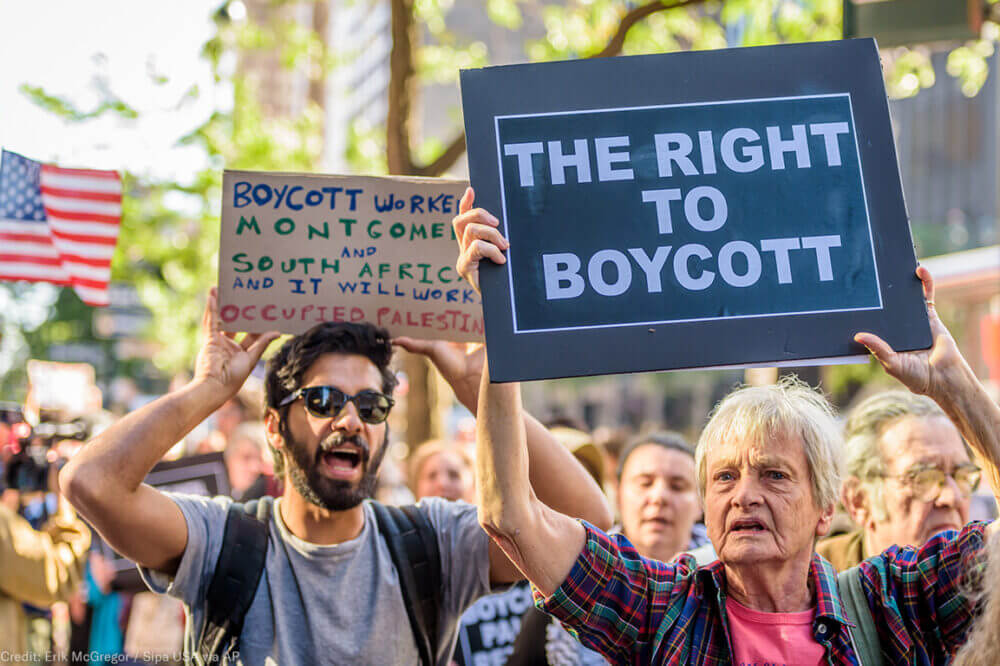
Canadians With A Conscience Denounce Zionist "McCarthyism"

Because Hamas/Palestinian movements will accept nothing other than the land where Israel currently exists. "It is their right, their destiny." They are willing to die for it. They want to be martyrs.

Regardless, nobody should be naive here. Having their own homeland is not the ultimate goal. The ethnic cleansing of Jews is the ultimate goal. They start in the middle east. Actually, the ultimate goal is for Islam to be the only religion. Anyone who doesn't follow Islam is an infidel. It is in their scriptures, teachings and speeches.

If they were to achieve their goal of ethnically cleansing the middle east of Jews, the Christians in the middle east would be next.
Realistically I don't think that will happen in terms of Israel budging and whatever motivation Palestinians have to regain what they believe they have lost won't get them anywhere either. So back to square one.
There will never be peace as long as the current arrangement is in place whether someone agrees with it or not.
So now what? It won't magically stop. Too many players backing both sides and unless the world is ready for a major war that drags a lot countries into it, there has to be another way.
 
I support a ceasefire and both sides returning all hostages/prisoners.
...
You've made clear you only support a ceasefire because you want Hamas to succeed. That's far different than the well meaning people who simply want to protect civilians.
 
Bull, there were 233 settler terrorist attacks in the West Bank this year before Oct 7.
...
And hundreds of attacks by Palestinians against Jews in the West Bank. You only care about jewish terrorists and keep justifying Palestinian terrorists.

Just a reminder that in response to Jewish civilians being killed in the West Bank, you claimed it was okay because some other Jews are terrorists and in your words, "you can't tell them apart".
 
Please stop your colonial attempts to speak for Palestinians.
...
From the guy who demands Palestinians be forced into a One State peace which they detest and who refuses to listen to what Palestinian factions like Hamas say.
 
You've made clear you only support a ceasefire because you want Hamas to succeed. That's far different than the well meaning people who simply want to protect civilians.

The best way to get rid of Hamas is to end the occupation and apartheid and give Palestinians the vote in general elections.
Then Hamas would be voted out of power and not needed.

Your attempt at killing all of Hamas and Gaza will only create another generation of resistance that will be even angrier.
Its really fucking stupid.

Just end the occupation already.

 
Both tropes are equally racist.

Valcazar posted this in another thread but it really applies here,
There are a couple of views on this.

1) For my friends, everything. For my enemies, the law.
2) There must be one class of people the law protects, but does not bind and another class that the law binds, but does not protect.

I say ceasefire now and let the law rule on both sides.
May Biden, who claims to be religious, listen to his pope.


  • Like
Reactions: Kautilya
Valcazar posted this in another thread but it really applies here,


I say ceasefire now and let the law rule on both sides.
May Biden, who claims to be religious, listen to his pope.


Ceasefire, alas, has become a 4 letter word. Devoid of a conscience, blind to the carnage on our screens, our leaders have deafened themselves to the dying cries of Gaza's children. How could such leaders possibly hear anything when they are all drowning in their own loud and persistent cacophony of "Israel has a right to defend itself".
I do not believe a word out of Washington that its agents are working behind the scenes because public pressure doesn't work on Israel. Tony Blinken, in his shuttle diplomacy, has achieved diddly squat in bringing an end to the on-going war crimes. My sources in Doha tell me that he was dismissed out of hand when he demanded that the Emir of Qatar bring al-Jazeera broadcasts under control because it was too upsetting the people.
So let us hear from the people.


And you clearly can't trust Trudeau who stated he supports the two state solution but then refused to condemn the illegal settlements that killed the two state solution at the UN.

 
And you clearly can't trust Trudeau who stated he supports the two state solution but then refused to condemn the illegal settlements that killed the two state solution at the UN.


OPINION
GUEST ESSAY
What I Believe as a Historian of Genocide
Nov. 10, 2023

Palestinians fleeing Gaza City on a road toward the south on Wednesday.

Palestinians fleeing Gaza City on a road toward the south on Wednesday.Credit...Mohammed Abed/Agence France-Presse — Getty Images

Palestinians fleeing Gaza City on a road toward the south on Wednesday.

  • Share full article


By Omer Bartov
Mr. Bartov is a professor of Holocaust and genocide studies at Brown University.
Want the latest stories related to Israel and West Bank and Gaza Strip? Sign up for the newsletter Your Places: Global Update, and we’ll send them to your inbox.
Israeli military operations have created an untenable humanitarian crisis, which will only worsen over time. But are Israel’s actions — as the nation’s opponents argue — verging on ethnic cleansing or, most explosively, genocide?
As a historian of genocide, I believe that there is no proof that genocide is currently taking place in Gaza, although it is very likely that war crimes, and even crimes against humanity, are happening. That means two important things: First, we need to define what it is that we are seeing, and second, we have the chance to stop the situation before it gets worse. We know from history that it is crucial to warn of the potential for genocide before it occurs, rather than belatedly condemn it after it has taken place. I think we still have that time.
It is clear that the daily violence being unleashed on Gaza is both unbearable and untenable. Since the Oct. 7 massacre by Hamas — itself a war crime and a crime against humanity — Israel’s military air and ground assault on Gaza has killed more than 10,500 Palestinians, according to the Gaza Health Ministry, a number that includes thousands of children. That’s well over five times as many people as the more than 1,400 people in Israel murdered by Hamas. In justifying the assault, Israeli leaders and generals have made terrifying pronouncements that indicate a genocidal intent.
Still, the collective horror of what we are watching does not mean that a genocide, according to the international legal definition of the term, is already underway. Because genocide, sometimes called “the crime of all crimes,” is perceived by many to be the most extreme of all crimes, there is often an impulse to describe any instance of mass murder and massacre as genocide. But this urge to label all atrocious events as genocide tends to obfuscate reality rather than explain it.
International humanitarian law identifies several grave crimes in armed conflict. War crimes are defined in the 1949 Geneva Conventions and subsequent protocols as serious violations of the laws and customs of war in international armed conflict against both combatants and civilians. The Rome Statute, which established the International Criminal Court, defines crimes against humanity as extermination of, or other mass crimes against, any civilian population. The crime of genocide was defined in 1948 by the United Nations as “the intent to destroy, in whole or in part, a national, ethnical, racial or religious group, as such.”
So in order to prove that genocide is taking place, we need to show both that there is the intent to destroy and that destructive action is taking place against a particular group. Genocide as a legal concept differs from ethnic cleansing in that the latter, which has not been recognized as its own crime under international law, aims to remove a population from a territory, often violently, whereas genocide aims at destroying that population wherever it is. In reality, any of these situations — and especially ethnic cleansing — may escalate into genocide, as happened in the Holocaust, which began with an intention to remove the Jews from German-controlled territories and transformed into the intention of their physical extermination.
My greatest concern watching the Israel-Gaza war unfold is that there is genocidal intent, which can easily tip into genocidal action. On Oct. 7, Prime Minister Benjamin Netanyahu said that Gazans would pay a “huge price” for the actions of Hamas and that the Israel Defense Forces, or I.D.F., would turn parts of Gaza’s densely populated urban centers “into rubble.” On Oct. 28, he added, citing Deuteronomy, “You must remember what Amalek did to you.” As many Israelis know, in revenge for the attack by Amalek, the Bible calls to “kill alike men and women, infants and sucklings.”

The deeply alarming language does not end there. On Oct. 9, Israel’s defense minister, Yoav Gallant, said, “We are fighting human animals and we are acting accordingly,” a statement indicating dehumanization, which has genocidal echoes. The next day, the head of the Israeli Army’s coordinator of government activities in the territories, Maj. Gen. Ghassan Alian, addressed the population of Gaza in Arabic: “Human animals must be treated as such,” he said, adding: “There will be no electricity and no water. There will only be destruction. You wanted hell, you will get hell.”
The same day, retired Maj. Gen. Giora Eiland wrote in the daily newspaper Yedioth Ahronoth, “The State of Israel has no choice but to turn Gaza into a place that is temporarily or permanently impossible to live in.” He added, “Creating a severe humanitarian crisis in Gaza is a necessary means to achieving the goal.” In another article, he wrote that “Gaza will become a place where no human being can exist.” Apparently, no army representative or politician denounced this statement.
I could quote many more.
Taken together, these statements could easily be construed as indicating a genocidal intent. But is genocide actually occurring? Israeli military commanders insist that they are trying to limit civilian casualties, and they attribute the large numbers of dead and wounded Palestinians to Hamas tactics of using civilians as human shields and placing their command centers under humanitarian structures like hospitals.
But on Oct. 13, the Israeli Ministry of Intelligence reportedly issued a proposal to move the entire population of the Gaza Strip to the Egyptian-ruled Sinai Peninsula (Mr. Netanyahu’s office said it was a “concept paper”). Extreme right-wing elements in the government — also represented in the I.D.F. — celebrate the war as an opportunity to be rid of Palestinians altogether. This month, a videotape emerged on social media of Capt. Amichai Friedman, a rabbi in the Nahal Brigade, saying to a group of soldiers that it was now clear that “this land is ours, the whole land, including Gaza, including Lebanon.” The troops cheered enthusiastically; the military said that his conduct “does not align” with its values and directives.
And so, while we cannot say that the military is explicitly targeting Palestinian civilians, functionally and rhetorically we may be watching an ethnic cleansing operation that could quickly devolve into genocide, as has happened more than once in the past.
None of this happened in a vacuum. Over the past several months I have agonized greatly over the unfolding of events in Israel. On Aug. 4, several colleagues and I circulated a petition warning that the attempted judicial coup by the Netanyahu government was intended to perpetuate the Israeli occupation of Palestinian land. It was signed by close to 2,500 scholars, clergy members and public figures who were disgusted with the racist rhetoric of members of the government, its anti-democratic efforts and the growing violence by settlers, seemingly supported by the I.D.F., against Palestinians in the occupied West Bank.
What we had warned about — that it would be impossible to ignore the occupation and oppression of millions for 56 years, and the siege of Gaza for 16 years, without consequences — exploded in our faces on Oct. 7. Following Hamas’s massacre of innocent Jewish civilians, our same group issued a second petition denouncing the crimes committed by Hamas and calling upon the Israeli government to desist from perpetrating mass violence and killings upon innocent Palestinian civilians in Gaza in response to the crisis. We wrote that the only way to put an end to these cycles of violence is to seek a political compromise with the Palestinians and end the occupation.
It is time for leaders and senior scholars of institutions dedicated to researching and commemorating the Holocaust to publicly warn against the rage- and vengeance-filled rhetoric that dehumanizes the population of Gaza and calls for its extinction. It is time to speak out against the escalating violence on the West Bank, perpetrated by Israeli settlers and I.D.F. troops, which now appears to also be sliding toward ethnic cleansing under the cover of war in Gaza; several Palestinian villages have reportedly self-evacuated under threats from settlers.
I urge such venerable institutions as the United States Holocaust Memorial Museum in Washington, D.C., and Yad Vashem in Jerusalem to step in now and stand at the forefront of those warning against war crimes, crimes against humanity, ethnic cleansing and the crime of all crimes, genocide.
If we truly believe that the Holocaust taught us a lesson about the need — or really, the duty — to preserve our own humanity and dignity by protecting those of others, this is the time to stand up and raise our voices, before Israel’s leadership plunges it and its neighbors into the abyss.
There is still time to stop Israel from letting its actions become a genocide. We cannot wait a moment longer.

Palestinians have lived through so much.


While Israeli zionists are so proud of what they've done.

 
The best way to get rid of Hamas is to end the occupation and apartheid and give Palestinians the vote in general elections.
...
They have a vote. The PA and Hamas just refuse to actually have elections and were killing each other to prevent the other side from following their democratic responsibilities.

And I noticed you didn't respond to the Times interview where Hamas leadership said their goal is endless war. Hamas is clear they don't want peace and they don't want Jews around.
 
  • Like
Reactions: Leimonis
They have a vote. The PA and Hamas just refuse to actually have elections and were killing each other to prevent the other side from following their democratic responsibilities.

And I noticed you didn't respond to the Times interview where Hamas leadership said their goal is endless war. Hamas is clear they don't want peace and they don't want Jews around.

They can vote for their favourite prison guard but they can't vote for the government that rules them.
They are still legally 'stateless refugees' so aren't allowed to vote in Israeli general elections.

Time to end apartheid and give Palestinians the vote.
You support democracy, don't you?
 
And you clearly can't trust Trudeau who stated he supports the two state solution but then refused to condemn the illegal settlements that killed the two state solution at the UN.


Why is our PM afraid to mouth one simple word: CEASEFIRE?
Recently the leadership of a TO mosque invited the PM to speak. While the intent may have been laudable, they completely misread the sentiment of their own congregation. Trudeau was chased out with angry jeers, boos and shouts of of "shame". Are you surprised, Prime Minister?


OTTAWA—Canada’s position on the Middle East has not changed, says Prime Minister Justin Trudeau, calling again for a “a significant humanitarian pause” in the Israel-Hamas war.
But, as he has for weeks, Trudeau did not endorse calls for a ceasefire one day after a senior cabinet minister said Canada agreed with France on the need for a humanitarian truce and to “work for a ceasefire.”
In Sault Ste. Marie, Trudeau reiterated that his government is calling for a “significant humanitarian pause,” as his foreign affairs minister’s office walked back other comments she made Thursday, in which she appeared to suggest Hamas would be at a negotiation table with the Israelis — a position the U.S. has flatly rejected.
ARTICLE CONTINUES BELOW

Foreign Affairs Minister Mélanie Joly went the farthest this week saying Canada agrees with France’s president on the need to “work for a ceasefire” in the Israel-Hamas war. It was the first time a leading Canadian government official had embraced the term “ceasefire” as Israel’s ground and air assault on Gaza continued more than four weeks after the Oct. 7 Hamas incursion into Israel triggered the war. The initial Hamas attack killed 1,400 people with about 240 taken hostage. The Israeli response in Gaza has killed more than 11,000 people, according to Hamas-controlled authorities.
Joly said a humanitarian truce would allow aid in to Gaza, let hostages and civilians get out, and permit a form of “détente and so allow, I hope, even more negotiations at a negotiating table where there are Israelis, Hamas and Qatar which is present … as moderator.”
On Friday afternoon, a spokesperson for Joly provided further clarification of the minister’s comments related to Hamas.
“The negotiations the minister referenced are the ongoing negotiations regarding the release of hostages, the exit of foreign nationals and the delivery of humanitarian aid between various players in the Middle East, including Israel, Egypt and Qatar who plays a mediating role with Hamas,” wrote Isabella Orozco-Madison, Joly’s press secretary.


“Canada’s position on Hamas as a terrorist organization remains unchanged.”
 
  • Like
Reactions: Frankfooter
Meanwhile Across The Pond in the UK..


To understand Israel-Palestine, first understand the history of racism and antisemitism
Rachel Shabi
Rachel Shabi


Anti-Jewish hate is rarely seen as part of a European racism that encompassed colonialism and slavery, with each distinct prejudice influencing the other
Mon 13 Nov 2023 16.20 GMT

On Saturday, hundreds of thousands took part in a history-making march for Gaza, while the hate mobs imagined by the now former home secretary Suella Braverman turned out to be the far right, who clashed with police. It’s true that the Palestine solidarity march did contain a fringe of hateful messages, but to portray these as characteristic of the whole is absurd. Protesters called for a halt to the death, catastrophe and terror being inflicted on Palestinians in Gaza. Demands for a ceasefire are accelerating globally, as about 11,000 people have been killed in the sealed Gaza Strip, including over 4,000 children – and with thousands more injured or orphaned. The Palestinian cause is close to the hearts of leftists, but polling shows it goes wider than that: most of the British public support a ceasefire.
Saturday’s demonstration contained a sizeable Jewish bloc, who marched despite alarmist warnings across our politics and media that the protests were hotbeds of antisemitism. Jewish people (me included) attend Gaza solidarity marches for many reasons. But I would bet that none include giving free passes on antisemitism to leftists – and neither should a Jewish presence be used to discount the existence of any such prejudice at these protests. More likely, we understand that while this ancient hatred can appear anywhere, it is not the fault of Palestinians that Christian Europe has a long, lingering and largely unacknowledged problem with antisemitism.

To even begin to address this in the midst of a gut-wrenching assault on Gaza means first to acknowledge that the role of progressive movements is currently complicated. We need two parallel conversations. One is in redress of the longstanding double standard exposed by global leaders greenlighting Israel’s intolerable pounding of Gaza. After the Hamas atrocities of 7 October, during which 1,200 were killed in a violent rampage and over 200, among them children, taken hostage, we rightly saw an outpouring of sympathy for the horrors unleashed in Israel. But western leaders are mostly muted in the face of unimaginable suffering in Gaza, bankrolling Israel’s battering of buildings and people, or calling only for humanitarian “pauses”, which despairing aid agencies have described as useless. There is a dismally familiar hypocrisy over whose lives count – all the more so in the context of this decades-long, asymmetric conflict, with Palestinians living under a violent Israeli occupation and a system several human rights groups have described as apartheid.
Aftermath of an Israeli strike in Deir al-Balah, Gaza, 7 November 2023.

‘Western leaders are mostly muted in the face of unimaginable suffering in Gaza, bankrolling Israel’s battering of buildings.’ Aftermath of an Israeli strike in Deir al-Balah, Gaza, 7 November 2023. Photograph: Anadolu Agency/Anadolu/Getty Images

But a second conversation is needed within progressive movements from which many Jews are now – often reluctantly – absent. Those gruesome Hamas attacks left Jewish people reeling in pain and fearful over an alarming, global spike in antisemitism. To make matters worse, the Israeli government points to Jewish trauma over those Hamas crimes as justification for its assault on Gaza, while the British right corrals the pain into its own culture-war agenda. Progressives are justifiably concentrating on Gaza now, but in doing so are often not speaking to the agony of a shaken Jewish minority that may not be able to focus only on this urgent bigger picture. Fear and trauma generate many different responses. Absent any acknowledgment of that, or a space in which to share it, many Jewish stalwarts of the Palestinian cause, never mind recent supporters, are simply not showing up.
All of which taps into deeper issues with the left’s conception of the Israel-Palestine conflict and antiracism more generally. With antisemitism too often viewed as historic, its abiding contours are barely examined – not even in Britain, which invented the blood libel conspiracy against Jews that fuelled centuries of Europe-wide persecution. Antisemitism is rarely placed within a catalogue of European racism that encompassed colonialism and slavery, with each distinct and particular racism influencing the other. We have lost the lens of intellectuals in the postwar period, who excavated the connections between racism, colonialism and antisemitism. The political theorist Hannah Arendt, among others, argued that the racist violence of European colonialism in Africa both shaped and paved the way for the hateful Nazi antisemitism, premised on racial hierarchy, that led to the unique horrors of the Holocaust. After visiting the Warsaw ghetto in 1949, the African-American civil rights giant WEB Du Bois wrote that the experience gave him “a broader conception of what the fight against race segregation, religious discrimination and the oppression by wealth had to become if civilisation was going to triumph and broaden in the world”.
Meanwhile, the common leftist view of Israel’s origins as colonial is borne out by the nation’s founding fathers describing it in these terms, while the Palestinians already living in that land experienced it as such in forced expulsions and dispossession. That same expansionist logic, one that violently displaces Palestinians, continues to this day in the illegal Jewish settlements network beyond Israel’s internationally recognised borders and into the occupied West Bank and East Jerusalem.
But this obscures the thing that propelled so many European Jews into Palestine in the first place: centuries of endless European antisemitism culminating in the Holocaust. There would be no Jewish national project in Israel had there been no deadly antisemitism racing across Europe at that time. The Palestinian intellectual Edward Said expressed this duality in Israel’s formation by describing Palestinians as “victims of victims, the refugees of the refugees”.

We can add to that the experiences of Jews who had lived in Arab countries for millennia, with no reason to leave, yet ended up as the socioeconomically disadvantaged majority Jewish population in Israel. Mostly free of the pogroms that were a feature of Christian Europe, these communities were uprooted by a pincer of competing forces: Jewish nationalism in Israel and the Arab nationalisms of countries such as Iraq, trying to shake off the yoke of British imperialism.
None of this justifies the ongoing dispossession of Palestinians, or cancels their right to the same freedoms all humans deserve. Instead, it introduces a universalist understanding of antiracism, to complement the analysis of this conflict as a relentless power imbalance between oppressor and oppressed. It means we can view the Palestinian Nakba (catastrophe), the Holocaust and the exodus of Jews from Arab lands as a tangle of communities caught in the expanse of European colonialism and extreme racial thinking. It opens up the possibility of a morally and politically coherent view of different racialised minorities, even while our experiences take distinct paths. It enables a rejection of any zero-sum competition over suffering and a rejection of the idea that the safety of one people can ever come at the expense of another. It allows us, in other words, to imagine a shared, equal future, in which everyone is free.
Rachel Shabi is the author of Not the Enemy: Israel’s Jews from Arab Lands. Her new book on how progressives can reclaim the fight against antisemitism will be out in 2024


And in Atlanta...


As Jews we know, this is not a war. It’s a genocide.
Understanding our own history as Jews leads us to speak out against Israel's genocide of the Palestinian people. We stand for the liberation of the Palestinian people because we have known what it is to not be free.
BY SASHA FRIEDMAN, SIG GIORDANO AND ARI BEE NOVEMBER 11, 2023 23
Share on Facebook Share on Twitter
Graffiti on building at Bradley St and Decatur St in Atlanta, GA, artist unknown, photo taken on October 28, 2023 (Photo: Sasha Friedman)
GRAFFITI ON BUILDING AT BRADLEY ST AND DECATUR ST IN ATLANTA, GA, ARTIST UNKNOWN, PHOTO TAKEN ON OCTOBER 28, 2023 (PHOTO: SASHA FRIEDMAN)
On October 18, 2023, the Fulton County Commission passed a proclamation for a “Stand with Israel” day. At the meeting, Dov Wilker, Atlanta regional director for the American Jewish Committee stated that “This is not a war against the Palestinian people. This is a war against a terrorist group that slaughters their own.”
At the time of Mr. Wilker’s statement, over 4,200 Palestinians had been killed by Israel’s incessant bombing. That number is now over 11,000, thousands of whom are children.
Residents in Gaza had already gone several days without food, water, or electricity as Israel had cut off access to water, shut off their electricity, and blocked the entrance of any aid from Egypt. Over 1 million Palestinians were being displaced from their homes as Israel warned them to evacuate Northern Gaza.
And yet, Mr. Wilker stated that this was not a war against the Palestinian people. With so many dead, so many displaced, and so many dying, he may be right, that this is not a war. It is a genocide of the Palestinian people.
We need only look at our own history as Jews to understand this.
Protest for cease fire in Gaza, outside of the Israeli Consulate in Atlanta, Georgia, October 22, 2023. (Photo: Sasha Friedman)
PROTEST FOR CEASE FIRE IN GAZA, OUTSIDE OF THE ISRAELI CONSULATE IN ATLANTA, GEORGIA, OCTOBER 22, 2023. (PHOTO: SASHA FRIEDMAN)
Many of us have grown up with personal accounts passed down from our ancestors. Our own great grandparents fled Ukraine shortly after World War I with only what they could fit in two suitcases. And they were part of the resistance in the camps in the former Czechoslovakia to prevent being deported to Auschwitz. They are fighting to regain citizenship to Spain on behalf of our families who faced the choice to convert or leave during the Inquisition. It is in our bones that our safety is not guaranteed and we carry that with us.
Our Jewish ancestors were persecuted as a means of protecting nation-states and their power. We were an existential threat subject to different laws from our neighbors, killed for challenging those laws, and told we had brought this treatment upon ourselves. The world repeatedly witnessed as we were displaced, targeted for violence, and subjected to horrific genocides. We were told we were untrustworthy, and so we were deserving of all this inhumane treatment.
Reflecting on this history, we see we have so much in common with the Palestinian people. A people whose land was seized from them over 75 years ago. A people who have been subjected to a different set of laws based on their ethnicity. A people who are told that any form of resistance against this treatment is unjustified and will be met with even greater violence and destruction. This has included the Israeli military targeting unarmed protestors, journalists, and medics with live ammunition and barring leaders of pro-Palestinian movements from travel.
Protest for cease fire in Gaza, outside of the Georgia Capitol, October 28, 2023 (Photo: Sasha Friedman)
PROTEST FOR CEASE FIRE IN GAZA, OUTSIDE OF THE GEORGIA CAPITOL, OCTOBER 28, 2023 (PHOTO: SASHA FRIEDMAN)
On our screens, from our beds and couches, we are watching bombs drop and tanks move into Gaza, and the faces of devastating loss. This cannot be called a war; it is more aptly described as an ongoing genocide. One that the U.S. provides financial, political, and military support to, and one with no sign of abating, even for a humanitarian ceasefire to allow sufficient water, food, and medical assistance into Gaza.
In understanding our own history, we must speak out against this state-sponsored violence, which has been ongoing for the last 75 years. We stand for the liberation of Palestinian people because we have known what it is to not be free. We join with one another to demand “free Palestine” because we hold to the tenets of Tikkun Olam that we are called to the work of “repairing the world.” We take to the streets and talk to our family and post on social media that Palestinian liberation is central to our Judaism because we were told “never again.”
The phrase “never again” lives in our bones and echoes in our ears over and over because never again will we be complicit in the genocide of any people. Never again will we allow the world to ignore the attempted erasure of human dignity and human lives. Never again means not now. Not ever. For anyone.
Sig, Ari, and Sasha are all part of a Jewish Atlanta collective working to end the occupation in Palestine.
 
Is This The Return of McCarthyism? Had McCarthyism Ever Left Us?


Palestine is the single most urgent free speech crisis in the U.S. today
Similar to attacks on LGBTQ books and works of “Critical Race Theory,” the pro-Israel crusade to suppress Palestinian voices is a systematic campaign of political targeting.
BY WHITNEY STRUB NOVEMBER 12, 2023 4
Share on Facebook Share on Twitter
Protest against the Israel Anti-Boycott Act, 2019. (Photo via ACLU)
PROTEST AGAINST THE ISRAEL ANTI-BOYCOTT ACT, 2019. (PHOTO VIA ACLU)
The repression of Palestinian rights claims is the single most urgent crisis of free speech in the United States today. How we narrate this crisis, and the frameworks we use to analyze organized efforts to silence pro-Palestine speech, shape the strategies through which we resist them. As Gaza burns, the hegemony of anti-Palestine, pro-apartheid zealots seems suffocating – and that’s the point. The history of McCarthyism, as Alex Kane recently noted in Jewish Currents, offers one useful lens: doxxing trucks, rescinded job offers, law-firm blacklists, and the ignominious House censure of Rashida Tlaib all carry the eerie chill of the 1950s Cold War era.
As a historian of censorship, I believe a complementary framework for analyzing the intensifying repression of pro-Palestinian voices can be found in recent censorship campaigns that have resulted in banning LGBTQ books and works of so-called “Critical Race Theory.” It’s firmly established that efforts to ban these texts are motivated by anti-gay sentiment and racism. But rarely is the suppression of Palestinian voices linked to such efforts – yet Islamophobia animates the pro-Israel crusade in strikingly parallel ways; these are deeply interrelated campaigns of political targeting. The only serious difference is that the recent censorship campaigns are aligned with the U.S. political right, whereas anti-Palestinian censorship is a joint project of the Republican and Democratic parties.

A thorough new report released by the Rutgers Law School Center for Security, Race and Rights maps out the role Islamophobia plays in structuring the national discussion of Palestinian rights. In Presumptively Antisemitic: Islamophobic Tropes in the Palestine-Israel Discourse, authors Mitchell Plitnick and Sahar Aziz identify how Palestinian rights claims are laundered by the Israel Lobby and others, through Islamophobic lenses. Self-styled experts imbue such claims – calls for Palestinian human rights, for the consistent application of international law, and the like – with the presumption they are antisemitic to preemptively nullify them. It’s essentially the same “folk devil” basis for moral panic that drives the book bans, with such organizations as AIPAC playing the parallel role to explicitly far-right groups like Moms for Liberty.
When right-wing dark-money groups come for Jonathan Evison’s Lawn Boy or Maia Kobabe’s Gender Queer, they’re extending a legacy dating back to the 1873 Comstock Act, which first put teeth in federal obscenity law. “Obscenity” was always a tool for enforcing sexual normativity. The anti-queer aspects of obscenity were on display when the Supreme Court affirmed the law in the 1957 Roth v. U.S. decision, pinning the legal definition of obscenity to “prurient interest,” defined by the “average person, applying contemporary community standards.” Sex was not inherently obscene, declared the court—but male physique magazines, lesbian pulp novels, queer avant-garde cinema, however, were all targets for obscenity charges. This has been replayed every subsequent decade; a generation ago, it was Heather Has Two Mommies under fire.

Signup for the Daily Headlines newsletter. You'll get new stories delivered directly to your inbox every morning at 8am EST.

Subscribe
The accompanying assault on “Critical Race Theory” is a patently bad-faith effort whose architect, Christopher Rufo, publicly acknowledged that he was devising a new dog whistle the right could use to win political campaigns. Of course, CRT is actually a small body of legal theory rarely assigned to high school or elementary school students, but under Rufo’s guidance, it came to mean anything critical of white supremacy – particularly when penned by Black authors. Rufo’s efforts are worth taking seriously only because their social power forces us to do so – his intellectually-bankrupt campaign simply repackaged previous anti-Black talking points: “welfare queens,” “forced busing,” etc. Yet, it has achieved a number of official bans.
Similar dynamics shape U.S. political discourse around Palestine.

The report takes stock of “Racist tropes that Muslims and Arabs innately hate Jews.” These tropes serve the same foundational role as heteronormative standards for obscenity: setting up foregone conclusions – here, “discrediting the Palestinian people from realizing their full civil, political, national, and human rights” by foreclosing free and open debate on Israel’s well-documented violations of international law that human rights organizations now consider apartheid. Instead, the House of Representatives diverts attention toward Tlaib for sharing the universalist human rights chant, “From the river to the sea…” and reading antisemitism into the terse rhyme where none exists. The message is clear: a Palestinian calling for a one-state solution where people of all faiths and ethnicities have equal rights is anathema that must be falsely depicted as antisemitic. Because the call comes from a prominent Arab and Muslim woman, the media gladly plays along – knowing full well the accusation is baseless.
In the report, the authors carefully define how Islamophobic tropes operate, in ways both heavy-handed (the post-9/11 knee-jerk Islamophobic backlash) and subtle (eugenics concerns over Palestinian birth rates that have seeped into even liberal senator Elizabeth Warren’s public comments). The report also charts an institutional nexus that shapes American Islamophobia, ranging from outright nativist groups like Christians United for Israel to the Democratic Majority for Israel, formed in 2019 to bolster flagging Zionist sentiment among the U.S. electorate and to bolster centrist politics more broadly within the Democratic Party. The money trails often converge; billionaire oil heiress Stacy Schusterman has funded both DMFI and AIPAC, and, through her family’s charity, the Islamophobic Middle East Media Research Institute. This “Islamophobia Network” helps blur the lines, ensuring pervasive anti-Muslim sentiment often bleeds into anti-Palestinian attitudes as well.
Support Mondoweiss with a donation today.
Ritualized attacks on representatives Ilhan Omar and Tlaib, repeatedly deemed terrorists and antisemites for challenging U.S. aid to Israel, exemplify the analysis. Muslims are rendered presumptively antisemitic. This scurrilous charge is then carried into discrediting Palestinian rights claims on the same basis: “The fallacy that all Muslims are presumptively antisemitic is increasingly deployed by Zionist groups to eliminate critical debate inclusive of Palestinian experiences. Muslims or Arabs criticizing Israel’s state practices are presumed to be motivated by antisemitism, not a commitment to universal human rights or social justice principles.” It’s a well-oiled (and well-funded) demonology machine.
While much of this process hinges on media complicity and the propagandistic forging of consensus, risks to free speech emerge when anti–Palestine speech efforts are blessed with formal state power, which occurs with alarming regularity. The nearly three dozen state-level anti-BDS laws are the most striking example (their chilling effect never acknowledged by the self-professed anti-“woke” reactionaries who bemoan “cancel culture”).
Recurring state and municipal efforts to adopt the International Holocaust Remembrance Alliance (IHRA) definition of antisemitism would put criticism of Israel at legal risk by marking it as hate speech. And in the days before Presumptively Antisemitic was published, Florida’s State University System new ban on Students for Justice in Palestine groups shows another use of state power to censor and silence oppositional voices, again through the Islamophobic rhetoric of “terrorism.”
Plitnick and Aziz, in their landmark report, methodically connect the component parts that make Islamophobic/anti-Palestinian politics systematic; being able to name and identify this system provides us better tools to chip away at its power. As a scholar of history and censorship, I would counsel that those who oppose the racism and homophobia of Moms for Liberty and its ilk recognize that the struggle for Palestinian liberation is not just parallel but precisely aligned with the fights for queer and racial justice, and that the forces of oppression follow the same strategies of demonization, stigmatization, and silencing.

Before you go – we need your support