

In my post, if you replace creation with the word climate, then the way you feel about my post is the same way I feel about your justification and support of climate science.
I understood the kooky claim you were trying to make.


In my post, if you replace creation with the word climate, then the way you feel about my post is the same way I feel about your justification and support of climate science.
well then please apply it to your view of science that it is a battle between the least shittiest computer models, look in the mirror, and see a real kook.
Your basic idea here is that if a model doesn't exactly match every single time interval that it is somehow to be rejected.
Excellent article on Exxon posted.
Internal documents show that Exxon knew about the dangers of climate change and fossil fuel use and then turned around and then denied all dangers as well as starting to fund lobbyists and denier disinformation sites.
http://www.nytimes.com/2015/10/10/opinion/exxons-climate-concealment.html?smid=tw-share&_r=0
PROFESSOR WILLIAM HAPPER, PHD
In the 1980s, Exxon scientists collaborated with academic and government researchers to build climate models and understand their implications. When one researcher expressed the opinion that the impacts would be “well short of catastrophic,” the director of the Theoretical and Mathematical Sciences Laboratory at Exxon Research responded in a memo, “I think that this statement may be too reassuring.” He said it was “distinctly possible” that the projected warming trend after 2030 “will indeed be catastrophic (at least for a substantial fraction of the earth’s population),” a conclusion that most climate scientists now hold, assuming we continue business as usual.
According to the IPCC, which used the average of the model runs for its predictions, the models have a 97% failure rate.
The temperature anomalies fit within the range of the models.
Climate Change “Tipping Points” and the Fate of the Earth
..
By Michael T. Klare |
Tomdispatch.com
Not so long ago, it was science fiction. Now, it’s hard science — and that should frighten us all. The latest reports from the prestigious and sober Intergovernmental Panel on Climate Change (IPCC) make increasingly hair-raising reading, suggesting that the planet is approaching possible moments of irreversible damage in a fashion and at a speed that had not been anticipated.
Scientists have long worried that climate change will not continue to advance in a “linear” fashion, with the planet getting a little bit hotter most years. Instead, they fear, humanity could someday experience “non-linear” climate shifts (also known as “singularities” or “tipping points”) after which there would be sudden and irreversible change of a catastrophic nature. This was the premise of the 2004 climate-disaster film The Day After Tomorrow. In that movie — most notable for its vivid scenes of a frozen-over New York City — melting polar ice causes a disruption in the North Atlantic Current, which in turn triggers a series of catastrophic storms and disasters. At the time of its release, many knowledgeable scientists derided the film’s premise, insisting that the confluence of events it portrayed was unlikely or simply impossible.
Fast forward 11 years and the prospect of such calamitous tipping points in the North Atlantic or elsewhere no longer looks improbable. In fact, climate scientists have begun to note early indicators of possible catastrophes.
Take the disruption of the North Atlantic Current, the pivotal event in The Day After Tomorrow. Essentially an extension of the Gulf Stream, that deep-sea current carries relatively warm salty water from the South Atlantic and the Caribbean to the northern reaches of the Atlantic. In the process, it helps keep Europe warmer than it would otherwise be. Once its salty water flows into sub-Arctic areas carried by this prolific stream, it gets colder and heavier, sinks to lower depths, and starts a return trip to warmer climes in the south where the whole process begins again.
So long as this “global conveyor belt” — known to scientists as the Atlantic Meridional Overturning Circulation, or AMOC — keeps functioning, the Gulf Stream will also continue to bring warmer waters to the eastern United States and Europe. Should it be disrupted, however, the whole system might break down, in which case the Euro-Atlantic climate could turn colder and more storm-prone. Such a disruption might occur if the vast Greenland ice sheet melts in a significant way, as indeed is already beginning to happen today, pouring large quantities of salt-free fresh water into the Atlantic Ocean. Because of its lighter weight, this newly introduced water will remain close to the surface, preventing the submergence of salty water from the south and so effectively shutting down the conveyor belt. Indeed, exactly this process now seems to be underway.
By all accounts, 2015 is likely to wind up as the hottest year on record, with large parts of the world suffering from severe heat waves and wildfires. Despite all this, however, a stretch of the North Atlantic below Iceland and Greenland is experiencing all-time cold temperatures, according to the National Oceanic and Atmospheric Administration. What explains this anomaly? According to scientists from the Potsdam Institute for Climate Impact Research and Pennsylvania State University, among other institutions, the most likely explanation is the arrival in the area of cold water from the Greenland ice sheet that is melting ever more rapidly thanks to climate change. Because this meltwater starts out salt-free, it has remained near the surface and so, as predicted, is slowing the northern advance of warmer water from the North Atlantic Current.
So far, the AMOC has not suffered a dramatic shutdown, but it is slowing, and scientists worry that a rapid increase in Greenland ice melt as the Arctic continues to warm will pour ever more meltwater into the North Atlantic, severely disrupting the conveyor system. That would, indeed, constitute a major tipping point, with severe consequences for Europe and eastern North America. Not only would Europe experience colder temperatures on an otherwise warmer planet, but coastal North America could witness higher sea levels than those predicted from climate change alone because the Gulf Stream tends to pull sea water away from the eastern U.S. and push it toward Europe. If it were to fail, rising sea levels could endanger cities like New York and Boston. Indeed, scientists discovered that just such a slowing of the AMOC helped produce a sea-level rise of four inches from New York to Newfoundland in 2009 and 2010.
That's 100% success.
Not according to the IPCC.
Try reading Page 769 of Chapter 9 of the IPCC's AR5 report -- it said only three of the 114 models got it right (a 97% failure rate) and that all of the temperature anomalies were below the CMIP5 mean trend that the IPCC used to make its predictions.
During the 15-year period beginning in 1998, the ensemble of HadCRUT4 GMST trends lies below almost all model-simulated trends
(Box 9.2 Figure 1a), whereas during the 15-year period ending in 1998, it lies above 93 out of 114 modelled trends (Box 9.2 Figure
1b; HadCRUT4 ensemble-mean trend 0.26°C per decade, CMIP5 ensemble-mean trend 0.16°C per decade). Over the 62-year period
1951–2012, observed and CMIP5 ensemble-mean trends agree to within 0.02ºC per decade (Box 9.2 Figure 1c; CMIP5 ensemble-mean
trend 0.13°C per decade). There is hence very high confidence that the CMIP5 models show long-term GMST trends consistent with
observations, despite the disagreement over the most recent 15-year period. Due to internal climate variability, in any given 15-year
period the observed GMST trend sometimes lies near one end of a model ensemble (Box 9.2, Figure 1a, b; Easterling and Wehner, 2009),
an effect that is pronounced in Box 9.2, Figure 1a, b because GMST was influenced by a very strong El Niño event in 1998.
The temperature anomalies fit within the range of the models.
No, they didn't 'fail', due to natural variability is was below trend lines (but within projection ranges, as you confirmed) for that 15 year period, the 15 year period before that it was over. But all within ranges and over the long term accurate.
So, the IPCC's predictions were right for about 10 years and have been consistently and spectacularly wrong for about the last 15 years.
For the hypothesis to have any merit, you have to be able to produce results that confirm the predictions and can be consistently replicated. By your own admission, the IPCC's predictions fail the test.
Over the 62-year period 1951–2012, observed and CMIP5 ensemble-mean trends agree to within 0.02ºC per decade
The temperature anomalies fit within the range of the models.
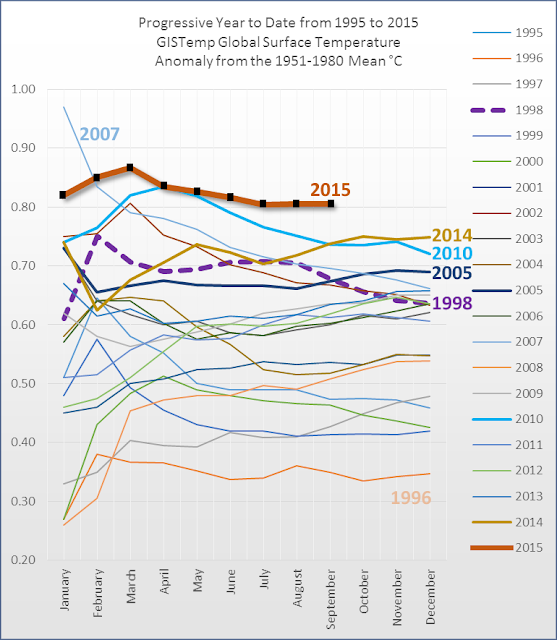
Now, I note that you refuse to discuss the AMOC slowdown.

No, by your metrics they pass.
Excellent article on Exxon posted.
Internal documents show that Exxon knew about the dangers of climate change and fossil fuel use and then turned around and then denied all dangers as well as starting to fund lobbyists and denier disinformation sites.
http://www.nytimes.com/2015/10/10/opinion/exxons-climate-concealment.html?smid=tw-share&_r=0
anelMore Than 1000 International Scientists Dissent Over Man-Made Global Warming Claims
No, I would not give a passing grade to models that only got three out of 114 projections correct.
Your metric might say that is "100% success." Those of us who are a bit stronger in math would say it's a 97% failure rate.
The temperature anomalies fit within the range of the models.
Time to talk about the 4 major tipping points, the big sudden change type disasters that we are close to experiencing.
1) AMOC slowdown.
If the AMOC slowdown turns into a stop, which has happened before, Eastern US and Canada and Europe will experience drastically colder weather.
Climate Change “Tipping Points” and the Fate of the Earth
..
By Michael T. Klare |
Tomdispatch.com
Not so long ago, it was science fiction. Now, it’s hard science — and that should frighten us all. The latest reports from the prestigious and sober Intergovernmental Panel on Climate Change (IPCC) make increasingly hair-raising reading, suggesting that the planet is approaching possible moments of irreversible damage in a fashion and at a speed that had not been anticipated.
Scientists have long worried that climate change will not continue to advance in a “linear” fashion, with the planet getting a little bit hotter most years. Instead, they fear, humanity could someday experience “non-linear” climate shifts (also known as “singularities” or “tipping points”) after which there would be sudden and irreversible change of a catastrophic nature. This was the premise of the 2004 climate-disaster film The Day After Tomorrow. In that movie — most notable for its vivid scenes of a frozen-over New York City — melting polar ice causes a disruption in the North Atlantic Current, which in turn triggers a series of catastrophic storms and disasters. At the time of its release, many knowledgeable scientists derided the film’s premise, insisting that the confluence of events it portrayed was unlikely or simply impossible.
Fast forward 11 years and the prospect of such calamitous tipping points in the North Atlantic or elsewhere no longer looks improbable. In fact, climate scientists have begun to note early indicators of possible catastrophes.
Take the disruption of the North Atlantic Current, the pivotal event in The Day After Tomorrow. Essentially an extension of the Gulf Stream, that deep-sea current carries relatively warm salty water from the South Atlantic and the Caribbean to the northern reaches of the Atlantic. In the process, it helps keep Europe warmer than it would otherwise be. Once its salty water flows into sub-Arctic areas carried by this prolific stream, it gets colder and heavier, sinks to lower depths, and starts a return trip to warmer climes in the south where the whole process begins again.
So long as this “global conveyor belt” — known to scientists as the Atlantic Meridional Overturning Circulation, or AMOC — keeps functioning, the Gulf Stream will also continue to bring warmer waters to the eastern United States and Europe. Should it be disrupted, however, the whole system might break down, in which case the Euro-Atlantic climate could turn colder and more storm-prone. Such a disruption might occur if the vast Greenland ice sheet melts in a significant way, as indeed is already beginning to happen today, pouring large quantities of salt-free fresh water into the Atlantic Ocean. Because of its lighter weight, this newly introduced water will remain close to the surface, preventing the submergence of salty water from the south and so effectively shutting down the conveyor belt. Indeed, exactly this process now seems to be underway.
By all accounts, 2015 is likely to wind up as the hottest year on record, with large parts of the world suffering from severe heat waves and wildfires. Despite all this, however, a stretch of the North Atlantic below Iceland and Greenland is experiencing all-time cold temperatures, according to the National Oceanic and Atmospheric Administration. What explains this anomaly? According to scientists from the Potsdam Institute for Climate Impact Research and Pennsylvania State University, among other institutions, the most likely explanation is the arrival in the area of cold water from the Greenland ice sheet that is melting ever more rapidly thanks to climate change. Because this meltwater starts out salt-free, it has remained near the surface and so, as predicted, is slowing the northern advance of warmer water from the North Atlantic Current.
So far, the AMOC has not suffered a dramatic shutdown, but it is slowing, and scientists worry that a rapid increase in Greenland ice melt as the Arctic continues to warm will pour ever more meltwater into the North Atlantic, severely disrupting the conveyor system. That would, indeed, constitute a major tipping point, with severe consequences for Europe and eastern North America. Not only would Europe experience colder temperatures on an otherwise warmer planet, but coastal North America could witness higher sea levels than those predicted from climate change alone because the Gulf Stream tends to pull sea water away from the eastern U.S. and push it toward Europe. If it were to fail, rising sea levels could endanger cities like New York and Boston. Indeed, scientists discovered that just such a slowing of the AMOC helped produce a sea-level rise of four inches from New York to Newfoundland in 2009 and 2010.
Right now that risk is considered still low, but considering that the globe is recording record warm temperatures while the AMOC warmed areas are experiencing record cold temperatures, its a real risk.
"In effect the scientific method has been abandoned in this field.”
— Atmospheric Physicist Dr. John Reid, who worked with Australia’s CSIRO’s (Commonwealth Scientific and Industrial Research Organization) Division of Oceanography and worked in surface gravity waves (ocean waves) research.
Why do you keep calling yourself a liar so often?


