Global Warming. Fact or grossly exaggerated??

Whats your opinion on global warming?

  • Its too late! We're all gonne bake, frie and die in a few years

    Votes: 44 30.1%
  • Its not as bad as scientists say. We got at least 100 to 200 years before shit hits the fan

    Votes: 33 22.6%
  • Its not real at all. Its a carbon credit money making scam

    Votes: 45 30.8%
  • Its all a big conspiracy MAN!!!

    Votes: 9 6.2%
  • Its way too cold in Canada, I wish it were real. Start up the SUV's

    Votes: 15 10.3%

  • Total voters
    146
  • Poll closed .
Oh yeah basketcase, those high temperatures of minus 29 Celsius are sure gonna melt those northern ice caps.

Oh my god, we're all gonna melt to death!!! :Eek:

In fact the higher temperatures mean less ice forms, and the higher summer temperatures will melt more of it. So yes, the ice cap is receding.

And as it recedes less light is reflected, so more heat absorbed, warming further.
 
As you keep ignoring that the theory of anthropogenic impact on climate change is the best predicts our observations over 100 years.

I'm not ignoring anything. I'm rejecting your premise that something unusual is happening.

(I'm also rejecting your earlier suggestion that the pause we are now experiencing must be an "anomaly." When the real-world evidence doesn't support the unsubstantiated computer-model predictions, we shouldn't assume the real-world results are an "anomaly").

I do have something better: The climate changes. It is not unusual for the climate to change, and changes in the climate are not unique to the past 200 years.

I'm not the only one who thinks nothing unusual is occurring:

http://www.independent.co.uk/enviro...roof-humans-cause-climate-change-9159627.html

... and Mr Patricks credentials have been dealt with on more than one occasion. He's paid by industries to make those comments. He is saying that the IPCC numbers MAY be falsified to suit the writers. Considering the 2014 report hasn't been released that's a hard statement to back up with facts so all he's doing is sowing his seed of suspicion based on nothing. i could just easily say they MAY NOT and hold as much weight.
 
More the same, good to see, DM has taught you well. It's clear you've decided to sit on the sideline for now and play with your boogers
lol


............................
 
... and then there was one. It looks like MF2 is on his own in this thread now, a thread you started with the biased poll
lol


............................
 
That's very debatable. Even if that were the case, it wouldn't prove that man-made carbon dioxide emissions were the cause.

The best way to test the theory of anthropogenic global warming is to make predictions based on the theory, and then analyze whether the predictions were accurate.


The IPCC and the climate researchers have certainly got the first part down pat. They're great at making predictions. When it comes to assessing the accuracy of the predictions, they're not so good.

By the way, I said the problem with the theory is that it isn't supported by evidence. I never said anything about requiring perfection (as basketcase has suggested) or requiring "absolute proof."

--
I shall do my best.

As I understand it, scientists generally don't believe a theory can be proven to be permanently true. Instead, they believe it is verified if it is "supported" by evidence and can be replicated, but it is recognized that a new theory might emerge that is stronger and will replace the existing theory.

However, while scientists don't believe a theory can be proven to be permanently true, they do believe a theory can be proven false. And they believe it is important (some feel it is most important) to test whether a theory can be falsified, to eliminate other possible explanations.

Research isn't about winning an argument. It should be conducted with a clear understanding of the types of results that would verify the theory and the types of results that would falsify it.

By comparing the past and present cycles, it 's not a stretch to say that human activity is a major factor, simply based on the differences of then and now. There are more humans now than before and more by products in the environment now than before, some of which have not ever existed. The natural filters and recycling processes aren't able to keep up. The biggest single recycling mechanism on earth, turning CO2 into O2, the worlds forest is being eliminated at an alarming rate, almost exclusively by human activity.

http://en.wikipedia.org/wiki/Deforestation

Global deforestation[92] sharply accelerated around 1852.[93][94] It has been estimated that about half of the Earth's mature tropical forests—between 7.5 million and 8 million km2 (2.9 million to 3 million sq mi) of the original 15 million to 16 million km2 (5.8 million to 6.2 million sq mi) that until 1947 covered the planet[95]—have now been destroyed.[8][96] Some scientists have predicted that unless significant measures (such as seeking out and protecting old growth forests that have not been disturbed)[95] are taken on a worldwide basis, by 2030 there will only be 10% remaining,[93][96] with another 10% in a degraded condition.[93] 80% will have been lost, and with them hundreds of thousands of irreplaceable species.[93] Some cartographers have attempted to illustrate the sheer scale of deforestation by country using a cartogram.[97]
Estimates vary widely as to the extent of tropical deforestation.[98][99] Scientists estimate that one fifth of the world's tropical rainforest was destroyed between 1960 and 1990.[citation needed] They claim that that rainforests 50 years ago covered 14%[citation needed] of the world's land surface, now only cover 5–7%, and that all tropical forests will be gone by the middle of the 21st century.[100]
A 2002 analysis of satellite imagery suggested that the rate of deforestation in the humid tropics (approximately 5.8 million hectares per year) was roughly 23% lower than the most commonly quoted rates.[101] Conversely, a newer analysis of satellite images reveals that deforestation of the Amazon rainforest is twice as fast as scientists previously estimated.[102][103]
Some have argued that deforestation trends may follow a Kuznets curve,[104] which if true would nonetheless fail to eliminate the risk of irreversible loss of non-economic forest values (for example, the extinction of species).[105][106]

Satellite image of Haiti's border with the Dominican Republic (right) shows the amount of deforestation on the Haitian side
A 2005 report by the United Nations Food and Agriculture Organization (FAO) estimates that although the Earth's total forest area continues to decrease at about 13 million hectares per year, the global rate of deforestation has recently been slowing.[107][108] Still others claim that rainforests are being destroyed at an ever-quickening pace.[109] The London-based Rainforest Foundation notes that "the UN figure is based on a definition of forest as being an area with as little as 10% actual tree cover, which would therefore include areas that are actually savannah-like ecosystems and badly damaged forests."[110] Other critics of the FAO data point out that they do not distinguish between forest types,[111] and that they are based largely on reporting from forestry departments of individual countries,[112] which do not take into account unofficial activities like illegal logging.[113]
Despite these uncertainties, there is agreement that destruction of rainforests remains a significant environmental problem. Up to 90% of West Africa's coastal rainforests have disappeared since 1900.[114] In South Asia, about 88% of the rainforests have been lost.[115] Much of what remains of the world's rainforests is in the Amazon basin, where the Amazon Rainforest covers approximately 4 million square kilometres.[116] The regions with the highest tropical deforestation rate between 2000 and 2005 were Central America—which lost 1.3% of its forests each year—and tropical Asia.[110] In Central America, two-thirds of lowland tropical forests have been turned into pasture since 1950 and 40% of all the rainforests have been lost in the last 40 years.[117] Brazil has lost 90–95% of its Mata Atlântica forest.,[118] Paraguay was losing its natural semi humid forests in the country’s western regions at a rate of 15.000 hectares at a randomly studied 2-month period in 2010,[119] Paraguay’s parliament refused in 2009 to pass a law that would have stopped cutting of natural forests altogether.[120]

Deforestation around Pakke Tiger Reserve, India
Madagascar has lost 90% of its eastern rainforests.[121][122] As of 2007, less than 1% of Haiti's forests remained.[123] Mexico, India, the Philippines, Indonesia, Thailand, Burma, Malaysia, Bangladesh, China, Sri Lanka, Laos, Nigeria, the Democratic Republic of the Congo, Liberia, Guinea, Ghana and the Ivory Coast, have lost large areas of their rainforest.[124][125] Several countries, notably Brazil, have declared their deforestation a national emergency.[126][127] The World Wildlife Fund's ecoregion project catalogues habitat types throughout the world, including habitat loss such as deforestation, showing for example that even in the rich forests of parts of Canada such as the Mid-Continental Canadian forests of the prairie provinces half of the forest cover has been lost or altered.
 
... and Mr Patricks credentials have been dealt with on more than one occasion. He's paid by industries to make those comments. He is saying that the IPCC numbers MAY be falsified to suit the writers. Considering the 2014 report hasn't been released that's a hard statement to back up with facts so all he's doing is sowing his seed of suspicion based on nothing. i could just easily say they MAY NOT and hold as much weight.

The 2013 report was released and there are very serious concerns with the statements in the report.

To give you an obvious example, since the computer-model predictions from the 2007 report were completely wrong, it is extremely difficult to understand -- from a scientific perspective -- how the IPCC's confidence in its predictions managed to increase (a level of confidence that apparently isn't shared by Groggy. :))

By comparing the past and present cycles, it 's not a stretch to say that human activity is a major factor, simply based on the differences of then and now. There are more humans now than before and more by products in the environment now than before, some of which have not ever existed. The natural filters and recycling processes aren't able to keep up. The biggest single recycling mechanism on earth, turning CO2 into O2, the worlds forest is being eliminated at an alarming rate, almost exclusively by human activity.

As I said in my assessment of the Doran hogwash, "human activity" may very well be a factor that affects the climate (although whether it affects the climate to an extent that anyone should worry about is a different matter). Deforestation probably has been a factor.

But that has nothing to do with the theory of anthropogenic global warming. The AGW theory is that man-made carbon dioxide emissions are the primary driver of increases in the Earth's temperature.

http://www.ipcc.ch/publications_and_data/ar4/syr/en/spms2.html

It's a theory that currently isn't supported by evidence.
 
The 2013 report was released and there are very serious concerns with the statements in the report.

To give you an obvious example, since the computer-model predictions from the 2007 report were completely wrong, it is extremely difficult to understand -- from a scientific perspective -- how the IPCC's confidence in its predictions managed to increase (a level of confidence that apparently isn't shared by Groggy. :))

As I said in my assessment of the Doran hogwash, "human activity" may very well be a factor that affects the climate (although whether it affects the climate to an extent that anyone should worry about is a different matter). Deforestation probably has been a factor.

But that has nothing to do with the theory of anthropogenic global warming. The AGW theory is that man-made carbon dioxide emissions are the primary driver of increases in the Earth's temperature.

http://www.ipcc.ch/publications_and_data/ar4/syr/en/spms2.html

It's a theory that currently isn't supported by evidence.

As mentioned earlier, the 2007 report is based on data and algorithms even older. Not totally irrelevant but definitely dated.

One of the biggest organization on the counter AGW debate is the SPPI, The Science and Public Policy Institute, with a serious group of international researchers acting on their behalf. You should check out their bios.

Christopher Walter Monckton, 3rd Viscount Monckton of Brenchley,

Science Adviser: William Kininmonth - B.Sc (UWA), M.Sc (Colo State U), M.Admin (Monash U). William Kininmonth is a consulting climatologist who

Science Adviser: Robert M. Carter, Ph.D., former Head of the School of Earth Sciences, James Cook University (Queensland).

Science Adviser: Craig Idso, Ph. D., -Chairman of the Board of Center for the Study of Carbon Dioxide and Global Change,

Doctor David Legates: Professor Legates is a climatologist who specializes in hydro climatology (water), statistical methods, climate change, and environmental education.

If you look deeper in the background of them you uncover a common thread, all are on the payroll of the Heartland Institute, a Libertarian think tank basically against anything the government does.

http://en.wikipedia.org/wiki/The_Heartland_Institute

The Heartland Institute does not disclose its funding sources. According to its brochures, Heartland receives money from approximately 1,600 individuals and organizations, and no single corporate entity donates more than 5% of the operating budget,[46] although the figure for individual donors can be much higher, with a single anonymous donor providing $4.6 million in 2008, and $979,000 in 2011, accounting for 20% of Heartland's overall budget, according to reports of a leaked fundraising plan.[47] Heartland states that it does not accept government funds and does not conduct contract research for special-interest groups.[48]
MediaTransparency reported that Heartland received funding from politically conservative foundations such as the Castle Rock Foundation, the Sarah Scaife Foundation, the John M. Olin Foundation, and the Lynde and Harry Bradley Foundation.[49] In 2011, the Institute received $25,000 from the Charles G. Koch Foundation.[17] The Charles Koch Foundation states that the contribution was "$25,000 to the Heartland Institute in 2011 for research in healthcare, not climate change, and this was the first and only donation the Foundation made to the institute in more than a decade".[50]
Oil and gas companies have contributed to the Heartland Institute, including over $600,000 from ExxonMobil between 1998 and 2005.[51] Greenpeace reported that Heartland received almost $800,000 from ExxonMobil.[23] In 2008, ExxonMobil said that they would stop funding to groups skeptical of climate warming, including Heartland.[51][52][53] Joseph Bast, president of the Heartland Institute, argued that ExxonMobil was simply distancing itself from Heartland out of concern for its public image.[51]
The Heartland Institute has also received funding and support from tobacco companies Philip Morris,[36] Altria and Reynolds American, and pharmaceutical industry firms GlaxoSmithKline, Pfizer and Eli Lilly.[47] State Farm Insurance, USAA and Diageo are former supporters.[54] The Independent reported that Heartland's receipt of donations from Exxon and Philip Morris indicates a "direct link"..."between anti-global warming sceptics funded by the oil industry and the opponents of the scientific evidence showing that passive smoking can damage people's health."[13]
As of 2006, the Walton Family Foundation (run by the family of the founder of Wal-Mart) had contributed approximately $300,000 to Heartland. The Heartland Institute published an op-ed in the Louisville Courier-Journal defending Wal-Mart against criticism over its treatment of workers. The Walton Family Foundation donations were not disclosed in the op-ed, and the editor of the Courier-Journal stated that he was unaware of the connection and would probably not have published the op-ed had he known of it.[55] The St. Petersburg Times described the Heartland Institute as "particularly energetic defending Wal-Mart."[55] Heartland has stated that its authors were not "paid to defend Wal-Mart" and did not receive funding from the corporation; it did not disclose the $300,000+ received from the Walton Family Foundation.[55]
In 2012, following the February 2012 document leak (see below) and a controversial advertising campaign, the institute lost substantial funding as corporate donors sought to dissociate themselves from the institute. According to the advocacy group Forecast the Facts, Heartland lost more than $825,000, or one third of planned corporate fundraising for the year. The shortfall led to the Illinois coal lobby sponsoring the institute's May 2012 climate conference – the "first publicly acknowledged donations from the coal industry".[34] Following the leak they also lost "a couple of directors and almost its entire branch in Washington, DC."[56]
February 2012 document misappropriation[edit]


In February 2012, environmentalist scientist and president of the Pacific Institute, Peter Gleick, obtained internal Heartland Institute documents by deceptive means, and divulged them, together with an additional document that he later claimed to have received from an unknown source, to public websites.[57] The documents contained the 2012 Heartland budget, a fundraising plan and board materials.[58] The documents disclosed the names of a number of donors to the institute – including the Charles G. Koch Charitable Foundation, tobacco companies Altria and Reynolds American, drug firms GlaxoSmithKline, Pfizer and Eli Lilly, Microsoft, liquor companies, and an anonymous donor who had given $13 million over the past five years.[5][59] Some of the documents also contained details of payments to climate skeptics and financial support to skeptics' research programs, namely the founder of the Center for the Study of Carbon Dioxide and Global Change Craig Idso ($11,600 per month), physicist Fred Singer ($5,000 plus expenses per month), geologist Robert M. Carter ($1,667 per month) and a pledge of $90,000 to meteorologist Anthony Watts. Carter and Watts confirmed receiving payments.[59] The documents also indicated that the institute planned to provide materials to teachers in the United States to undercut the teaching of global warming in schools.[17][59] The documents also appeared to disclose Heartland's plans for "Operation Angry Badger", in which $612,000 was to be allocated for activities related to Wisconsin's recall elections.[17] None of the leaked documents were independently authenticated.[60]
Heartland maintained that the documents, which were first published on Desmogblog, were fraudulently acquired and declared that the last document was a fake that had been fabricated with the purpose of defaming and discrediting the institute.[61][62] The Heartland Institute asserted that one in particular of the released documents, the "Climate Strategy Memo", was forged.[17][63] Following an inquiry, the Pacific Institute reinstated Gleick, an action that "implicitly backed Gleick's assertion that he was not responsible for creating a document labeled a fake by Heartland." The Heartland Institute branded this action as a "whitewash".[64]
In support of Heartland's claims of forgery, The Atlantic editor Megan McArdle concluded that the offending document's mismatched metadata, unprofessional writing style and references to specific individuals made its authenticity extremely unlikely.[65]
In the wake of the release, several environmental organizations called on General Motors and Microsoft – companies that had donated to the institute in the past – to sever their ties with Heartland; additionally, scientists previously attacked by Heartland called on it to "recognise how its attacks on science and scientists have poisoned the debate about climate change policy."[5]
On February 16, Gleick resigned as chair of American Geophysical Union's Task Force on Scientific Ethics.[66] On February 20, 2012, Gleick said he was mailed the disputed strategy memo from an anonymous source. He admitted obtaining the other documents from Heartland by deceptive means, "in a serious lapse of my own professional judgment and ethics", and stated that "My judgment was blinded by my frustration with the ongoing efforts – often anonymous, well-funded, and coordinated – to attack climate science and scientists and prevent this debate, and by the lack of transparency of the organizations involved."[57]
On February 22, 2012, Congressman Raúl Grijalva requested a House Committee on Natural Resources hearing to investigate whether alleged Heartland payments to Indur Goklany, a senior adviser to the Interior Department, violated Federal ethics rules. Greenpeace also requested an investigation into this allegation on the same date.[67] Golklany told Politico he had previously cleared his activities with his department's ethics unit. On February 28, 2012, the Committee announced that it was planning to ignore Congressman Grijalva's request.[68]
 
url
 
I'm not ignoring anything. I'm rejecting your premise that something unusual is happening.

(I'm also rejecting your earlier suggestion that the pause we are now experiencing must be an "anomaly." When the real-world evidence doesn't support the unsubstantiated computer-model predictions, we shouldn't assume the real-world results are an "anomaly").

I do have something better: The climate changes. It is not unusual for the climate to change, and changes in the climate are not unique to the past 200 years.

I'm not the only one who thinks nothing unusual is occurring:

http://www.independent.co.uk/enviro...roof-humans-cause-climate-change-9159627.html

Too bad for you the scientific data shows a much more rapid change than in the past which has a strong correlation to increases in atmospheric CO2. Of course the world has been hotter in the past but I don't think our population will do too well.

Your 'nothing unusual' hypothesis doesn't match the scientific research.
 
The 2013 report was released and there are very serious concerns with the statements in the report.

To give you an obvious example, since the computer-model predictions from the 2007 report were completely wrong, it is extremely difficult to understand -- from a scientific perspective -- how the IPCC's confidence in its predictions managed to increase (a level of confidence that apparently isn't shared by Groggy. :))
.

They weren't wrong.
In fact the 'footnote of death' covered one of the main possible natural events could and most likely change the global temperature from smack in the middle of their range of predictions to the outside edges. Which is why I'll win the bet.

You still keep reading crappola by the Heartland people, ex tobacco lobbyists, and believing it because you still don't have any understanding of the science.

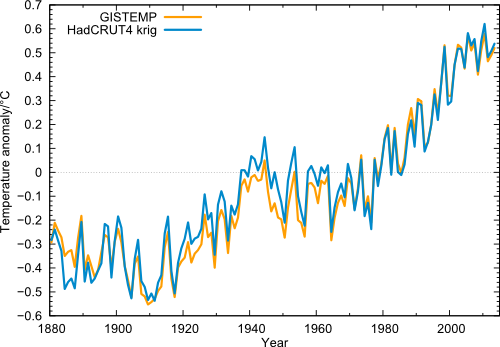
The evidence clearly supports the IPCC reports and predictions, including the news that 2013 was the fourth warmest year on record.
http://www.scilogs.de/klimalounge/files/had4_v2_giss.png
had4_v2_giss.png
 
Too bad for you the scientific data shows a much more rapid change than in the past which has a strong correlation to increases in atmospheric CO2. Of course the world has been hotter in the past but I don't think our population will do too well.

Your 'nothing unusual' hypothesis doesn't match the scientific research.

A "strong correlation"? Not lately. Besides, I don't know how you can claim to know what the data show, when the researchers have refused to make the methodology and data available to determine if it can be replicated. You know ... the kind of thing objective scientists would do.

Here's what the 36,000-member Institute of Physics said to a Commons inquiry in the U.K. looking into Climategate:

The Institute is concerned that, unless the disclosed e-mails are proved to be forgeries or adaptations, worrying implications arise for the integrity of scientific research in this field and for the credibility of the scientific method as practised in this context.

http://www.publications.parliament.uk/pa/cm200910/cmselect/cmsctech/memo/climatedata/uc3902.htm

In fact, the e-mails were not forgeries or adaptations. Which means the IOP's take was that your so-called "scientific research" hasn't been credible.

You test the theory by checking the predictions against the actual results. Surely, I don't need to keep reminding you what the outcome was.