Global Warming. Fact or grossly exaggerated??

Whats your opinion on global warming?

  • Its too late! We're all gonne bake, frie and die in a few years

    Votes: 44 30.1%
  • Its not as bad as scientists say. We got at least 100 to 200 years before shit hits the fan

    Votes: 33 22.6%
  • Its not real at all. Its a carbon credit money making scam

    Votes: 45 30.8%
  • Its all a big conspiracy MAN!!!

    Votes: 9 6.2%
  • Its way too cold in Canada, I wish it were real. Start up the SUV's

    Votes: 15 10.3%

  • Total voters
    146
  • Poll closed .
Charles Krauthammer has a great piece coming Saturday in the National Post on the so-called "settled science." I love the line in the first paragraph about the climate researchers who are predicting the apocalypse being "white-coated propagandists."

Another one of my favourite quotes in the article is specifically about the failed computer model predictions:


http://fullcomment.nationalpost.com...plays-high-priest-to-climate-change-religion/

As well, here is the McNider and Christy article that Krauthammer referenced:

http://online.wsj.com/news/articles...0001424052702303945704579391611041331266.html

"Consistently and spectacularly wrong" is a bang-on assessment of the models.

Charles Krauthammer couldn't have found another topic that he knows less about to comment on and ultimately say so little. The second article says little that's new, having been dealt with in earlier posts, except for a Kerry connection, big whoop.
 
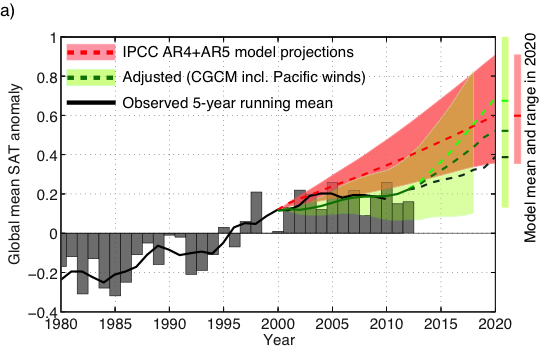
Thing is though rockie, the "experts" predicted earth would keep getting warmer from 1998 onwards to where we are now in 2014. It hasnt gotten warmer, they've been completely wrong.

No, you are wrong, as are your sources.
Even when you use the cherry picked date of 1998, the global temperature is still rising, just not as fast as previous years and still within the IPCC projections.
(its in the gif, but that's probably too technical for you)
When you use 2000 or 1996 as your start date it falls right where they predicted.

You are still wrong.
 
Another one of my favourite quotes in the article is specifically about the failed computer model predictions:

But that line is total bullshit.
And I've shown you the proof twice.
Do I have to post that chart again for you?
Can you not read charts?
 
...the global temperature is still rising, just not as fast as previous years and still within the IPCC projections.

Really? "Still within the IPCC projections"? That's not what the IPCC's fifth assessment report said in its summary for policy makers.

You obviously missed Post #118, so I'll repeat it.

Let's make a friendly wager on the IPCC's predictions. We'll bookmark this thread and see who was right.

By 2017, I will bet that the 0.2 degrees Celsius temperature increase that the IPCC predicted in 2007 will fail to be reached (i.e., that the Earth's surface temperature in 2017 will not be 0.2 degrees Celsius higher than what it was in 2007). You can bet that the IPCC prediction is accurate.

If you win, I have to hold my nose and buy the following book:

http://www.chapters.indigo.ca/books/...nn&ikwsec=Home

But if I win, you have to buy the following:

http://www.chapters.indigo.ca/books/...FUok5godImoAAA

Do we have a bet?
 
Last edited:
Really? "Still within the IPCC projections"? That's not what the IPCC's fifth assessment report said in its summary for policy makers.

You obviously missed Post #118, so I'll repeat it.

Let's make a friendly wager on the IPCC's predictions. We'll bookmark this thread and see who was right.

By 2017, I will bet that the 0.2 degrees Celsius temperature increase that the IPCC predicted in 2007 will fail to be reached (i.e., that the Earth's surface temperature in 2017 will not be 0.2 degrees Celsius higher than what it was in 2007). You can bet that the IPCC prediction is accurate.

Do we have a bet?

Sure, but lets use 1987 as our start date, not your cheating 1998 cherry picking date.
Fair?

I checked the latest estimates and I'd be willing to trust the IPCC crew's estimates and predictions.
Assuming that we're both still on here in three years...

england5.png


By the way, I'd suggest you read the article where that came from, except I don't think you are smart enough to understand it.
In fact, I'd be willing to up the bet and give you a bonus chance of winning right now.
If you can read the whole article and summarize in your own words (plagiarize and you buy the book) what the article is about and what science they are talking about, I'll buy it right now.

Will you accept that challenge?
http://www.realclimate.org/index.php/archives/2014/02/going-with-the-wind/#more-16861
 
Sure, but lets use 1987 as our start date, not your cheating 1998 cherry picking date.

The bet is on the IPCC's predictions. Once again, despite all your bluster, it doesn't look like you actually have any faith in its predictions.

Let's review the 2007 prediction one more time. In its fourth assessment report in 2007, the IPCC said the Earth's surface temperature would increase 0.2 degrees Celsius by 2017.

I'm not "cherry picking" the 2007 date. That date (and the time frame for the prediction made at that time) was selected by the IPCC, not me.

I say the models are flawed -- that they have been "spectacularly wrong," as some experts say -- and that it isn't going to happen. Presumably, since you believe the IPCC's predictions are never wrong, you believe it is going to happen.

So let's see who's right.

Is it a bet? Yes or no.
 
The bet is on the IPCC's predictions.


Sure, as long as you admit that by refusing the really easy bet right now you have admitted that you aren't smart enough to understand a legit posting on the science.
That's fair.
Or, if you think it unfair, you can still try for the challenge.
But I understand if its too hard for you.....


Once again, despite all your bluster, it doesn't look like you actually have any faith in its predictions.

Let's review the 2007 prediction one more time..

The global mean surface temperature change for the period 2016–2035 relative to 1986–2005 will likely be in the range
of 0.3°C to 0.7°C (medium confidence). This assessment is based on multiple lines of evidence and assumes there will be
no major volcanic eruptions or secular changes in total solar irradiance. Relative to natural internal variability, near-term
increases in seasonal mean and annual mean temperatures are expected to be larger in the tropics and subtropics than
in mid-latitudes (high confidence).


That was the prediction from the 2007 assessment, AR5.
I'd be willing to go double or nothing on it their prediction being right, but then you'd have to read the paragraph and understand it to know what the terms are. And that might also just be a tiny bit too hard for you to follow.

So the bet is on their prediction as they phrased it, not your second hand misquote.
That's fair, that's what you said you were contesting.

Then the bets on.
 
This thread is STILL going? I thought it was concluded that "Global Warming" was a myth... and that the only thing that is truly happening is that the weather is ALWAYS changing, and there are always individuals like Suzuki and Gore, that will exploit this fact, and profit ridiculously from it.

Oh, wait... I see that groggy, blackrock and fuji are the trumpeters and perpetrators of this thread...

laughing.gif


Makes sense now... carry on with your exercise in futility. Those three can "argue" a moot point to death!

Your first contribution to this thread and this is the sum total of it. So much for what you actually know. Thanks for coming out back on your perch putz.
 
I've been trying to decide whether I should really provide comment on the realclimate.org link that Groggy provided.

Putting aside its revisionist history, the first paragraph is rather damning to Groggy's own case, since it includes a sentence that says, "the fact that global average temperatures can deviate for a decade or longer from the long term trend comes as no surprise."

"Comes as no surprise"? Tell that to the IPCC and the leading climate researchers who completely failed to predict such an occurrence.

More important for our purposes, though, the post suggests that anyone who couldn't have anticipated such a thing knows little about science. I'm not sure how we reconcile that with Groggy's comment a few weeks ago that he wasn't prepared to "accept" such a possibility unless I could find the direct quote in the IPCC's fifth report.

It sounds to me like the people at realclimate.org don't think folks like Groggy know anything about science.
 
I've been trying to decide whether I should really provide comment on the realclimate.org link that Groggy provided.

Putting aside its revisionist history, the first paragraph is rather damning to Groggy's own case, since the post says, "the fact that global average temperatures can deviate for a decade or longer from the long term trend comes as no surprise."

"Comes as no surprise"? Tell that to the IPCC and the leading climate researchers who completely failed to predict such an occurrence.

More important for our purposes, though, the post suggests that anyone who couldn't have anticipated such a thing knows little about science. I'm not sure how we reconcile that with Groggy's comment a few weeks ago that he wasn't prepared to "accept" such a possibility unless I could find the direct quote in the IPCC's fifth report.

It sounds to me like the people at realclimate.org don't think folks like Groggy know anything about science.

Knock yourself out and contact them and then get back to us with a report.
 
The two polar regions are totally different and won't react in unison. Most high school geography student are taught that. You are still trying to equate a single event, a single cold temperature record, to a trend
If I can't use the fact that Antarctica is gaining ice to deny global warming is real, then your side can't use the fact arctic ice is melting as proof GW is real either.

You can't have it both ways
 
If I can't use the fact that Antarctica is gaining ice to deny global warming is real, then your side can't use the fact arctic ice is melting as proof GW is real either.

You can't have it both ways

Gaining Ice? If you are equating more ice surface as gaining ice you still are a rookie at this.

Then again, from http://www.skepticalscience.com/antarctica-gaining-ice.htm

Skeptic arguments that Antarctica is gaining ice frequently hinge on an error of omission, namely ignoring the difference between land ice and sea ice.

In glaciology and particularly with respect to Antarctic ice, not all things are created equal. Let us consider the following differences. Antarctic land ice is the ice which has accumulated over thousands of years on the Antarctica landmass itself through snowfall. This land ice therefore is actually stored ocean water that once fell as precipitation. Sea ice in Antarctica is quite different as it is ice which forms in salt water primarily during the winter months. When land ice melts and flows into the oceans global sea levels rise on average; when sea ice melts sea levels do not change measurably.

In Antarctica, sea ice grows quite extensively during winter but nearly completely melts away during the summer (Figure 1). That is where the important difference between Antarctic and Arctic sea ice exists as much of the Arctic's sea ice lasts all the year round. During the winter months it increases and before decreasing during the summer months, but an ice cover does in fact remain in the North which includes quite a bit of ice from previous years (Figure 1). Essentially Arctic sea ice is more important for the earth's energy balance because when it increasingly melts, more sunlight is absorbed by the oceans whereas Antarctic sea ice normally melts each summer leaving the earth's energy balance largely unchanged.

One must also be careful how you interpret trends in Antarctic sea ice. Currently this ice is increasing overall and has been for years but is this the smoking gun against climate change? Not quite. Antarctic sea ice is gaining because of many different reasons but the most accepted recent explanations are listed below:

i) Ozone levels over Antarctica have dropped causing stratospheric cooling and increasing winds which lead to more areas of open water that can be frozen (Gillet 2003, Thompson 2002, Turner 2009).

ii) The Southern Ocean is freshening because of increased rain and snowfall as well as an increase in meltwater coming from the edges of Antarctica's land ice (Zhang 2007, Bintanga et al. 2013). Together, these change the composition of the different layers in the ocean there causing less mixing between warm and cold layers and thus less melted sea and coastal land ice.

All the sea ice talk aside, it is quite clear that really when it comes to Antarctic ice and sea levels, sea ice is not the most important thing to measure. In Antarctica, the largest and most important ice mass is the land ice of the West Antarctic and East Antarctic ice sheets.

Estimates of recent changes in Antarctic land ice (Figure 2, bottom panel) show an increasing contribution to sea level with time, although not as fast a rate or acceleration as Greenland. Between 1992 and 2011, the Antarctic Ice Sheets overall lost 1350 giga-tonnes (Gt) or 1,350,000,000,000 tonnes into the oceans, at an average rate of 70 Gt per year (Gt/yr). Because a reduction in mass of 360 Gt/year represents an annual global-average sea level rise of 1 mm, these estimates equate to an increase in global-average sea levels by 0.19 mm/yr.

There is variation between regions within Antarctica (Figure 2, top panel), with the West Antarctic Ice Sheet and the Antarctic Peninsula Ice Sheet losing ice mass, and with an increasing rate. The East Antarctic Ice Sheet is growing slightly over this period but not enough to offset the other losses. There are of course uncertainties in the estimation methods but independent data from multiple measurement techniques (explained here) all show the same thing, Antarctica is losing land ice as a whole, and these losses are accelerating quickly.


SeaIce.jpg


F5.large.jpg
 
Rockie, do you just copy/paste stuff from websites and assume it all to be true??
 
Don't know if this will help or not, but I used to work at NOAA CPC (post doc in mid 1990s), and we did both climate and weather research and forecasting. The dividing line between them is kind of fuzzy. The forecasts of most relevance to the AGW debate run in the 50-100 year range, so a lot of the stuff that the Center publishes on its web site is less germane. Also, while it's true that the East Antarctic ice sheet is getting bigger, the entire Antarctic ice cap (land and sea ice together) is shrinking. The summary given above is quite correct. There is also some rather disquieting evidence that the Antarctic land ice sheets are starting behavior like warm glaciers, rather than cold ones. The main difference is how the sheets behave down at the bottom, where they are attached to the substrate. Warm glaciers move much faster, which is what we are observing with the EAIS. If this is true, it's very bad news, indeed.
 
Rockie, do you just copy/paste stuff from websites and assume it all to be true??

That's all you got? You can't refute, so you attack the authors. They have more credibility than you. The primary sources are provided for you.

Another one who thinks if you C&P you don't know what you're talking about. The C&P is simply the quickest way the open you up to the most information about this topic.

Where did you get you information?

What part of this report is wrong?