Provide proof please. Citation needed. Link?
Unfortunately i didn't know back in the late 70's i'd be challenged by a maroon like you so i don't have the written report. This is not a new discovery.
How about a similar study in the US.
Professionals or Politicians: The Uncertain Empirical Case for an Elected Rather Than Appointed Judiciary
Stephen J. Choi
New York University School of Law
G. Mitu Gulati
Duke University - School of Law
Eric A. Posner
University of Chicago - Law School
August 2007
U of Chicago Law & Economics, Olin Working Paper No. 357
2nd Annual Conference on Empirical Legal Studies Paper
Although federal judges are appointed with life tenure, most state judges are elected for short terms. Conventional wisdom holds that appointed judges are superior to elected judges because appointed judges are less vulnerable to political pressure. However, there is little empirical evidence for this view. Using a dataset of state high court opinions, we construct objective measures for three aspects of judicial performance: effort, skill and independence. The measures permit a test of the relationship between performance and the four primary methods of state high court judge selection: partisan election, non-partisan election, merit plan, and appointment. The empirical results do not show appointed judges performing at a higher level than their elected counterparts.Appointed judges write higher quality opinions than elected judges do, but elected judges write many more opinions, and the evidence suggests that the large quantity difference makes up for the small quality difference. In addition, elected judges do not appear less independent than appointed judges.
The results suggest that elected judges are more focused on providing service to the voters (that is, they behave like politicians), whereas appointed judges are more focused on their long-term legacy as creators of precedent (that is, they behave like professionals).
I'm sure you'd really want to read the 70+ pages just to prove it's flawed, feel free.
http://www.tulanelink.com/tulanelink/electorappoint_08a.htm
Money Talks, Says Study of Justices
Donations Taint La. Top Court, It Finds
SUSAN FINCH
February 1, 2008
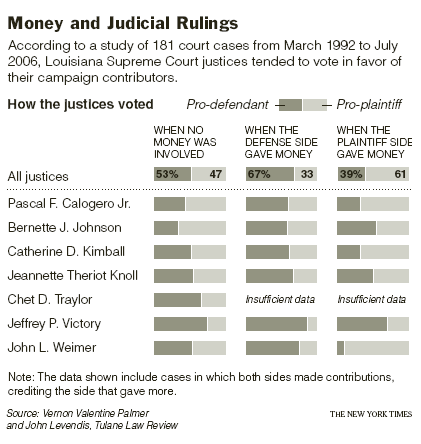
The Louisiana Supreme Court should change its rules to require justices to recuse themselves from deciding cases that involve litigants or lawyers who have given them campaign contributions, a Tulane Law School professor has concluded after he and another scholar studied voting patterns on the state's high court over 14 years. In 181 civil cases between 1992 and 2006, the nine justices have been significantly influenced by campaign donations in making their decisions, says the study, which is soon to be published in the Tulane Law Review.
The study, based on a statistical analysis of how each justice voted on cases involving their campaign donors, was conducted by Tulane comparative law professor Vernon Palmer and Loyola assistant professor of economics John Levendis.
"What we show in this study is there is an unusually high correlation between campaign contributions and decisions in favor of contributors, with very little possibility of being in error because it's done statistically," Palmer said.
Through a spokeswoman, the state high court declined to comment on the report, "The Louisiana Supreme Court in Question: An Empirical and Statistical Study of the Effects of Campaign Money on Judicial Function."
The study concluded that statistically speaking, campaign donors have a favored status among litigants appearing before the court, a sign it says indicates that campaign cash may have eroded the qualities most needed in such a court: independence, impartiality and adherence to the rule of law.
Palmer launched the study, he said in an interview, after getting no response to letters he sent the Supreme Court suggesting it adopt a rule barring its members from hearing cases in which their campaign donors are participants.
The study found that in 47 percent of the cases reviewed — 85 cases involving total campaign donations of about $400,000 — there was at least one donor before the court who had contributed to a justice's campaign.
In cases involving a single donor, the study found, Supreme Court justices voted for their contributor's position, on average, about 65 percent of the time, and no justice voted for his or her contributor's position less than 55 percent of the time.
According to the report, Chief Justice Pascal Calogero and Associate Justice John Weimer voted for positions advanced by their campaign contributors at much higher levels than the rest of the court: 81 percent and 80 percent of the time, respectively.
When it came to cases in which both sides made campaign donations to the same justice but one side gave more money, the study found that Weimer and Associate Justice Catherine Kimball usually voted for the side that gave the most.
When a defendant was the bigger donor, the analysis showed, Kimball ruled for the defendant's position 61 percent of the time, and Weimer, 75 percent of the time.
If the plaintiff's side gave larger amounts, Kimball voted for the plaintiff 67 percent of the time, and Weimer, 90 percent of the time, the study said.
"The marked statistical shift favoring the (largest) contributor irrespective of being plaintiff or defendant strongly indicates that it is the donation, not the underlying philosophical orientation, that accounts for the voting outcome," the report said. Weimer and Kimball display no such patterns in voting on cases that didn't involve any of their campaign donors.
Campaign donations had the most influence with court members in deciding cases of tort and constitutional law, the study said.
Copyright 2008, The Times-Picayune Publishing Corporation
From: The Times-Picayune, New Orleans, February 1, 2008, Metro, p. 1. Susan Finch can be reached at
sfinch@timespicayune.com. Reprinted in accordance with the "fair use" provision of Title 17 U.S.C. § 107 for a non-profit educational purpose.
Note 1: The distribution of Professor Palmer's manuscript to the media prior to publication in the Tulane Law Review (see PDF) suggests the law school's support for judicial appointments. Palmer is also a member of the Board of Directors of the Louisiana Organization for Judicial Excellence (LOJE), an organization that strongly advocates "Merit Selection" of judges, a euphemism for judicial appointment. Tulane Law School has long cultivated close relationships with judges.
"Merit Selection in LA's Judicial Process," Louisiana Organization for Judicial Excellence,
http://www.loje.org, accessed 02/03/08.
Note 2: In December, 2009, the University of Denver's Institute for the Advancement of the American Legal System (IAALS) announced the formation of the (Sandra Day) O'Connor Judicial Selection Initiative, a forum that advocates the appointment of judges under the guise of "the need to re-examine how we choose judges in America."
"O'Connor Judicial Selection Initiative," Transparent Courthouse Quarterly, Special Edition,
http://www.du.edu/legalinstitute/ newsletter/special_edition.html (remove space), accessed 03/01/10.
Additional Reading:
James Gill, "Judges: Appoint or elect?" The Times-Picayune, New Orleans, December 14, 2007, Metro, p. 7.
David Yas, "Elect judges? Sure, as long as you don't mind a horror show," Massachusets Lawyers Weekly, December 10, 2007. [Like other establishment publications, this article uses an example of egregious electoral campaign abuse to justify its support for appointing judges.]
Pascal F. Calogero Jr., "Justice questions campaign contribution study," [Letter] The Times-Picayune, New Orleans, February 6, 2008, Metro, p. 6. [A bitter complaint by the Chief Justice of the Louisiana Supreme Court about being denied a prepublication copy of Professor Palmer's article (which had been distributed to the media) “because it was still being 'thoroughly edited'” by the Tulane Law Review.]
T. Haller Jackson IV, "Law Review outlines policies," [Letter] The Times-Picayune, February 10, 2008, Metro, p. 6. [The Editor in Chief of the Tulane Law Review claims: "This volume's policy is not to release copies of articles before they have been completely edited for publication..."]
David L. Campbell, "Get politics out of courtrooms," [Letter] The Times-Picayune, February 11, 2008, Metro, p. 4. [Substantiates that the Palmer-Levendis article justifies the appointment of judges.]
Looking Anew at Campaign Cash and Elected Judges
ADAM LIPTAK
January 29, 2008
Vernon Valentine Palmer, a law professor at Tulane University in New Orleans, could not understand how justices of the Louisiana Supreme Court could routinely hear cases involving people who had given them campaign contributions. It seemed to him a raw and simple conflict of interest.
So he wrote polite letters to each of the seven justices, urging them to adopt a rule that would make disqualification mandatory in those cases.
Six months passed without a single response, and he wrote again. "I used seven more stamps," he said, "and I still got no reply."
Professor Palmer is a senior member of the Tulane law faculty and the director of its European legal studies program. He is not an expert on judicial ethics, but he knows a thing or two about the rule of law.
Peeved, he decided to take a closer look at the Louisiana Supreme Court. He recruited Dr. John Levendis, an economics professor at Loyola University in New Orleans, to help with the statistics, along with a half-dozen law students to crunch numbers and code cases. Their conclusions, to be published next month in the Tulane Law Review, are not pretty.
In nearly half of the cases they reviewed, over a 14-year period ended in 2006, a litigant or lawyer had contributed to at least one justice, sometimes recently and sometimes long before. On average, justices voted in favor of their contributors 65 percent of the time, and two of the justices did so 80 percent of the time.
The conventional response to such findings is that they do not prove much.
Judges do not change their votes in response to contributions, the argument goes. Rather, contributors support judges whose legal philosophies they find congenial and, incidentally, sometimes benefit when their judges apply those philosophies in a principled and consistent way that just happens to benefit them.
You may think that is a distinction without a difference, which is why you do not teach judicial ethics.
Professor Palmer was, in any event, able to address that objection by asking several additional questions.
He looked first at cases in which no one involved in the lawsuit had ever made a contribution, before or after the suit was filed, to establish a baseline. Some judges tended to vote for plaintiffs, others for defendants.
Justice John L. Weimer, for instance, was slightly pro-defendant in cases where neither side had given him contributions, voting for plaintiffs 47 percent of the time. But in cases where he received money from the defense side (or more money from the defense when both sides gave money), he voted for the plaintiffs only 25 percent of the time. In cases where the money from the plaintiffs' side dominated, on the other hand, he voted for the plaintiffs 90 percent of the time. That is quite a swing.
"It is the donation, not the underlying philosophical orientation, that appears to account for the voting outcome," Professor Palmer said.
Larger contributions had larger effects, the study found. Justice Catherine D. Kimball was 30 percent more likely to vote for a defendant with each additional $1,000 donation. The effect was even more pronounced for Justice Weimer, who was 300 percent more likely to do so.
"The greater the size of the contribution," Professor Palmer said, "the greater the odds of favorable outcomes."
A similar study of the Ohio Supreme Court conducted by The New York Times in 2006 continues to echo in that state. It appeared about a year after an appeals court there threw out a $212 million jury verdict in a case involving a business dispute between two companies, and it caused the lawyers on the losing side to take a look at who had contributed to the campaign of the judge who wrote the decision. It turned out that the judge, William G. Batchelder, had received a lot of money from Robert Meyerson, the chief executive of the company on the winning side, the Telxon Corporation.
The lawyers for the company on the losing side, Smart Media, asked for a rehearing and got one, sort of. In November, a substitute panel of appeals court judges refused to undo the earlier decision, saying there was no procedure to allow that. Judge Robert Nader, dissenting, could barely contain his disbelief, saying the initial decision was infected by "approximately $1 million in contributions from a very financially interested individual" to Judge Batchelder, a Republican, and to the local Republican Party.
This was, Judge Nader wrote, "a classic scenario giving rise to every nuance of political influence in our courts which calls for self-disqualification."
The case is now before the Ohio Supreme Court. Mr. Meyerson, the executive, has given money to two of its justices as well.
A couple of weeks ago, the United States Supreme Court said the Constitution had nothing to say about the way New York elects its judges. But several justices went out of their way to question the practice of electing judges. Justices Anthony M. Kennedy and Stephen G. Breyer said, for instance, that campaign fund-raising in judicial elections might be at odds "with the perception and the reality of judicial independence and judicial excellence."
But you do not have to do away with elections and or even fund-raising to make a drastic improvement in the quality of justice in state courts around the nation. All you need to do is listen to Professor Palmer. If a judge has taken money from a litigant or a lawyer, Professor Palmer says, the judge has no business ruling on that person's case.
Copyright 2008, The New York Times Company
There's more, but I doubt you'll digest these.