Edmonton police finding new ways to battle sex trade
So far this year sting operations have been conducted every other week
By Janice Johnston, CBC News Posted: Apr 05, 2017 6:00 AM MT Last Updated: Apr 05, 2017 6:00 AM MT
Edmonton police expect to arrest more than 200 johns in 2017, double the number arrested last year, says a senior officer whose work targets the prostitution trade.
The Edmonton Police Service has conducted six stings so far this year aimed at targeting people trying to buy sex. That's an average of one sting every other week.
Last week's round-up resulted in 11 arrests — 10 men and one woman.
"We've made a concerted effort to improve our numbers, increase our numbers of stings, just so we can have that much greater of an impact on the demand," explained Staff Sgt. Dale Johnson.
Johnson is in charge of the human trafficking and exploitation unit, which until last week was known as the vice unit.
It's just one of the many recent changes that have been made in the fight against prostitution in Edmonton. The sex trade itself is also undergoing significant change as prostitutes move off the street and onto the internet.
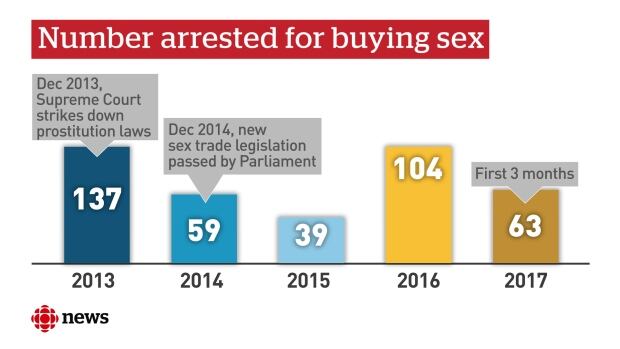
"We've managed to arrest 63 johns, and those numbers are on pace to at least double the numbers that we achieved last year," Johnson said.
In 2016, Edmonton police laid charges against 104 people trying to buy sex.
Johnson said most of the johns being nabbed are first-time offenders who are usually diverted from the courts to the longstanding prostitution offender program, also known as "john school."
So many arrests have been made this year that an extra spring session of the one-day course has been added.
In December 2013, the Supreme Court struck down Canada's prostitution laws. A year later, Parliament passed new legislation making it legal to sell sex, but against the law to purchase it.
Number arrested for buying sex
The number of johns arrested by Edmonton police dropped off sharply in 2014 and 2015, while the dust settled. Last year there was a dramatic increase that pales compared to the targets set for 2017.
And now police are only going after the buyers. Because of the new law, they had to change their approach.
Police admit they've had to adapt with the times, to develop new techniques to effectively target the men and women purchasing sex online.
Johnson refused to divulge details, but admitted placing dummy or decoy ads is a tactic police use.
"Well, our focus is almost entirely on the demand side of the equation," Johnson said. "We've had to adapt, to sort of reimagine how we do business and how we're going to enforce these laws. Because I would say they are a little bit more complex than they were in the past."
The name change — from vice unit to human trafficking and exploitation unit — reflects the new approach.
"We've decided to sort of modernize our image, and our name to more accurately reflect the realities of what's occurring in this line of work," Johnson said.
"You know by focusing our attention there, the ultimate goal is to reduce the amount of trafficking and victimization that's occurring."
Less street prostitution
Not only have sex trade laws changed, the way sex is being sold in Edmonton has mostly moved off the street and onto the internet. Johnson estimated prostitution in Edmonton is now 80 per cent online and 20 per cent on the street.
He's been a cop for 22 years.
"I mean it's hard to imagine how much it's changed," Johnson said. "It's unbelievable."
"I mean, 118th Avenue is nothing what it was when I began policing. 95th Street has changed. It's greatly improved. There's still other areas in the city that still encounter a little bit of street prostitution. It's nothing what it once was."
Johnson estimated on any given night in the city there are now usually no more than eight women working as street prostitutes. And he said they tend to be some of the most disenfranchised and the most desperate.
"I think those individuals who are working on the street are there for survival," he said.
"They're trying to meet their basic needs, whether it's food, money to pay rent or money to support an addiction. There is a core group of vulnerable, drug-addicted women that that's their option and that's where they work. I mean that's their reality. It's a sad reality."
Impact on communities
Fewer street prostitutes equals happier residential communities that no longer have to contend with the blatant nuisance of the sex trade.
"You know, open drug use, to cruising, to men soliciting young girls on their way to school and mothers just walking to buy a loaf of bread," Johnson said. "Things like that that really hurt the community, and the reputation of the community."
Kate Quinn, executive director of CEASE, the Centre to End All Sexual Exploitation, welcomes the decline of street prostitution in Edmonton.
"It's good because now girls can go to school without as much fear as in the past that men would harass them on the way to school," Quinn said. "Women can stand at bus stops and not experience that level of harassment."
Quinn isn't surprised sex trade workers are choosing the internet over street corners.
"All of us use the internet," Quinn said. Just like there's Amazon and eBay to buy and sell, there are sex industry buy-and-sell sites."
She recalled one woman who used to be a street prostitute who chose to go high-tech.
"She saw it as a way out of that visibility on the street," Quinn explained. "But what she didn't realize was that in order to sell on the internet, she would have to pose nearly nude and in very provocative, pornographic type of poses."
Quinn also worries about the relative invisibility of selling sex on the internet.
"It could be a 15-year-old girl who's been recruited and sold online. So I think we have to be just as concerned today about what's happening in the exploitation of vulnerable people as we were when it was a more visible exploitation on the street. It's just that the internet makes everything easier to buy and sell."
Increased victimization behind closed doors
The relative invisibility can lead to increased victimization for both buyers and sellers of sex.
Johnson thinks there's been an increase in robberies, even though victims rarely complain to police..
"It's been our experience that we're seeing both sides being victimized and being robbed," he said. "A number of things can go wrong."
"If a john for example were to show up, likely he's going to be alone. He's going to have cash and he likely knows what he's doing is illegal.
"So when he's strong-armed and he's robbed and relieved of his cash and his bank card and whatever else, the person who's robbed him has probably stolen more money than they would take from a commercial robbery.
"That person is very unlikely to come forward to the police."
http://www.cbc.ca/news/canada/edmon...inding-new-ways-to-battle-sex-trade-1.4054882