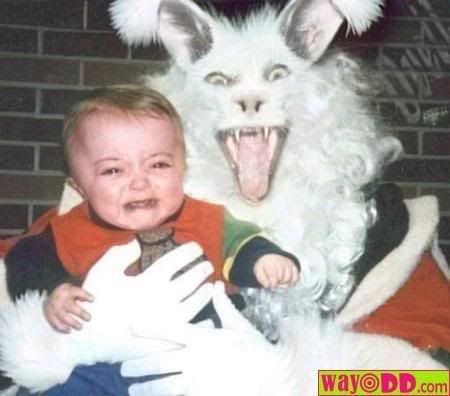
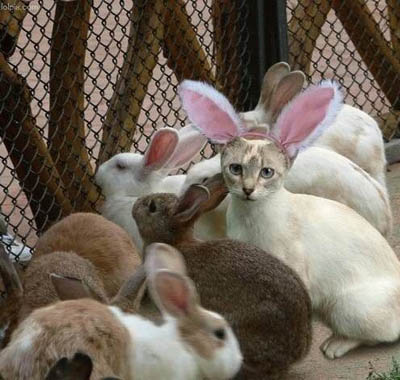
Watch out for him! He is pretty sneaky!
he tends to scam the guys on Terb for there money.

Ladies he just wants to give Daty and toss your salad...
then take off!
Origins
The Easter Bunny as an Easter symbol seems to have its origins in Alsace and southwestern Germany, where it was first mentioned in German writings in the 1600s. The first edible Easter Bunnies were made in Germany during the early 1800s and were made of pastry and sugar.
The Easter Bunny was introduced to America by the German settlers who arrived in the Pennsylvania Dutch country during the 1700s.[2] The arrival of the "Oschter Haws" (a phonetic transcription of the German Osterhase[3]) was considered one of "childhood's greatest pleasures," similar to the arrival of Kris Kringle (from the German Christkindl) on Christmas Eve.
According to the tradition, children would build brightly colored nests, often out of caps and bonnets, in secluded areas of their homes. The Oschter Haws would, if the children had been good, lay brightly colored eggs in the nest. As the tradition spread, the nest has become the manufactured, modern Easter basket, and the placing of the nest in a secluded area has become the tradition of hiding baskets
he tends to scam the guys on Terb for there money.
Ladies he just wants to give Daty and toss your salad...
then take off!
Origins
The Easter Bunny as an Easter symbol seems to have its origins in Alsace and southwestern Germany, where it was first mentioned in German writings in the 1600s. The first edible Easter Bunnies were made in Germany during the early 1800s and were made of pastry and sugar.
The Easter Bunny was introduced to America by the German settlers who arrived in the Pennsylvania Dutch country during the 1700s.[2] The arrival of the "Oschter Haws" (a phonetic transcription of the German Osterhase[3]) was considered one of "childhood's greatest pleasures," similar to the arrival of Kris Kringle (from the German Christkindl) on Christmas Eve.
According to the tradition, children would build brightly colored nests, often out of caps and bonnets, in secluded areas of their homes. The Oschter Haws would, if the children had been good, lay brightly colored eggs in the nest. As the tradition spread, the nest has become the manufactured, modern Easter basket, and the placing of the nest in a secluded area has become the tradition of hiding baskets