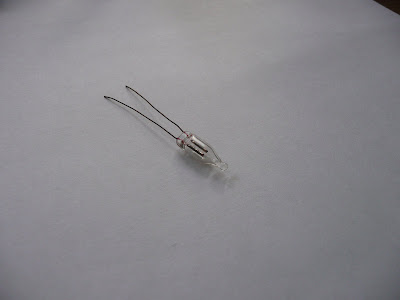
You may not miss anything - if a transformer has a no current in the secondary does the ratio of windings have any effect ? The coupling is a changing magnetic field driven by current but there is no current so I was leaning on zero. I guess I should have worded the question - If I have a neon pilot tube that will fire at 90 volts across the transformer - will it light up ? That was my thought behind the question.
Yes, if you connect the neon lamp across the 2ndary terminals, it will draw a (small) current, and it will light up.
The terminals of the 2ndary coil may be compared to water in a tap. Even if the tap is turned off, still the water behind the tap is under pressure. Same with the 2ndary coil. Even if no current is flowing, still the potential of 240 volts is there, ready.
Electric current (amps) is equivalent to the flow of water. Voltage is equivalent to water pressure. Electrical resistance (ohms) is equivalent to friction in the pipe.
If you put a load of any kind across the 2ndary terminals (being the kind of load that can respond to 240 volts), current will flow through the load -- the amps being determined by the amps = volts / ohms law.
Same with a voltmeter. If the terminals of the 2ndary coil are open, and you connect a voltmeter across them, the voltmeter will register 240 volts - but the voltmeter works by drawing a current, in order to do that.
Same with your fingers. If you span the 2ndary terminals between your finger and thumb, at 240 volts (don't try this at home), you will get a nasty shock. You get the shock because a current flows through your hand. (Note: If you walk across a nylon carpet, you can build up a static charge of several thousand volts, and when you touch the door handle, you can get a zap. But in that case, the current flowing through your body is minute, and the zap does you no harm. It's not the volts that kill you, it's the amps.