


ARITHMETIC
1. Write in words the following:
.5764; .000003; .123416; 653.0965; 43.37.
2. Solve: 35.7 plus 4, 5.8 plus 5.14 – 59.112.
3. Find cost at 12½ cents per sq. yd. of kalsomining the walls of a room 20 ft. long, 16 ft. wide and 9 ft. high, deducting 1 door 8 ft. by 4 ft 6 in. and 2 windows 5 ft. by 3 ft. 6 in. each. (By the way, “kalsomining” is whitewash).
4. A man bought a farm for $2400 and sold it for $2700. What percent did he gain?
5. A man sold a watch for $180 and lost 16⅔%. What was the cost of the watch?
6. Find the amount of $50.30 for 3 yrs., 3 mo. and 3 days, at 8 percent.
7. A school enrolled 120 pupils and the number of boys was two thirds of the number of girls. How many of each sex were enrolled?
8. How long a rope is required to reach from the top of a building 40 ft. high, to the ground 30 ft. from the base of the building?
9. How many steps 2 ft. 4 in. each will a man take in walking 2¼ miles?
10. At $1.62½ a cord, what will be the cost of a pile of wood 24 ft. long, 4 ft. wide and 6 ft. 3 in. high? (Interesting to note that a cord of wood was only $1.62 during 1912!)
GRAMMAR
1. How many parts of speech are there? Define each.
2. Define proper noun; common noun. Name the properties of a noun.
3. What is a Personal Pronoun? Decline I.
4. What properties have verbs?
5. “William struck James.” Change the Voice of the verb.
6. Adjectives have how many Degrees of Comparison? Compare good; wise, beautiful.
7. Diagram: The Lord loveth a cheerful giver.
8. Parse all the words in the following sentences:
“John ran over the bridge.”
“Helen’s parents love her.”
GEOGRAPHY
1. Define longitude and latitude.
2. Name and give the boundaries of the five zones.
3. Tell what you know of the Gulf Stream.
4. Locate Erie Canal; what waters does it connect, and why is it important?
5. Locate the following countries which border each other: Turkey [Ottoman Empire], Greece, Servia [Serbia today], Montenegro, Roumania [early spelling of Romania].
6. Name and give the capitals of States touching the Ohio River.
7. Locate these cities: Mobile, Quebec, Buenos Aires, Liverpool, Honolulu.
8. Name in order of their size three largest States in the United States.
9. Locate the following mountains: Blue Ridge, Himalaya, Andes, Alps, Wasatch.
10. Through what waters would a vessel pass in going from England through the Suez Canal to Manila?
PHYSIOLOGY
1. How does the liver compare in size with other glands in the human body? Where is it located? What does it secrete?
2. Name the organs of circulation.
3. Describe the heart.
4. Compare arteries and veins as to function. Where is the blood carried to be purified?
5. Where is the chief nervous center of the body?
6. Define Cerebrum; Cerebellum.
7. What are the functions (or uses) of the spinal column?
8. Why should we study Physiology?
9. Give at least five rules to be observed in maintaining good health.
CIVIL GOVERNMENT
1. Define the following forms of government: Democracy, Limit Monarchy, Absolute Monarchy, Republic. Give examples of each.
2. To what four governments are students in school subjected?
3. Name five county officers, and the principal duties of each.
4. Name and define the three branches of the government of the United States.
5. Give three duties of the President. What is meant by the veto power?
6. Name three rights given Congress by the Constitution and two rights denied Congress.
7. In the election of a president and vice-president, how many electoral votes is each State allowed?
8. Give the eligibility of president, vice-president and Governor of Kentucky.
9. What is a copyright? Patent right?
10. Describe the manner in which the president and vice-president of the United States are elected.
HISTORY
1. Who first discovered the following places: Florida, Pacific Ocean, Mississippi River, St. Lawrence River?
2. Sketch briefly Sir Walter Raleigh, Peter Stuyvesant.
3. By whom were the following settled: Georgia, Maryland, Massachusetts, Rhode Island, Florida?
4. During what wars were the following battles fought: Brandywine, Great Meadows, Lundy’s Lane, Antietam, Buena Vista?
5. Describe the battle of Quebec.
6. Give the cause of the War of 1812, and name an important battle fought during that war.
7. Name 2 presidents who have died in office; three who were assassinated.
8. Name the last battle of the Civil War; War of 1812; French and Indian War, and the commanders in each battle.
9. What president was impeached, and on what charge?
10. Who invented the following: magneto, telegraph, cotton gin, sewing machine, telephone, phonograph?
'So, what do you think? How does this compare with today’s 8-th graders in general?
While times have changed… does this 100 year old test illustrate a fundamental change?'
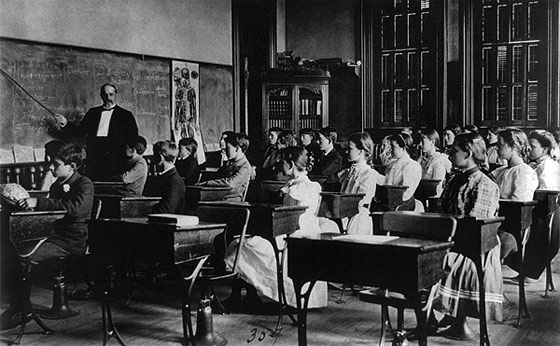
An Eighth Grade Test From 1912
These questions of an exam for 8th graders during 1912 illustrates how far our education system has been dumbed-down since then.
 modernsurvivalblog.com


