

Really? Perhaps I just can't find it; can you help me find it?
You are using an out of date browser. It may not display this or other websites correctly.
You should upgrade or use an alternative browser.
You should upgrade or use an alternative browser.


War with Iran
- Thread starter Butler1000
- Start date

TRUTH? From A Trump Envoy?
Trump Envoy Tells Nervous Gulf Allies U.S. Can’t Guarantee Security Forever
Message at a Doha security conference comes as allies worry the U.S. will leave them to clean up after the Iran war
By
Feliz Solomon
Oct. 20, 2026 10:47 am ET
 Tom Barrack, the U.S. ambassador to Turkey and President Trump’s special envoy for Syria and Iraq. Riza Ozel/AP
Quick Summary
Tom Barrack, the U.S. ambassador to Turkey and President Trump’s special envoy for Syria and Iraq, said the grand bargains that have underpinned global security for decades are undergoing major transformation, and countries in the Middle East and elsewhere should focus on securing themselves via regional partnerships.
“America as the guarantor to the world, for the last 80 years, it is no longer there,” Barrack said at the Global Security Forum in Doha, an annual summit that brings together top security officials and experts from around the world. “What’s happening in this administration is not an abandonment. It’s a message for realignment.”
“And that message is like raising a teenager. It’s not easy,” he said.
Arrangements forged in the wake of World War II—essentially a quid pro quo whereby the U.S. provided security in exchange for oil—no longer fit Washington’s imperatives, Barrack said. Americans don’t want to sacrifice their lives for the Middle East, and Gulf states know the U.S. can’t assure their security, he said.
He said the region is right to pivot toward smaller and more diversified alliances like the new defense pact between Saudi Arabia, Pakistan and Turkey. But he acknowledged the transition would be uncertain.
“We don’t have a playbook,” he said. “We’re all on audibles. We can go one play at a time.”
Trump administration officials have delivered similar calls for self reliance at security gatherings in Europe and Asia.
Gulf states tried and failed to talk Trump out of going to war with Iran. Barrack’s message lands as they worry the U.S. will retreat from the conflict, leaving them to deal with an angered and newly aggressive foe. Many are questioning whether they can rely on the U.S. as a partner even as they recognize there are no good alternatives to its military technology and backing.
Barrack said the war launched by the U.S. and Israel in late February brought unexpected consequences, likening the Middle East to a Rubik’s Cube whereby a single move can change the whole picture. He said there are lessons to be learned and limits to U.S. power.
“Every time we try and intervene and change the person or the regime, it seems to have been a mistake,” he said, pointing to Iraq, Libya and Afghanistan.
American administrations have long hoped to disentangle the country from the Middle East without success. Even now, the Trump administration is delivering a mixed message.
Last year, the U.S. added Saudi Arabia as a major non-NATO ally, a list that includes Gulf neighbors Qatar, Bahrain and Kuwait. Trump also continues to build up forces around Iran. The military is bringing in a third aircraft carrier and an additional Marine expeditionary unit, and is resupplying forces in case needed for a renewed fight.
“We’re not leaving,” Barrack said.
Both Trump and Iranian officials have signaled they’re preparing for a possible resumption of large-scale hostilities after a monthslong impasse in diplomacy. The U.S. has ramped up economic pressure on the regime, but that has so far failed to bring about a breakthrough, and regional allies are bracing for the possibility of another round of fighting that could potentially hit sensitive energy infrastructure.
Gulf countries are looking nervously at Saudi Arabia, where missile and drone attacks by Iran-backed Houthi militants have damaged energy facilities and the international airport in the capital, Riyadh.
Saudi Arabia appealed to the U.S. to intervene militarily, but Trump has limited the country’s role to providing intelligence and guidance. The damage done by the Houthis’ attacks has heightened concerns about the region’s ability to fend off further missile and drone incursions after burning through air defenses earlier in the war.
Barbara Leaf, a top Middle East envoy under former President Joe Biden, said regional allies are already moving away from dependence on U.S. protection but there are limits to an American retreat.
“They’re already doing, I think, a lot of logical things—diversification of security partnerships and security defense equipment resources,” she said, also speaking in Doha. “I think we simply haven’t seen where things will ultimately go yet, and therefore how these regional partners are best suited to defend themselves, but they do need big partners like the U.S.”
Ali Vaez, an Iran analyst at International Crisis Group, said the region hears different messages from different U.S. officials, which hurts America’s credibility and leads countries to hedge their bets.
“At the end of the day, the United States will remain highly influential and involved in the region’s defense, but it has proven to be clearly insufficient,” he said.
Copyright ©2026 Dow Jones & Company, Inc. All Rights Reserved. 87990cbe856818d5eddac44c7b1cdeb8
Feliz Solomon is a reporter for The Wall Street Journal covering the Middle East, with a focus on Israel and the Palestinian territories. She contributes to the paper’s coverage of the war in Gaza and has reported from across the West Bank. She previously spent more than a decade in Asia writing on
Trump Envoy Tells Nervous Gulf Allies U.S. Can’t Guarantee Security Forever
Message at a Doha security conference comes as allies worry the U.S. will leave them to clean up after the Iran war
By
Feliz Solomon
Oct. 20, 2026 10:47 am ET
Quick Summary
U.S. envoy Tom Barrack said the U.S. is no longer the guarantor of global security and Middle East nations must focus on regional partnerships.View more
Tom Barrack, the U.S. ambassador to Turkey and President Trump’s special envoy for Syria and Iraq, said the grand bargains that have underpinned global security for decades are undergoing major transformation, and countries in the Middle East and elsewhere should focus on securing themselves via regional partnerships.
“America as the guarantor to the world, for the last 80 years, it is no longer there,” Barrack said at the Global Security Forum in Doha, an annual summit that brings together top security officials and experts from around the world. “What’s happening in this administration is not an abandonment. It’s a message for realignment.”
“And that message is like raising a teenager. It’s not easy,” he said.
Arrangements forged in the wake of World War II—essentially a quid pro quo whereby the U.S. provided security in exchange for oil—no longer fit Washington’s imperatives, Barrack said. Americans don’t want to sacrifice their lives for the Middle East, and Gulf states know the U.S. can’t assure their security, he said.
He said the region is right to pivot toward smaller and more diversified alliances like the new defense pact between Saudi Arabia, Pakistan and Turkey. But he acknowledged the transition would be uncertain.
“We don’t have a playbook,” he said. “We’re all on audibles. We can go one play at a time.”
Trump administration officials have delivered similar calls for self reliance at security gatherings in Europe and Asia.
Gulf states tried and failed to talk Trump out of going to war with Iran. Barrack’s message lands as they worry the U.S. will retreat from the conflict, leaving them to deal with an angered and newly aggressive foe. Many are questioning whether they can rely on the U.S. as a partner even as they recognize there are no good alternatives to its military technology and backing.
Barrack said the war launched by the U.S. and Israel in late February brought unexpected consequences, likening the Middle East to a Rubik’s Cube whereby a single move can change the whole picture. He said there are lessons to be learned and limits to U.S. power.
“Every time we try and intervene and change the person or the regime, it seems to have been a mistake,” he said, pointing to Iraq, Libya and Afghanistan.
American administrations have long hoped to disentangle the country from the Middle East without success. Even now, the Trump administration is delivering a mixed message.
Last year, the U.S. added Saudi Arabia as a major non-NATO ally, a list that includes Gulf neighbors Qatar, Bahrain and Kuwait. Trump also continues to build up forces around Iran. The military is bringing in a third aircraft carrier and an additional Marine expeditionary unit, and is resupplying forces in case needed for a renewed fight.
“We’re not leaving,” Barrack said.
Both Trump and Iranian officials have signaled they’re preparing for a possible resumption of large-scale hostilities after a monthslong impasse in diplomacy. The U.S. has ramped up economic pressure on the regime, but that has so far failed to bring about a breakthrough, and regional allies are bracing for the possibility of another round of fighting that could potentially hit sensitive energy infrastructure.
Gulf countries are looking nervously at Saudi Arabia, where missile and drone attacks by Iran-backed Houthi militants have damaged energy facilities and the international airport in the capital, Riyadh.
Saudi Arabia appealed to the U.S. to intervene militarily, but Trump has limited the country’s role to providing intelligence and guidance. The damage done by the Houthis’ attacks has heightened concerns about the region’s ability to fend off further missile and drone incursions after burning through air defenses earlier in the war.
Barbara Leaf, a top Middle East envoy under former President Joe Biden, said regional allies are already moving away from dependence on U.S. protection but there are limits to an American retreat.
“They’re already doing, I think, a lot of logical things—diversification of security partnerships and security defense equipment resources,” she said, also speaking in Doha. “I think we simply haven’t seen where things will ultimately go yet, and therefore how these regional partners are best suited to defend themselves, but they do need big partners like the U.S.”
Ali Vaez, an Iran analyst at International Crisis Group, said the region hears different messages from different U.S. officials, which hurts America’s credibility and leads countries to hedge their bets.
“At the end of the day, the United States will remain highly influential and involved in the region’s defense, but it has proven to be clearly insufficient,” he said.
Copyright ©2026 Dow Jones & Company, Inc. All Rights Reserved. 87990cbe856818d5eddac44c7b1cdeb8
Feliz Solomon is a reporter for The Wall Street Journal covering the Middle East, with a focus on Israel and the Palestinian territories. She contributes to the paper’s coverage of the war in Gaza and has reported from across the West Bank. She previously spent more than a decade in Asia writing on
Will trump attack before his midterms or before the Israeli election?

Israel's war on Iran is causing mass protest globally over food and fuel costs.
Israel is screwing over the entire planet.
Israel is screwing over the entire planet.
Netanyahu & Ronald Reagan
40 Years Ago, Netanyahu Laid the Groundwork for America’s Disastrous ‘Global War on Terror’
The Israeli prime minister’s old writings from the 1980s and 1990s also reveal his long game for war against Iran – and how he influenced everyone from Reagan to Bush to Trump.
Prem Thakker
2 hours ago
∙ Paid
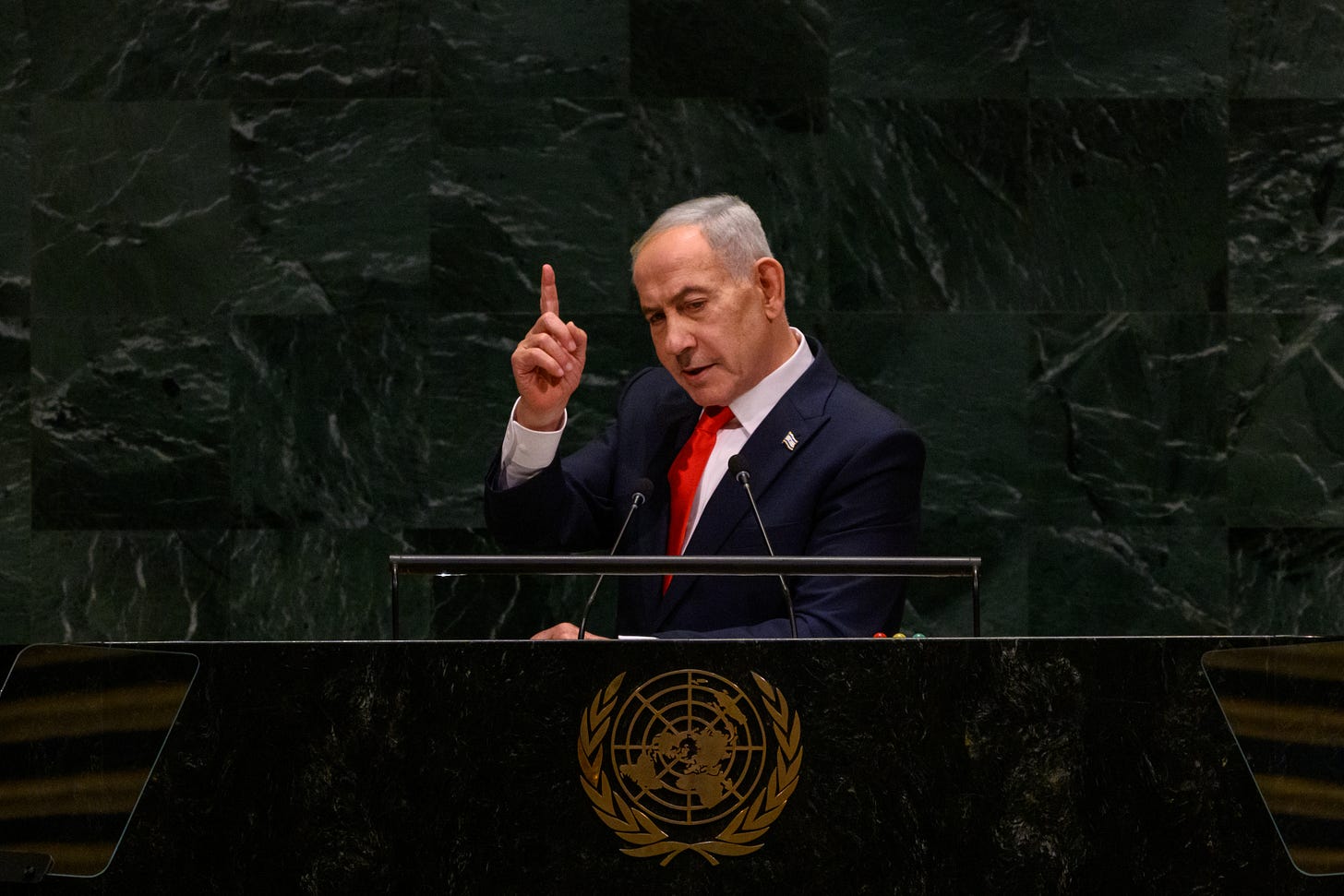
Benjamin Netanyahu addresses the United Nations General Assembly on Sept. 24, 2026 in New York City. Photo by Alexi J. Rosenfeld/Getty Images.
It was the spring of 1986. President Ronald Reagan had just delivered a national address pleading with Congress to give $100 million in military aid to the Contras – a right-wing paramilitary group seeking to overthrow the socialist Nicaraguan government – whom he once called the moral equivalent of America’s founding fathers.
Next, he launched strikes in Libya – causing domestic and international frustration, as the administration only notified Congress once the planes were airborne.
Involvement in Libya was an easier pill than Nicaragua for his opponents to swallow. Reagan attempted to use that reality to rally support for both efforts.
In remarks at a Heritage Foundation dinner, Reagan claimed the Nicaraguan Sandinistas were “training, supporting, and directing, as well as sheltering terrorists; and in this sense, they’re trying to build a Libya on our doorstep.” Conversely, he said, it was “the Contras, the freedom fighters, who are stopping them.”
This language did not come out of nowhere. Around that time, Reagan read a manual of sorts: Terrorism: How the West Can Win – a collection edited by Israel’s representative to the United Nations, a young diplomat in his late 30s named Benjamin Netanyahu.
The book and its contributors focus on Libya as a nexus of terror, and “communist totalitarianism and Islamic (and Arab) radicalism” as harbors of terrorism, as they make self-serving distinctions between “freedom fighters” and “terrorists” – emphasizing the necessity to support the former, often fiercely against the latter.
Reagan’s then-National Security Adviser John Poindexter (who at the time was orchestrating the covert sale of U.S. weapons to Iran, to illegally divert the money to fund the Contras in what is known now as the Iran-Contra scandal) told Congress about the president’s interest in the book.
During a 1987 hearing, Poindexter recounted an episode on a flight in May 1986. He claimed that, after he and Reagan talked about Netanyahu’s book, the president asked if there was anything he could do “unilaterally” to back the Contras, despite an explicit congressional ban on funding the group. Here, Poindexter testified, is when he considered telling Reagan about the Iran-Contra scheme, but opted not to, to save him from political embarrassment.
A month after that episode, in June, the International Court of Justice, or the United Nations’ World Court, ruled that the U.S. had violated international law by backing the Contras.
The Reagan State Department rejected the ruling and said the ICJ was “not equipped” to rule on complex international military issues; the administration went on to veto UN resolutions calling for compliance with the judgment, rebelling against an institution that Netanyahu had for years lambasted as “incapable” of handling terror threats.
The episode is just one example of how the United States would utilize Netanyahu’s blueprint for a permanent “war on terror,” with increasingly disastrous consequences for Americans and millions all over the globe.
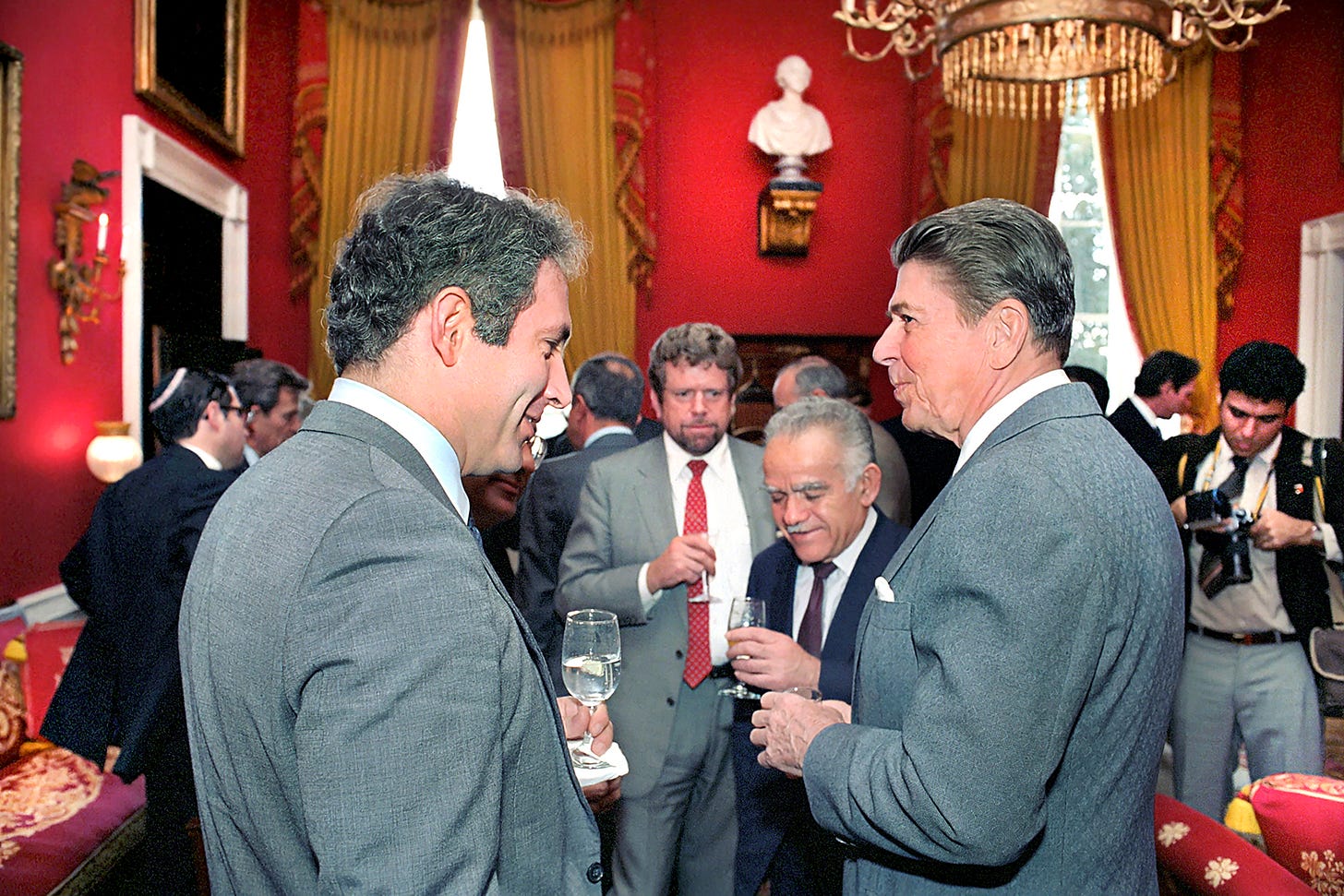
Ronald Reagan talking to Benjamin Netanyahu and Israeli Prime Minister Yitzhak Shamir in the White House on Nov. 29, 1983. Photo by Circa Images/GHI/Universal History
Rising Costs
It’s been nearly eight months since the U.S.-Israeli War on Iran first began, commencing with a horrific U.S. strike on a school that killed more than 120 children. All told, thousands of Iranians have been killed. At least 21 U.S. service members have been killed with 865 injured. As a result of the war, global energy prices have spiked.
While there is a ceasefire between Israel and Iran, the war between the U.S. and Iran is ongoing, and the U.S. and Israel are apparently planning to re-escalate after the forthcoming Israeli and American elections.
The failed and illegal war, unpopular in the U.S. from the start, has crippled Trump’s approval ratings, threatening to cost Republicans in the midterms.
In Israel, on the other hand, the war has been popular. Netanyahu instead is weathering domestic disapproval for other reasons. There are the longstanding allegations of corruption. There are the accusations he failed to stop October 7 despite being warned of looming attacks. There are the allegations that he failed to rescue hostages from Hamas, and that his government deliberately killed people on October 7 through the “Hannibal Directive.” There are also complaints that he’s not doing enough genocide in Palestine.
Now, as the Israeli election approaches, I reviewed Israeli Prime Minister Benjamin Netanyahu’s decades-old writings, and the exclusive conferences and meetings with D.C. elites he hosted, and congressional archives, and found how extensive – and successful – his efforts have been to define “terrorism” in Western power circles, and consequently, how influential he has been in steering the American-led “War on Terror,” including on Iran.
40 Years Ago, Netanyahu Laid the Groundwork for America’s Disastrous ‘Global War on Terror’
The Israeli prime minister’s old writings from the 1980s and 1990s also reveal his long game for war against Iran – and how he influenced everyone from Reagan to Bush to Trump.
Prem Thakker
2 hours ago
∙ Paid
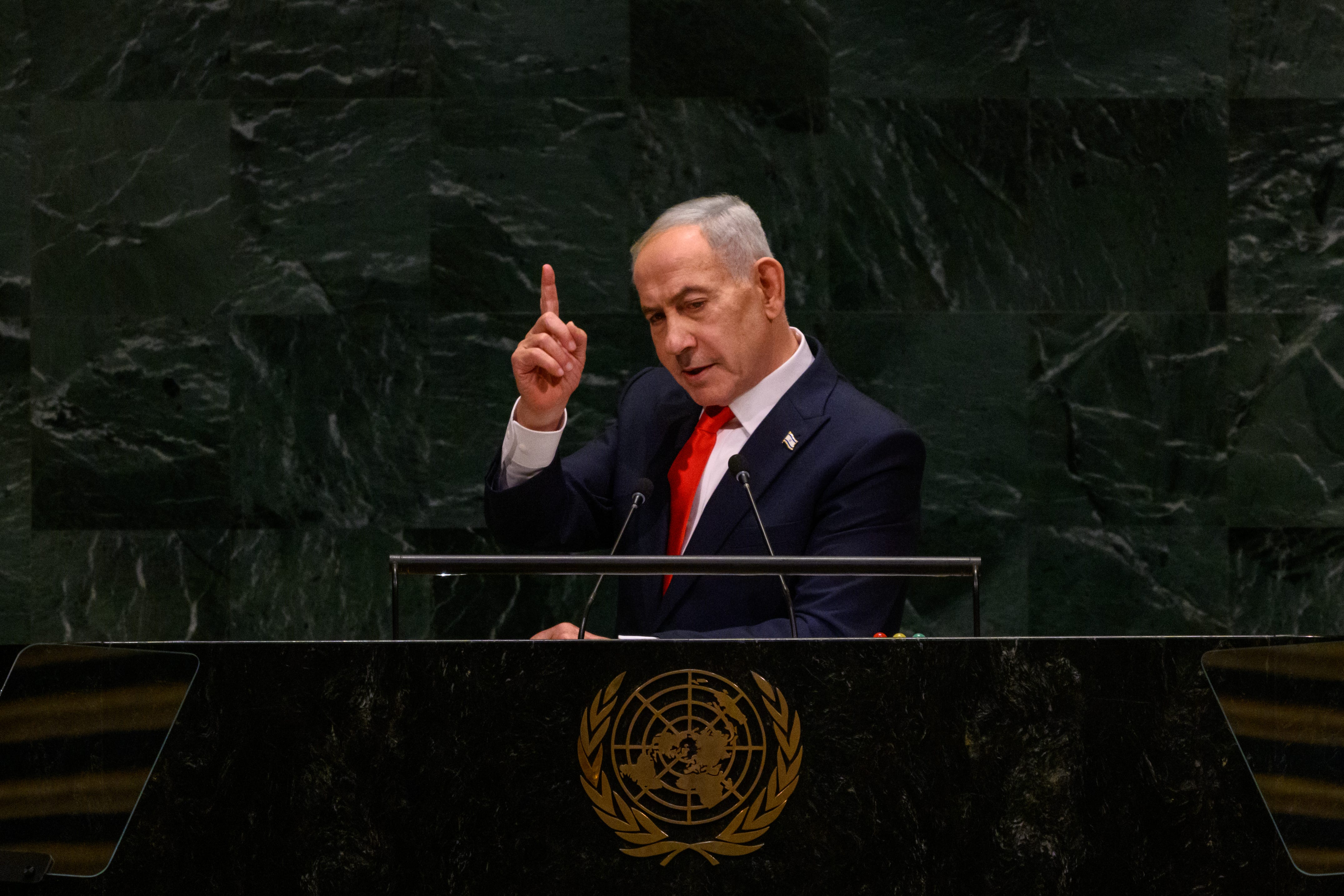
Benjamin Netanyahu addresses the United Nations General Assembly on Sept. 24, 2026 in New York City. Photo by Alexi J. Rosenfeld/Getty Images.
It was the spring of 1986. President Ronald Reagan had just delivered a national address pleading with Congress to give $100 million in military aid to the Contras – a right-wing paramilitary group seeking to overthrow the socialist Nicaraguan government – whom he once called the moral equivalent of America’s founding fathers.
Next, he launched strikes in Libya – causing domestic and international frustration, as the administration only notified Congress once the planes were airborne.
Involvement in Libya was an easier pill than Nicaragua for his opponents to swallow. Reagan attempted to use that reality to rally support for both efforts.
In remarks at a Heritage Foundation dinner, Reagan claimed the Nicaraguan Sandinistas were “training, supporting, and directing, as well as sheltering terrorists; and in this sense, they’re trying to build a Libya on our doorstep.” Conversely, he said, it was “the Contras, the freedom fighters, who are stopping them.”
This language did not come out of nowhere. Around that time, Reagan read a manual of sorts: Terrorism: How the West Can Win – a collection edited by Israel’s representative to the United Nations, a young diplomat in his late 30s named Benjamin Netanyahu.
The book and its contributors focus on Libya as a nexus of terror, and “communist totalitarianism and Islamic (and Arab) radicalism” as harbors of terrorism, as they make self-serving distinctions between “freedom fighters” and “terrorists” – emphasizing the necessity to support the former, often fiercely against the latter.
Reagan’s then-National Security Adviser John Poindexter (who at the time was orchestrating the covert sale of U.S. weapons to Iran, to illegally divert the money to fund the Contras in what is known now as the Iran-Contra scandal) told Congress about the president’s interest in the book.
During a 1987 hearing, Poindexter recounted an episode on a flight in May 1986. He claimed that, after he and Reagan talked about Netanyahu’s book, the president asked if there was anything he could do “unilaterally” to back the Contras, despite an explicit congressional ban on funding the group. Here, Poindexter testified, is when he considered telling Reagan about the Iran-Contra scheme, but opted not to, to save him from political embarrassment.
A month after that episode, in June, the International Court of Justice, or the United Nations’ World Court, ruled that the U.S. had violated international law by backing the Contras.
The Reagan State Department rejected the ruling and said the ICJ was “not equipped” to rule on complex international military issues; the administration went on to veto UN resolutions calling for compliance with the judgment, rebelling against an institution that Netanyahu had for years lambasted as “incapable” of handling terror threats.
The episode is just one example of how the United States would utilize Netanyahu’s blueprint for a permanent “war on terror,” with increasingly disastrous consequences for Americans and millions all over the globe.
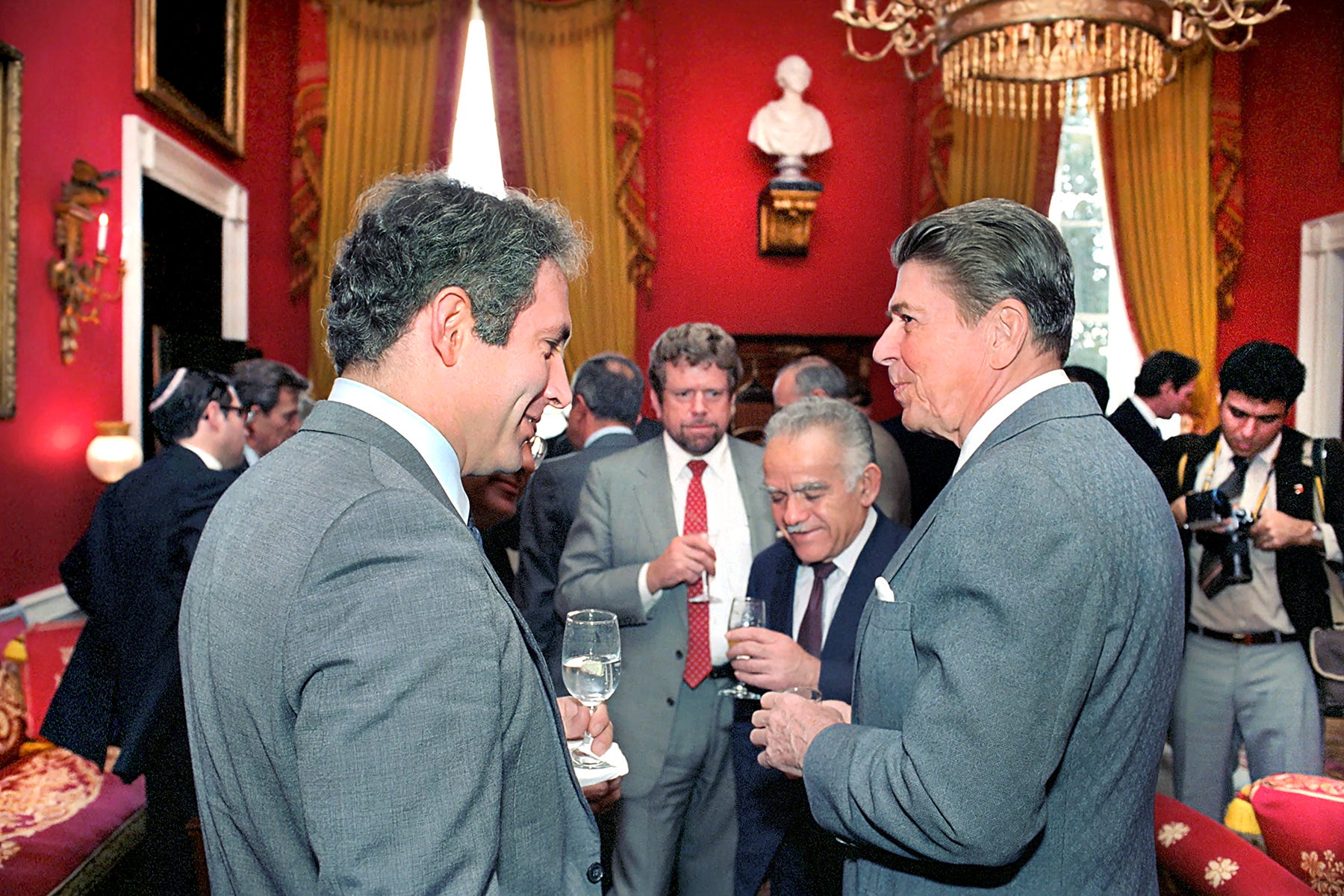
Ronald Reagan talking to Benjamin Netanyahu and Israeli Prime Minister Yitzhak Shamir in the White House on Nov. 29, 1983. Photo by Circa Images/GHI/Universal History
Rising Costs
It’s been nearly eight months since the U.S.-Israeli War on Iran first began, commencing with a horrific U.S. strike on a school that killed more than 120 children. All told, thousands of Iranians have been killed. At least 21 U.S. service members have been killed with 865 injured. As a result of the war, global energy prices have spiked.
While there is a ceasefire between Israel and Iran, the war between the U.S. and Iran is ongoing, and the U.S. and Israel are apparently planning to re-escalate after the forthcoming Israeli and American elections.
The failed and illegal war, unpopular in the U.S. from the start, has crippled Trump’s approval ratings, threatening to cost Republicans in the midterms.
In Israel, on the other hand, the war has been popular. Netanyahu instead is weathering domestic disapproval for other reasons. There are the longstanding allegations of corruption. There are the accusations he failed to stop October 7 despite being warned of looming attacks. There are the allegations that he failed to rescue hostages from Hamas, and that his government deliberately killed people on October 7 through the “Hannibal Directive.” There are also complaints that he’s not doing enough genocide in Palestine.
Now, as the Israeli election approaches, I reviewed Israeli Prime Minister Benjamin Netanyahu’s decades-old writings, and the exclusive conferences and meetings with D.C. elites he hosted, and congressional archives, and found how extensive – and successful – his efforts have been to define “terrorism” in Western power circles, and consequently, how influential he has been in steering the American-led “War on Terror,” including on Iran.


What a crazy read, now the decades of "Iran is almost finished a nuke" rhetoric he's been spouting makes a little more sense
Iran listed their targets if Netanyahu attacks again.
Eisenkot has the right idea

 nypost.com
Israeli PM Netanyahu and challenger Gadi Eisenkot have very different views on how to end the Iran war
Israeli Prime Minister Benjamin Netanyahu and opposition leader Gadi Eisenkot remained split on the best way to handle Iran — as Israeli polls are set to open in hours to decide the country’s…
nypost.com
How to win friends and influence people…lol.Israel's war on Iran is causing mass protest globally over food and fuel costs.
Israel is screwing over the entire planet.
It was all a ploy by Iran and rotten Ronny. Republicans are disgusting to say the leastBack in 1979-80 I was actually more sympathetic for the U.S.
through the hostage crisis. I might have supported the Carter
administration bombing Iran if that could have rescued the
American civilians taken hostages by Iranian 'students'.
It was all a ploy by Iran and rotten Ronny. Republicans are disgusting to say the least
Iran thinks the nuclear threat is real.
But now its up to the senile pedo guy.

Where do Muslims find time to fight when they have to pray 5 times a day.
Can't think for themselves because they're praying and worried about when they have to pray next, so that explains why they're so simple.
But fighting? How can they fight on their knees?
That's a bit blatant.
Senator Chris Murphy has been briefed on trump's Iran war plans.
Likely we are talking about nukes again.
Likely we are talking about nukes again.
Senator Chris Murphy has been briefed on trump's Iran war plans.
Likely we are talking about nukes again.
More Toxic Gassy Emissions From Hasbara
Israel warns US that Iran may use chemical weapons, but Washington questions intelligence - report
Israeli intelligence officials told their American counterparts that they believe Iran is rapidly advancing technology that would allow it to mount chemical weapons on missiles.
Follow us on Google

Israel has provided the United States with intelligence indicating that Iran is considering using chemical weapons against its adversaries, but officials in Washington are divided over the information's credibility and significance, The New York Times reported on Tuesday, citing American and regional officials.
Some senior US officials received the intelligence with concern, while others expressed deep skepticism, viewing it as part of a pressure campaign by Prime Minister Benjamin Netanyahu's government aimed at convincing the Trump administration to resume large-scale fighting against Iran.
According to the report, during discussions with US intelligence agencies and other officials over the past two weeks, senior Israeli officials presented the chemical weapons threat as more urgent than Iran's ambitions to develop nuclear weapons.
Israeli intelligence officials told their American counterparts that they believe Iran is rapidly advancing technology that would allow it to mount chemical weapons on missiles or smuggle them into Israel or another country to carry out an attack.
Other senior American officials believe the threat should be taken seriously, particularly in light of a series of recent warnings about Iranian preparations to attack US interests.
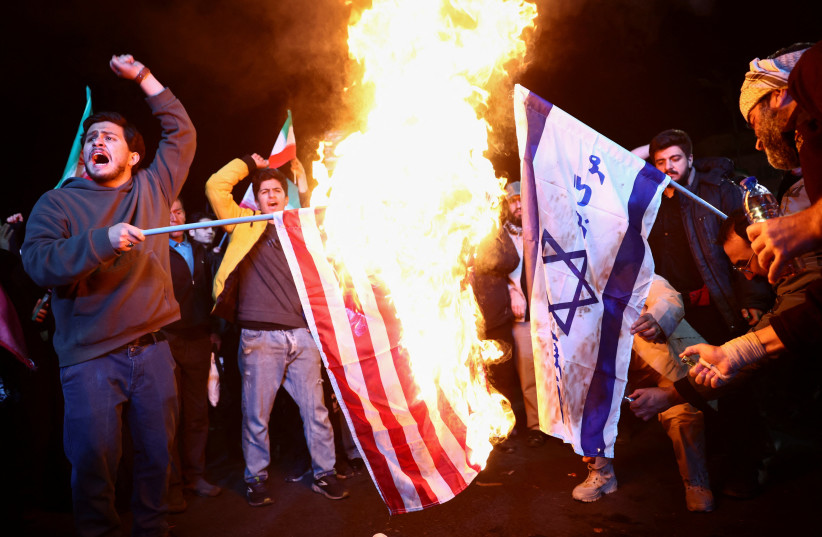
According to the newspaper, there is little disagreement within the American intelligence community that Iran is developing chemical weapons. The central dispute concerns whether Iranian leaders would actually use them, particularly if Iran is not attacked again.
Gulf officials question Israeli chemical weapons intelligence: 'No evidence'
Israel also shared some of the intelligence with officials in Gulf states. Several questioned whether Iran was developing plans to use chemical weapons and believe Israel is attempting to push the United States and its partners toward a more intensive phase of the war.
A regional official told the newspaper that Israel had presented Gulf countries with assessments suggesting Iran was working to make its chemical weapons operational, but had not shared supporting evidence.
According to the official, Gulf governments regarded the claims as lacking seriousness.
For some American officials, the warnings have revived memories of the faulty intelligence surrounding Iraq's weapons of mass destruction in 2002.
At the time, US intelligence agencies presented the White House with a firm assessment that Iraq possessed such weapons, although the country had largely abandoned or suspended its nuclear, chemical and biological weapons programs.
Even among those briefed on the new intelligence, assessments differ regarding how quickly and effectively Iran could deploy chemical weapons.
According to experts and American officials who spoke with the newspaper, mounting a chemical weapon on a ballistic missile is not particularly difficult, but ensuring the effective dispersal of the chemical agent is more complicated.
Smuggling a bomb across a border also presents difficulties. Another possibility mentioned was the use of a drone.
Despite the Israeli warnings, the newspaper reported that preparations for responding to chemical weapons attacks are not a central component of the Home Front Command exercises taking place across Israel this week.
Two Home Front Command officials said there had also been no widespread reminders distributed to officers or the public regarding protective instructions against such a threat.
The IDF declined to comment.
US prepares potential Iran strike as Washington, Tehran pursue diplomatic solution
The intelligence was shared as the United States and Iran explore the possibility of a diplomatic breakthrough while simultaneously preparing for a resumption of hostilities.
According to senior American officials, US Central Command (CENTCOM) has a plan for an attack on Iran that could be carried out as early as Wednesday, November 4, one day after the US midterm elections.
The report stated that three American aircraft carriers are currently in the region, while the preferred operational window for an attack is expected to be brief.
One of the aircraft carriers will need to return to its home port after the beginning of November, and particularly dark nights are expected in the coming days, providing favorable conditions for military operations.
However, President Donald Trump has not yet approved a large-scale attack, and diplomatic contacts between Washington and Tehran are continuing.
In recent weeks, the United States has concentrated warships, fighter jets and bombers in the region in preparation for a possible relatively short military campaign involving intensive strikes.
At the same time, diplomats are attempting to formulate an agreement that would reopen the Strait of Hormuz, address Iran's nuclear program and postpone further military action.
According to the report, the military buildup could also serve as leverage to support the diplomatic effort.
Meanwhile, US intelligence agencies assess that the threat to Americans in the Middle East and several other countries is at its highest level since the war began in February.
Intelligence collection was intensified after an Iranian plot to attack a base in Britain used by American fighter jets was uncovered.
On October 23, a warning memorandum regarding potential Iranian attacks was sent to senior administration officials. Diplomats and other personnel were subsequently placed on heightened alert.
The newspaper also linked Netanyahu's efforts to his political situation following the Israeli elections, in which he failed to secure a clear path toward forming a government.
Several commentators who spoke with the newspaper suggested that Netanyahu might attempt to use a national security emergency to pressure opposition leaders into joining a coalition under his leadership.
Iran denies chemical weapons program as US officials warn of possible escalation
American allegations regarding an Iranian chemical weapons program date back decades.
In 2003, Iran acknowledged that it had developed chemical capabilities during the Iran-Iraq War but claimed that it subsequently dismantled them.
Tehran denies possessing chemical weapons and has previously described such accusations as psychological warfare conducted by Israel and Netanyahu.
Dana Stroul, a former senior Pentagon official responsible for Middle East policy during the Biden administration, said it has been known for more than two decades that Iran has been stockpiling components for chemical weapons, but has never used them.
However, she warned that Tehran could feel "existential pressure" and potentially cross the threshold into directly using such weapons offensively.
A spokesperson for Netanyahu's office told the NYT: "Israel closely monitors every threat posed by the Iranian terrorist regime and is prepared to confront it."
The White House did not respond to the newspaper's request for comment, but an American official said Trump would defend the United States and its allies against any potential threat.
Last edited:
Islam with the genius idea of covering their women with drapes so men don't get tempted.
Instead, they go to foreign countries and rape little girls. I feel bad for SPs that see these infidels.
Islam with the genius idea of covering their women with drapes so men don't get tempted.
Instead, they go to foreign countries and rape little girls. I feel bad for SPs that see these infidels.
Every accusation is a confession.
Similar threads

