Hello Gentlemen,
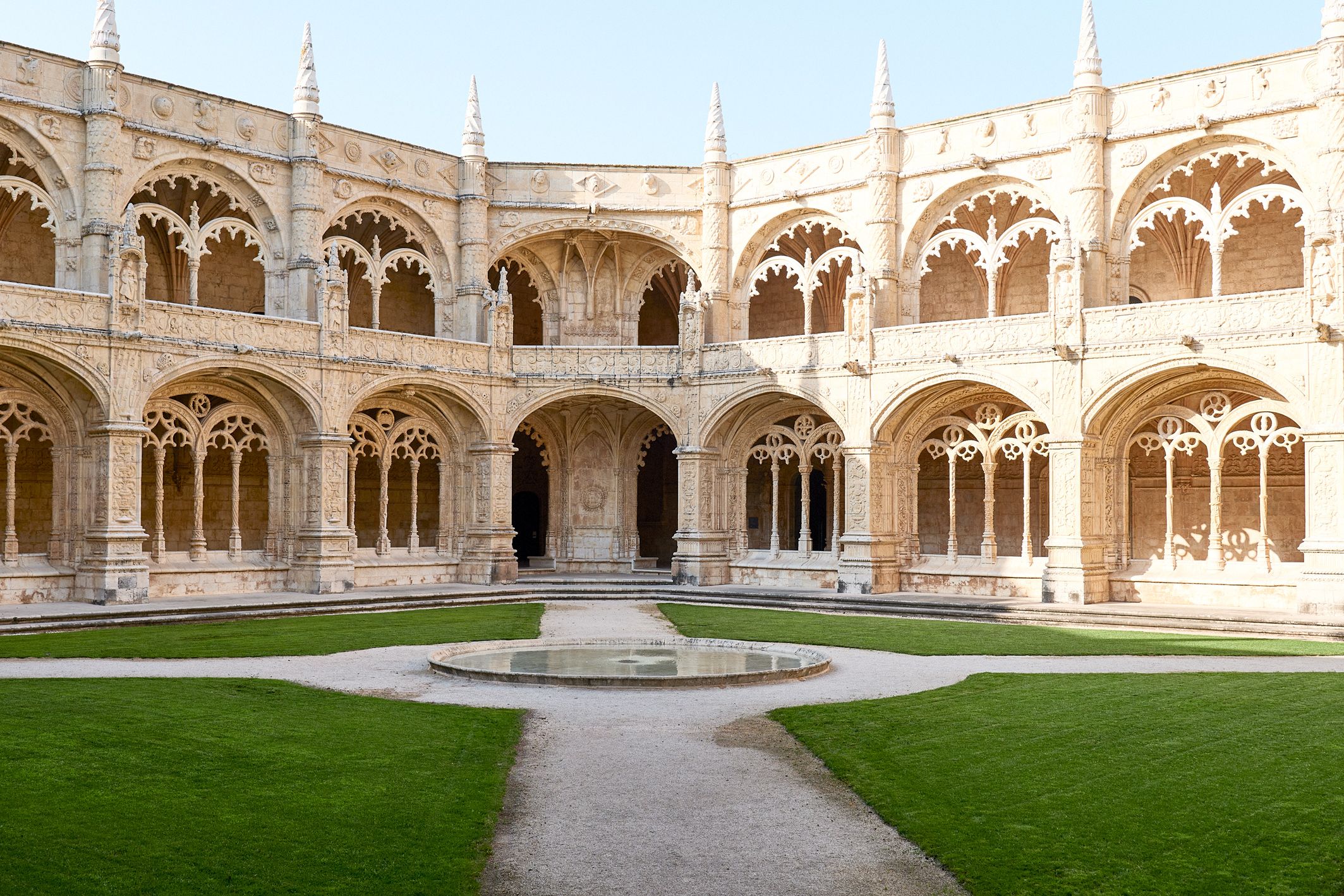
The Jerónimos Monastery is one of the most prominent examples of the late Portuguese Gothic Manueline style of architecture in Lisbon. It was erected in the early 1500s near the launch point of Vasco da Gama's first journey, and its construction funded by a tax on the profits of the yearly Portuguese India Armadas.
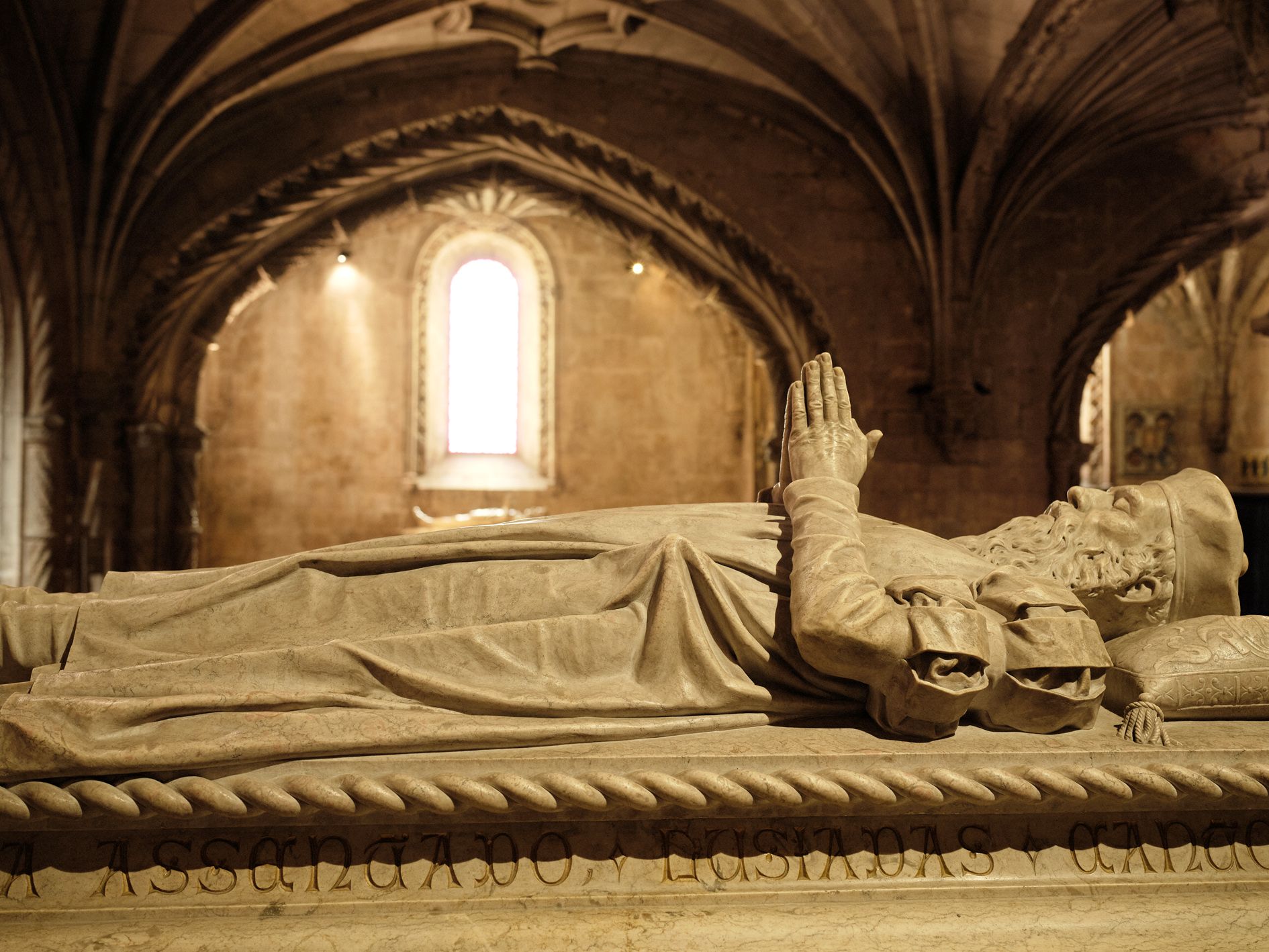
In 1880, Vasco da Gama's remains and those of the poet Luís de Camões (who celebrated da Gama's first voyage in his 1572 epic poem The Lusiad), were moved to new carved tombs in the nave of the monastery's church, only a few meters away from the tombs of the kings Manuel I and John III, whom da Gama had served. In 1983, the Jerónimos Monastery was classified as a UNESCO World Heritage Site, along with the nearby Tower of Belém.
This alabaster tomb of India Discoverer Vasco da Gama is to see in the church Santa Maria in Monastery of St. Jeronimos. Vasco da Gama discovered the maritime route to India in 1498.
The monastery was designed in a manner that later became known as Manueline: a richly ornate architectural style with complex sculptural themes incorporating maritime elements and objects discovered during naval expeditions, carved in limestone. Diogo de Boitaca, the architect, pioneered this style in the Monastery of Jesus in Setúbal. Boitaca was responsible for drawing the plans and contracting work on the monastery, the sacristy, and the refectory. For its construction he used calcário de lioz, a gold-coloured limestone quarried from Ajuda, the valley of Alcántara etc.
Boitaca was succeeded by the Spaniard Juan de Castillo, who took charge of construction around 1517. Castilho gradually moved from the Manueline to the Spanish Plateresque style, an ornamentation that included lavish decorations suggesting the decorative features of silverware.
Hello Gentlemen,
On 16 July 1604, Philip of Spain made the monastery a royal funerary monument, prohibiting anyone but the royal family and the Hieronymite monks from entering the building. A new portal was constructed in 1625, as well as the cloister door, the house of the doorkeepers, a staircase and a hall that was the entrance to the upper choir designed by the royal architect Teodósio Frias and executed by the mason Diogo Vaz. In 1640, the prior Bento de Siqueira ordered construction of the monastery's library, where books owned by the Infante Luís (son of King Manuel I) and others linked to the religious order were deposited.
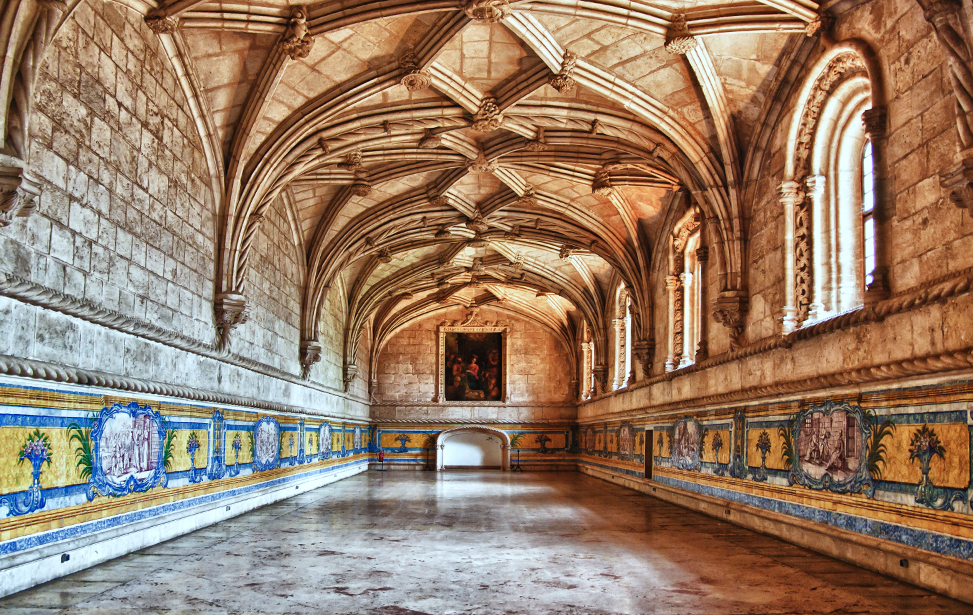
The 37-meter-long refectory at Jerónimos Monastery in Lisbon was built in 1517-1518 by master builder Leonardo Vaz. It is a masterpiece of Manueline architecture, featuring a multi-ribbed vaulted ceiling and 18th-century azulejo (painted tile) panels depicting biblical scenes.
The monastic dining hall is one of the key highlights of the complex, notable for several historical and artistic features:
Manueline Architecture: Designed by Leonardo Vaz, the 37-meter by 9-meter hall displays the quintessential thick stone ropes and intricate vaulting of the Manueline period.
Azulejo Tiles: The lower walls are lined with tiles dating from 1780 to 1785 that depict the Miracle of the Bread and the Fish (north end) and the life of Joseph in Egypt (side walls).
The Wooden Pulpit: Facing the windows, you will find a small wooden pulpit where scriptures and the lives of the saints were read aloud to the monks while they ate in silence.
Art: You can explore a historic 17th-century painting of Saint Jerome.
The Jerónimos Monastery is a stunning masterpiece of late-Gothic Manueline architecture and a UNESCO World Heritage Site that celebrates Portugal's golden Age of Discovery. Inside is just WOW, the beautifully carved cloisters... never seen anything like it. It is a must-see when you are in Lisbon.
Hello Gentlemen,
Located in the historic Belém district of Lisbon, "Pastéis de Belém" is the legendary 1837 bakery where the world-famous pastel de nata (Portuguese custard tart) originated. Tarts cost roughly €1.5 each and are served warm, featuring flaky, blistered pastry and a creamy custard, best enjoyed with a dusting of cinnamon and powdered sugar.
The original, closely guarded recipe—dating back to the monks of the nearby Jerónimos Monastery—makes this a globally renowned dessert destination. Though you will find similar tarts (often referred to as pastéis de nata elsewhere), fans and food critics generally agree on Pastéis de Belém as the ultimate, authentic pilgrimage. It holds its place as one of the top must-visit food spots in the city.
After visited Jerónimos Monastery, I treated myself the fabulous dessert first, then a delicious dinner.
Yummy!
Hello Gentlemen,
Afonso de Albuquerque Square is a public square in the Belém district of the city of Lisbon.
The square is located in front of Belém Palace, an early 18th-century palace that nowadays serves as residence for the President of Portugal. The square is named after the Second Governor of Portuguese India Afonso de Albuquerque, and offers views of Belém Palace. It has a monument, in neo-Manueline style, by artists Silva Pinto and Costa Mota tio, inaugurated in 1902. The monument carries a bronze statue of Afonso de Albuquerque and has reliefs about his life.
The site of the square used to be a harbour, built in 1753. In 1807, Queen Mary I, Prince John VI and the royal family fled Lisbon from this harbour to Rio de Janeiro, in Brazil, to escape the Napoleonic troops which had invaded Portugal.
The Albuquerque monument in front of the Belém Palace
Hello Gentlemen,
São Jorge Castle (English: Saint George's Castle), is a historic castle in Lisbon. Human occupation of the castle hill dates to at least the 8th century BC while the oldest fortifications on the site date from the 2nd century BC.
The hill on which Saint George's Castle stands has played an important part in the history of Lisbon, having served as the location of fortifications occupied successively by Phoenicians, Carthaginians, Romans, and Moors, before its conquest by the Portuguese in the 1147 Siege of Lisbon. Since the 12th century, the castle has variously served as a royal palace, a military barracks, home of the Torre do Tombo National Archive, and now as a national monument and museum.
Hello Gentlemen,
When Lisbon became the capital of the Kingdom of Portugal in 1255, the castle served as the alcáçova, a fortified residence for Afonso III, in his role as governor. It was extensively renovated around 1300 by King Denis, transforming the Moorish alcáçova into the Royal Palace of the Alcáçova.
Between 1373 and 1375, King Ferdinand I ordered the building of the Cerca Nova or Cerca Fernandina, the walled compound that enclosed all but the north flank of the castle. The master builders João Fernandes and Vasco Brás were responsible for its construction. This wall, which partially replaced the old Moorish walls, was designed to encircle previously unprotected parts of the city. Completed in two years, it had 77 towers, 34 or 38 gates, and a perimeter of 5,400 metres.
The castle walls and towers, constructed during the Moorish occupation of Lisbon
Hello Gentlemen,
Although the first fortifications on this hilltop date from the 1st century BC, archaeological excavations have identified a human presence in the Tagus valley as far back as the 8th century BC. The first fortification was, presumably, erected in 48 BC, when Lisbon was classified as a Roman municipality.
The hill was first used by Celtic tribes, then by Phoenicians, followed by Greeks and later the Carthaginians as a defensive outpost that was later expropriated successively by the Romans, the Suebi, the Visigoths, and the Moors. During the 10th century, the fortifications were built by Berber forces; these included the walls or Cerca Moura ("Moorish Encirclement").
In the context of the Christian Reconquista, the castle and the city of Lisbon were freed from Moorish rule in 1147 by Afonso Henriques and northern European knights in the Siege of Lisbon during the Second Crusade; this victory was the only notable success of that failed crusade.
According to an oft-repeated legend, the knight Martim Moniz, noticing that one of the doors to the castle was open, prevented the Moors from closing it by throwing his own body into the breach, thus allowing Christian soldiers to enter at the cost of his own life. With the taking of the castle Christian forces were able to maintain the defense of Lisbon until the end of the 12th century.
The white stone sculpture you are referring to is a female figure known as Olisipona. It is a modern homage carved from lioz (Portuguese limestone) and depicts an unclothed kneeling woman. You can find this striking piece along the pathways winding up toward the castle's historical center. The statue gets its name from Olisipo, the ancient Roman name for modern-day Lisbon. It honors the city's deep roots and mythological origins, representing the historic female personification of Lisbon while it was under the Roman Empire.
Hello gentlemen,
In the beginning of the 15th century, a royal menagerie was established in the Royal Palace of Lisbon, located nearby the Castle of Saint George. Following the conquest of Ceuta in 1415, King John I of Portugal brought back to Lisbon two Barbary lions, and they were installed in a large room inside his Palace in the Citadel of Lisbon. This area of the Palace came to be known as Casa dos Leões (the "Lions' House"); today the area is occupied by a famed restaurant with the same name.
As the royal palace, the castle was the setting for the reception by King Manuel I of the navigator Vasco da Gama when he returned from discovering the maritime route to India in 1498. The castle also served as a theater in 1502 when pioneering playwright Gil Vicente staged his Monólogo do Vaqueiro to honor the birth of Manuel I's son and heir, the future John III.
Lisbon Cathedral - The Cathedral of Saint Mary Major, is a Roman Catholic cathedral located in Lisbon, Portugal. It is the oldest church in the city, built in 1147. The cathedral has survived many earthquakes and has been modified, renovated and restored several times, resulting in a mix of different architectural styles. It is the seat of the Patriarchate of Lisbon, and has been classified as a National Monument since 1910.
The cathedral is in the shape of a Latin cross with three aisles, a transept and a main chapel surrounded by an ambulatory. The church is connected with a cloister on the eastern side. The main façade of the cathedral looks like a fortress, with two towers flanking the entrance and crenellations over the walls. This menacing appearance, also seen in other Portuguese cathedrals of the time, is a relic from the Reconquista period, when the cathedral may have been used as a base to attack the enemy during a siege.