Trump says oil price spike is ‘very small price to pay for safety and peace’ as Iran war rages

oil&gas

Well-known member
Apr 16, 2002
16,537
3,191
113
Ghawar
09 March 2026

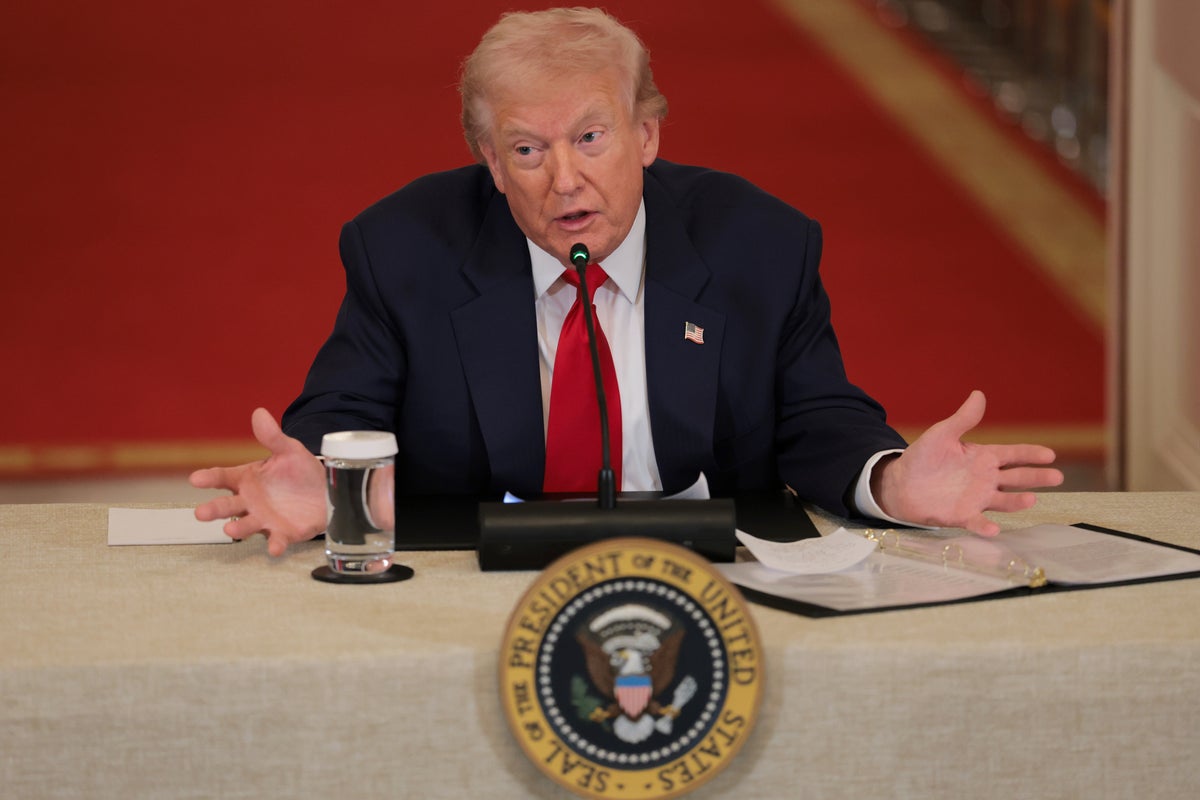
President Donald Trump has claimed higher oil prices are a “very small price to pay” for global “peace and safety” as the Iran war rages.

Oil prices have surged since the U.S. and Israel launched joint military strikes on Iran just over a week ago, recording their largest one‑week spike since March 1983.

The increase showed no signs of abating Sunday, passing the $100-a-barrel milestone for the first time in more than three-and a-half years as the Iran war hinders production and shipping in the Middle East.

“Short term oil prices, which will drop rapidly when the destruction of the Iran nuclear threat is over, is a very small price to pay for U.S.A., and World, Safety and Peace,” the president wrote on Truth Social Sunday.

U.S. Energy Secretary Chris Wright acknowledged that Americans may feel pain at the gas pump “for weeks.”

“Gasoline today is still $1.50 a gallon cheaper than it was in the middle of the Biden administration,” Wright told CNN Sunday.

But he acknowledged that it was too high for Americans struggling with the cost of living. “We want it back below $3 a gallon. And it will be again before too long,” the energy chief said.

“What do you mean by too long?” asked CNN anchor Jake Tapper. “How much longer?”

“You never know exactly the time frame of this, but, in the worst case, this is a weeks, this is not a months thing,” Wright said.

Wright, the former CEO of fracking firm Liberty Energy, also suggested that the market’s underlying anxiety is not justified.

“You’re seeing a little bit of fear premium in the marketplace, but the world is not short of oil today or natural gas,” he said.

Trump has appeared blasé about the rise in gas prices since the conflict began. He acknowledged Tuesday that pump prices would be higher “for a little while.” By Thursday, his stance had hardened, as he told Reuters: “If they rise, they rise.”

Behind the scenes, the Trump administration is “looking under every rock for ideas on improving energy prices,” an unnamed industry executive told Politico this week.

The executive added that Wright and Interior Secretary Doug Burgum had been “screamed at” to find “good news.” The White House dismissed the story as “unverified gossip.”

A Marist poll conducted earlier this month found that most Americans, 56 percent, oppose U.S. military action in Iran. At the same time, the public has major concerns about affordability, with over half of voters describing health care, a new car and a weeklong vacation as unaffordable, according to a late February Ipsos survey.

On Sunday, Brent crude — the global benchmark — traded at $101.19 a barrel, shortly after markets reopened on the Chicago Mercantile Exchange, marking a 9.2 percent rise from Friday.

U.S.-produced West Texas Intermediate stood around $107.06 per barrel, climbing more than 16 percent from Friday. The surge follows a dramatic 36 percent spike in U.S. crude prices last week.

Multiple experts and foreign officials have warned that prices could keep climbing.

On Sunday, Patrick De Haan, head of petroleum analysis for GasBuddy, estimated that there’s an 80 percent chance the national average price of gasoline will reach $4 in the next month. The U.S. average currently stands at $3.45, according to AAA.

Goldman Sachs estimated the price of oil could shoot up to as high as $150 per barrel by the end of the month. And Qatar’s energy minister warned that the Iran war could lead to a dramatic spike in oil prices and “bring down the economies of the world.”

Gas prices have long been vulnerable to geopolitical conflicts, largely due to impacts on oil supply chains, including shipping lanes and refineries. The Iran war, which has embroiled the broader Middle East region, is no exception.

Since the war began in late February, tanker traffic through the Strait of Hormuz has sharply declined. The waterway, located along southern Iran, is a critical chokepoint through which about 20 percent of global oil supplies travel, according to the Environmental Protection Agency.
 

Frankfooter

dangling member
Apr 10, 2015
109,557
33,058
113

SaturnFan

Well-known member
Feb 15, 2009
1,210
624
113
If the Orange Felon wanted to, he could direct the all powerful U.S. military fleet to keep the Strait of Hormuz open which would keep the oil tankers moving. He alone is responsible for the huge jump in oil prices.
 
  • Like
Reactions: Shaquille Oatmeal

oil&gas

Well-known member
Apr 16, 2002
16,537
3,191
113
Ghawar
Trump administration starts to panic over rapidly rising oil costs

MAR 9, 2026

The Trump administration has started to panic about the spiking price of oil.

While senior Trump aides had anticipated some brief surge in oil prices in the first days of the war with Iran, the size and sustainability of the market reaction caught them off guard, people familiar with the internal discussions told CNN.

Now, as oil prices hover near $100 a barrel just over a week into the war and US gas prices are moving sharply higher, it’s prompted a belated rush to try to reassure investors and seek ways to tamp down the impact. But the administration is confronting the limits of its power — and the reality that President Donald Trump’s decision to wage war abroad threatens to wipe out some of his key economic accomplishments at home.

“It’s hard to see anything but continued upward pressure on prices,” said Neil Atkinson, a longtime energy analyst and former head of the International Energy Agency’s oil industry and markets division. “People will get hurt at the pump.”

Officials spent the weekend and Monday urgently drawing up a wider array of options aimed at calming financial markets and limiting the impact of oil’s surge on US gas prices, the people familiar said. Those ideas have ranged from more limited regulatory actions, such as easing restrictions on the flow of domestic oil, to far more extreme steps like directly intervening in the global oil trade. Trump aides were expected to present a slate of options to the president as soon as Monday, according to the people familiar.

For now, shipping traffic through the Strait of Hormuz remains at an effective standstill, disrupting roughly 20% of the world’s oil supply with little sign of when tankers will again be able to safely traverse the critical waterway off the coast of Iran.

Few shipping firms have been willing to risk the threat of Iran firing on their tankers since the US and Israel bombed Iran more than a week ago, creating a backlog that’s driven up global oil prices at a historic pace.

Oil prices early Monday neared $120 a barrel before backing off somewhat, a level not seen since the early stages of Russia’s war against Ukraine in 2022. That run-up has swiftly rippled through to gas prices in the US, spurring a 51-cent-per-gallon jump in the national average over the last week.

The spike has prompted alarm throughout the Trump administration, where officials had originally planned to make lower gas prices a key pillar of the GOP’s efforts to hold onto their majorities in November’s midterm elections.

That level of urgency picked up markedly over the weekend, the people said, as the price of oil hit $100 a barrel and it became clear that the administration’s initial steps had largely failed to allay fears of a prolonged energy crisis.

Energy Secretary Chris Wright, Treasury Secretary Scott Bessent and Interior Secretary Doug Burgum have taken the lead in developing a slate of new options, alongside staffers on the White House’s National Energy Dominance Council.

Wright and other officials have sought to downplay the concern in public appearances over the last several days, blaming oil traders for irrationally bidding up prices and insisting that traffic through the Strait of Hormuz would soon resume as normal.

“We are not too long away, I think, before you’ll see more regular resumption of ship traffic,” Wright said Sunday on CNN. “This is a weeks, this is not a months, thing.”

Trump in recent days has also dismissed the war’s impact on gas prices, writing Sunday on Truth Social that it’s a “very small price to pay” and that “ONLY FOOLS WOULD THINK DIFFERENTLY!”

In a statement, White House spokeswoman Taylor Rogers called the surge “a short-term change in oil prices, which will drop dramatically once the objectives of Operation Epic Fury are achieved.”

President Trump and his entire energy team have had a strong game plan to keep the energy markets stable well before Operation Epic Fury began, and they will continue to review all credible options,” she said.

But behind the scenes, officials have frantically sought ways to ease a crisis they worry will damage Trump with voters already anxious over the cost of living and has the acute potential to ripple across the wider US economy. They’ve also pressed oil industry representatives for ways to accelerate production, though there’s little inclination among companies to produce significantly more oil without any clear sense of how long the high prices will last.

Aides have explored a range of potential administrative levers, including easing Jones Act restrictions to boost the flow of domestic oil around the country and loosening other regulations that might slow the rise in gas prices.

They have also weighed more aggressive steps, including new restrictions on US exports, the possibility of imposing price controls and even having Treasury intervene directly in oil futures markets to put downward pressure on prices, the people familiar said.

And Trump officials have now broached the potential for deploying the US’ strategic petroleum reserve, after days of firmly ruling it out as an option. But there is still deep aversion to using the SPR, which the Biden administration leaned on to ease oil prices in 2022 — to only marginal success.

Trump has repeatedly criticized former President Joe Biden’s use of the reserve, accusing him of depleting it for political purposes.

On Monday, the Group of Seven nations discussed a coordinated release of their countries’ reserves in a bid to address the supply crunch. But the US was among those skeptical of that step, one of the people familiar said, and the group opted against any immediate action.

The White House deferred a request for comment to a joint G7 statement that the nations “stand ready” to release their stockpiles if necessary.

The remaining options under discussion within the administration could have some marginal benefit for the oil markets and US gas prices, energy experts said. Yet they’re unlikely to shift the trajectory and would do little to make up the loss of as many as 20 million barrels of oil a day that typically transits the Strait of Hormuz.

Already, one initiative that Trump officials were optimistic might shift the dynamics — offering up to $20 billion in insurance for tankers willing to cross the waterway — has fallen flat.

“Even if you’re insured against the risk of your ship being sunk, you don’t want your ship to be sunk,” said Tobin Marcus, the head of US policy and politics at financial research firm Wolfe Research. “They’re not bad ideas, but they’re not enabling people to ignore the fact that the Strait has had nothing go through it for six days.”

Trump officials in recent days have also floated the potential for military escorts through the Strait. But it remains unclear how quickly the US will be able to organize those escorts. And in the meantime, it’s only further reinforced that the only certain way to stabilize the oil markets is to bring an end to the war — and do it fast enough to avert lasting economic consequences.

Still, it remains unclear how quickly the US will be able to organize those escorts. And Trump himself said in an interview with CBS News on Monday that his administration is “thinking” of taking over the Strait.

In the meantime, the idea has further reinforced that the only certain way to stabilize the oil markets is to bring an end to the war — and do it fast enough to avert lasting economic consequences.

“The other options that the administration has, other than ending the war, are actually pretty limited,” Atkinson said. “The oil market is massively short of supply.”


Insidious Von

My head is my home
Sep 12, 2007
43,842
10,126
113
If the Orange Felon wanted to, he could direct the all powerful U.S. military fleet to keep the Strait of Hormuz open which would keep the oil tankers moving. He alone is responsible for the huge jump in oil prices.
Silly Alexander the Great II, Trix are for kids.

He can send the entire American Fleet if he wants, if the Omanis don't co-operate he's SOL. Without them the Strait of Hormuz will permanently close due to shipwrecks.
 

oil&gas

Well-known member
Apr 16, 2002
16,537
3,191
113
Ghawar
Why Trump can't afford to brush off the Iran war's economic impact

Cost of living is a key issue for U.S. voters, and the war's effect on gas prices won't help

Mar 10, 2026

U.S. President Donald Trump is trying to downplay the effect of the Iran war on the domestic economy even as American drivers are already feeling the impact on their wallets every time they fill up their cars and trucks.

During a news conference in Florida Monday evening, Trump implicitly acknowledged the spiking prices of crude oil on world markets and the rising cost of gas at pumps in the U.S. by dismissing them as a short-term spin-off of the U.S.-Israeli military campaign against the Iranian regime.

"In the long run, oil supplies will be dramatically more secure without the threat of Iranian ships, drones, missiles, nuclear menace or anything," Trump said.

"We're putting an end to all of this threat once and for all, and the result will be lower oil prices, oil and gas prices for American families."

Trump's promise that the war will ultimately bring lower energy prices is a sign of how important the cost of living is in U.S. politics right now, and suggests that the president is aware of the potential impact a long-term increase in such costs could have on public opinion.

Dan Cassino, a polling expert and a professor of government and politics at Fairleigh Dickinson University in New Jersey, says for U.S. voters who drive, a jump in the price of gas at the pumps is visible evidence of the rising cost of living.

"Gas prices are important because they are so visceral. They are immediately experienced by almost all Americans," Cassino told CBC News.

The national average price of a gallon of gas at the pumps hit $3.48 US on Monday, up 48 cents from the previous Monday, according to automotive and travel firm AAA.

That's an even sharper spike than the biggest weekly increase triggered by Russia's war against Ukraine, when the average price jumped 45 cents US a gallon in March 2022.

War could impact more than price of gas

Cassino says the political damage for Trump and his Republican Party will depend on how long prices stay high and how much the broader U.S. economy is affected as the year progresses.

Midterm elections happen in November and if the Republicans lose control of Congress, Trump will be handcuffed in pursuing his agenda for the final two years of his term.

"Democrats are salivating at the thought of being able to say that 'President Trump increased your gas prices to fight this war in Iran,' " Cassino said.

If the war does not end quickly, the economic impact is likely to be felt well beyond the gas pumps. Rising transportation costs could affect the price of everything from family vacations to putting food on the table.

The countries surrounding the Persian Gulf also provide much of the global supply of certain fertilizers, so any lengthy disruption in shipments as a result of the war could disrupt farming and push up food prices worldwide, the New York Times reported.

Political risk for Trump

A surge in gasoline prices in a midterm year poses a risk for the president, says Kevin Book, a managing director for ClearView Energy Partners, a research and analysis firm based in Washington.

"If you go to the pump and you see a massive increase in prices you might not forget it in November even if prices retreat," Book told Bloomberg. "The memory can last longer than the price spike, that's the political risk."

Brittany Martinez, executive director of Principles First, a U.S. conservative political organization, says the longer the war drags on, the more it risks triggering the kind of economic fallout that could hurt the Republicans this election year.

"The real question is whether this turns into a prolonged conflict that voters feel in their household budgets," Martinez told CNBC this weekend.

"If energy prices rise or markets stay volatile, affordability becomes a harder message for Republicans to carry cleanly," she said.

It's anything but clear that the U.S. economy has the resilience to withstand a sustained increase in energy prices.

Employment numbers have been feeble for a year, with the U.S. economy creating far fewer jobs in 2025 under the Trump administration than it did in 2024 during the final year of Joe Biden's presidency. Inflation remains as high as it was when Trump took office.

Trump's top political advisers have been urging him for months to emphasize economic progress — particularly on reining in the cost of living — in his messaging to U.S. voters.

Over the weekend, key figures in the administration have been trying to reassure Americans that the price shock from the Iran war is unlikely to last for any significant length of time.

Energy Secretary Chris Wright said the worst case scenario for the spike in gas prices is a spike lasting weeks rather than months.

"We want it back below $3 [US] a gallon and it will be again before too long," Wright told CNN on Sunday.

Trump won't let

Yet Trump himself is risking undermining that message by downplaying the impact of the war on people's wallets.

"I knew oil prices would go up if I did this, and they've gone up probably less than I thought they'd go up," Trump said during Monday's news conference.

Trump, who repeatedly boasted about low gasoline prices over the past year including in his state of the union address two weeks ago, has said he's not concerned about the spike.

"They'll drop very rapidly when this is over, and if they rise, they rise, but this is far more important than having gasoline prices go up a little bit," he told Reuters last week.


Karl Schamotta, chief market strategist at Corpay, a global financial services firm, says while it's conceivable that the war could push the price of oil to record highs, he doesn't believe Trump will let things go that far before declaring victory.

"I think that we are going to see a TACO moment here at some point — a 'Trump Always Chickens Out' moment in which we have Mr. Trump saying that he's accomplished his mission and is taking all of his toys and going home," Schamotta told CBC News Network on Monday.


oil&gas

Well-known member
Apr 16, 2002
16,537
3,191
113
Ghawar
Trump Threatens Military Response 'At a Level Never Seen Before' If Iran Deploys Mines in Strait of Hormuz

MAR 10, 2026

President Donald Trump threatened Iran with “military consequences” at “a level never seen before” if the country failed to immediately remove any mines it might have deployed in the Strait of Hormuz.

In a post on Truth Social Tuesday afternoon, Trump said that his Administration had “no reports” of Iran having placed mines in the strait––a narrow passage between the Persian Gulf and the Gulf of Oman through which around a fifth of global oil production flows––but demanded that if it had, “we want them removed, IMMEDIATELY!”


“If for any reason mines were placed, and they are not removed forthwith, the Military consequences to Iran will be at a level never seen before,” the President continued. “If, on the other hand, they remove what may have been placed, it will be a giant step in the right direction!”

Trump added that any vessels attempting to place mines in the strait would “be dealt with quickly and violently.” Shortly after his warning, the President announced in another post that “within the last few hours, we have hit, and completely destroyed, 10 inactive mine laying boats and/or ships, with more to follow!”

Trump’s warning to Iran followed reports from CNN and CBS on Tuesday that Iran had begun laying mines in the Strait of Hormuz. CNN reported, citing people familiar with U.S. intelligence reporting, that a few dozen mines have been laid in recent days and that Iranian forces were potentially capable of laying hundreds.

Trump earlier vowed on Monday night that the U.S. would hit Iran “twenty times harder” than it already has if the country did anything to block the flow of oil through the Strait of Hormuz.

“We will take out easily destroyable targets that will make it virtually impossible for Iran to ever be built back as a nation again,” he threatened. “Death, fire, and fury will reign upon them. But I hope, and pray, that it does not happen.”

Trump went on to emphasize the international importance of the Strait, which is often used as a geopolitical bargaining chip.

“This is a gift from the United States of America to China, and all of those nations that heavily use the Hormuz,” he continued. “Hopefully, it is a gesture that will be greatly appreciated.”

Defense Secretary Pete Hegseth and White House Press Secretary Karoline Leavitt appeared to double down on the President’s threat on Tuesday.

“He [Trump] takes very seriously the condition of that Strait. We have capabilities that no nation on earth has, and we're certainly working with our energy partners across the Administration,” Hegseth said during a press briefing at the Pentagon early in the day.

At an afternoon press conference, Leavitt later vowed that “President Trump will not allow rogue Iranian terrorists to stop the freedom of navigation and the free flow of energy.”

Iranian security official Ali Larijani hit back against Trump's warning via social media Tuesday morning, saying Iran doesn't fear "empty threats." According to a translation by the Associated Press, Larijani signed off his post with the message: "Be careful not to get eliminated yourself."

The war, which is now in its 11th day, has brought movement in the Strait to a standstill as Iran has targeted oil tankers. Shipping costs have soared as a result, with companies forced to find longer, alternative routes. Some insurance providers for oil companies and tankers also dropped war risk protections amid rising uncertainty and fear.

With global trade severely disrupted, the prices of oil and liquefied natural gas soared. Early Monday, crude oil prices topped $100 a barrel for the first time since Russia’s 2022 invasion of Ukraine.

Trump previously dismissed concerns over the rising costs, insisting it's a “small price to pay” for “safety and peace.”

But the price of crude oil saw a significant turnaround as global markets opened Tuesday, falling as much as $25 per barrel since Monday’s highs.

The plummet came after Trump—just hours before threatening “death, fire, and fury” on Iran—indicated that the war would soon be reaching its end.

In a phone interview with CBS, Trump said he thought the war in Iran was "very complete" and claimed Washington was "very far ahead" of its initial four-to five-week estimated timeframe.

Insisting that Iran’s military capabilities had been mostly destroyed following repeated strikes from the U.S. and Israel, he added: “If you look, they have nothing left. There's nothing left in a military sense.”

However, he somewhat reversed course later in the day when addressing Republican lawmakers at a House policy retreat in Florida, prompting confusion over the actual status of the Iran war.

“We’ve already won in many ways, but we haven’t won enough,” said Trump. “We go forward more determined than ever to achieve ultimate victory that will end this long-running danger once and for all.”

Trump, last week, called for an “unconditional surrender” from Iran, but the country has firmly rejected such a proposal, and has since announced Mojtaba Khamenei, the second son of Ali Khamenei who was killed in U.S.-Israeli strikes, as the new Supreme Leader.

The selection is a strong indication that the hardline Iranian regime intends to stay the course.

Iranian Foreign Minister Abbas Araghchi presented a defiant stance on Monday, calling the U.S. strikes a “failure” and vowing to fight for "as long as it takes."

“Yes, they have attacked many of our facilities. They have attacked our nuclear facilities, but they couldn't destroy our nuclear program because it is technology advanced and developed by ourselves,” he claimed in an interview with PBS. “So the firings continue. And we are prepared. We are well prepared to continue attacking them with our missiles as long as needed and as long as it takes.”


Ceiling Cat

Well-known member
Feb 25, 2009
29,726
2,280
113
I think the orange cancer and his cronies are making money from the war.
 

Shaquille Oatmeal

Well-known member
Jun 2, 2023
10,141
11,106
113
This is the new bullshit they are pushing. "Short term pain, for long term gain".
Looks like this Trump term is full of short term pains for a very long time for the average American. lmfao.
 

southpaw

Well-known member
May 21, 2002
2,009
1,875
113
Next thing will be a draft. Trump will say there will be casualties but it's a sacrifice he's willing to make.
Lots of country boys and urban youths available for the draft. Cannon fodder for Israel's neverending wars.
 
Ashley Madison
Toronto Escorts