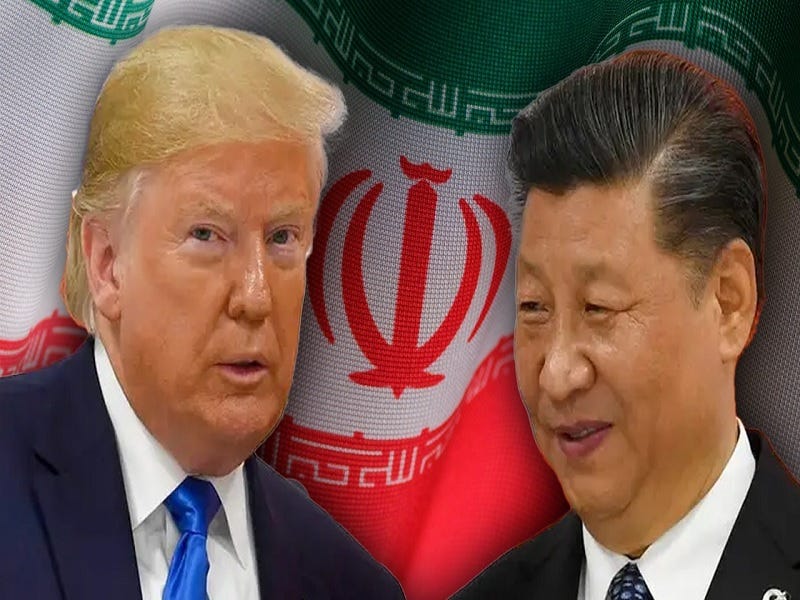
The US Military Campaign Against Iran Is Part Of Trump’s Grand Strategy Against China

oil&gas

Well-known member
Apr 16, 2002
16,547
3,198
113
Ghawar
Andrew Korybko
Mar 01, 2026

Trump claimed that the US’ military campaign against Iran is to “defend the American people”, while many critics have alleged (whether in jest or not) that it’s to distract from the Epstein Files, but few observers realize that it’s actually all about China. It was explained here that Trump 2.0 “decided to gradually deprive China of access to markets and resources, ideally through a series of trade deals, in order to imbue the US with the indirect leverage required to peacefully derail China’s superpower rise.”

To elaborate, “The US’ trade deals with the EU and India could ultimately result in them curtailing China’s access to their markets under pain of punitive tariffs if they refuse. In parallel, the US’ special operation in Venezuela, pressure on Iran, and simultaneous attempts to subordinate Nigeria and other leading energy producers could curtail China’s access to the resources required for fueling its superpower rise.” The resource dimension that’s relevant to Iran is a major part of the US’ “Strategy of Denial”.

That’s the brainchild of Under Secretary of War for Policy Elbridge Colby, and it was expanded on in this analysis here from early January. As was written, “US influence over Venezuela’s and possibly soon Iran’s and Nigeria’s energy exports and trade ties with China could be weaponized via threats of curtailment or cut-offs in parallel with pressure upon its Gulf allies to do the same in pursuit of this goal”, which is to coerce China into indefinite junior partnership status vis-à-vis the US through a lopsided trade deal.

Most observers missed it, but the new National Security Strategy calls for ultimately “rebalance[ing] China’s economy toward household consumption”. This is a euphemism for radically re-engineering the global economy through the previously described means, namely curtailing China’s access to the markets and resources responsible for its superpower rise, so that it no longer remains “the world’s factory” and thus ends its era of being the US’ only systemic rival. US-led unipolarity would then be restored.

Circling back to Iran, “[it] represented about 13.4% of the total 10.27 MMbpd of oil [that China] imported by sea” last year per Kpler, hence why the US wants to control, curtail, or outright cut off this flow. ‘Plan A’ was to achieve this through diplomatic means for replicating the Venezuelan model that entered into effect after Maduro’s capture. Iran flirted with this but didn’t commit since it would entail the country’s strategic surrender, ergo why Trump authorized military action for achieving this instead.

In pursuit of this, Trump promised the IRGC in his video announcing his country’s military campaign against Iran that they’d have immunity if they laid down their arms. This reinforces the abovementioned claim that the US wants to replicate the Venezuelan model since it strongly suggests that he envisages newly US-aligned IRGC running Iran in the political interim before new elections just like the newly US-aligned Venezuelan security services run their own country during their own current political interim.

Such a scenario would avert Iran’s possible “Balkanization”, thus preserving the state so that it can then resume its prior role as one of the US’ top regional allies, which might then aid the Azeri-Turkish Axis’ efforts to project Western influence along Russia’s entire southern periphery. In that event, the US would simultaneously obtain unparalleled resource leverage over China via proxy control of Iran’s oil and gas industries while tightening its encirclement of Russia, which would deal a powerful blow to multipolarity.
 

Insidious Von

My head is my home
Sep 12, 2007
43,876
10,144
113
Alexander The Great II must fulfill his density. Young Americans must accept death for the good of Israel.

When Putin invaded Ukraine, he said the war would be over in a matter of days. Alexander The Great II is echoing his words. Trump's problem is he doesn't have the stomach for a full scale invasion. His only other option is the Trueman one. When President Trueman nuked Hiroshima and Nagasaki, no other nation had nuclear weapons. If Alexander The Great II uses the nuclear option on Iran, WW III will ignite in a matter of minutes. What Carl Sagan predicted back in 1980 could become reality.


If only he were alive today.


silentkisser

Master of Disaster
Jun 10, 2008
5,350
7,268
113
This is an interesting theory, but I get a solid impression that Trump's foreign policy is much more chaotic than strategic. I mean, he seems to veer from one thought to another, and gets easily distracted by things. This unpredictability messes with everyone, friend and foe alike.

Let's think about this on a few levels: Venezuela and Iran supplied China with a lot of oil. They've both been attacked by Trump. The idea is that this stop China from getting access to these resources, and maybe influence other countries into not doing business with China. However, due to Trump's idiotic and unpredictable foreign policy strategy (or lack thereof), he's pissed off his trading partners and allies. Look at us, Canada. Our government cannot trust the US anymore, so they are looking to China, India and the EU to open up new markets. Other countries are doing the same thing, looking for ways to bypass the US market. That will help boost Chinese GDP and economic clout.

Now, on to the other issues: denying China of resources. For those who study history, you might recall that the US did something similar in the 1930s with Japan. The blocked oil, steel, rubber and other materials that Japan needed (well, mostly to fuel its war machine that was invading, ironically, China). What did this eventually push them to do? Attack Pearl Harbour and force the US into WWII. Now, I'm not saying this will do the same thing to China, but we need to realize that they will not take this lying down. There could be trade wars, and China has shown that it the power to mess up the US economy...just ask all those farmers who need a bailout.

The scary thing here is, I doubt that Trump or his advisors have really thought about the consequences of what this plan could lead to. I mean, there is a VERY strong chance that this inflames the middle east and causes a power vacuum in Iran and other places. Basically, instability for a few years. But, Trump will either be dead or out of office when a lot of the worst consequences happen...
 
  • Like
Reactions: mandrill

oil&gas

Well-known member
Apr 16, 2002
16,547
3,198
113
Ghawar
Beijing’s Red Line: Can China Defend Iran Without Going to War With America?

China is working to compensate for Iran's military losses, having been working for some time to rebuild Iran's missile capabilities to replace those lost during previous conflicts.

Dr.Nadia Helmy
February 28, 2026

In light of the large-scale attack launched by the United States and Israel against Iran on February 28, 2026, China adopted a stance focused on diplomatic condemnation and indirect technical and military support for Iran, while also taking precautionary measures for its citizens. As tensions escalated on February 28, 2026, China pursued a defensive strategy toward Iran, relying on indirect technological and military support rather than direct military intervention. Given the current US and Israeli attacks, Beijing’s efforts are concentrated on the following tracks: strengthening military deterrence and expediting arms deals, specifically China’s arming of Iran with anti-ship missiles to counter US and Israeli attacks. Iran is nearing completion of a deal to purchase Chinese CM-302 cruise missiles. These are supersonic missiles designed to penetrate ship defenses and threaten naval forces in the region. In addition to China’s accelerated efforts to supply Iran with air defense systems, negotiations between China and Iran have intensified to provide Tehran with man-portable air defense systems, which the military knows as MANPADS, and anti-ballistic missile and anti-satellite weapons to enhance its ability to repel air raids. China is working to compensate for Iran’s military losses, having been working for some time to rebuild Iran’s missile capabilities to replace those lost during previous conflicts. This includes providing ballistic missile components and dual-use civilian-military materials.

China is also working to supply Iran with cyber defense and technological systems. By supporting Tehran with alternative cyber and technological systems, China began implementing a strategy in January 2026 to replace Western software in Iran with secure, closed Chinese systems that are difficult to penetrate. This aims to reduce the risk of cyber sabotage by Mossad and the CIA. China is keen to enhance Iran’s digital sovereignty, a goal reflected in its “Fifteenth Five-Year Plan” (2026-2030) provisions to enhance cybersecurity and artificial intelligence in Iran as essential tools for protecting Iranian cyberspace.

Here, China was keen to provide all means of technical and military support (before and during the escalation) against Iran, through supplying Chinese drones to Iran. Intelligence reports on February 27, 2026, indicated that China sent “loitering munitions” (kamikaze drones) and air defense systems to Iran shortly before the attack began. Along with China supplying Iran with missile programs, negotiations continued between Beijing and Tehran to supply Iran with CM-302 supersonic anti-ship missiles, a technology that is difficult to intercept and is considered a game-changer in the region. Along with providing cybersecurity to Iran, China began in January 2026 a strategy to support Iranian digital sovereignty by replacing Western software with closed Chinese systems to protect against Israeli and American cyberattacks. With China rebuilding Iran’s missile capabilities, China contributed to compensating for Iran’s weapons losses following the 2025 attacks, including the provision of advanced ballistic missiles.

While China began diplomatic and political action to support its ally Iran in international forums, it condemned and rejected the use of force to forcibly change the political system in Iran. China also strongly condemned the use of military force and strikes targeting Iranian facilities, considering them a violation of the UN Charter. China was quick to condemn Israeli and American military operations against Iran, deeming them a violation of Iran’s sovereignty, territorial integrity, and the principles of the UN Charter. The Chinese Foreign Ministry affirmed its support for Iran in preserving its security, national dignity, and legitimate rights, opposing what it described as “unilateralism” by Washington. Beijing called on all parties to exercise restraint to avoid further regional escalation that could lead to dire consequences in the region and jeopardize its significant investments in Belt and Road Initiative projects in the region.


In this context, China exercised its right. China has repeatedly vetoed resolutions supporting Iran at the UN Security Council. Beijing uses its influence in the Security Council to obstruct resolutions imposing additional sanctions or authorizing military action against Iran, while consistently calling for dialogue and restraint. Following the planned military strikes against Iran on February 28, 2016, China took measures to protect its citizens within Iran. Alongside its strategic support for Iran, China urged its citizens in Iran to leave immediately and advised against travel to the country on February 17 and 28, 2016, due to the deteriorating security situation and the commencement of large-scale military operations
against Tehran. Hours before the major attack on Iran, China called on its citizens in Iran to leave the country “as soon as possible,” due to the escalating security risks. Furthermore, Israel raised its alert level to maximum. The Chinese Embassy in Tel Aviv advised its citizens there to strengthen their personal security measures and remain prepared for emergencies, given the anticipated military strikes against Iranian territory by Washington and Tel Aviv.


Given the recent military developments in February 2026, a joint US-Israeli attack on Iran would have significant economic and political repercussions for China, due to its deep strategic partnership with Tehran. China’s most prominent potential losses include a threat to energy security and oil supplies, as imports would be affected, especially since China relies heavily on Iranian oil. Any large-scale attack that threatens oil facilities or disrupts shipping in the Gulf would lead to a severe shortage of supplies and a dramatic price surge. China also fears the potential for trade disruptions, as such attacks against Iran might force Beijing to alter its oil smuggling or import strategies used to circumvent previous US sanctions on Iran, thus increasing energy costs.


Furthermore, China fears the disruption of its investments and strategic projects in Iran and the region, particularly in light of the 25-year comprehensive strategic partnership agreement with Iran. China has
invested billions of dollars in Iranian infrastructure, communications, and ports under this strategic cooperation agreement. Therefore, the destruction of this Iranian infrastructure represents a direct and significant capital loss for Beijing. China also fears the impact on its Belt and Road Initiative projects, as Iran is a vital link for the Chinese initiative in the Middle East, and instability there hinders China’s expansionist ambitions in the region.


Furthermore, these attacks against Iran will cause direct economic pressure on Tehran, including the collapse of the Iranian market. Given that China is Iran’s largest trading partner, a full-scale war would mean the loss of a huge consumer market for Chinese exports, in addition to the freezing of Iranian debts owed to Chinese companies. There is also the possibility of China being drawn into the conflict: Here, China finds itself facing difficult choices: either to let its ally fall (a strategic loss) or to support Iran and face harsh secondary US sanctions on its companies and its international financial system. For all these reasons, China strongly condemned these US-Israeli military attacks on Iran, warning that “any military adventure will push the region into the abyss of the unknown,” and called for an immediate return to dialogue to protect its direct interests.

Therefore, Beijing views the US-Israeli attack on Iran as a “crucial test” of its influence in the region. Its failure to prevent the attack through diplomatic channels could weaken its image as a superpower capable of protecting its allies. China also considered the military strikes on Iran a dangerous legal precedent. The Chinese Foreign Ministry described the attacks on Iranian nuclear facilities as a “bad precedent” that violates international law, potentially opening the door to similar interventions in other areas of Chinese influence.


40micmic

Well-known member
Nov 12, 2014
1,125
750
113
This is an interesting theory, but I get a solid impression that Trump's foreign policy is much more chaotic than strategic. I mean, he seems to veer from one thought to another, and gets easily distracted by things. This unpredictability messes with everyone, friend and foe alike.

Let's think about this on a few levels: Venezuela and Iran supplied China with a lot of oil. They've both been attacked by Trump. The idea is that this stop China from getting access to these resources, and maybe influence other countries into not doing business with China. However, due to Trump's idiotic and unpredictable foreign policy strategy (or lack thereof), he's pissed off his trading partners and allies. Look at us, Canada. Our government cannot trust the US anymore, so they are looking to China, India and the EU to open up new markets. Other countries are doing the same thing, looking for ways to bypass the US market. That will help boost Chinese GDP and economic clout.

Now, on to the other issues: denying China of resources. For those who study history, you might recall that the US did something similar in the 1930s with Japan. The blocked oil, steel, rubber and other materials that Japan needed (well, mostly to fuel its war machine that was invading, ironically, China). What did this eventually push them to do? Attack Pearl Harbour and force the US into WWII. Now, I'm not saying this will do the same thing to China, but we need to realize that they will not take this lying down. There could be trade wars, and China has shown that it the power to mess up the US economy...just ask all those farmers who need a bailout.

The scary thing here is, I doubt that Trump or his advisors have really thought about the consequences of what this plan could lead to. I mean, there is a VERY strong chance that this inflames the middle east and causes a power vacuum in Iran and other places. Basically, instability for a few years. But, Trump will either be dead or out of office when a lot of the worst consequences happen...

Xi has got his own troubles with a crippled military, his military exports have been shown to be highly ineffective and not to mention his economy is on the brink. It is a paper tiger which is unfortunate as it should've been the dominant power in the world. The leadership continues its predatory alliances and I think the world will eventually wake up to this. Reformers are no doubt putting a lot of pressure on him.

1772602132288.png 1772602144810.png
 
  • Like
Reactions: mandrill

40micmic

Well-known member
Nov 12, 2014
1,125
750
113
Beijing’s Red Line: Can China Defend Iran Without Going to War With America?

China is working to compensate for Iran's military losses, having been working for some time to rebuild Iran's missile capabilities to replace those lost during previous conflicts.

Dr.Nadia Helmy
February 28, 2026

In light of the large-scale attack launched by the United States and Israel against Iran on February 28, 2026, China adopted a stance focused on diplomatic condemnation and indirect technical and military support for Iran, while also taking precautionary measures for its citizens. As tensions escalated on February 28, 2026, China pursued a defensive strategy toward Iran, relying on indirect technological and military support rather than direct military intervention. Given the current US and Israeli attacks, Beijing’s efforts are concentrated on the following tracks: strengthening military deterrence and expediting arms deals, specifically China’s arming of Iran with anti-ship missiles to counter US and Israeli attacks. Iran is nearing completion of a deal to purchase Chinese CM-302 cruise missiles. These are supersonic missiles designed to penetrate ship defenses and threaten naval forces in the region. In addition to China’s accelerated efforts to supply Iran with air defense systems, negotiations between China and Iran have intensified to provide Tehran with man-portable air defense systems, which the military knows as MANPADS, and anti-ballistic missile and anti-satellite weapons to enhance its ability to repel air raids. China is working to compensate for Iran’s military losses, having been working for some time to rebuild Iran’s missile capabilities to replace those lost during previous conflicts. This includes providing ballistic missile components and dual-use civilian-military materials.

China is also working to supply Iran with cyber defense and technological systems. By supporting Tehran with alternative cyber and technological systems, China began implementing a strategy in January 2026 to replace Western software in Iran with secure, closed Chinese systems that are difficult to penetrate. This aims to reduce the risk of cyber sabotage by Mossad and the CIA. China is keen to enhance Iran’s digital sovereignty, a goal reflected in its “Fifteenth Five-Year Plan” (2026-2030) provisions to enhance cybersecurity and artificial intelligence in Iran as essential tools for protecting Iranian cyberspace.

Here, China was keen to provide all means of technical and military support (before and during the escalation) against Iran, through supplying Chinese drones to Iran. Intelligence reports on February 27, 2026, indicated that China sent “loitering munitions” (kamikaze drones) and air defense systems to Iran shortly before the attack began. Along with China supplying Iran with missile programs, negotiations continued between Beijing and Tehran to supply Iran with CM-302 supersonic anti-ship missiles, a technology that is difficult to intercept and is considered a game-changer in the region. Along with providing cybersecurity to Iran, China began in January 2026 a strategy to support Iranian digital sovereignty by replacing Western software with closed Chinese systems to protect against Israeli and American cyberattacks. With China rebuilding Iran’s missile capabilities, China contributed to compensating for Iran’s weapons losses following the 2025 attacks, including the provision of advanced ballistic missiles.

While China began diplomatic and political action to support its ally Iran in international forums, it condemned and rejected the use of force to forcibly change the political system in Iran. China also strongly condemned the use of military force and strikes targeting Iranian facilities, considering them a violation of the UN Charter. China was quick to condemn Israeli and American military operations against Iran, deeming them a violation of Iran’s sovereignty, territorial integrity, and the principles of the UN Charter. The Chinese Foreign Ministry affirmed its support for Iran in preserving its security, national dignity, and legitimate rights, opposing what it described as “unilateralism” by Washington. Beijing called on all parties to exercise restraint to avoid further regional escalation that could lead to dire consequences in the region and jeopardize its significant investments in Belt and Road Initiative projects in the region.


In this context, China exercised its right. China has repeatedly vetoed resolutions supporting Iran at the UN Security Council. Beijing uses its influence in the Security Council to obstruct resolutions imposing additional sanctions or authorizing military action against Iran, while consistently calling for dialogue and restraint. Following the planned military strikes against Iran on February 28, 2016, China took measures to protect its citizens within Iran. Alongside its strategic support for Iran, China urged its citizens in Iran to leave immediately and advised against travel to the country on February 17 and 28, 2016, due to the deteriorating security situation and the commencement of large-scale military operations
against Tehran. Hours before the major attack on Iran, China called on its citizens in Iran to leave the country “as soon as possible,” due to the escalating security risks. Furthermore, Israel raised its alert level to maximum. The Chinese Embassy in Tel Aviv advised its citizens there to strengthen their personal security measures and remain prepared for emergencies, given the anticipated military strikes against Iranian territory by Washington and Tel Aviv.


Given the recent military developments in February 2026, a joint US-Israeli attack on Iran would have significant economic and political repercussions for China, due to its deep strategic partnership with Tehran. China’s most prominent potential losses include a threat to energy security and oil supplies, as imports would be affected, especially since China relies heavily on Iranian oil. Any large-scale attack that threatens oil facilities or disrupts shipping in the Gulf would lead to a severe shortage of supplies and a dramatic price surge. China also fears the potential for trade disruptions, as such attacks against Iran might force Beijing to alter its oil smuggling or import strategies used to circumvent previous US sanctions on Iran, thus increasing energy costs.


Furthermore, China fears the disruption of its investments and strategic projects in Iran and the region, particularly in light of the 25-year comprehensive strategic partnership agreement with Iran. China has
invested billions of dollars in Iranian infrastructure, communications, and ports under this strategic cooperation agreement. Therefore, the destruction of this Iranian infrastructure represents a direct and significant capital loss for Beijing. China also fears the impact on its Belt and Road Initiative projects, as Iran is a vital link for the Chinese initiative in the Middle East, and instability there hinders China’s expansionist ambitions in the region.


Furthermore, these attacks against Iran will cause direct economic pressure on Tehran, including the collapse of the Iranian market. Given that China is Iran’s largest trading partner, a full-scale war would mean the loss of a huge consumer market for Chinese exports, in addition to the freezing of Iranian debts owed to Chinese companies. There is also the possibility of China being drawn into the conflict: Here, China finds itself facing difficult choices: either to let its ally fall (a strategic loss) or to support Iran and face harsh secondary US sanctions on its companies and its international financial system. For all these reasons, China strongly condemned these US-Israeli military attacks on Iran, warning that “any military adventure will push the region into the abyss of the unknown,” and called for an immediate return to dialogue to protect its direct interests.

Therefore, Beijing views the US-Israeli attack on Iran as a “crucial test” of its influence in the region. Its failure to prevent the attack through diplomatic channels could weaken its image as a superpower capable of protecting its allies. China also considered the military strikes on Iran a dangerous legal precedent. The Chinese Foreign Ministry described the attacks on Iranian nuclear facilities as a “bad precedent” that violates international law, potentially opening the door to similar interventions in other areas of Chinese influence.

How many red lines have been crossed over and over again?

1772602322841.png
 

nottyboi

Well-known member
May 14, 2008
26,838
4,720
113
Its too early to conclude that Chinese tech is not effective. Iran is highly infiltrated. I am starting to wonder if the Ayatollah was actually assassinated or if the Iranian President is an Israeli agent. The body of Khatami seemed FAR too intact considering they hit the compound with 86 strikes, It really shoulda been hamburger or ashes. The whole mayordom narrative is bullshit. Why would his daughter and grandchild be there if it was his decision to take martyrdom. Does not add up to me. I suspect they were murdered either by pro US or Anti US factions. If he was killed by Pro revolution, its because he was making dumb assed decisions.
 

silentkisser

Master of Disaster
Jun 10, 2008
5,350
7,268
113
Xi has got his own troubles with a crippled military, his military exports have been shown to be highly ineffective and not to mention his economy is on the brink. It is a paper tiger which is unfortunate as it should've been the dominant power in the world. The leadership continues its predatory alliances and I think the world will eventually wake up to this. Reformers are no doubt putting a lot of pressure on him.

View attachment 558530 View attachment 558531
Look, we can talk a lot about China's military capabilities. They might be total shit. The men above might have been removed because they weren't good at their jobs or corrupt. But, here's something to consider: Stalin purged his top generals just before he agreed to join German in taking Poland apart. Now, I don't think anyone believes the Red Army was led by tactical geniuses, but they still got the job done by throwing men and materials at the Nazi's. Sure, they lost millions more people then any other combatant, but they might have marched to Paris if the allies didn't help.

The point is, China could still fuck shit up if push came to shove. I'm not saying they necessarily win, but they would certainly give the US a bloody nose. And, that would be without nuclear weapons.
 
  • Like
Reactions: 40micmic

Frankfooter

dangling member
Apr 10, 2015
109,736
33,222
113
Look, we can talk a lot about China's military capabilities. They might be total shit. The men above might have been removed because they weren't good at their jobs or corrupt. But, here's something to consider: Stalin purged his top generals just before he agreed to join German in taking Poland apart. Now, I don't think anyone believes the Red Army was led by tactical geniuses, but they still got the job done by throwing men and materials at the Nazi's. Sure, they lost millions more people then any other combatant, but they might have marched to Paris if the allies didn't help.

The point is, China could still fuck shit up if push came to shove. I'm not saying they necessarily win, but they would certainly give the US a bloody nose. And, that would be without nuclear weapons.
This war we really have no clue what is actually happening.
Israel is arresting journalists that report the damage.
The states are blocking any real news of deaths and losses.
Iran is doing the same.

Even the xitter is blocking most video and direct posts.

 
  • Like
Reactions: silentkisser

oil&gas

Well-known member
Apr 16, 2002
16,547
3,198
113
Ghawar
Iran To Allow Only Chinese Vessels Through Strait Of Hormuz: Sources
Mar 04, 2026

Iran has said it will allow only Chinese vessels to pass through the Strait of Hormuz as an expression of gratitude for Beijing's stand towards Tehran since the war in the Middle East began, sources have said. This is significant because the Strait, which provides the Persian Gulf ports access to the open sea, is a key chokepoint that Iran has blocked since the conflict in the region began, threatening global supply chains.

Iranian forces have warned that any ship attempting to cross the Strait will be targeted. The Islamic Revolutionary Guard Corps, Tehran's elite force spearheading the counter-attack after the US and Israel offensive, has said they now have "complete control" of the Strait and any vessels seeking to pass risked damage from missiles or stray drones.

The Strait of Hormuz provides open sea access to countries such as the United Arab Emirates and Qatar. Roughly 20% of global oil supplies move through it before proceeding to Asian markets such as China and India. With Iran blocking this route, a massive disruption in global supply chains is expected.

How China Reacted To Iran War

China has said that airstrikes carried out in Iran by the US and Israel were "unacceptable". According to a report in state news agency Xinhua, Foreign Minister Wang Yi told his Russian counterpart Sergei Lavrov on Sunday that the "blatant killing of a sovereign leader" -- Iran's Supreme Leader Ayatollah Ali Khamenei -- and the incitement of regime change were unacceptable.

Earlier, China appealed for an immediate ceasefire and the safety of shipping lanes. Beijing is the main buyer of Iranian oil and most of its supplies pass through the Strait. A prolonged blockade would lead to a massive crisis in China.

"China urges all parties to immediately cease military operations, avoid further escalation of tensions, maintain the safety of shipping lanes in the Strait of Hormuz, and prevent a greater impact on the global economy," Chinese foreign ministry spokeswoman Mao Ning has said. "Energy security is of great importance to the global economy... China will take necessary measures to ensure its energy security," she said.

Trump's Navy Escort Promise

US President Donald Trump has said that the country's Navy will escort tankers through the Strait if necessary. "If necessary, the United States Navy will begin escorting tankers through the Strait of Hormuz, as soon as possible. No matter what, the United States will ensure the FREE FLOW of ENERGY to the WORLD," he has said on his Truth Social platform.

US President Donald Trump has said that the country's navy would escort oil tankers through the Strait of Hormuz if needed. "If necessary, the United States Navy will begin escorting tankers through the Strait of Hormuz, as soon as possible. No matter what, the United States will ensure the FREE FLOW of ENERGY to the WORLD," Trump said on his Truth Social platform.

Ensuring free passage through the Strait is also crucial for Trump domestically. A prolonged blockade will push up oil prices, raising inflation in the US. The US is self-sufficient in natural gas, but a hit to the global supply chain will have a ripple effect and hike prices. And this at a time when many in the US are worried about job security and struggling due to the impact of Trump's tariff wars.

 
Last edited:

40micmic

Well-known member
Nov 12, 2014
1,125
750
113
Look, we can talk a lot about China's military capabilities. They might be total shit. The men above might have been removed because they weren't good at their jobs or corrupt. But, here's something to consider: Stalin purged his top generals just before he agreed to join German in taking Poland apart. Now, I don't think anyone believes the Red Army was led by tactical geniuses, but they still got the job done by throwing men and materials at the Nazi's. Sure, they lost millions more people then any other combatant, but they might have marched to Paris if the allies didn't help.

The point is, China could still fuck shit up if push came to shove. I'm not saying they necessarily win, but they would certainly give the US a bloody nose. And, that would be without nuclear weapons.
Sure china has a lot of people to throw in as cannon fodder. But it would be suicide politically if a move on Taiwan doesnt succeed. We had been told how great the PLA is and we need to liberate Taiwan and we could take it in a day if we wantrd too. Given that most of their armed forces are still products of the one child policy anything short of a swift victory in Taiwan without massive cassaulties would probably be viewed as a failure and xi knows this would give his political opponents an opportunity to strike. Also with all recents failures with chinese war tech in Venezuela, Cambodia and thailand, Pakistan and Iran, Xi is scrambling. He even decided to purge 2 more generals ahead of the 2 sessions today.

The good news is they have seemed to cease the daily harrassment into Taiwanese airspace by the PLAAF. Lets see how long this lasts.
 
  • Like
Reactions: mandrill

Frankfooter

dangling member
Apr 10, 2015
109,736
33,222
113
You definitely need a better source than that tankie jackson hinkle. Not sure anyone else here posts a higher percentage of debunked, misinformation or ai slop. Congratulations
The xitter is a mess right now. Musk is blocking news in a way he's never done before. This is the first war this century where you can't see both sides live, the way you could even with the Gaza genocide. American media is blocking the news, Israel has a 5 year sentence for posting war damage and there is no direct social media source right now. So yes, hinkle's post was an old video and I deleted it. Its more work to get the news but I'll try to limit the crap.

Meanwhile, trump has depleted his defences massively.
China could see this as the best window to take Taiwan as a result.

trump is already trying to blame Biden for running out of missiles in his war.

 
Last edited:

silentkisser

Master of Disaster
Jun 10, 2008
5,350
7,268
113
Sure china has a lot of people to throw in as cannon fodder. But it would be suicide politically if a move on Taiwan doesnt succeed. We had been told how great the PLA is and we need to liberate Taiwan and we could take it in a day if we wantrd too. Given that most of their armed forces are still products of the one child policy anything short of a swift victory in Taiwan without massive cassaulties would probably be viewed as a failure and xi knows this would give his political opponents an opportunity to strike. Also with all recents failures with chinese war tech in Venezuela, Cambodia and thailand, Pakistan and Iran, Xi is scrambling. He even decided to purge 2 more generals ahead of the 2 sessions today.

The good news is they have seemed to cease the daily harrassment into Taiwanese airspace by the PLAAF. Lets see how long this lasts.
I too doubt the military capabilities of China's armed forces. I highly doubt they could easily take Taiwan. It would certainly be a bloody battle. Let's face the fact that the PLAN hasn't really proven itself as blue sea navy yet. They have ships and aircraft carriers, but there is a lot of doubt if they have the ability to project power like the USN. However, I think they could successfully take Taiwan as long as there was no intervention from the US. And, I wonder if Trump would fuck around with that right now...

Let's remember that the PLAN has more war ships than the USN (albeit less tonnage), and most of their ships are fairly advanced. Now, at this point, because of the PLAN's lack of experience, I would say the USN could take them out, but would likely suffer some significant casualties.
 

mandrill

monkey
Aug 23, 2001
90,188
145,836
113
You definitely need a better source than that tankie jackson hinkle. Not sure anyone else here posts a higher percentage of debunked, misinformation or ai slop. Congratulations
I have Fran on ignore, specifically because of the endless disinformation slop that he endlessly posts. I have specifically told him about Hinkle. He disregards all advice and roams unchecked however.
 
  • Like
Reactions: 40micmic

mandrill

monkey
Aug 23, 2001
90,188
145,836
113
I too doubt the military capabilities of China's armed forces. I highly doubt they could easily take Taiwan. It would certainly be a bloody battle. Let's face the fact that the PLAN hasn't really proven itself as blue sea navy yet. They have ships and aircraft carriers, but there is a lot of doubt if they have the ability to project power like the USN. However, I think they could successfully take Taiwan as long as there was no intervention from the US. And, I wonder if Trump would fuck around with that right now...

Let's remember that the PLAN has more war ships than the USN (albeit less tonnage), and most of their ships are fairly advanced. Now, at this point, because of the PLAN's lack of experience, I would say the USN could take them out, but would likely suffer some significant casualties.
Doing an amphibious landing against well prepared defences and then maintaining the waterborne supply lines is EXTREMELY difficult and requires the sort of power imbalance the Allies had by June 1944 to pull off. My $ would be on a disastrous PLA fail.

There are videos on all this stuff on YT.
 
  • Like
Reactions: 40micmic
Toronto Escorts