


I don't know why don't they hunt the wild pigs, butcher them and give the meat to food banks. Look at the goldfish that you flushed down the toilette now

But even the gold fish can be eaten, they're carp.
Invasive species are imported as livestock, pets and attractions in zoos. Some hitch rides on plants, on the bottom of a boot, in the ballast of ships. Then they wreak havoc. Here's how we're tackling three of them
In the beginning, there were pigs. Domestic breeds, such as Duroc, Landrace and Yorkshire have been staples of the Prairie Provinces for more than a century, and while plenty escaped their resident farms over the years, few survived their first Saskatchewan winter.
Then came European wild boar, a species imported gleefully throughout the 1980s to diversify Canada’s livestock sector. For meat, and for “shoot farms,” boars materialized in most Canadian provinces, but especially in Manitoba, Saskatchewan and Alberta. When these escaped their resident farms, the result was a slow-moving catastrophe.
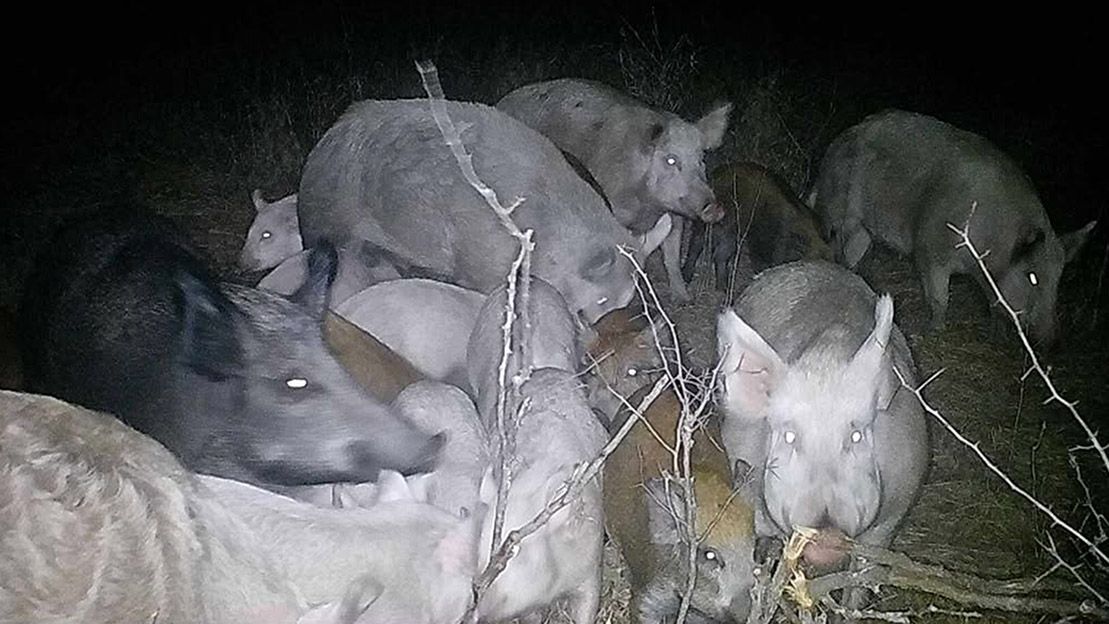
For one thing, escapees began forming sounders (herds) of wild boars and domestic pigs both, living and moving together across the prairie. They interbred, blending the resourcefulness and vigour of the wild species with the extra ribs, fat reserves and reproductive capacities of the domestic one. What we now call the “wild pig” was born.
“They became the perfect invasive species,” says Ryan Brook, a professor at the University of Saskatchewan and head of the Canadian Wild Pig Research Project. “They have a large body, heavy hair, they’re super smart, they eat almost anything, and they reproduce like crazy.”
This cocktail was more than enough to survive a prairie winter, though no one believed it at the time. Well into the 2010s, when Brook began his research, these invasive swine were taken about as seriously as Bigfoot, with intelligent people denying their very existence. By 2017, Brook and PhD student Ruth Aschim had demonstrated that not only did wild pigs exist, they were conquering entire watersheds.
Thriving at the intersection of wetland and farmland, they rip the former up by its roots — young trees, ground vegetation, cattails, whatever — and raid the latter for seeds and crops, carving up fields like rototillers. They pack their stomachs with corn and canola, birds and eggs, small mammals, reptiles, amphibians and even insect larvae. They hunt, kill and eat adult whitetail deer, and at least the fawns of moose and elk. They retreat into mud to escape summer heat, and burrow underground to escape winter cold.
Article content
“The biggest we ever handled in Saskatchewan was 638 pounds,” says Brook. “That was a female. We had eyes on another that my grad student swore was over 800.”
The Canadian prairies are not the first region invaded by European wild boar. They have, for example, infested the southern United States, numbering in the millions in Texas alone, but they’re expanding in the Prairie Provinces faster than anywhere else. The reasons are probably myriad, says Brook. For one thing, the prairies have a low population density, giving wild pigs few humans to avoid. Another factor is widespread recreational hunting, which breaks up sounders, scatters pigs and hastens their spread.
“Up to the killing of that pack of wolves,” says wildlife biologist Gilbert Proulx, “we never, ever encountered wild pigs in the reserve. Then, suddenly, boom, they were all over the place, and that happened immediately after the province destroyed that wolf pack.”
Brook and colleagues have studiously mapped the spread of wild pigs, and found that, by the year 2000, they were relatively restricted to only five watersheds — two in Saskatchewan, and one each in Alberta, Manitoba and northeastern British Columbia.
Since then, they’ve expanded in all cardinal directions, their range now exceeding one million square kilometres. They’ve even begun showing up in the boreal forest, 100 kilometres north of the nearest farm.
“If you’re still talking about eradicating wild pigs,” says Brook, “then you fundamentally misunderstand the situation.”
Such is the birth of an invasive species. They come from afar by one means or another — imported as livestock, as pets, as attractions in zoos or aquariums, or else hitch rides on plants, in soil, in the creases of a tourist’s boots, in the ballast of ships — then wreak havoc. Either they are destroyed in time, or they spread beyond control, becoming permanent headaches to the people and places they invade.
In Canada, the wild pig is one of hundreds. Here, it is one of three. And how we are dealing with each is an interesting tale.
A different kind of Gold Rush
In the summer of 2025, Prof. Nicholas Mandrak, with the University of Toronto, reconnoitred a pond in London, Ont. At least, it used to be a pond. On the day of his visit, its water and sediment had been so thoroughly mixed that no useful distinction could be made between the two, the entire water body a single, gelatinous mass.
“It was like quicksand,” he says.
But he needed samples, so he and students spent an hour dragging a net through this oxygen-starved molasses. The net was ruined, but it didn’t come up empty. Emerging from the mud was a writhing pile of glittering bronze, speckled throughout with wide and frantic eyes.
Goldfish. Hundreds of them.
It would be impractical to count every body of water in Canada infested with goldfish, says Mandrak. They’ve been here for 150 years, and continue their relentless spread across the country, as people dump unwanted pets into the nearest pond, and as those pets multiply, following rivers and streams to the next pond over. Wherever there are pet stores and people, says Mandrak, goldfish are invading the wild.
And becoming huge.
Freed from living room aquariums, their bellies and flanks bulge outward like front-heavy footballs, and they lengthen. One caught recently in Lake Ontario, says Mandrak, was pushing 50 centimetres (almost 20 inches). Three species of goldfish have been identified in Canada so far, from Lethbridge to the Great Lakes, from Whitehorse to the South Saskatchewan River. Native to East Asia, they thrive in both tropical and polar waters, and could, if introduced, live in virtually any Canadian lake.
“Goldfish are one of the most tolerant fish species on Earth,” says Mandrak. “They can live in water temperatures of zero to 40 degrees. They can even live in water with very low levels of oxygen.”
Or without any oxygen at all, for weeks at a time. Mandrak has seen infested ponds in the Greater Toronto Area drained over winter, then refilled the following spring, their resident goldfish miraculously unharmed. They probably overwinter in the mud, he says, in a kind of torpor, not unlike hibernating turtles.
“If they weren’t so dangerous,” he says, “they’d be pretty impressive.”
As with wild pigs, goldfish have no equivalent in Canadian ecology, dropped into watersheds like the proverbial wrench in the works. Also like pigs, goldfish uproot their new homes. They dig feverishly through sediments in search of invertebrate prey. This tossed sediment blends with water, blocking out sunlight, killing aquatic vegetation and starving the water of oxygen. The suffocating influence of goldfish can be so extreme that native fish, and even other invasive species, cannot survive in their company.
This is what happened in Cootes Paradise, at the western extreme of Lake Ontario in Hamilton, Ont. Once among the most biodiverse wetlands in all the Great Lakes, it was overrun by invasive common carp, which were then largely smothered by a wave of bulbous goldfish. This is probably happening across the Great Lakes, says Mandrak, one invader displacing another.
“Goldfish are becoming more abundant in the wild while common carp are declining,” says Mandrak. “It’s almost the perfect relationship.”
This trend — a sudden, destructive spike in Great Lakes goldfish — is as sharp as it is mysterious. Mandrak and colleagues suspect a warming climate has something to do with it, but a more disturbing possibility only just crossed his desk. After 150 years of relative stability, and in addition to their grotesque size, their suffocating influence and their apparent disregard for water and oxygen, goldfish in the Great Lakes might have begun cloning themselves. Mandrak’s been in contact with researchers in China who’ve observed goldfish eggs maturing into goldfish without fertilization.
“This might explain why they’re becoming super abundant,” says Mandrak. “Goldfish have risen again.”
Insect warfare
In the fall of 1959, thousands of birds died in Michigan. Scattered on roadsides and in backyards across tens of thousands of acres of forest and suburbs, robins, thrashers, starlings, grackles, meadowlarks, pheasants and more were afflicted with tremors, paralysis and convulsions, to which all eventually succumbed. Small mammals such as rabbits, squirrels, foxes and raccoons followed suit, alongside insects of every kind, tumbling to earth in one continuous blanket. Earthworms squirmed to the surface of soils, then expired like the rest.
All of this, over a beetle.
Popillia japonica, the Japanese beetle, was accidentally imported to a New Jersey nursery sometime before 1916. Small and glossy green, it feeds on the absolute tenderest tissues of more than 300 species of plant, devouring, for example, the bodies of leaves without touching their tougher veins, “skeletonizing” the canopies of Norway maples, Linden trees, rose bushes and crab apple trees. The beetles also have a taste for delicate fruits, spoiling crops of raspberry, blueberry, cherry, plum, apricot and grape, as often by mixing their bodies into harvests as by directly damaging the fruit. They go after soybean and corn in the field, and their larvae, overwintering underground, assault the roots of turf grasses.
“They’re good at what they do,” says PhD student Alexe Indigo, who is with Dalhousie University.
The species invaded Canada in the 1920s, and is now established in Ontario, Quebec, New Brunswick, Nova Scotia and Prince Edward Island, though some years its presence is more pronounced than others. Japanese beetle infestations exploded in Halifax in the summer of 2024, almost certainly a consequence of a warming climate.
The irony of the Japanese beetle, says Indigo, is that it tends to victimize imported plants rather than native ones. Crops, turfs and ornamental species native to Eurasia are what it evolved to eat, so unlike the emerald ash borer or hemlock woolly adelgid — invasive insects that are annihilating native forests across eastern North America — the Japanese beetle makes a meal of the human landscape, the bane not of forests but of farmers, gardeners and city planners.
To confront this invader, scorched-earth became government policy. In the 1920s, the United States Department of Agriculture surveyed Japan for any and all insects that might prey on Japanese beetles, collected 47 candidate species, and dumped them all in New England without serious consideration for how many of these might become invasive in turn. And in the 1950s and ’60s, planes flew low over Michigan, Kentucky, Iowa, Indiana, Illinois and Missouri, dropping pellets of aldrin, heptachlor, lead arsenate or cyanide. Beetles died — along with almost everything else, an ecological hecatomb featured in Rachel Carson’s book, Silent Spring.
“The Midwestern states now on the fringe of the beetle’s range,” she wrote, “have launched an attack worthy of the most deadly enemy instead of only a moderately destructive insect … ”
Article content
“You go into an area looking for beetles,” says Indigo, “and you find them all on this one giant tree, thousands of them, and the tree next to it, of the same species, might have none.”
This is the “aggregative feeding” of Japanese beetles, co-ordinating their attack on individual plants by way of hormones. Because of this, says Indigo, beetle traps tend to backfire in urban gardens. Yes, beetles will pool in traps, but their hormones will attract more beetles and overwhelm the garden in question.
“What we’ve seen over the past 10 or 15 years is this really dramatic increase in population,” she says. “They’re not necessarily in every community, but they’re close to every community. Within the next few years, we’ll probably see them absolutely everywhere.”
Twenty-three piglets
It was a winter day in southeastern Saskatchewan in 2017 when Ryan Brook and a small army of wildlife wranglers went in search of a particular wild pig.
It should have been easy to find. The pig — a male — wore a GPS collar, and Brook was in a helicopter, soaring toward its unambiguous signal with another team on the ground, following on snowmobiles. They also had some serious hardware: rifles, net guns, infrared cameras, radios and so on.
Article content
But on that day, all their equipment and expertise were confounded. The fancy GPS collar led them to the centre of a very empty meadow, and no matter how many times the helicopter circled overhead, and no matter how many sweeps were made by the convoy of snowmobiles, no pig materialized. Glances were exchanged. Trigger fingers itched. Someone suggested giving up.
“But the GPS signal was blowing out my eardrums,” says Brook, who was burning through thousands of research dollars every hour the team was kept in the field.
 nationalpost.com
But even the gold fish can be eaten, they're carp.
Invasive species are imported as livestock, pets and attractions in zoos. Some hitch rides on plants, on the bottom of a boot, in the ballast of ships. Then they wreak havoc. Here's how we're tackling three of them
In the beginning, there were pigs. Domestic breeds, such as Duroc, Landrace and Yorkshire have been staples of the Prairie Provinces for more than a century, and while plenty escaped their resident farms over the years, few survived their first Saskatchewan winter.
Then came European wild boar, a species imported gleefully throughout the 1980s to diversify Canada’s livestock sector. For meat, and for “shoot farms,” boars materialized in most Canadian provinces, but especially in Manitoba, Saskatchewan and Alberta. When these escaped their resident farms, the result was a slow-moving catastrophe.
For one thing, escapees began forming sounders (herds) of wild boars and domestic pigs both, living and moving together across the prairie. They interbred, blending the resourcefulness and vigour of the wild species with the extra ribs, fat reserves and reproductive capacities of the domestic one. What we now call the “wild pig” was born.
“They became the perfect invasive species,” says Ryan Brook, a professor at the University of Saskatchewan and head of the Canadian Wild Pig Research Project. “They have a large body, heavy hair, they’re super smart, they eat almost anything, and they reproduce like crazy.”
This cocktail was more than enough to survive a prairie winter, though no one believed it at the time. Well into the 2010s, when Brook began his research, these invasive swine were taken about as seriously as Bigfoot, with intelligent people denying their very existence. By 2017, Brook and PhD student Ruth Aschim had demonstrated that not only did wild pigs exist, they were conquering entire watersheds.
Thriving at the intersection of wetland and farmland, they rip the former up by its roots — young trees, ground vegetation, cattails, whatever — and raid the latter for seeds and crops, carving up fields like rototillers. They pack their stomachs with corn and canola, birds and eggs, small mammals, reptiles, amphibians and even insect larvae. They hunt, kill and eat adult whitetail deer, and at least the fawns of moose and elk. They retreat into mud to escape summer heat, and burrow underground to escape winter cold.
Article content
“The biggest we ever handled in Saskatchewan was 638 pounds,” says Brook. “That was a female. We had eyes on another that my grad student swore was over 800.”
The Canadian prairies are not the first region invaded by European wild boar. They have, for example, infested the southern United States, numbering in the millions in Texas alone, but they’re expanding in the Prairie Provinces faster than anywhere else. The reasons are probably myriad, says Brook. For one thing, the prairies have a low population density, giving wild pigs few humans to avoid. Another factor is widespread recreational hunting, which breaks up sounders, scatters pigs and hastens their spread.
Finally, there are almost no native predators left in the Prairie Provinces, and so none — neither wolf nor bear — to discourage the spread of wild pigs. This point was made, anecdotally, in the Blackfoot Provincial Recreation Area, where a pack of resident wolves was culled by the Alberta government between 2014 and 2018.If you’re still talking about eradicating wild pigs, then you fundamentally misunderstand the situation.
Ryan Brook
“Up to the killing of that pack of wolves,” says wildlife biologist Gilbert Proulx, “we never, ever encountered wild pigs in the reserve. Then, suddenly, boom, they were all over the place, and that happened immediately after the province destroyed that wolf pack.”
Brook and colleagues have studiously mapped the spread of wild pigs, and found that, by the year 2000, they were relatively restricted to only five watersheds — two in Saskatchewan, and one each in Alberta, Manitoba and northeastern British Columbia.
Since then, they’ve expanded in all cardinal directions, their range now exceeding one million square kilometres. They’ve even begun showing up in the boreal forest, 100 kilometres north of the nearest farm.
“If you’re still talking about eradicating wild pigs,” says Brook, “then you fundamentally misunderstand the situation.”
Such is the birth of an invasive species. They come from afar by one means or another — imported as livestock, as pets, as attractions in zoos or aquariums, or else hitch rides on plants, in soil, in the creases of a tourist’s boots, in the ballast of ships — then wreak havoc. Either they are destroyed in time, or they spread beyond control, becoming permanent headaches to the people and places they invade.
In Canada, the wild pig is one of hundreds. Here, it is one of three. And how we are dealing with each is an interesting tale.
A different kind of Gold Rush
In the summer of 2025, Prof. Nicholas Mandrak, with the University of Toronto, reconnoitred a pond in London, Ont. At least, it used to be a pond. On the day of his visit, its water and sediment had been so thoroughly mixed that no useful distinction could be made between the two, the entire water body a single, gelatinous mass.
“It was like quicksand,” he says.
But he needed samples, so he and students spent an hour dragging a net through this oxygen-starved molasses. The net was ruined, but it didn’t come up empty. Emerging from the mud was a writhing pile of glittering bronze, speckled throughout with wide and frantic eyes.
Goldfish. Hundreds of them.
It would be impractical to count every body of water in Canada infested with goldfish, says Mandrak. They’ve been here for 150 years, and continue their relentless spread across the country, as people dump unwanted pets into the nearest pond, and as those pets multiply, following rivers and streams to the next pond over. Wherever there are pet stores and people, says Mandrak, goldfish are invading the wild.
And becoming huge.
Freed from living room aquariums, their bellies and flanks bulge outward like front-heavy footballs, and they lengthen. One caught recently in Lake Ontario, says Mandrak, was pushing 50 centimetres (almost 20 inches). Three species of goldfish have been identified in Canada so far, from Lethbridge to the Great Lakes, from Whitehorse to the South Saskatchewan River. Native to East Asia, they thrive in both tropical and polar waters, and could, if introduced, live in virtually any Canadian lake.
“Goldfish are one of the most tolerant fish species on Earth,” says Mandrak. “They can live in water temperatures of zero to 40 degrees. They can even live in water with very low levels of oxygen.”
Or without any oxygen at all, for weeks at a time. Mandrak has seen infested ponds in the Greater Toronto Area drained over winter, then refilled the following spring, their resident goldfish miraculously unharmed. They probably overwinter in the mud, he says, in a kind of torpor, not unlike hibernating turtles.
“If they weren’t so dangerous,” he says, “they’d be pretty impressive.”
As with wild pigs, goldfish have no equivalent in Canadian ecology, dropped into watersheds like the proverbial wrench in the works. Also like pigs, goldfish uproot their new homes. They dig feverishly through sediments in search of invertebrate prey. This tossed sediment blends with water, blocking out sunlight, killing aquatic vegetation and starving the water of oxygen. The suffocating influence of goldfish can be so extreme that native fish, and even other invasive species, cannot survive in their company.
This is what happened in Cootes Paradise, at the western extreme of Lake Ontario in Hamilton, Ont. Once among the most biodiverse wetlands in all the Great Lakes, it was overrun by invasive common carp, which were then largely smothered by a wave of bulbous goldfish. This is probably happening across the Great Lakes, says Mandrak, one invader displacing another.
“Goldfish are becoming more abundant in the wild while common carp are declining,” says Mandrak. “It’s almost the perfect relationship.”
This trend — a sudden, destructive spike in Great Lakes goldfish — is as sharp as it is mysterious. Mandrak and colleagues suspect a warming climate has something to do with it, but a more disturbing possibility only just crossed his desk. After 150 years of relative stability, and in addition to their grotesque size, their suffocating influence and their apparent disregard for water and oxygen, goldfish in the Great Lakes might have begun cloning themselves. Mandrak’s been in contact with researchers in China who’ve observed goldfish eggs maturing into goldfish without fertilization.
“This might explain why they’re becoming super abundant,” says Mandrak. “Goldfish have risen again.”
Insect warfare
In the fall of 1959, thousands of birds died in Michigan. Scattered on roadsides and in backyards across tens of thousands of acres of forest and suburbs, robins, thrashers, starlings, grackles, meadowlarks, pheasants and more were afflicted with tremors, paralysis and convulsions, to which all eventually succumbed. Small mammals such as rabbits, squirrels, foxes and raccoons followed suit, alongside insects of every kind, tumbling to earth in one continuous blanket. Earthworms squirmed to the surface of soils, then expired like the rest.
All of this, over a beetle.
Popillia japonica, the Japanese beetle, was accidentally imported to a New Jersey nursery sometime before 1916. Small and glossy green, it feeds on the absolute tenderest tissues of more than 300 species of plant, devouring, for example, the bodies of leaves without touching their tougher veins, “skeletonizing” the canopies of Norway maples, Linden trees, rose bushes and crab apple trees. The beetles also have a taste for delicate fruits, spoiling crops of raspberry, blueberry, cherry, plum, apricot and grape, as often by mixing their bodies into harvests as by directly damaging the fruit. They go after soybean and corn in the field, and their larvae, overwintering underground, assault the roots of turf grasses.
“They’re good at what they do,” says PhD student Alexe Indigo, who is with Dalhousie University.
The species invaded Canada in the 1920s, and is now established in Ontario, Quebec, New Brunswick, Nova Scotia and Prince Edward Island, though some years its presence is more pronounced than others. Japanese beetle infestations exploded in Halifax in the summer of 2024, almost certainly a consequence of a warming climate.
The irony of the Japanese beetle, says Indigo, is that it tends to victimize imported plants rather than native ones. Crops, turfs and ornamental species native to Eurasia are what it evolved to eat, so unlike the emerald ash borer or hemlock woolly adelgid — invasive insects that are annihilating native forests across eastern North America — the Japanese beetle makes a meal of the human landscape, the bane not of forests but of farmers, gardeners and city planners.
To confront this invader, scorched-earth became government policy. In the 1920s, the United States Department of Agriculture surveyed Japan for any and all insects that might prey on Japanese beetles, collected 47 candidate species, and dumped them all in New England without serious consideration for how many of these might become invasive in turn. And in the 1950s and ’60s, planes flew low over Michigan, Kentucky, Iowa, Indiana, Illinois and Missouri, dropping pellets of aldrin, heptachlor, lead arsenate or cyanide. Beetles died — along with almost everything else, an ecological hecatomb featured in Rachel Carson’s book, Silent Spring.
“The Midwestern states now on the fringe of the beetle’s range,” she wrote, “have launched an attack worthy of the most deadly enemy instead of only a moderately destructive insect … ”
This chemical warfare became a lot smarter with time, and much more targeted, going after the Japanese beetle in its larval state with soil-drenched insecticides, rather than broad-spectrum killers dropped by plane. In spite of this, the Japanese beetle has been leapfrogging its way north and west for more than a century, carried hither and yon in plants and soils. Cities have stamped it out repeatedly, often to have it show up again. In Halifax, urban parks and backyard gardens have been struck hard for two summers and, bizarrely, one at a time.Within the next few years, we’ll probably see (Japanese beetles) absolutely everywhere.
Alexe Indigo
Article content
“You go into an area looking for beetles,” says Indigo, “and you find them all on this one giant tree, thousands of them, and the tree next to it, of the same species, might have none.”
This is the “aggregative feeding” of Japanese beetles, co-ordinating their attack on individual plants by way of hormones. Because of this, says Indigo, beetle traps tend to backfire in urban gardens. Yes, beetles will pool in traps, but their hormones will attract more beetles and overwhelm the garden in question.
“What we’ve seen over the past 10 or 15 years is this really dramatic increase in population,” she says. “They’re not necessarily in every community, but they’re close to every community. Within the next few years, we’ll probably see them absolutely everywhere.”
Twenty-three piglets
It was a winter day in southeastern Saskatchewan in 2017 when Ryan Brook and a small army of wildlife wranglers went in search of a particular wild pig.
It should have been easy to find. The pig — a male — wore a GPS collar, and Brook was in a helicopter, soaring toward its unambiguous signal with another team on the ground, following on snowmobiles. They also had some serious hardware: rifles, net guns, infrared cameras, radios and so on.
Article content
But on that day, all their equipment and expertise were confounded. The fancy GPS collar led them to the centre of a very empty meadow, and no matter how many times the helicopter circled overhead, and no matter how many sweeps were made by the convoy of snowmobiles, no pig materialized. Glances were exchanged. Trigger fingers itched. Someone suggested giving up.
“But the GPS signal was blowing out my eardrums,” says Brook, who was burning through thousands of research dollars every hour the team was kept in the field.
Wild pigs, giant goldfish and bugs that won't die: Invaders 'absolutely everywhere' in Canada
How can we manage the species that are devastating Canada's natural ecosystems and shouldn't even be here?
nationalpost.com


