What Iran’s Naval Exercise With China And Russia In The Strait Of Hormuz Actually Means
FEB 18, 2026
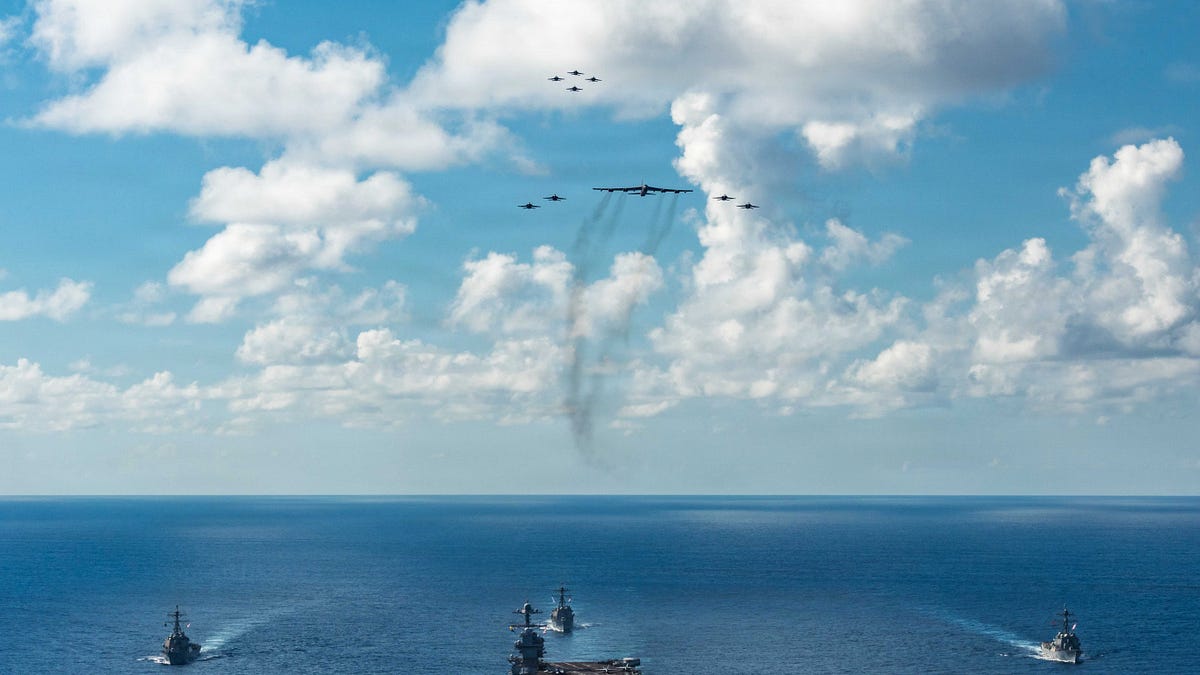
As the U.S. flows assets toward the Middle East, including the Gerald R. Ford Carrier Strike Group (CSG) now reportedly off the Moroccan coast, Iran, China and Russia will hold their recurring joint naval training exercise in the Strait of Hormuz, according to Iranian media. Moscow and Tehran see the Maritime Security Belt 2026 exercise as particularly relevant in light of current events, and there are reasons for the White House and Pentagon to take note. Having Russian or Chinese warships in these waters amid a U.S. attack on Iran could have military and political implications planners must address. At the same time, the timing of the still ongoing U.S. buildup and the exercise point to it having more of a messaging effect than an operational one.
The exercise, first held in 2019, is being hosted in the southern Iranian port city of Bandar Abbas, located on the Strait of Hormuz. Russian, Chinese, and Iranian naval units “are expected to participate with various ships and operational capabilities to test coordination, tactical readiness, and rapid-response procedures in the Strait of Hormuz,” the official Iranian Mehr news outlet reported.
U.S. Central Command (CENTCOM) declined to comment on the exercise.
As Iranian and Russian officials gathered Wednesday aboard the Russian corvette Stoiky, a top Iranian official issued a new threat against the growing U.S. Navy presence in the region, which includes the Abraham Lincoln CSG and at least eight other surface combatants. The Ford could arrive in the region in the next four or five days given its location posted by the MarineTraffic ship tracking website. The Navy said only that the ship is now in the Atlantic Ocean.
“The Islamic Republic of Iran has faced threats, noise, propaganda and the presence of extra-regional fleets in West Asia for 47 years, Iran’s Navy Commander Rear Adm. Shahram Irani warned. “The presence of extra-regional fleets in West Asia is unjustified.”
“If the extra-regional fleet feels it has come with power, it should know that the Iranian people will confront them with greater power,” he added. “The faith of the people and missiles are the Islamic Republic of Iran’s deterrent weapons against the enemy.”
Nikolai Patrushev, a top aide to Russian President Vladimir Putin, framed the exercise as part of a larger struggle between the U.S. and the BRICS alliance, an informal group of 21 nations that includes Russia, China and Iran. Patrushev took aim at the ongoing U.S. and NATO efforts to seize tankers containing Russian oil as well as the ongoing tensions between Washington and Tehran.
“We will tap into the potential of BRICS, which should now be given a full-fledged strategic maritime dimension,” Patrushev posited. “The Maritime Security Belt 2026 exercises in the Strait of Hormuz, where Russia, China, and Iran [will send] their ships, proves to be relevant.”
Both Russia and Iran say the exercise will increase their ability to work together.
“The level of existing interactions and cooperation shows that we can manage and resolve many maritime and coastal issues together,” Captain First Rank Alexey Sergeev, commander of the Russian naval group, said, according to The Telegraph. “We are ready to hold joint exercises in any region, including specialised drills such as anti-maritime terrorism operations that will be executed with vessels and boats from both sides.”
Experts we spoke with say the presence of a small number of Russian and Chinese ships in the Strait of Hormuz and Gulf of Oman does not pose a significant threat to U.S. interests, but could complicate efforts to attack Iran. They also note that this exercise was likely planned months ago, well before U.S. President Donald Trump started threatening Iran over its harsh treatment of anti-regime protesters.
“I don’t believe it increases in any significant way the likelihood of conflict with Russia and China, but it probably would introduce additional considerations for any planned strikes against Iran,” Tom Shugart, an adjunct senior fellow at the Center for a New American Security (CNAS) think tank and a retired U.S. Navy submarine warfare officer told us Wednesday morning.
“For starters, you’d want to make sure that their sensors don’t give advanced warning of your strike to the Iranians, and you’d want to make sure that those Russian and Chinese platforms aren’t in the way,” he explained. “You’d also of course want to ensure that there is no way they could be inadvertently struck a la USS Stark during the Iraq-Iran Tanker Wars of the 1980s.”
The Stark, an Oliver-Hazard Perry class guided-missile frigate, was hit by two Iraqi Exocet missiles while in the Persian Gulf on May 17, 1987. The strike killed 37 sailors and wounded 21 others.
Shugart downplayed the timing of the exercise, given that its planning has been in the works for a while.
“I also don’t think that the small number of Russian and Chinese ships involved amount to much militarily relative to U.S. naval forces in the region – though their presence might matter politically, should the administration decide it wants to take military action against Iran,” he explained.
“I don’t think this fundamentally changes anything,” former CENTCOM commander Joseph Votel told us. “It is an easy way for Russia and China to show support after having abandoned Iran last summer.”
Votel, a retired Army General and current distinguished fellow at the Middle East Institute, was referring to last June’s U.S. Operation Midnight Hammer attack on Iranian nuclear facilities and Israel’s 12-Day War against Iran.
“Certainly the timing makes it seem more provocative,” Votel added. “There is likely also an internal message for regime supporters – pushing back on the U.S. and Israel.”
“I don’t think it raises the threat of conflict,” the former CENTCOM commander surmised. “I view it as a form of great power competition.”
The presence of Russian and Chinese ships near Bandar Abbas, a major center of Iranian military activity, could complicate U.S. targeting if they remain in the area. The coastal city would be a prime target to take out many types of kinetic capabilities, sensors, and other assets, especially Iran’s naval forces. Still, the Chinese and Russian ships should leave at some point and the U.S. would know their location and it doesn’t appear the U.S. is in a place to strike yet. Unless the exercise goes on for weeks, the Russian and Chinese ships will likely have moved on by the time all the pieces are in place for a U.S.-led kinetic operation to begin.
The joint naval exercise follows a more recently planned drill by the Iranian Islamic Revolutionary Guard Corps (IRGC), which has closed off the Strait of Hormuz for a live-fire exercise. It marks the first time Iran has shut parts of the Strait since Trump threatened Iran with military action in January.
Dubbed “Smart Control of the Strait of Hormuz,” the drills began Monday and include firing anti-ship cruise missiles at targets and IRGC naval drone and submarine units carrying out operations originating from the three Iranian islands, according to Iranian media.
“The armed drones used in the exercise—capable of engaging both air and sea targets—are among the IRGC Navy’s newest strategic platforms and are deployed in significant numbers, though their names and technical specifications remain classified,” the official Iranian FARS News outlet claimed.
We’ll have to wait and see how the exercises unfold, especially as the U.S. buildup fully matures. But at this time it seems that the presence of these vessels is more of a political factor than an operational one, at least for the time being.

 www.twz.com
FEB 18, 2026
As the U.S. flows assets toward the Middle East, including the Gerald R. Ford Carrier Strike Group (CSG) now reportedly off the Moroccan coast, Iran, China and Russia will hold their recurring joint naval training exercise in the Strait of Hormuz, according to Iranian media. Moscow and Tehran see the Maritime Security Belt 2026 exercise as particularly relevant in light of current events, and there are reasons for the White House and Pentagon to take note. Having Russian or Chinese warships in these waters amid a U.S. attack on Iran could have military and political implications planners must address. At the same time, the timing of the still ongoing U.S. buildup and the exercise point to it having more of a messaging effect than an operational one.
The exercise, first held in 2019, is being hosted in the southern Iranian port city of Bandar Abbas, located on the Strait of Hormuz. Russian, Chinese, and Iranian naval units “are expected to participate with various ships and operational capabilities to test coordination, tactical readiness, and rapid-response procedures in the Strait of Hormuz,” the official Iranian Mehr news outlet reported.
U.S. Central Command (CENTCOM) declined to comment on the exercise.
As Iranian and Russian officials gathered Wednesday aboard the Russian corvette Stoiky, a top Iranian official issued a new threat against the growing U.S. Navy presence in the region, which includes the Abraham Lincoln CSG and at least eight other surface combatants. The Ford could arrive in the region in the next four or five days given its location posted by the MarineTraffic ship tracking website. The Navy said only that the ship is now in the Atlantic Ocean.
“The Islamic Republic of Iran has faced threats, noise, propaganda and the presence of extra-regional fleets in West Asia for 47 years, Iran’s Navy Commander Rear Adm. Shahram Irani warned. “The presence of extra-regional fleets in West Asia is unjustified.”
“If the extra-regional fleet feels it has come with power, it should know that the Iranian people will confront them with greater power,” he added. “The faith of the people and missiles are the Islamic Republic of Iran’s deterrent weapons against the enemy.”
Nikolai Patrushev, a top aide to Russian President Vladimir Putin, framed the exercise as part of a larger struggle between the U.S. and the BRICS alliance, an informal group of 21 nations that includes Russia, China and Iran. Patrushev took aim at the ongoing U.S. and NATO efforts to seize tankers containing Russian oil as well as the ongoing tensions between Washington and Tehran.
“We will tap into the potential of BRICS, which should now be given a full-fledged strategic maritime dimension,” Patrushev posited. “The Maritime Security Belt 2026 exercises in the Strait of Hormuz, where Russia, China, and Iran [will send] their ships, proves to be relevant.”
Both Russia and Iran say the exercise will increase their ability to work together.
“The level of existing interactions and cooperation shows that we can manage and resolve many maritime and coastal issues together,” Captain First Rank Alexey Sergeev, commander of the Russian naval group, said, according to The Telegraph. “We are ready to hold joint exercises in any region, including specialised drills such as anti-maritime terrorism operations that will be executed with vessels and boats from both sides.”
Experts we spoke with say the presence of a small number of Russian and Chinese ships in the Strait of Hormuz and Gulf of Oman does not pose a significant threat to U.S. interests, but could complicate efforts to attack Iran. They also note that this exercise was likely planned months ago, well before U.S. President Donald Trump started threatening Iran over its harsh treatment of anti-regime protesters.
“I don’t believe it increases in any significant way the likelihood of conflict with Russia and China, but it probably would introduce additional considerations for any planned strikes against Iran,” Tom Shugart, an adjunct senior fellow at the Center for a New American Security (CNAS) think tank and a retired U.S. Navy submarine warfare officer told us Wednesday morning.
“For starters, you’d want to make sure that their sensors don’t give advanced warning of your strike to the Iranians, and you’d want to make sure that those Russian and Chinese platforms aren’t in the way,” he explained. “You’d also of course want to ensure that there is no way they could be inadvertently struck a la USS Stark during the Iraq-Iran Tanker Wars of the 1980s.”
The Stark, an Oliver-Hazard Perry class guided-missile frigate, was hit by two Iraqi Exocet missiles while in the Persian Gulf on May 17, 1987. The strike killed 37 sailors and wounded 21 others.
Shugart downplayed the timing of the exercise, given that its planning has been in the works for a while.
“I also don’t think that the small number of Russian and Chinese ships involved amount to much militarily relative to U.S. naval forces in the region – though their presence might matter politically, should the administration decide it wants to take military action against Iran,” he explained.
“I don’t think this fundamentally changes anything,” former CENTCOM commander Joseph Votel told us. “It is an easy way for Russia and China to show support after having abandoned Iran last summer.”
Votel, a retired Army General and current distinguished fellow at the Middle East Institute, was referring to last June’s U.S. Operation Midnight Hammer attack on Iranian nuclear facilities and Israel’s 12-Day War against Iran.
“Certainly the timing makes it seem more provocative,” Votel added. “There is likely also an internal message for regime supporters – pushing back on the U.S. and Israel.”
“I don’t think it raises the threat of conflict,” the former CENTCOM commander surmised. “I view it as a form of great power competition.”
The presence of Russian and Chinese ships near Bandar Abbas, a major center of Iranian military activity, could complicate U.S. targeting if they remain in the area. The coastal city would be a prime target to take out many types of kinetic capabilities, sensors, and other assets, especially Iran’s naval forces. Still, the Chinese and Russian ships should leave at some point and the U.S. would know their location and it doesn’t appear the U.S. is in a place to strike yet. Unless the exercise goes on for weeks, the Russian and Chinese ships will likely have moved on by the time all the pieces are in place for a U.S.-led kinetic operation to begin.
The joint naval exercise follows a more recently planned drill by the Iranian Islamic Revolutionary Guard Corps (IRGC), which has closed off the Strait of Hormuz for a live-fire exercise. It marks the first time Iran has shut parts of the Strait since Trump threatened Iran with military action in January.
Dubbed “Smart Control of the Strait of Hormuz,” the drills began Monday and include firing anti-ship cruise missiles at targets and IRGC naval drone and submarine units carrying out operations originating from the three Iranian islands, according to Iranian media.
“The armed drones used in the exercise—capable of engaging both air and sea targets—are among the IRGC Navy’s newest strategic platforms and are deployed in significant numbers, though their names and technical specifications remain classified,” the official Iranian FARS News outlet claimed.
We’ll have to wait and see how the exercises unfold, especially as the U.S. buildup fully matures. But at this time it seems that the presence of these vessels is more of a political factor than an operational one, at least for the time being.
What Iran's Naval Exercise With China And Russia In The Strait Of Hormuz Actually Means
The Maritime Security Belt 2026 exercise comes as the U.S. is flowing forces to the Middle East ahead of a possible attack on Iran.
www.twz.com