Hot Pink List

PM Carney considers Canada a 'leader in climate change’

Frankfooter

dangling member
Apr 10, 2015
110,264
33,662
113
take your idiotic high school drop out ,pseudo logic up with AI
What is also incredibly entertaining is that you have repeatedly declared its impossible to measure the global temperature or the global sea surface temperature.
Instead you have declared it very easy to use a handful of balloons and find the global temperature from surface to 15km high.

That is quite some jump in logic.
 

JohnLarue

Well-known member
Jan 19, 2005
19,848
5,117
113
Is the 'Mid Troposphere' the same as the surface to you?
Your AI quote says the warming happens from the surface to the troposphere, or 10-15km high.
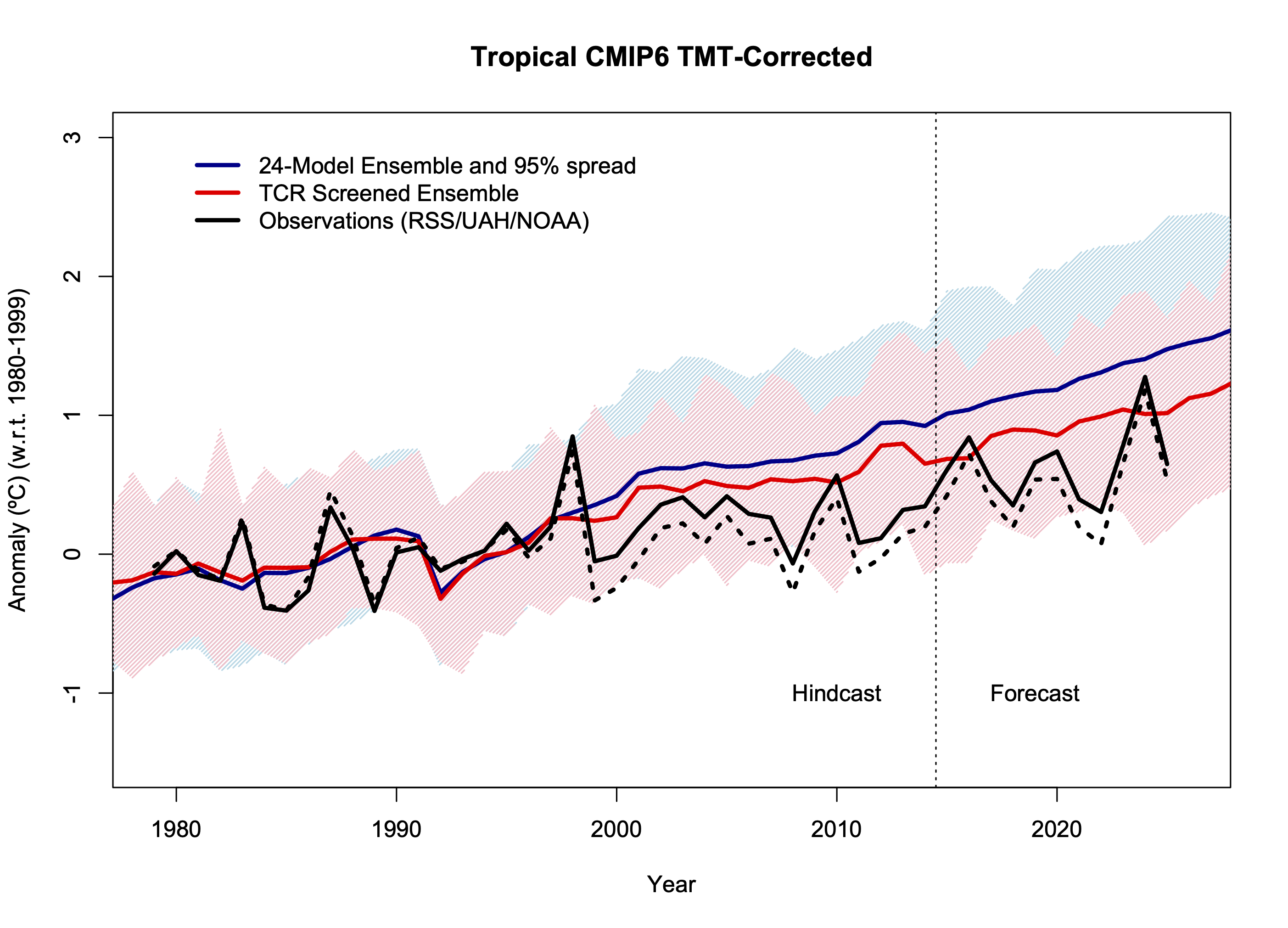
Your chart says ' Tropical Mid Troposphere'.
what is wrong with you?

lets ask AI to be a little more specific

AI Overview


Yes, greenhouse gas (GHG) theory and climate models specifically predict that warming should be amplified in the upper to mid-troposphere in the tropics
. This phenomenon is often referred to as the "tropical tropospheric hotspot" or "tropical upper-tropospheric amplification".

John Christy is measuring temperature anomaly's exactly where the the greenhouse gas theory (or Greenhouse Effect) predicts that warming will occur
end of story


You still think the temperature in the mid troposphere is the same as the temperature on the surface.
Were you to climb Mt Everest, which is 8.89 km from the surface, or about the same height as the tropical mid troposphere, you would likely just hike up in shorts and a tshirt. Because to you the temperature at the top of Everest is the same as the temperature at sea level.
there are temperature anomaly's


nothing new there,,
that was known by physicists long before the greenhouse gas theory
and the greenhouse gas theory still predicts that warming will occur specifically in the troposphere


AI Overview


Yes, greenhouse gas (GHG) theory and climate models specifically predict that warming should be amplified in the upper to mid-troposphere in the tropics
. This phenomenon is often referred to as the "tropical tropospheric hotspot" or "tropical upper-tropospheric amplification".
would you like a framed copy of the 2017 Christy graphic ?

you can hang it in your wall where your diploma would go, had you not dropped out of high school

1770498580749.jpeg


or how about a truth stating quote from Noble prize winner (in physics) Richard Feynman

1770503375274.jpeg

the climate models do not agree with experiment results

the theory behind the climate model is wrong
 
Last edited by a moderator:

Frankfooter

dangling member
Apr 10, 2015
110,264
33,662
113
A reminder.

The almighty larue can only use a 10 year old chart because it uses faulty data that is since corrected.
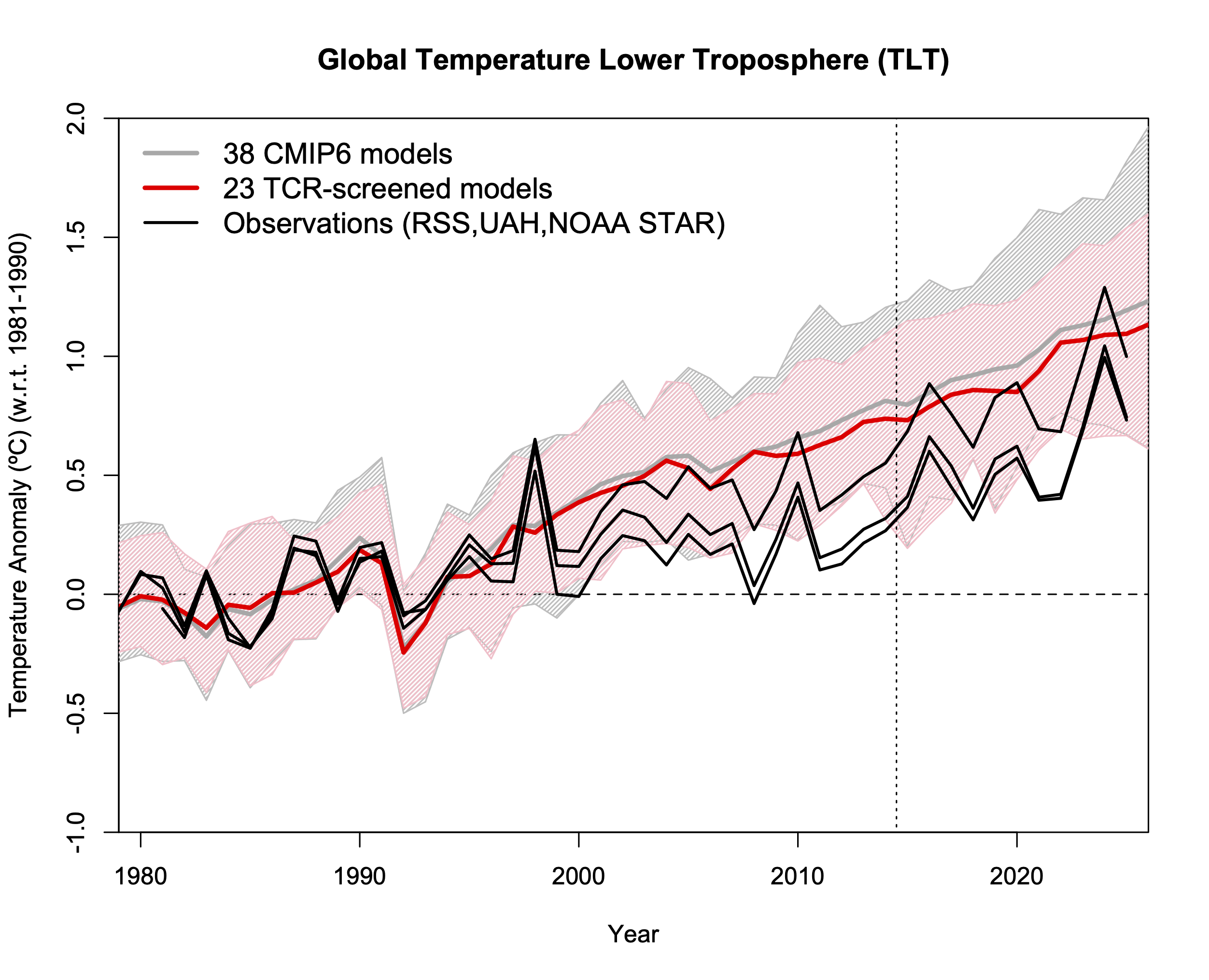
Here's an updated chart that compares UAH (larue's source) with the models and surface temperature.
larue is as clever as a flat earther.

 
Last edited:
  • Like
Reactions: shakenbake

JohnLarue

Well-known member
Jan 19, 2005
19,848
5,117
113
i see you are reduced to posting useless cartoons after your nonsense was proven to be nonsense

you had made the claim about temperature in the clouds for years, never bothering find out it was bull shit

your temperature in the clouds nonsense was proven to be just that, nonsense
John Christy is measuring temperature anomaly's exactly where the the greenhouse gas theory (or Greenhouse Effect) predicts that warming should occur

just as i have been stating for years

and your temperature in the clouds stupidity was just part of your unscientific campaign of ignorance and deliberate attempts to mislead


you were so proud you found a recent up-to-date UAH chart you had to post right away.
you foolishly thought you had the smoking gun and were going to catch me in a ''gotcha moment''
instead you showed how grossly overstated the climate model prediction have been (0.28 C degrees/ decade for the model predictions vs. 0.14 or 0.156 C degrees / decade for actual measurement from UAH)
i am still chuckling over that

then you tried to claim the impossible / not going to happen, RCP 8.5 scenario (0.5°C to over 0.6°C per decade).was a sure thing , a done deal
shortly after you had just posted a trend of 0.156 C degrees / decade for UAH..
that was just as funny
again copy / paste without understanding, rather with the definite intent to mislead others

1770529111328.jpeg
1770529130895.jpeg

1770529157998.jpeg
 
Last edited by a moderator:
  • Like
Reactions: roddermac

JohnLarue

Well-known member
Jan 19, 2005
19,848
5,117
113
A reminder.

The almighty larue can only use a 10 year old chart because it uses faulty data that is since corrected.
Here's an updated chart that compares UAH (larue's source) with the models and surface temperature.
larue is as clever as a flat earther.


here is the rate of change of the satellite data which you posted


1770529922753.png

0.155 C degrees per decade, inline with the 10 year old chart
ands well below the model predictions of 0.28 C degrees per decade

and no where near the RCP 8.5 scenario (0.5°C to over 0.6°C per decade), which you claimed to be a sure thing , a done deal

1770530171277.png

1770530197263.png

1770530222103.png
 
Last edited by a moderator:

oil&gas

Well-known member
Apr 16, 2002
16,603
3,230
113
Ghawar
No Matter Which Way You Look at It, Carney Has Abandoned Climate

ARNO KOPECKY
Dec. 22, 2025

FOR THE FIRST FEW MONTHS of Mark Carney’s prime ministerial tenure, Canada’s climate community of advocacy groups, think tanks, journalists, and scientists held their judgement—and their breath. A former United Nations special envoy on climate action and finance was now running the country; surely, that was a good thing. But the moment he took office, he stopped talking about emissions. Where was this going, exactly?

Give him a minute, the thinking went. Consider the political landscape. Canadians elected Carney to confront United States president Donald Trump, not climate change, and fair enough. If rising temperatures were a malignant tumour, America’s sudden hostility was a speeding bullet. First things first.

And so, we got our first clue (or was it a red flag?): the Building Canada Act, which raced through Parliament’s spring session to become law within two months of Carney’s victory. The act envisioned a self-reliant Canada building its way out of US dependence. Industrial megaprojects “in the national interest” would be sped to fruition through a Major Projects Office.

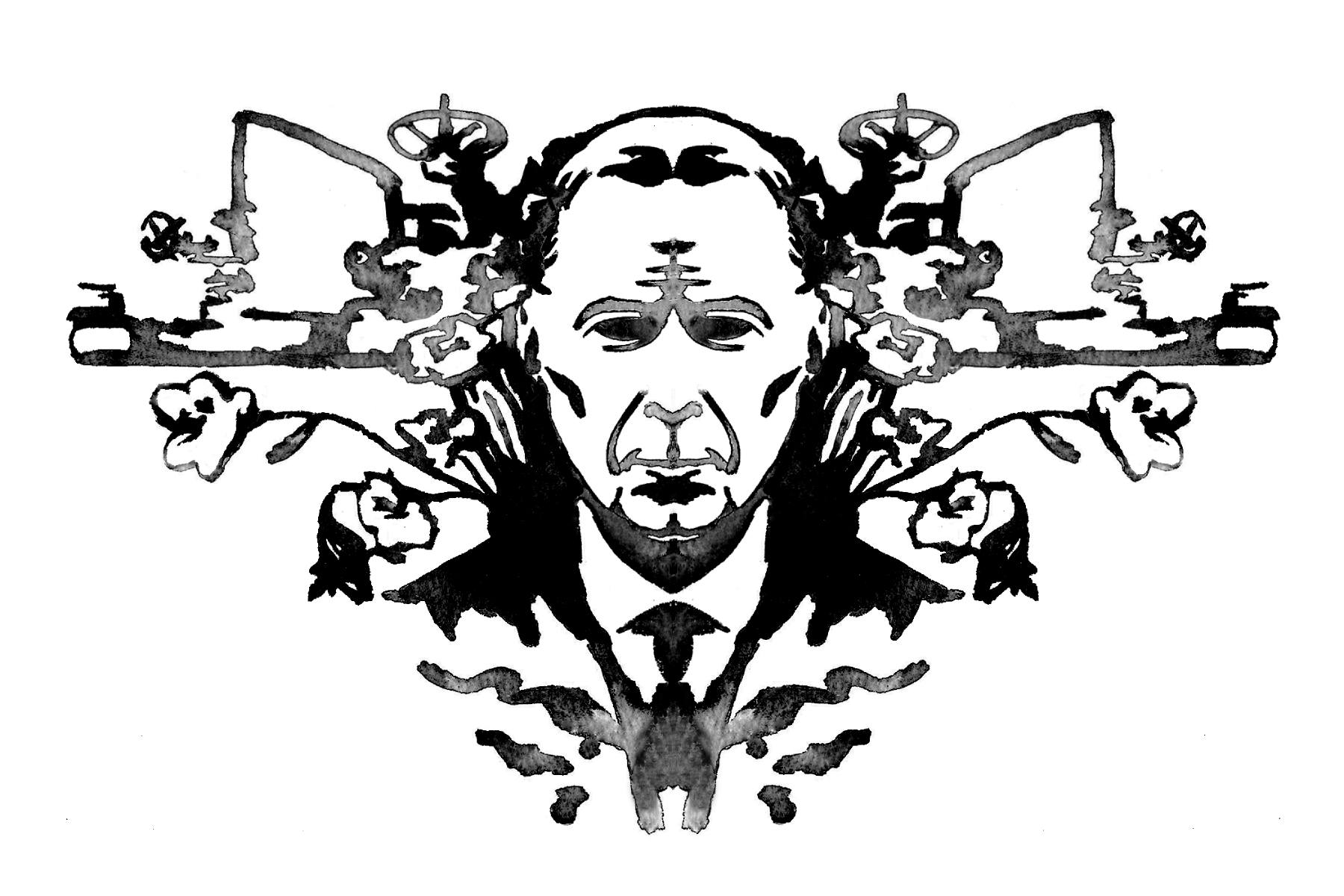
From a climate perspective, it all resembled a national Rorschach blot taking shape before our eyes: those who wanted to believe in Climate Carney could focus on the wind power, nuclear, and critical mineral projects, among the first announced in September; others beheld fossil fuel expansion, in the form of increasing liquified natural gas (LNG) exports, and the rising drumbeat of an oil pipeline to British Columbia’s north coast. That pattern was repeated in November, when Carney announced the second tranche of major projects.

Confusing, yes, but not yet terribly surprising. Carney had been promising to make Canada an “energy superpower in both clean and conventional [i.e., fossil fuel] energy” since the campaign trail in April. He put it in the Speech from the Throne. But what did that mean for emissions—the currency of climate policy? Was the investment into carbon-free energy somehow supposed to atone for a simultaneous expansion of the fossil fuel sector? Was carbon capture going to save the day? Or might emissions reductions in other parts of the economy—housing, say, or transportation—make up for increased production in the oil patch?

These questions got a partial answer in the “climate competitiveness strategy” buried in Carney’s November budget. We learned then that Carney was placing all his climate chips on two bets: the industrial carbon price (which charges large-emitting industries for their carbon emissions) and methane regulations (aimed at reducing methane emissions from oil and gas production by 75 percent, relative to 2012 levels).

This strategy produced a lot of groans in the climate community; so many other elements of Canada’s climate policy were being abandoned. Billions in cuts to various climate programs, from the federal tree-planting program to the Greener Homes Grant. The federal electric vehicles mandate remained paused. Instead of cash for clean energy, the budget dangled tax incentives—for fossil fuels and renewables alike.

Even so, enough people spoke up for the new climate policy that the collective jury remained hung. Clamping down on methane emissions (which are almost thirty times more potent than carbon dioxide) would have a major impact. An aggressive industrial carbon price is a powerful climate policy—the EU’s version of it has cut emissions from power plants and industry almost in half since it launched in 2005.
Convincing Ottawa to get serious about these two regulations has been a top priority among climate advocates for years.

Even Green Party of Canada leader Elizabeth May came around, giving Carney’s budget her reluctant vote on November 17. She did so because Carney had promised her, and Canadians, that very day that Canada “will respect our Paris commitments for climate change and we are determined to achieve them.” How, exactly, remained unclear. But a promise is a promise, right?

May’s agonized support—you could see her struggling with her conscience throughout the press conference when she announced her vote—seemed to capture the spirit of the climate community. “The Liberals can’t count on me voting confidence in the government again without delivering on the words I heard,” she said, and so, on the inside, did many of us.

But less than two weeks later, on November 27, Ottawa’s memorandum of understanding with Alberta shattered all remaining benefit of the doubt. It wasn’t a final straw so much as a cannonball, fired straight into the body of climate science. Ten days after winning the confidence of the House, he lost ours.

Steven Guilbeault, the Liberal Party’s long-time climate flag-bearer, instantly resigned from cabinet. May said she’d made the wrong decision on the budget vote. Groups that had cautiously supported Carney’s climate strategy, like the Pembina Institute and the Canadian Climate Institute, reversed their position. Two of Canada’s most prominent climate advocates, Simon Donner and Catherine Abreu, quit the federal Net-Zero Advisory Body with scathing words of protest. “There is no question the hard-won downward trend in Canadian greenhouse gas emissions will be reversed by the current government,” wrote Abreu in her resignation letter. “Canada will fail its international commitment to reduce emissions 40–45 percent by 2030 by such a large margin that meeting the 2035 milestone is highly unlikely. There is no getting to net-zero by 2050 if these milestones are missed.”

That MOU crystalized Carney’s new political alignment: he wasn’t just pretending to appease the oil patch, as many had suspected or hoped. He genuinely wanted that million-barrel-per-day oil pipeline to BC’s coast and was committing the full resources of the federal government to get it built. According to the MOU, that
pipeline’s emissions will be countered by the Pathways Alliance carbon capture project, whose fate is now tied to the pipeline. As the document states, “the two projects . . . are mutually dependent.”

But according to Pathways’ own numbers, the project would capture less than one-tenth of the carbon this new pipeline will unleash. It’s the perfect illustration of carbon capture’s moral hazard: by explicitly tying it to increased oil production, carbon capture literally increases emissions.

It beggars belief to suppose Carney doesn’t know all this. Yet he’s adopted phrases like “decarbonized oil” to suggest otherwise, as part of the sales pitch. That kind of language cuts deeper than any policy betrayal. It’s one thing to make compromises in times of national crisis; this twisting of math and meaning verges on disinformation.

At least now we know: Carney isn’t playing climate chess. There will be no effort to constrain Canada’s fossil fuel production, by far the biggest source of greenhouse gas emissions for country and planet alike. The question is no longer what he’s doing, but why? Why, that is, did Carney trade the support of climate progressives for that of the oil patch? Money is one answer, no doubt. But politics are another.

Canadians are getting used to tariffs and Trump, whose “fifty-first state” talk has faded away. Carney can’t rely on his anti-Trump status to win the next election. Conservatives won over 41 percent of the vote in April—that’s often enough to form a majority government in any normal election, which could come at any time. And depressing as it is from a climate perspective, polling suggests that a majority of Canadians do support a new pipeline. That includes British Columbians.

By signing pipeline deals, promoting LNG, and cultivating an unprecedented friendship with Alberta, Carney has painted the federal opposition into a corner. Two Conservative members of Parliament have crossed the floor to join the Liberals. The two most powerful Conservative premiers—Alberta’s Danielle Smith and Ontario’s Doug Ford—now have a better relationship with Carney than they do with the federal Conservative leader, Pierre Poilievre.

The MOU cemented this state of affairs. A Leger poll, conducted over the three days following its release, put Liberals well ahead of Conservatives: 43 to 36 percent. Carney’s personal performance had a 51 percent approval rating compared to Poilievre’s 31 percent. Canadians seemingly just aren’t as worried about climate change as they used to be—or maybe they’re just more afraid of other things. Or are they just tired of being scared?

Whatever it is, Carney’s success presents a lesson for everyone: the man never looks concerned. His positivity and confidence are contagious. When he first took office, many wondered if he understood politics as well as economics. Turns out, he understands them all too well.


Frankfooter

dangling member
Apr 10, 2015
110,264
33,662
113
John Christy is measuring temperature anomaly's exactly where the the greenhouse gas theory (or Greenhouse Effect) predicts that warming should occur

just as i have been stating for years
And UAH shows the warming as expected both in the mid troposhere and on the surface.


JohnLarue

Well-known member
Jan 19, 2005
19,848
5,117
113
That's not what I posted.
You are lying, typical science denier,.
sure it is and you just posted it again

see post # 72
1770575902858.png

0.155 C degrees per decade, inline with the 10 year old chart
ands well below the model predictions of 0.28 C degrees per decade

and there are no surface temperature anomaly's presented in that same graphic

you should read what you are posting
 

Frankfooter

dangling member
Apr 10, 2015
110,264
33,662
113
sure it is and you just posted it again

see post # 72
View attachment 548190

0.155 C degrees per decade, inline with the 10 year old chart
ands well below the model predictions of 0.28 C degrees per decade

and there are no surface temperature anomaly's presented in that same graphic

you should read what you are posting
I'm talking about the 0.28ºC slope, that's your claim.
Roy Spencer is an oil funded kook, so posting his satellite chart that shows Christy and you wrong is extra entertaining.

The chart I normally would choose for the troposphere would be more like this.
\


But that's only to make you realize how stupid your arguments are.
We should get back to surface measurements, I don't know about you but I live on the surface of this planet.


oil&gas

Well-known member
Apr 16, 2002
16,603
3,230
113
Ghawar
No matter what Canada does it will make no difference.

Canada does make a big difference if the warning of
climate catastrophe from alarmists is real.

Canada is one of the world's major fossil fuel exporters.
Canada will play a major role in destroying the Earth's climate.
 
  • Like
Reactions: Frankfooter

JohnLarue

Well-known member
Jan 19, 2005
19,848
5,117
113
I'm talking about the 0.28ºC slope, that's your claim.
nope

it is not a claim, the 0.28ºC slope is taken from the average output from 102 CMIPS models
1770605783189.png

obtaining slopes from graphs wit labeled axis was taught in grade 5

1770605658970.jpeg

Roy Spencer is an oil funded kook, so posting his satellite chart that shows Christy and you wrong is extra entertaining.
The chart I normally would choose for the troposphere would be more like this.
what you would chose is irrelevant


But that's only to make you realize how stupid your arguments are.
We should get back to surface measurements, I don't know about you but I live on the surface of this planet.
nope
the green house gas theory predicts the warming should specifically occur in the troposphere

and the surface temperature record data set is a mess
filled with errors
incomplete
biased by the urban island heat effect
has been fiddled with

the surface temperature record data set is completely unsuitable
 

Frankfooter

dangling member
Apr 10, 2015
110,264
33,662
113
the green house gas theory predicts the warming should specifically occur in the troposphere
The satellite data you prefer says it is warming.


and the surface temperature record data set is a mess
You also don't think the greenhouse effect is real, so who cares about your opinion.
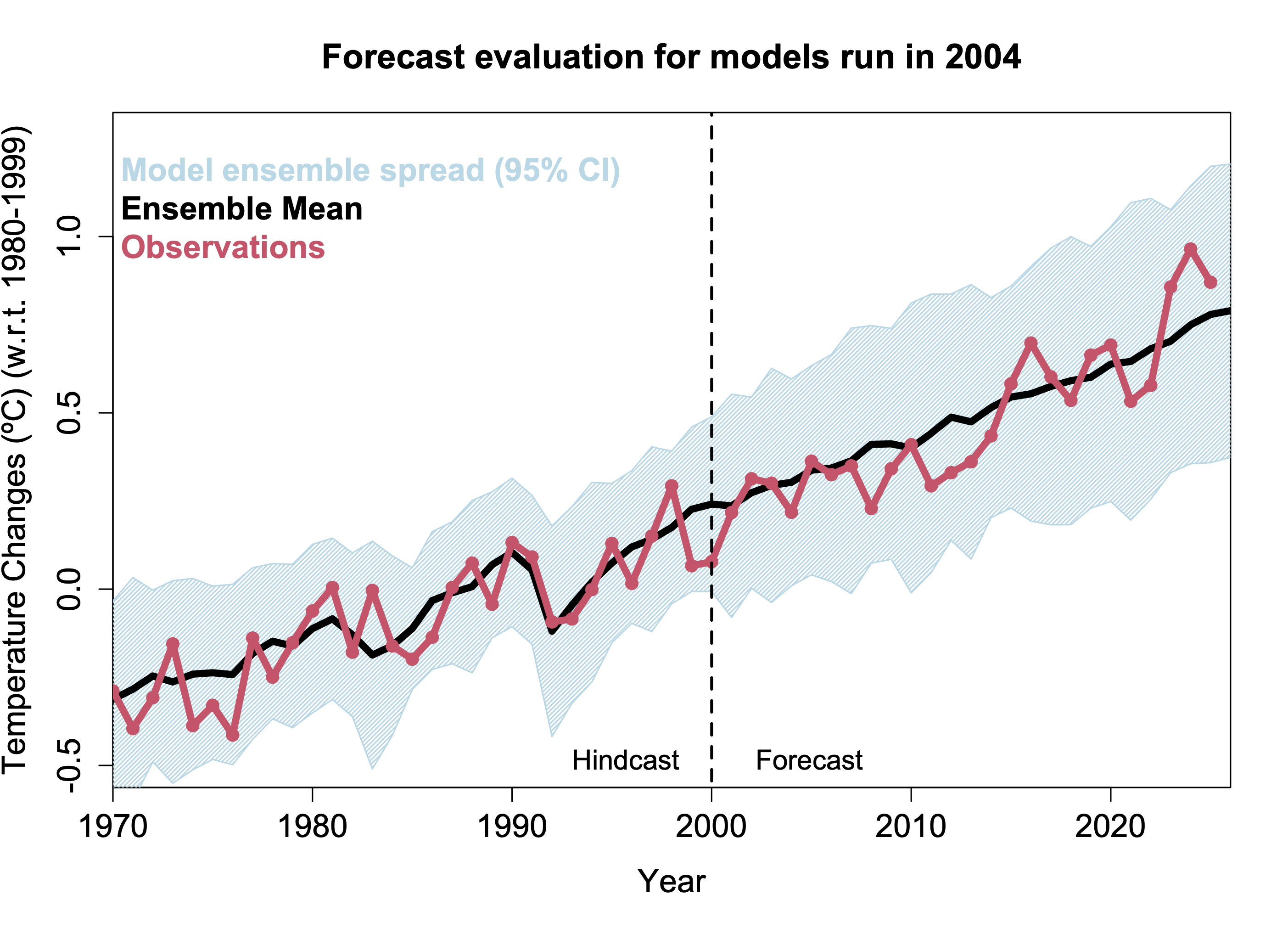
The models are right, you've been wrong every year you've been here.


JohnLarue

Well-known member
Jan 19, 2005
19,848
5,117
113
The satellite data you prefer says it is warming.
satellite data displays at a rate of 0.155 C degrees per decade, not at a rate 0.28 degrees per decade the models predict

0.155 C degrees per decade, is certainly within the realm of natural variability as we are still emerging from an ice age

1770619628303.png
and 0.155 C degrees per decade is certainly not at the 0.3 to 0.4 C degrees per decade the not going to happen , totally impossible RCP 8.5 predicts


AI Overview

Under the RCP 8.5 high-emissions scenario, global temperatures are projected to increase at a rate of approximately
0.3°C to 0.4°C per decade during the 21st century.
This "worst-case" or "business-as-usual" scenario, which assumes little to no climate policy, leads to rapid, sustained warming that accelerates over time, resulting in an overall rise of roughly 5°C or more by the end of the century (relative to 1986–2005).
AI Overview


RCP 8.5, often described as a "worst-case" or "business-as-usual" scenario, is considered highly improbable—and by some, effectively impossible—due to its reliance on outdated, extreme assumptions about future energy use, technology, and economic growth.

While initially designed as a high-end, 90th-percentile baseline scenario, RCP 8.5 was mistakenly treated by many as a "most likely" outcome.
you recently stated the RCP 8.5 was a done deal and what we are experiencing right now
despite the fact RCP 8.5 is impossible

RCP 8.5 was mistakenly treated by many as a "most likely" outcome and hence used to create the massive volumes of nonsense climate crisis nonsense the public has subjected to


You also don't think the greenhouse effect is real, so who cares about your opinion.
do not misrepresent me
the greenhouse gas theory has never been proven experimentally. it is a theory

Thermal deactivation of excited state photon energy on the other hand has been proven experimentally, during the development of C02 lasers
only 1 in 50,000 photons absorbed by molecules re-emits
that is why 99 % if the infrared radiation leaving the earths surface is absorbed within 10 meters of the surface


The models are right, you've been wrong every year you've been here.
No
the models are expensive pieces of useless, misleading junk which have been the basis for propaganda and scare stories
the models use seriously flawed physics
the models do not agree with each other
the models can not reproduce the past & thus can not possibly properly predict the future

Climate Change is a Myth. John Clauser, PhD
Noble Prize winner in physics
 
Last edited:

Frankfooter

dangling member
Apr 10, 2015
110,264
33,662
113
satellite data displays at a rate of 0.155 C degrees per decade, not at a rate 0.28 degrees per decade the models predict
Satellite data shows warming in the troposphere as expected, we've been over this.
Now we are on track for the worst case scenario, RCP 8.5.
We've hit 1.5ºC warming and will hit 2.0ºC in the next decade.


0.155 C degrees per decade, is certainly within the realm of natural variability as we are still emerging from an ice age
That's idiotic.


you recently stated the RCP 8.5 was a done deal and what we are experiencing right now
despite the fact RCP 8.5 is impossible

RCP 8.5 was mistakenly treated by many as a "most likely" outcome and hence used to create the massive volumes of nonsense climate crisis nonsense the public has subjected to
No, RCP 8.5 was the 'worst case scenario' if we did nothing. CO2 levels continue to increase as if we have done nothing.


the greenhouse gas theory has never been proven experimentally. it is a theory
That's idiotic.


No
the models are expensive pieces of useless, misleading junk which have been the basis for propaganda and scare stories
the models use seriously flawed physics
the models do not agree with each other
the models can not reproduce the past & thus can not possibly properly predict the future
You've been wrong every year for decades but the models have been very accurate.
And yet you still think you're right.
That's also idiotic.

 
Toronto Escorts